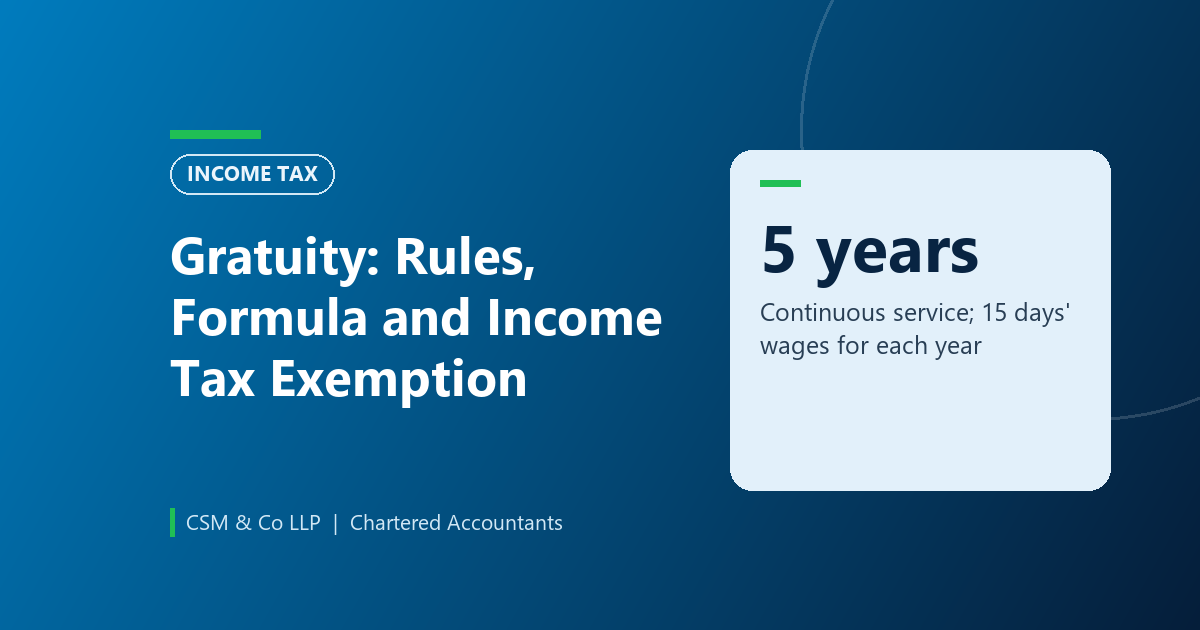
Gratuity: Rules, Formula and Income Tax Exemption (Tax Year 2026-27)

Last updated: 02 October 2026 · Written and reviewed by CA Meet Dhrangadhariya, CSM & Co LLP

Quick summary

  • Gratuity is payable on five years of continuous service (one year for fixed-term employees) at 15 days’ wages for each completed year, worked out as last monthly wages ÷ 26 × 15 × years.
  • The Code on Social Security, 2020 has been in force since 21/11/2025 and now governs gratuity; the ₹20 lakh ceiling is a notified amount, so check it before you rely on it.
  • Under the Income-tax Act, 2025 the exemption is in section 19(1): government employees get it in full, others get the least of the gratuity received, the notified limit (₹20 lakh) and the statutory formula.
  • The gratuity exemption is also available in the new tax regime.

Gratuity is a lump sum an employer pays for long service. Two questions come up every time: how much is payable, and how much of it escapes tax. This post answers both under the Code on Social Security, 2020 and the Income-tax Act, 2025.

Which law governs gratuity now

The Code on Social Security, 2020 repealed the Payment of Gratuity Act, 1972 (section 164(1)). The four labour codes were made effective from 21 November 2025 (PIB press release), and the Ministry of Labour has said gratuity under the Code applies from that date. Notifications made under the old Act, such as the ceiling, are deemed to continue under the corresponding provisions of the Code (section 164(2)(a)). Gratuity is now in sections 53 to 56 of the Code. Older articles that quote the 1972 Act describe the same scheme, but the section numbers have changed.

Eligibility and formula under section 53

  • Five years of continuous service is needed on superannuation, retirement, resignation, death or disablement. The five years are not needed on death or disablement.
  • Fixed-term employees are paid gratuity pro rata and do not need five years. The Ministry of Labour has clarified (FAQs of 16/03/2026) that a fixed-term employee is eligible after rendering one year of service under the contract. This covers employees engaged directly by the employer, not contract labour supplied by a contractor.
  • Rate: 15 days’ wages for every completed year of service or part of a year in excess of six months, on the wages last drawn.
  • Monthly-rated employees: the 15 days’ wages are the monthly wages last drawn ÷ 26 × 15.
  • Ceiling: the Central Government notifies the maximum (section 53(3)). The Ministry of Labour’s FAQs say it is currently ₹20 lakh.
  • Time to pay: within 30 days from the date gratuity becomes payable, with simple interest for delay (section 56(3) and (4)). The employer must work out the amount and give written notice even if you have not applied.
  • Nomination: if the employee dies, gratuity goes to the nominee or heirs.
  • Forfeiture: wholly or partly, only for wilful damage to property, riotous or violent conduct, or an offence involving moral turpitude committed during employment.

Gratuity = Last drawn monthly wages ÷ 26 × 15 × completed years

Example: monthly wages ₹40,000, service 8 years: 40,000 ÷ 26 × 15 × 8 = ₹1,84,615.

Under section 2(88) of the Code, “wages” are basic pay, dearness allowance and retaining allowance, and if the excluded allowances (house rent allowance, conveyance and others) are more than half of total remuneration, the excess is added back to wages. The Ministry of Labour’s FAQs say performance incentives, ESOPs and reimbursements are not wages, and that gratuity and retrenchment compensation are left out of the 50% test. If your pay structure keeps basic pay low, the gratuity base may now be higher than under the old 1972 Act, from 21/11/2025. Ask your employer how the base is worked out.

Is gratuity taxable?

Gratuity is part of salary (section 16(c) of the Income-tax Act, 2025). Section 19(1) then allows these deductions from it, in the order of the Table:

Who receives it Exempt amount
Death-cum-retirement gratuity under the Central Government pension rules or a similar government scheme (serial 3) The entire amount
Retiring gratuity under the defence services pension code (serial 4) The entire amount
Gratuity under the Payment of Gratuity Act, 1972, now the Code (serial 5) The amount received, limited to the amount worked out under section 4(2) and (3) of that Act, which gives the 15/26 formula and the ₹20 lakh ceiling
Any other gratuity on retirement, incapacity before retirement or termination (serial 6) The least of the actual gratuity, the notified amount (₹20 lakh) and half a month’s salary for each completed year

“Salary” for these purposes is basic pay plus dearness allowance, if the terms of employment provide for it. All other allowances and perquisites are left out (section 19(2)(b)).

Employees covered by the gratuity law (serial 5)

The exempt amount is the least of three figures:

  1. the gratuity actually received,
  2. the formula amount: last drawn salary ÷ 26 × 15 × completed years (a part year of more than six months counts as a year), and
  3. ₹20 lakh.

Example: last drawn basic plus DA is ₹1,00,000 a month, service is 19 years and 7 months, so 20 years are counted. Gratuity paid is ₹15,00,000.

  • Formula amount: 1,00,000 ÷ 26 × 15 × 20 = ₹11,53,846
  • Ceiling: ₹20,00,000
  • Received: ₹15,00,000
  • Exempt: ₹11,53,846. Taxable: ₹3,46,154, added to salary income.

Employees not covered (serial 6)

The exempt amount is the least of the gratuity received, ₹20 lakh and half a month’s salary for each completed year of service, where the salary is the average of the ten months before the month of the event (retirement, incapacity or termination). Only completed years count.

Example: average salary of the last ten months is ₹90,000, service is 25 years and 2 months, gratuity received is ₹14,00,000.

  • Half month’s salary: 90,000 × 1/2 × 25 = ₹11,25,000
  • Exempt: ₹11,25,000. Taxable: ₹2,75,000.

Gratuity from more than one employer

For serial 6, if you receive gratuity from more than one employer in a tax year, or received exempt gratuity in earlier years, the total exemption cannot exceed the notified limit reduced by what was already exempted (section 19(2)(a)). Keep a record of gratuity exempted in earlier jobs.

New tax regime

Of the section 19(1) Table, section 202(2) bars only serial number 1 (professional tax) in the new regime. The gratuity entries are not barred, so the gratuity exemption is available in both regimes.

Employer side

  • Contributions to an approved gratuity fund created under an irrevocable trust are deductible (section 29(1)(c)).
  • A provision for gratuity that has become payable during the tax year is deductible (section 29(1)(d)).
  • Gratuity paid during the employee’s lifetime is treated as salary (Schedule XI, Part B, paragraph 5). The income of an approved gratuity fund is itself exempt (Schedule VII).
  • TDS on the taxable part is deducted with other salary under section 392.

Gratuity and pension compared

Point Gratuity Pension
Payment One time, on leaving Monthly, for life
Paid by Employer Employer, a pension fund or the government
Condition Five years of continuous service (one for fixed-term) As per the scheme
Tax Exempt up to the limits above Taxable as salary when received (commuted lump sum has separate rules)

Things to check before you rely on this

  • The Income-tax Act, 2025 still names the Payment of Gratuity Act, 1972 in serial 5 and its section 4(2) and (3). Those sub-sections (15 days’ wages and the ceiling) are now section 53(2) and (3) of the Code, and section 164(2)(a) of the Code carries the old notifications forward, so the exemption works as described. A future amendment of the Income-tax Act may update the wording.
  • The ₹20 lakh ceiling is a notified amount, not a number in the Act. The labour ceiling dates from 29/03/2018 and the income-tax limit from S.O. 1213(E) of 08/03/2019. The Ministry of Labour still calls ₹20 lakh the current ceiling, and we found no newer notification. Check before you advise on a very large gratuity.

Frequently asked questions

Who is eligible for gratuity?

An employee who has completed continuous service of five years, on superannuation, retirement, resignation, death or disablement. Death and disablement do not need five years. A fixed-term employee is eligible after one year of service under the contract, with pro-rata gratuity.

What is the gratuity formula?

Last drawn monthly wages ÷ 26 × 15 × completed years of service. A part year of more than six months counts as a full year.

How much gratuity is tax free?

For a government employee, the whole amount. For an employee covered by the gratuity law, the least of the gratuity received, the amount worked out by the statutory formula and the notified ceiling (₹20 lakh). For others, the least of the gratuity received, the notified ceiling and half a month’s average salary for each completed year.

Is gratuity exempt in the new tax regime?

Yes. Section 202(2) bars section 19(1) serial number 1 (professional tax) in the new regime, but not the gratuity entries at serial numbers 3 to 6.

Is gratuity taxable at all?

Yes, to the extent it exceeds the exempt amount. It is part of salary (section 16), so the excess is taxed at your slab rate and TDS applies.

Can the employer forfeit gratuity?

Only in the cases the law allows: wilful damage to the employer’s property, riotous or violent conduct, or an offence involving moral turpitude committed during employment. Forfeiture can be whole or partial.

Official sources

Related reading

Disclaimer

This article is for general informational purposes only and should not be considered professional advice. Please consult a qualified expert for advice tailored to your specific situation. The author and website owner are not liable for any errors or actions based on this content.

Sign-On Bonus Repaid to the Old Employer: Can You Deduct It From Salary? (ITAT Chennai)

Last updated: 03 August 2026 · Written and reviewed by CA Meet Dhrangadhariya, CSM & Co LLP

Quick summary

  • A sign-on bonus is salary and is taxed when you receive it.
  • In S.S.N. Ravi v ACIT (ITAT Chennai, 06/05/2016), an employee who repaid a ₹25 lakh sign-on bonus to his old employer on leaving early was not allowed to reduce his taxable salary by that amount.
  • The Tribunal held that the bonus was a revenue receipt, he left voluntarily, and the Act has no provision to deduct such a repayment from salary.
  • Section 19 of the Income-tax Act, 2025 lists the deductions from salary, and a repaid bonus is not one of them.

A sign-on bonus is a payment to attract you to a job. Most contracts add a clawback: if you leave within a year, you repay it. The tax question that follows is a hard one. You were taxed on the bonus when you got it. Can you reduce your taxable salary when you pay it back?

The tax position on receipt

A sign-on bonus is paid by the employer because of the employment. That makes it salary. Section 16 of the Income-tax Act, 2025 says salary includes wages, fees or commission, perquisites and profits in lieu of salary, and a joining bonus falls in these. The employer deducts TDS under section 392 when it pays the bonus.

The case: S.S.N. Ravi v ACIT

Forum and date: Income Tax Appellate Tribunal, Chennai, order dated 06/05/2016, I.T.A. No. 933/Mds/2015, assessment year 2008-09.

Facts

  • The taxpayer joined Barclays in November 2006 and received a sign-on bonus of ₹25 lakh in FY 2006-07, which he included in his income of that year.
  • The bonus was repayable if he left within one year.
  • He left on 31/10/2007, before the year was complete, and moved to Deutsche Bank. Deutsche Bank paid him ₹25 lakh, which he used to repay Barclays.
  • In his return for FY 2007-08 he reduced his salary by ₹25 lakh. The Assessing Officer added it back.

Decision. The Tribunal dismissed the appeal. In short:

  • The sign-on bonus is a revenue receipt of the nature of employment income.
  • The employee left voluntarily; he was not terminated.
  • Section 17(1) of the 1961 Act made no provision for reducing salary by a refund of the bonus.
  • The amount that the new employer paid to cover the repayment could not be treated as compensation for the lost bonus.
  • The ₹25 lakh could not be reduced from taxable income.

The position under the Income-tax Act, 2025

The 2025 Act has the same structure. Section 19(1) lists the deductions from salary: professional tax, the standard deduction, the retirement exemptions (gratuity, commutation of pension, leave encashment and similar) and compensation items. A repayment of a bonus is not in that list.

The ruling is a Tribunal order on its facts, in a case where the employee left voluntarily and a new employer paid the sum. Do not treat it as settling every repayment: a different fact pattern could be argued differently.

Practical points

  1. Read the clawback clause before you sign. Check the repayment period and whether the repayment is of the gross amount or of the amount net of tax.
  2. If your new employer reimburses the repayment, remember that the reimbursement is a payment from an employer, so expect it to be taxed as salary, with no deduction for the amount you repay.
  3. Take advice before claiming a deduction for a repaid bonus. If you claim it, keep the contract, the repayment proof and the old employer’s acknowledgement.

Frequently asked questions

Is a sign-on bonus taxable?

Yes. It is a payment from the employer in connection with employment, so it is salary under section 16 of the Income-tax Act, 2025 and taxed in the year you receive it, with TDS.

Can I deduct a sign-on bonus that I repay to my old employer?

The Chennai Tribunal held that you cannot reduce your taxable salary by a repaid sign-on bonus when the employee left voluntarily. The Act does not provide a deduction for the repayment.

Does it matter that my new employer reimbursed the repayment?

In S.S.N. Ravi the new employer paid the employee the amount to repay. The Tribunal treated it as a revenue receipt, not a capital receipt, and the employee was taxed on it as well.

Which case is this?

S.S.N. Ravi, Chennai v ACIT, ITAT Chennai, order dated 06/05/2016, I.T.A. No. 933/Mds/2015, assessment year 2008-09.

What should I do before signing a sign-on bonus clause?

Read the clawback terms and ask who bears the tax if you have to repay. If a new employer will reimburse the repayment, ask for advice on how that payment will be taxed in your hands.

Official sources

Disclaimer

This article is for general informational purposes only and should not be considered professional advice. Please consult a qualified expert for advice tailored to your specific situation. The author and website owner are not liable for any errors or actions based on this content.
How to Calculate Income From Salary: Step by Step With Example (Tax Year 2026-27)

Last updated: 05 September 2026 · Written and reviewed by CA Meet Dhrangadhariya, CSM & Co LLP

Quick summary

  • Income from salary is worked out in four steps: add everything that counts as salary (section 16), subtract the exempt allowances, add taxable perquisites, then subtract the section 19 deductions.
  • Section 19 allows the standard deduction (₹75,000 new regime, ₹50,000 old), professional tax (old regime) and retirement items such as gratuity and leave encashment within their limits.
  • Chapter VIII deductions (section 123 and others) are subtracted afterwards, in the old regime only.
  • Employers deduct TDS on salary under section 392 and issue Form 130 by 15 June; check it against your AIS before filing.

Income from salary is the first and usually the largest head of income for an employee. This post shows how it is worked out under the Income-tax Act, 2025 and then how tax is calculated on it, with a full example under both regimes.

Step 1: add up what counts as salary

Section 16 of the Act says salary includes:

  • wages (basic pay, dearness allowance, allowances, bonus),
  • any annuity or pension,
  • any gratuity,
  • any fees or commission,
  • perquisites (rent-free accommodation, a car for personal use, free shares and others in section 17),
  • profits in lieu of salary (section 18), such as compensation on termination,
  • any advance of salary,
  • any payment for leave not availed of (leave encashment),
  • the taxable annual accretion to a recognised provident fund, and
  • the employer’s contribution to the notified pension scheme (NPS).

Under section 15, salary due to you in the tax year is chargeable whether paid or not, salary paid in advance is chargeable in the year it is paid, and arrears paid in the year are chargeable if not taxed earlier. So salary that is due but unpaid at year end is still income of that year.

Step 2: take out exempt allowances

Some allowances are exempt in part or full, within limits, under Schedule III and Rule 279. The best known is house rent allowance (old regime only). It is exempt to the extent of the least of the HRA received, the rent paid less 10% of salary, and 50% of salary in Mumbai, Kolkata, Delhi, Chennai, Hyderabad, Pune, Ahmedabad and Bengaluru (40% elsewhere), where salary is basic pay plus dearness allowance if the terms provide. Leave travel concession and some others are also old regime items. See our posts on allowances for each.

Step 3: add the taxable perquisites

Free or concessional accommodation, a car, free meals above the limit, loans at a low rate, gifts above the limit, and shares allotted under an ESOP or RSU are valued under Rule 15 and added. See our posts on perquisites and ESOP taxation.

Step 4: subtract the deductions from salary (section 19)

Deduction Amount Regime
Professional tax The whole amount Old only
Standard deduction ₹75,000, or the salary if less New
Standard deduction ₹50,000, or the salary if less Old
Death-cum-retirement gratuity of government employees The whole amount Both
Gratuity of other employees Within the limits in our gratuity post Both
Leave encashment on retirement Government employees: the whole amount. Others: the least of the cash equivalent of leave at credit (up to 30 days for each year of service), ten times the average monthly salary of the last ten months, the notified limit and the amount received Both
Voluntary retirement payment The least of the amount received and ₹5,00,000, subject to the conditions in section 19(2)(e) Both
Retrenchment compensation to a workman The least of three amounts in the Table Both

The result is income from salary. If you received arrears or advance salary that pushes you into a higher slab, claim relief under section 157 with Form 39.

Step 5: from income from salary to taxable income

Add income from other heads (house property, other sources and so on), set off losses and then, in the old regime only, subtract the Chapter VIII deductions: section 123 (up to ₹1,50,000), your own NPS contribution up to ₹50,000, health insurance, education loan interest, donations and others. The new regime allows only a few of these, mainly the employer’s NPS contribution. The balance is total income.

Step 6: apply the rates

New regime (section 202), tax year 2026-27: up to ₹4,00,000 nil; 5% to ₹8,00,000; 10% to ₹12,00,000; 15% to ₹16,00,000; 20% to ₹20,00,000; 25% to ₹24,00,000; 30% above. Rebate under section 156(2) of up to ₹60,000 if total income is up to ₹12,00,000.

Old regime: up to ₹2,50,000 nil; 5% to ₹5,00,000; 20% to ₹10,00,000; 30% above. Rebate of up to ₹12,500 if total income is up to ₹5,00,000. Higher basic exemption limits apply for resident senior citizens.

Then add surcharge if income is above ₹50 lakh, and 4% health and education cess.

Worked example

Basic ₹6,00,000, HRA ₹3,00,000, special allowance ₹4,50,000, bonus ₹1,50,000. Employee’s PF ₹72,000. Rent paid ₹3,30,000 a year in Pune. Professional tax ₹2,400. Other qualifying investments ₹78,000.

Item Old regime (₹) New regime (₹)
Gross salary 15,00,000 15,00,000
Less: HRA exemption (least of 3,00,000; 3,30,000 - 60,000 = 2,70,000; 50% of 6,00,000 = 3,00,000) 2,70,000 Not available
Less: professional tax 2,400 Not available
Less: standard deduction 50,000 75,000
Income from salary 11,77,600 14,25,000
Less: section 123 (PF 72,000 + others 78,000) 1,50,000 Not available
Total income 10,27,600 14,25,000
Tax on slabs 1,20,780 93,750
Add: cess at 4% 4,831 3,750
Tax payable 1,25,611 97,500

The new regime costs ₹28,111 less for this employee because the deductions (₹4,72,400 in all: HRA, professional tax, standard deduction and section 123) are below the break-even for a ₹15 lakh salary. See our post on saving tax by salary level.

TDS on salary

The employer deducts tax on salary under section 392(1) at the average rate on your estimated income for the year, after taking into account the evidence you give in Form 124 (Rule 205) and details of other income and previous employment (Form 122). It can adjust later months for any excess or shortfall (section 392(5)(c)). The employer pays the tax to the government and issues Form 130 by 15 June after the end of the year (Rule 215).

Documents you need to file the return

  1. Form 130, the TDS certificate for salary.
  2. AIS and the TDS statement on the e-filing portal, to reconcile TDS and any interest or other income.
  3. Rent receipts, landlord’s PAN, investment and loan statements for the old regime claims.
  4. Form 123, if the employer gives perquisite details separately.

If Form 130 and your AIS differ, ask your employer to correct the TDS return before you file, or report the figures you are able to support.

Frequently asked questions

What is included in salary for income tax?

Wages, any annuity or pension, gratuity, fees or commission, perquisites, profits in lieu of salary, advance salary, payment for leave not availed of, and certain provident fund and pension scheme items (section 16 of the Income-tax Act, 2025).

What deductions are allowed from salary?

Under section 19(1): professional tax (old regime only), the standard deduction (₹75,000 new regime, ₹50,000 old regime), and retirement items such as gratuity, leave encashment and commutation of pension within their limits.

Is the standard deduction available in both regimes?

Yes. It is ₹75,000 or the salary, whichever is less, in the new regime, and ₹50,000 or the salary, whichever is less, in the old regime.

Which form shows my salary and TDS?

Form 130, the TDS certificate for salary under section 395. The employer must furnish it by 15 June after the end of the tax year (Rule 215).

Do I need Form 124?

Give your employer Form 124 with evidence of HRA, LTA, home loan interest and Chapter VIII claims so that TDS is deducted on the right income (section 392(5)(b), Rule 205).

Where do I report salary in the return?

In the salary schedule of the return, using Form 130 and the figures in your AIS. Reconcile any difference before filing.

Official sources

Related reading

Disclaimer

This article is for general informational purposes only and should not be considered professional advice. Please consult a qualified expert for advice tailored to your specific situation. The author and website owner are not liable for any errors or actions based on this content.
Standard Deduction for Salaried Individuals in New and Old Tax Regime

Last updated: 15 September 2026 · Written and reviewed by CA Meet Dhrangadhariya, CSM & Co LLP

Quick summary

  • The standard deduction is a flat amount subtracted from salary or pension income without any proof of expenses.
  • It is ₹75,000 in the new tax regime and ₹50,000 in the old regime, and cannot exceed your salary or pension income.
  • For family pension the deduction is ₹25,000 in the new regime and ₹15,000 in the old regime.
  • From Tax Year 2026-27 it is allowed under section 19 of the Income-tax Act, 2025.

The standard deduction is a fixed amount that salaried employees and pensioners can subtract from their income without producing any bills or proof. It was removed years ago, brought back in Budget 2018, and has been increased since, most recently in the new regime to ₹75,000.

Amount of standard deduction

Regime Salary or pension Family pension
New tax regime (default) ₹75,000 ₹25,000
Old tax regime ₹50,000 ₹15,000

In each case the deduction cannot exceed the salary or pension you actually received. These amounts apply to FY 2025-26 and to Tax Year 2026-27. The Union Budget 2026 did not change income tax rates or slabs for Tax Year 2026-27, and the standard deduction stayed as it was.

Which section gives it?

For FY 2025-26 (assessment year 2026-27) it is section 16(ia) of the Income-tax Act, 1961, whose proviso substituting ₹75,000 for the new regime applies from 01/04/2025. For Tax Year 2026-27 onwards it is section 19 of the Income-tax Act, 2025, which lists all the deductions from salary in one place.

Who can claim?

  • Employees who earn salary income, in private or government jobs.
  • Pensioners, since pension is taxed as salary.
  • Recipients of family pension, at the lower family pension amount.

It is not available for business or professional income, or to someone with no salary or pension.

Why does it matter?

  • It reduces taxable income automatically, so it lowers the tax of nearly every salaried person.
  • No documents are needed.
  • It is available in both regimes, so it does not change the choice between them, but the new regime’s higher amount is one reason many salaried taxpayers find it cheaper.

Example

Ms C earns a salary of ₹9,00,000 in FY 2025-26 and has no other income. In the new regime her taxable income is ₹9,00,000 less ₹75,000, which is ₹8,25,000. In the old regime it would be ₹8,50,000 before any other deductions.

What about the documents for filing the return?

You need no proof for the standard deduction. For the return as a whole, you should still keep Form 16, Form 26AS, the AIS and any proofs for other deductions you claim.

Frequently asked questions

What is the standard deduction for salaried employees?

₹75,000 in the new tax regime and ₹50,000 in the old tax regime, or the amount of your salary if that is less.

Do I need documents to claim the standard deduction?

No. It is allowed automatically on salary and pension income, without proof of any expense.

Can pensioners claim the standard deduction?

Yes. Pension is taxed as salary, so pensioners can claim it. Family pension has a separate deduction of ₹25,000 in the new regime and ₹15,000 in the old regime.

Can a self-employed person claim the standard deduction?

No. It is only for income taxed as salary or pension.

Which section gives the standard deduction now?

Section 19 of the Income-tax Act, 2025 from Tax Year 2026-27. Earlier it was section 16(ia).

Official sources

Related reading

Disclaimer

This article is for general informational purposes only and should not be considered professional advice. Please consult a qualified expert for advice tailored to your specific situation. The author and website owner are not liable for any errors or actions based on this content.
Entertainment Allowance: Is It Still Deductible from Tax Year 2026-27?

Last updated: 21 July 2026 · Written and reviewed by CA Meet Dhrangadhariya, CSM & Co LLP

Quick summary

  • Under section 16(ii) of the 1961 Act, only Government employees could deduct entertainment allowance, in the old regime, limited to the least of ₹5,000, 20% of basic salary and the allowance received.
  • Private sector employees never got this deduction; the allowance was fully taxable for them.
  • The Income-tax Act, 2025 does not carry the deduction forward, so from Tax Year 2026-27 the allowance is taxable in full for everyone.
  • For FY 2025-26 (assessment year 2026-27) the old rule still applies to Government employees in the old regime.

Entertainment allowance is an amount an employer pays for entertaining visitors or clients on the employer’s behalf. It is part of salary and is taxable. For many years one narrow deduction existed for Government employees. The Income-tax Act, 2025 does not carry it forward.

The old rule: section 16(ii) of the 1961 Act

The allowance is first added to salary. A deduction is then allowed, but only to a Government employee in the old tax regime. The deduction is the least of:

  1. ₹5,000,
  2. 20% of the basic salary, and
  3. the entertainment allowance received.

Points to note:

  • The amount actually spent on entertainment makes no difference. The deduction is a fixed formula.
  • “Salary” for the 20% test excludes any allowance, benefit or perquisite, so it is in practice the basic pay.
  • The deduction depends on the allowance being paid as an entertainment allowance.
  • Private sector employees, and employees of statutory and local authorities, never got any deduction. The whole allowance was taxable for them.

Example (up to FY 2025-26, old regime)

A Government employee has a basic salary of ₹4,00,000 and receives an entertainment allowance of ₹40,000.

Test Amount in ₹
Fixed limit 5,000
20% of basic salary (20% of 4,00,000) 80,000
Allowance received 40,000
Deduction (the least) 5,000

The remaining ₹35,000 stays taxable as salary.

What the Income-tax Act, 2025 says

From Tax Year 2026-27, deductions from salary are listed in section 19 of the Income-tax Act, 2025. The list covers tax on employment (professional tax), the standard deduction, and the gratuity, pension commutation, retrenchment compensation, voluntary retirement and leave salary items. Entertainment allowance does not appear in it, and the Act does not mention the allowance anywhere else. So from Tax Year 2026-27 the whole entertainment allowance is taxable in every employee’s hands, whether in the government or the private sector.

New regime

The new regime never allowed this deduction. It allows the standard deduction of ₹75,000 and the few other items that survive in section 202.

What this means for payroll

A Government department paying entertainment allowance should stop allowing the ₹5,000 deduction in the TDS calculation for Tax Year 2026-27 onwards, and show the whole allowance as taxable salary.

Frequently asked questions

Who could claim a deduction for entertainment allowance?

Only Government employees, under section 16(ii) of the 1961 Act and only in the old tax regime. Private sector employees and employees of local authorities or statutory bodies could not.

What was the limit?

The least of ₹5,000, 20% of basic salary, and the entertainment allowance actually received. The amount spent is not relevant.

Is the deduction available for Tax Year 2026-27?

No. The list of deductions from salary in section 19 of the Income-tax Act, 2025 has no entry for entertainment allowance, so the whole allowance is taxable.

Does the allowance have to be called entertainment allowance?

Yes. The deduction depended on the employer paying it as an entertainment allowance.

Is it available in the new tax regime?

No. The new regime never allowed it, apart from the standard deduction.

Official sources

Disclaimer

This article is for general informational purposes only and should not be considered professional advice. Please consult a qualified expert for advice tailored to your specific situation. The author and website owner are not liable for any errors or actions based on this content.

WhatsApp