
Verify Your PAN Name Before You Apply: Free TRACES PAN Verification for Income Tax, TDS, GST, ICEGATE and DSC

Last updated: 03 October 2026 · Reading time: 4 min

Quick summary

  • A name that does not match the PAN database is one of the most common reasons a registration or mapping gets stuck or rejected.
  • The TRACES website offers a free PAN Verification facility for individuals, using only the PAN, date of birth and a captcha.
  • Check it before applying for Income Tax or TDS registration, GST registration, ICEGATE registration or DSC mapping.
  • If the name is not aligned, correct the PAN record first, then proceed with the application.

Most registrations in India are validated against the PAN database. When you apply for Income Tax or TDS registration, GST registration, an ICEGATE account or a Digital Signature Certificate (DSC) mapping, the name you type in the form is compared with the name held against your PAN. If the two do not line up exactly, the application can be rejected, held back or sent for rework, and the delay usually costs more than the registration itself.

The simple fix is to check the PAN record before you apply. The TRACES portal of the Income Tax Department provides a ready tool for exactly this purpose.

The tool at a glance

  • Facility: PAN Verification (Individual) on the TRACES portal
  • Link: traces.tdscpc.gov.in/auth/pan-verification/individual-pan-verification
  • Details asked on the page: PAN, date of birth (or date of incorporation) and the verification code (captcha)
  • Cost: free of charge
  • Note shown by the portal: the date of Aadhaar-PAN linking is displayed where Aadhaar has been linked with the PAN after 1 July 2023

Why a name mismatch causes trouble

A PAN record is the base identity for almost every government registration. Differences that look minor to a person are treated as a mismatch by the system, for example:

  • The middle name is written in full on one document and as an initial on another.
  • The surname and first name are in a different order.
  • A spelling variation, a missing or extra space, or an abbreviation.
  • A name changed after marriage, or after a gazette or court order, that was never updated in the PAN record.

Where you should run this check first

  • Income Tax and TDS registration: the TAN, e-filing and TRACES profiles all depend on the PAN details being correct.
  • GST registration: the legal name of the proprietor or the person is validated against the PAN.
  • ICEGATE registration: required for import and export filings, and the PAN details must be consistent.
  • DSC mapping: the certificate holder’s name must be consistent with the PAN for the DSC to map to the account.

How to use it

  • Step 1. Open the TRACES PAN Verification page using the link above.
  • Step 2. Enter the PAN and the date of birth (for an individual) exactly as per your records.
  • Step 3. Type the verification code shown on the screen and submit.
  • Step 4. Compare what the portal shows with the name on your Aadhaar, bank account and the form you are about to file.
  • Step 5. If anything differs, get the PAN record corrected first. Only then start the registration.

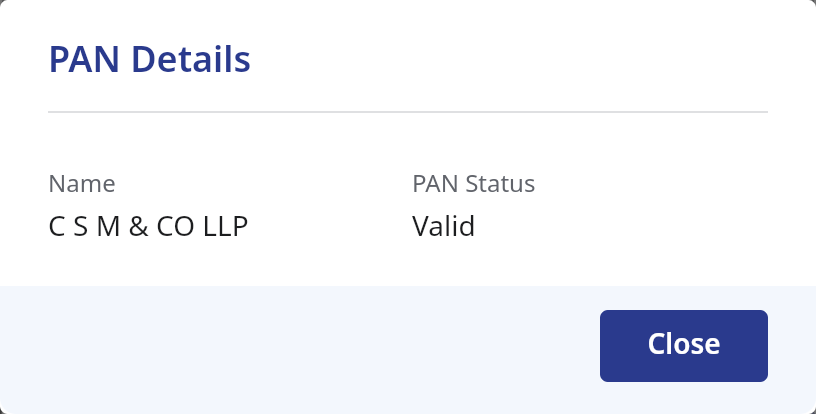
On submitting, the portal shows a “PAN Details” box with the name held against the PAN and the PAN status. Here is the result for our own firm’s PAN:
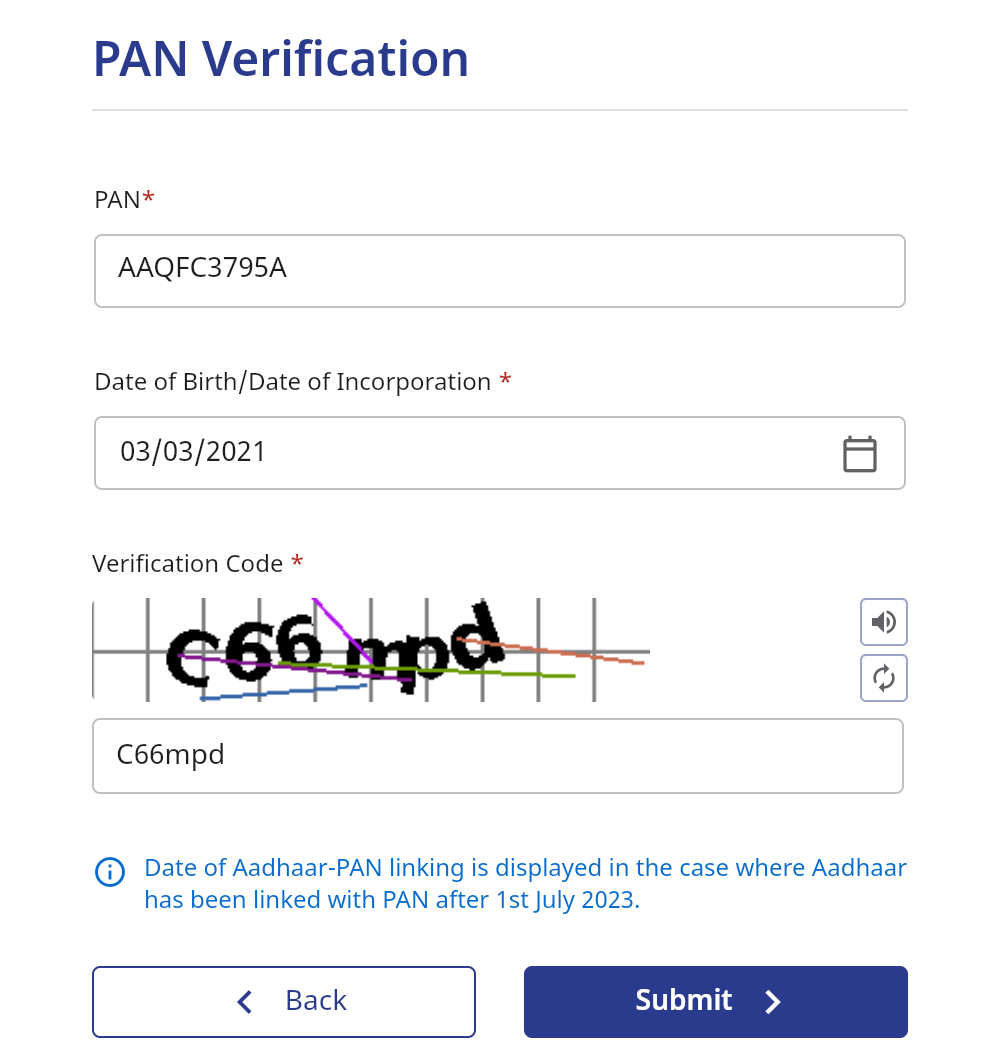
TRACES PAN Verification form filled with PAN, date of birth and verification code
Step 1: enter the PAN, the date of birth or incorporation, and the verification code, then click Submit.
TRACES PAN Details popup showing the name as C S M & CO LLP and PAN status as Valid
Step 2: the PAN Details box shows the name and PAN status as held in the database.

Notice how the database spells the name: C S M & CO LLP, with spaces between the letters and “CO” in capitals. This is exactly the kind of difference, compared with how we normally write “CSM & Co LLP”, that you should be aware of before filling a registration form.

Practical tips

  • Use the date of birth exactly as recorded for the PAN, not as written on some other document.
  • Keep the name identical across the PAN, the application form and the supporting documents.
  • Do this check for each person involved, such as directors, partners and authorised signatories, when the registration is for a firm or company.
  • Never share your PAN details or OTPs with anyone claiming to verify them for you. Use only the official government website.

Frequently asked questions

Do I need to log in to use this facility?

No. The page asks only for the PAN, date of birth and a captcha, as seen on the portal on 03/10/2026.

Is it only for Income Tax registrations?

No. It is useful before any registration that validates your PAN, including GST, ICEGATE and DSC mapping.

What if the name does not match?

Get the PAN record corrected through the official correction process, and wait for the update before applying for the registration.

Is there a separate check for companies and firms?

The page we reference is the individual PAN verification. For entities, verify the PAN of each individual involved and the entity details on the relevant portal.

How CSM & Co LLP can help

We handle Income Tax and TDS registrations, GST registration, ICEGATE and DSC related work for individuals, firms and companies. We run the PAN check before every application, so that name mismatches are fixed up front rather than after a rejection. Please reach out to our team and we will be happy to assist.

Disclaimer

This article is for general informational purposes only and should not be considered professional advice. Please consult a qualified expert for advice tailored to your specific situation. The author and website owner are not liable for any errors or actions based on this content.

When No TDS Is Deducted: Form 121 (Old Form 15G and 15H), Exempt Payees and Personal-Purpose Payments under Section 393 (Tax Year 2026-27)

Last updated: 20 September 2026 · Written and reviewed by CA Meet Dhrangadhariya, CSM & Co LLP

Quick summary

  • A resident whose estimated total income for the year will be nil can give the payer a declaration in Form 121 under section 393(6) so that no tax is deducted on interest, dividend, units, rent, insurance commission, life insurance receipts and an accumulated provident fund balance; it replaces Forms 15G and 15H.
  • The declaration does not work for a person other than a resident individual aged 60 or more if the total of the income exceeds the maximum amount not chargeable to tax in the year (note to section 393(6)), and it is invalid without a valid PAN (section 397(2)(f)).
  • The payer gives each declaration a unique identification number, reports it in the quarterly statement whether or not tax was deducted, and must keep the declaration for seven years (Rule 211).
  • Other cases of no deduction include payments to the Government, RBI and certain corporations and mutual funds (section 393(5)), payments by individuals and HUFs for personal purposes to contractors and professionals, dividends of ₹10,000 or less paid to an individual by a non-cash mode, and e-commerce payments of up to ₹5 lakh to individuals and HUFs with a PAN or Aadhaar.

Tax is not deducted at source in every case. Section 393 of the Income-tax Act, 2025 (from 01/04/2026) lists payments and payees where there is no deduction, and lets a person claim receipt without deduction by giving a declaration to the payer. This post explains the declaration in Form 121 and the main no-deduction cases.

The declaration: section 393(6) and Rule 211

A person can receive certain incomes without deduction of tax if he gives the payer a written declaration in duplicate (in the prescribed form) that the tax on his estimated total income of the year in which the income is to be included will be nil.

Who can give it and for which income (section 393(6), Table)

Person Incomes covered
An individual who is a resident Accumulated balance due under section 392(7) (provident fund); insurance commission (Table Sl. No. 1(i)); rent (Table Sl. No. 2(ii)); income from units (4(i)); interest (5(i), (ii) and (iii)); sums under a life insurance policy (8(i)); dividend (7)
Any person who is not a company, a firm or the individual above The same incomes except provident fund balance and dividend: insurance commission, rent, units, interest, life insurance sums

Condition for people other than senior resident individuals

The declaration does not apply to a person (other than a resident individual who is 60 years or more at any time in the tax year) if the aggregate of the incomes of that kind credited, paid or likely to be credited or paid during the year exceeds the maximum amount not chargeable to tax (note to section 393(6)).

How the form works (Rule 211)

  1. The declaration is made in Form 121, electronically (after verification) or in paper form.
  2. The payer gives each declaration a unique identification number for the quarter.
  3. The payer reports the declarations in the quarterly statement (Rule 219) with the number, even if no tax was deducted that quarter.
  4. The authority can ask for the declaration up to seven years from the end of the tax year in which it was received.
  5. The payer delivers the declarations to the prescribed authority by the 7th of the month after the end of each quarter (section 393(7), as substituted by Finance Act 2026). From 01/04/2027 the declaration for units, interest on securities and dividend can also be filed electronically with a depository holding the securities (new clause 393(6)(b)).

PAN is compulsory

A declaration without a valid PAN is invalid, and the payer must deduct tax as if no declaration was given, at the higher rate under section 397(2) (section 397(2)(f) and (g)).

Payments where no tax is deducted (section 393(4) and (5))

Payment No deduction where
Contract payments (Table Sl. No. 6(i)) A goods carriage operator with ten or fewer carriages gives a declaration with PAN and the payer furnishes the particulars; or an individual or HUF pays exclusively for personal purposes
Professional and technical fees (6(iii)) Paid by an individual or HUF exclusively for personal purposes
Dividend (7) To LIC, GIC and its subsidiaries, other insurers, a business trust by an SPV, other notified persons; or to an individual by a mode other than cash if the total is ₹10,000 or less in the year
E-commerce payments (8(v)) To an individual or HUF e-commerce participant, if gross sales or services are up to ₹5 lakh in the year and the participant has given PAN or Aadhaar
Virtual digital asset (8(vi)) Consideration up to ₹50,000 in the year when paid by an individual or HUF with turnover up to ₹1 crore (business) or ₹50 lakh (profession) and no business income; ₹10,000 in other cases
Interest (5(ii), (iii)) Interest credited to banks and certain financial institutions; interest by co-operative societies to members or other societies; interest on deposits (other than time deposits made on or after 01/07/1995) with a banking company; deposits with primary agricultural credit societies; interest on Motor Accidents Claims Tribunal compensation; interest on zero coupon bonds of specified issuers; interest paid by a firm to a partner
Cash payments (393(3) Sl. No. 5) Payments to the Government, banks, post offices, business correspondents and white label ATM operators

No deduction at all from payments to the Government, the Reserve Bank of India, a corporation established by a Central Act that is exempt from income-tax, and a specified mutual fund (interest, dividend and other income), under section 393(5). Tax is also not deducted from interest paid by an Offshore Banking Unit to a non-resident (section 393(8)) or on payments to the NPS Trust (section 393(9)).

Other rules in section 393

  • Tax borne by the payer (section 393(10)): if the payer agrees to bear the tax, the income is grossed up so that the payee receives the net amount agreed.
  • Credit to a suspense account (section 393(11)): treated as credit to the payee, so the TDS duty arises.

Practical points

  1. Get Form 121 early in the year, and renew it each year.
  2. A senior citizen below the exemption limit can use it; other persons must check the maximum amount not chargeable to tax.
  3. Do not give a declaration if your total income will be taxable: the declaration is for nil tax only.
  4. Payers should keep the declaration and its number, and report it every quarter.

How CSM & Co LLP can help

We prepare declarations, review TDS exemptions for employers and payers, and file the TDS statements. Please reach out to our team and we will be happy to assist.

Frequently asked questions

What replaces Form 15G and Form 15H?

Form 121 under Rule 211 of the Income-tax Rules, 2026: the declaration under section 393(6) for receiving certain incomes without deduction of tax. Section 393(6) gives one declaration for the persons listed in the Table, instead of separate Forms 15G and 15H.

Who can give the declaration?

A resident individual, for an accumulated provident fund balance under section 392(7), insurance commission, rent under Table Sl. No. 2(ii), units, interest, life insurance receipts and dividend; and any person who is not a company, a firm or the individual above, for the income in clauses (a) to (f) of the first entry (section 393(6), Table). The declaration states that the tax on the person’s estimated total income of the year will be nil.

When does the declaration not work?

For a person other than a resident individual aged 60 or more at any time during the tax year, the declaration is not available if the aggregate of the income of that kind credited or paid or likely to be credited or paid in the year exceeds the maximum amount not chargeable to tax (note to section 393(6)). A declaration without a valid PAN is invalid, and the payer must then deduct tax under section 397(2) (section 397(2)(f) and (g)).

What must the payer do with the declaration?

Allot a unique identification number to each declaration received in a quarter, report the declarations in the quarterly TDS statement of that quarter (even if no tax was deducted), and keep the declaration so that it can be produced for verification for seven years from the end of the tax year in which it was received (Rule 211(3) to (5)). Section 393(7), as substituted by Finance Act 2026, requires the declarations to be delivered to the prescribed authority by the 7th of the month after the end of each quarter.

Is TDS deducted when an individual pays a contractor or professional for personal use?

No. No tax is deducted on payments to contractors (Table Sl. No. 6(i)) or fees for professional or technical services (Table Sl. No. 6(iii)) when credited or paid by an individual or HUF exclusively for personal purposes of the individual or a member of the HUF (section 393(4), Table Sl. Nos. 8(b) and 9).

Are there other no-deduction cases?

Yes: payments to the Government, the Reserve Bank, a corporation exempt under its Act, and specified mutual funds (section 393(5)); interest on deposits with a banking company other than time deposits made on or after 01/07/1995; interest on deposits with primary agricultural credit societies; interest on a Motor Accidents Claims Tribunal compensation to an individual (or up to ₹50,000 in the year to others); dividend of ₹10,000 or less to an individual paid by a mode other than cash; e-commerce payments to an individual or HUF up to ₹5 lakh of gross sales with PAN or Aadhaar; and VDA consideration up to ₹50,000 (or ₹10,000 in other cases) in the year (section 393(4)).

Official sources

Disclaimer

This article is for general informational purposes only and should not be considered professional advice. Please consult a qualified expert for advice tailored to your specific situation. The author and website owner are not liable for any errors or actions based on this content.
TDS on Payments to Non-Residents and NRIs under Section 393(2): Rates in Force, Property Sale and Surcharge (Tax Year 2026-27)

Last updated: 11 August 2026 · Written and reviewed by CA Meet Dhrangadhariya, CSM & Co LLP

Quick summary

  • Payments to non-residents are covered by section 393(2) of the Income-tax Act, 2025 (old section 195): special rates for sportsmen, certain bonds and funds, and for everything else “rates in force”, which Part II of the First Schedule to the Finance Act 2026 sets: for a non-resident Indian 20% on investment income, 12.5% on long-term capital gains, 20% on short-term gains under section 196, 20% on royalty, fees for technical services and foreign currency interest, 30% on winnings and 30% on other income.
  • For other non-residents (not NRI) the rates are the same except the residual rate is 30% for non-company and 35% for a foreign company, with 10% on dividend referred to in section 207(1) and 20% on other dividend.
  • Where a tax treaty applies and the payee furnishes the residence certificate under section 159(8), the treaty rate applies for units of specified mutual funds and Foreign Institutional Investor income if lower than 20% (Note 2).
  • The tax is increased by surcharge calculated on the income, and a payer who doubts that the whole payment is chargeable can apply to the Assessing Officer in Form 129 to fix the taxable proportion (section 395(2)); a payee can seek a lower deduction certificate in Form 128.

When an Indian payer pays a non-resident a sum that is chargeable to tax in India, tax must be deducted at source. In the Income-tax Act, 2025 (from 01/04/2026) this is section 393(2), which replaces section 195 of the 1961 Act. The table in the section gives special rates for a few payments and says “rates in force” for most; the rate in force is fixed each year by the Finance Act.

How section 393(2) works

  • The payer deducts tax on the amount of the income or sum, at the rate in column E, at the earlier of credit and payment (section 393(2)(a) and (b)).
  • The table covers payments to a non-resident (and, for some items, a foreign company). Item 17, the main one, covers any interest (other than interest in items 2 to 5) or any other sum chargeable under the Act, not being salary, paid to a non-resident other than a company, or to a foreign company, at the rates in force.
  • The obligation applies to all payers, resident or non-resident, whether or not the non-resident payee has a residence, place of business, business connection or other presence in India (Note 3(b) to item 17).
  • Where interest is paid by the Government or a public sector bank or public financial institution (item 17), tax is deducted only at the time of payment (Note 3(a)).

Special rates in the table

Item Payment Rate
1 Income of a non-resident sportsman or entertainer who is not an Indian citizen, or a non-resident sports association or institution (section 211) 20%
2 Interest on foreign currency loans or long-term infrastructure bonds, 01/07/2012 to 30/06/2023, by an Indian company or business trust 5%
3 Interest on rupee denominated bonds issued before 01/07/2023 5%
4 Interest on long-term or rupee denominated bonds listed only on an IFSC exchange 4% (issued 01/04/2020 to 30/06/2023); 9% (issued on or after 01/07/2023)
5 Interest paid by an infrastructure debt fund 5%
6 Distributed income of a business trust to a non-resident unit holder 5% or 10% by type of income
10 and 15 Income from units of specified mutual funds, and income of a Foreign Institutional Investor from securities 20%, or the lower treaty rate where the payee furnishes the residence certificate under section 159(8) (Note 2)
11, 12 Offshore fund: income from units, and long-term capital gains 10%; 12.5%
13, 14 Interest, dividend and long-term capital gains on bonds or Global Depository Receipts 10%; 12.5%
16 Income of a specified fund 10%
17 Any other sum chargeable Rates in force

For interest in items 2 to 4, the deduction applies only on interest up to the amount at the rate approved by the Central Government (Note 1).

“Rates in force” for tax year 2026-27 (Finance Act 2026, First Schedule Part II)

Non-resident Indian (investment income, capital gains and others):

Income Rate
Investment income 20%
Long-term capital gains under section 214 or 197(4), and other long-term capital gains (not those in Schedule II items 14 and 17 relating to old section 10(36)) 12.5%
Long-term capital gains under section 198 above ₹1,25,000 12.5%
Short-term capital gains under section 196 20%
Interest payable by the Government or an Indian concern on money borrowed in foreign currency (other than items 2 to 5) 20%
Royalty or fees for technical services payable by the Government or an Indian concern under approved agreements (and royalty on copyright or software to a resident, as listed) 20%
Winnings from lotteries, games, horse races and net winnings from online games 30%
Dividend referred to in section 207(1) Table Sl. No. 2 10%
Other dividend 20%
Whole of the other income 30%

Other non-residents who are not companies: the same list for royalty, fees, winnings, capital gains and dividends, and 30% on the whole of the other income.

Foreign company: 20% on interest, royalty and fees under the cases above, 30% on winnings, 20% on short-term gains under section 196 and 12.5% on long-term gains, with 35% on the whole of the other income.

Surcharge

The tax deducted is increased by a surcharge on a non-resident individual, HUF, association of persons, body of individuals or artificial juridical person (other than where income is taxed under section 202): 10% where the income subject to deduction exceeds ₹50 lakh and up to ₹1 crore, 15% above ₹1 crore up to ₹2 crore, 25% above ₹2 crore up to ₹5 crore and 37% above ₹5 crore, with the surcharge on dividend income and capital gains under sections 196, 197 and 198 limited to 15%. Companies have their own table in Part II. Check the Schedule for the exact conditions for each class of payee.

Property sold by an NRI

The buyer deducts tax under item 17 at the rate for the type of gain: 12.5% on long-term capital gains and, it appears, the residual 30% rate on short-term gains on property (confirm for the case), plus surcharge. The text of the Act applies the rate to the sum chargeable, so a buyer who deducts on the whole sale price without a certificate may deduct much more than the tax on the actual gain. To avoid this, the payee can apply in Form 128 for a lower deduction certificate (section 395(1)), or the payer can apply in Form 129 for the taxable proportion (section 395(2)). A resident individual or HUF buyer does not need a TAN for this deduction (section 397(1)(c)(iii)).

Treaty relief and documents

The payee who wants a treaty rate must hold a certificate of residence from its government and furnish the information in Form 41 (section 159(8), Rule 75). The payer reports payments to non-residents in Form 145 and, where required, a certificate of an accountant in Form 146 (Rule 220). Deductions on non-residents are reported in Form 144 (quarterly statement; Rule 219).

Practical points

  1. Decide whether the sum is chargeable in India before deciding to deduct; use Form 129 if it is only partly so.
  2. Use the right rate for the payee’s category (NRI, other non-resident or foreign company) and the nature of the payment.
  3. Deposit the tax by the 7th of the next month and file Form 144 on time; the late fee under section 427 applies to late statements.
  4. Obtain the residence certificate and Form 41 before applying a treaty rate.

How CSM & Co LLP can help

We advise on deduction of tax on foreign payments, apply for lower deduction and taxable proportion certificates, and file Forms 144, 145 and 146. Please reach out to our team and we will be happy to assist.

Frequently asked questions

What is the TDS rate on an NRI’s sale of property?

Tax is deducted under section 393(2), Table Sl. No. 17, at the “rates in force”, which Part II of the First Schedule to the Finance Act 2026 sets as 12.5% for long-term capital gains on assets other than those covered by special rules, 20% for short-term capital gains under section 196 (equity shares and equity-oriented fund units on which securities transaction tax is paid), and, for short-term gains on property, it appears the residual “other income” rate of 30% applies (confirm for the case), increased by surcharge where the surcharge conditions are met. A payer or payee can apply for a certificate so that tax is deducted only on the gain.

Does the buyer of an NRI’s property need a TAN?

A resident individual or HUF who must deduct tax on consideration for the transfer of immovable property to a non-resident under section 393(2), Table Sl. No. 17 is exempt from applying for a TAN (section 397(1)(c)(iii)), but the deduction and deposit are still required.

What rate applies to royalty and fees for technical services paid to a foreign company?

For payments by the Government or an Indian concern under approved agreements, 20% where the agreement is made after 31 March 1976 (royalty and fees for technical services). For other foreign company income the residual rate is 35% on the whole of other income. Check the treaty, which can reduce the tax if the payee holds a residence certificate and furnishes the information in Form 41.

What if the whole payment is not income in India?

The payer can apply to the Assessing Officer in the prescribed form (Form 129, Rule 214) to determine the appropriate proportion of the sum chargeable to tax, and tax is deducted only on that proportion (section 395(2)).

Do foreign payers or non-residents also have to deduct tax?

Yes. The obligation to deduct tax under item 17 extends to all persons, resident or non-resident, whether or not the non-resident has a residence, place of business, business connection or other presence in India (section 393(2), Note 3(b)).

Can the payee get a lower rate?

Yes, by applying in Form 128 for a lower or nil deduction certificate (section 395(1), Rule 213). The payer must then deduct at the rate in the certificate for its validity (section 395(1)(c)).

Official sources

Related reading

Disclaimer

This article is for general informational purposes only and should not be considered professional advice. Please consult a qualified expert for advice tailored to your specific situation. The author and website owner are not liable for any errors or actions based on this content.
TDS and TCS Compliance under the Income-tax Act, 2025: TCS Rates, Due Dates, Quarterly Statements, PAN Rule and Late Fee (Tax Year 2026-27)

Last updated: 23 August 2026 · Written and reviewed by CA Meet Dhrangadhariya, CSM & Co LLP

Quick summary

  • Tax collected at source (TCS) is in section 394: 2% on liquor, tendu leaves, timber and forest produce, scrap, coal, lignite and iron ore, overseas tour packages and parking lots, toll plazas and mines, 1% on motor vehicles above ₹10 lakh, and on Liberalised Remittance Scheme remittances above ₹10 lakh 2% for education or medical treatment and 20% for other purposes (Finance Act 2026 cut several rates).
  • TDS and TCS must be deposited by the 7th of the next month (30th April for March, 30 days for property, rent of a non-specified person, contract and professional payments by individuals and VDA purchases through Form 141); quarterly statements go in Forms 138, 140, 143 and 144 by 31 July, 31 October, 31 January and 31 May.
  • A payee who does not give a valid PAN suffers deduction at the higher of the normal rate, rates in force, 5% (for goods and e-commerce) or 20%, and TCS at twice the rate or 5%, up to 20% (section 397(2)).
  • A late statement costs ₹200 a day, up to the tax deductible, payable before filing (section 427); certificates are issued under section 395(4) and lower-deduction certificates under section 395(1) on Form 128.

This post covers the other half of Chapter XIX-B: tax collected at source (TCS) in section 394, and the compliance for both TDS and TCS in sections 395 to 397, with the Rules that fix the due dates.

TCS rates (section 394(1))

Item Receipt Collected by Rate
1 Sale of alcoholic liquor for human consumption Seller 2% (was 1%)
2 Sale of tendu leaves Seller 2% (was 5%)
3 Sale of timber, or forest produce (other than tendu leaves) obtained under a forest lease Seller 2%
4 Sale of scrap Seller 2% (was 1%)
5 Sale of coal, lignite or iron ore Seller 2% (was 1%)
6 Sale consideration above ₹10 lakh for a motor vehicle or other goods notified by the Central Government Seller 1%
7 Liberalised Remittance Scheme remittance of ₹10 lakh or more in aggregate Authorised dealer 2% for education or medical treatment (was 5%); 20% for other purposes
8 Sale of an overseas tour programme package (including travel, hotel and related expenses) Seller 2% (earlier 5% up to ₹10 lakh and 20% above)
9 Use of a parking lot, toll plaza, mine or quarry for business (not mineral oil) Licensor or lessor 2%

The “was” figures are from the footnotes to section 394 as substituted by Finance Act 2026 from 01/04/2026.

Time and exceptions. TCS is collected at the earlier of debit to the buyer’s account and receipt of the amount (section 394(1)(c)). A resident buyer who declares that goods under items 1 to 5 are for manufacturing, processing, producing articles or generating power, and not for trading, is not charged TCS, and the seller sends a copy of the declaration to the Commissioner by the 7th of the following month (section 394(2) and (3)). The authorised dealer does not collect TCS on LRS where the overseas tour package TCS was collected by the seller, or the remittance is an education loan from a notified financial institution, or the buyer has already had tax deducted at source (section 394(4) and (5)).

Payment to the government (Rule 218)

Case Due date
Government office, without a challan Same day
Government office, with a challan Within seven days from the end of the month
Other deductors and collectors, tax deducted or collected in March 30th April
Other deductors and collectors, any other month 7th of the next month
Rent under Table Sl. No. 2(i), property transfer (3(i)), contract, professional fees and commission by an individual or HUF not a specified person (6(ii)), virtual digital asset purchases (8(vi)) Within thirty days from the end of the month, with the challan-cum-statement in Form 141
Quarterly payment in special cases approved by the Assessing Officer 7 July, 7 October, 7 January, 30 April

(Rule 218(1) to (4).)

Quarterly statements (section 397(3)(b), Rule 219)

Form Used for
138 Salary under section 392 (other than section 392(7)), and income of a specified senior citizen under Table Sl. No. 8(iii)
140 Section 392(7), section 393(1) (other than 8(iii)) and 393(3), for deductees other than those in Form 144
144 Sections 392(7), 393(2) and 393(3) for a deductee who is a non-resident (not being a company or foreign company) or a resident but not ordinarily resident
143 Section 394(1) (TCS)
142 Exchange’s statement on virtual digital asset transactions, where it pays the tax instead of the buyer

Due dates (Rule 219(4)): 31 July (quarter ending 30 June), 31 October (30 September), 31 January (31 December) and 31 May of the following financial year (31 March). A refund claim by the deductor is made in Form 139 (Rule 219(6)).

TAN and PAN rules (section 397(1) and (2))

  • Every deductor and collector must apply for a TAN (Forms 134 and 135) unless exempt, and quote it in challans, statements and certificates. TAN is not required for rent under Table Sl. No. 2(i), property transfer under 3(i), the ₹50 lakh individual and HUF payments under 6(ii), and certain other cases (section 397(1)(c)).
  • The payee must furnish a valid PAN. If not, tax is deducted at the higher of the rate in the provision, the rate in force, or 5% (goods purchase and e-commerce operator) or 20% (any other case); TCS is collected at the higher of twice the rate or 5%, not exceeding 20% (section 397(2)(b)).
  • A declaration under section 393(6) or 394(2) without a valid PAN is invalid, and a certificate application without PAN is refused (section 397(2)(f)).
  • The 20% rule does not apply to a non-resident (not a company) for interest on long-term bonds in section 393(2) Table Sl. Nos. 2 to 4, and TCS at the higher rate does not apply to a non-resident without a permanent establishment in India (section 397(2)(c) and (d)).

Certificates and lower deduction (section 395)

  • TDS and TCS certificates (section 395(4), Rule 215): Form 130 for salary, Forms 131 and 132 for other deduction, Form 133 for TCS.
  • Lower or nil deduction: the payee applies in Form 128 (Rule 213); the Assessing Officer or the prescribed authority issues a certificate valid for the period shown, and the payer then deducts at the rate in the certificate or not at all (section 395(1) and (6)).
  • Lower collection: a buyer, licensee or lessee can apply for a certificate for TCS at a lower rate (section 395(3)).
  • Non-resident payments: the payer can apply to the Assessing Officer to decide the proportion of the sum chargeable to tax under section 393(2) Table Sl. No. 17 (section 395(2), Form 129 under Rule 214).

Late fee and other consequences

  • Fee for a late statement: ₹200 for every day of delay, not more than the tax deductible or collectible, paid before the statement is delivered (section 427(1) and (2)). It replaces section 234E.
  • Correction statement: within two years from the end of the tax year in which the statement is required to be furnished (section 397(3)(f)).
  • Penalty: failure to deduct or pay: equal to the tax (section 448); failure to collect: equal to the tax (section 449). The deductor can be treated as an assessee in default (section 391(3)).
  • Credit to the payee: tax deducted is treated as income received by the payee, and credit follows the deductor’s statement (sections 390(5) and 396).

How CSM & Co LLP can help

We prepare TDS and TCS returns, deposits, certificates and corrections, and handle notices on defaults. Please reach out to our team and we will be happy to assist.

Frequently asked questions

What are the TCS rates for 2026-27?

Under section 394(1): 2% on sale of alcoholic liquor for human consumption, tendu leaves, timber and forest produce, scrap, coal, lignite or iron ore, overseas tour programme packages, and use of parking lot, toll plaza, mine or quarry; 1% on sale of a motor vehicle or other notified goods for more than ₹10 lakh; and on Liberalised Remittance Scheme remittances above ₹10 lakh through an authorised dealer, 2% for education or medical treatment and 20% for other purposes. Finance Act 2026 reduced liquor, tendu leaves, scrap, coal and ore (earlier 1% or 5%), the LRS education or medical rate (earlier 5%) and the overseas tour package rate (earlier 5% up to ₹10 lakh and 20% above).

When must TDS and TCS be deposited?

By the 7th of the month following the month of deduction or collection; for amounts deducted or collected in March, by 30th April (Rule 218(2)). For rent under Table Sl. No. 2(i), property transfer, contract and professional payments by an individual or HUF who is not a specified person, and virtual digital asset purchases, within thirty days from the end of the month, with the challan-cum-statement in Form 141 (Rule 218(3)). Government offices deposit on the same day without a challan or by the 7th with a challan (Rule 218(1)).

What are the due dates for the quarterly statements?

For the quarters ending 30 June, 30 September and 31 December, by 31 July, 31 October and 31 January; for the quarter ending 31 March, by 31 May of the following financial year (Rule 219(4)). Form 138 is for salary and senior citizen tax, Form 140 for payments other than salary to residents (and certain others), Form 144 for non-residents (other than companies) and residents not ordinarily resident, and Form 143 for TCS (Rule 219(1)).

What if the payee does not give a PAN?

Tax is deducted at the higher of the rate in the relevant provision, the rate in force, or 5% (goods purchase and e-commerce) or 20% in any other case; TCS is collected at the higher of twice the rate or 5%, not exceeding 20% (section 397(2)(b)). A declaration without a valid PAN becomes invalid (section 397(2)(f)). Non-resident exceptions are in section 397(2)(c) and (d).

What is the fee for a late TDS statement?

₹200 for every day of delay, not exceeding the tax deductible or collectible, and it must be paid before the statement is delivered (section 427(1) and (2)). A correction statement can be filed within two years from the end of the tax year in which the original statement was due (section 397(3)(f)).

Who issues TDS certificates and when can the rate be lowered?

Every deductor and collector issues a certificate of the tax deducted or collected, rate and other particulars, within the prescribed period (section 395(4)); the forms are 130 to 133 (Rule 215). A payee can apply for a lower or nil deduction certificate in Form 128 (section 395(1) and Rule 213), and a buyer can apply for lower TCS (section 395(3)).

Official sources

Disclaimer

This article is for general informational purposes only and should not be considered professional advice. Please consult a qualified expert for advice tailored to your specific situation. The author and website owner are not liable for any errors or actions based on this content.
TDS Rate Chart under Section 393 of the Income-tax Act, 2025: Rates and Thresholds for Payments to Residents (Tax Year 2026-27)

Last updated: 02 September 2026 · Written and reviewed by CA Meet Dhrangadhariya, CSM & Co LLP

Quick summary

  • From 01/04/2026 all tax deduction at source on payments to residents is in the table in section 393(1) of the Income-tax Act, 2025: 1% or 2% for contractors, 2% or 10% for rent, 1% on property of ₹50 lakh or more, 10% for professional fees and 2% for technical services, 10% on dividend, 0.1% on goods bought above ₹50 lakh, 1% on virtual digital assets and 10% on benefits or perquisites above ₹20,000.
  • Where the table says “rates in force” (interest, lottery and game winnings, insurance commission, interest on securities), the rate comes from Part II of the First Schedule to the Finance Act 2026: 10% for interest, 30% for winnings, and 2% for insurance commission.
  • Salary is covered separately in section 392 at the average rate on estimated income; the old section letters (194C, 194J and so on) no longer exist in the Act.
  • The payer must deduct at the earlier of credit and payment, and tax is deducted on the whole amount once the threshold is crossed (section 393(1)(a) to (c)).

Tax Deducted at Source (TDS) is tax that the payer deducts when paying certain income. In the Income-tax Act, 2025 (from 01/04/2026), the sections 192 to 206AA of the old Act are gathered in Chapter XIX-B. Section 392 covers salary, and section 393(1) has one table for payments to residents. This post gives that table, with the old section numbers for reference.

How deduction works (section 393(1))

  • The payer deducts tax on the entire amount once the amount (or the total of amounts) exceeds the threshold in column D, at the rate in column D (section 393(1)(a) and (b)).
  • Tax is deducted at the earlier of the credit of the sum to the payee’s account and payment by cash, cheque, draft or any other mode (section 393(1)(c)).
  • The table is subject to the no-deduction rules, declarations and other provisions in sub-sections (4), (5), (6), (8) and (9).
  • A “specified person” is any person other than an individual or HUF, or an individual or HUF whose turnover exceeded ₹1 crore in business or ₹50 lakh in profession in the preceding tax year (section 2(37)).

The table for payments to residents

Table item Payment Old section Rate Threshold
1(i) Insurance commission 194D Rates in force (2% for a resident other than a company, per the Finance Act) ₹20,000
1(ii) Commission or brokerage (other than insurance) by a specified person 194H 2% ₹20,000
2(i) Rent by a person who is not a specified person 194-IB 2% ₹50,000 for a month or part of a month
2(ii) Rent by a specified person 194-I 2% for machinery, plant or equipment; 10% for land, building, furniture or fittings ₹50,000 for a month or part of a month
3(i) Consideration for transfer of immovable property (other than agricultural land) 194-IA 1% of the higher of consideration or stamp duty value ₹50 lakh (on consideration or stamp duty value)
3(ii) Consideration (not in kind) under a joint development agreement under section 67(14) 194-IC 10% Nil
3(iii) Compensation or consideration for compulsory acquisition of immovable property (other than agricultural land) 194LA 10% ₹5,00,000
4(i) Income in respect of units of specified mutual funds and the specified undertaking or company 194K 10% ₹10,000
4(ii) to (iv) Business trust, investment fund and securitisation trust income to unitholders and investors 194LBA, 194LBB, 194LBC 10% Nil
5(i) Interest on securities 193 Rates in force (10%) ₹10,000
5(ii) Interest (other than on securities) by a bank, co-operative bank or post office 194A Rates in force (10%) ₹1,00,000 for a senior citizen; ₹50,000 for others
5(iii) Interest (other than on securities) by other specified persons 194A Rates in force (10%) ₹10,000
6(i) Contract work, including supply of labour, by a designated person 194C 1% (individual or HUF contractor); 2% (others) ₹30,000 per sum; ₹1,00,000 in aggregate
6(ii) Contract work, professional fees, commission or brokerage by an individual or HUF who is not a specified person 194M 2% ₹50 lakh
6(iii) Fees for professional services, technical services, director’s remuneration not taxed as salary, royalty and certain other sums by a specified person 194J 10%; 2% for technical services (not professional), film royalty and call centres ₹50,000 (nil for director fees)
7 Dividend declared by a domestic company 194 10% Nil
8(i) Sum under a life insurance policy (including bonus) not exempt 194DA 2% of the income in the sum ₹1,00,000
8(ii) Purchase of goods by a buyer, on the sum exceeding ₹50 lakh 194Q 0.1% As per Note 1 (₹50 lakh)
8(iii) Total income of a specified senior citizen (75 or more with pension and interest from the same bank) by a specified bank 194P Rates in force As applicable
8(iv) Benefit or perquisite from business or profession of a resident, by a specified person 194R 10% of the value ₹20,000
8(v) Sale of goods or services by an e-commerce participant, by an e-commerce operator 194O 0.1% of the gross amount Nil
8(vi) Consideration for transfer of a virtual digital asset 194S 1% Nil

Other payments to any person (section 393(3))

Table item Payment Old section Rate Threshold
1 Winnings from a lottery, crossword puzzle, card game, gambling or betting 194B Rates in force (30%) ₹10,000 in a single transaction
2 Net winnings from an online game 194BA Rates in force (30%) As per Note 1 (net winnings in the user account)
3 Winnings from a horse race by a bookmaker or licence holder 194BB Rates in force (30%) ₹10,000 in a single transaction
4 Commission, remuneration or prize on lottery tickets 194G 2% ₹20,000
5 Cash withdrawal from accounts by a banking company, co-operative bank or post office 194N 2% ₹1 crore (₹3 crore for a co-operative society recipient)
6 Amount under the scheme for deposit-linked section 80CCA(2)(a) 194EE 10% ₹2,500
7 Salary, remuneration, commission, bonus or interest paid to a partner by a firm 194T 10% ₹20,000

Salary and provident fund (section 392)

  • Salary: the payer deducts tax at the average rate on the estimated income under the head salaries for the year, taking into account other income and losses the employee declares (section 392(1) and (4)).
  • Provident fund: the Employees’ Provident Fund Scheme trustees deduct 10% where an accumulated balance of ₹50,000 or more is taxable (section 392(7)).

Rates fixed by the Finance Act (where the table says “rates in force”)

Part II of the First Schedule to the Finance Act 2026 gives, for a person other than a company who is resident in India: 10% on interest other than interest on securities, 30% on winnings from lotteries, puzzles, card games and other games (other than online games), horse races and net winnings from online games, 2% on insurance commission, 10% on interest on listed debentures, local authority and government securities, and 10% on any other income. For a domestic company, the rate is 10% on interest and on any other income, and 30% on winnings.

Practical points

  1. Check “specified person” first. It decides whether rent is at 2% flat or at 2% and 10%, and whether the professional fee threshold or the ₹50 lakh rule applies.
  2. Property purchase: the buyer deducts 1% on the higher of the price and the stamp duty value when either is ₹50 lakh or more.
  3. Thresholds are annual (aggregate of the year) unless the table says a single payment or a month.
  4. Deposit on time and file the quarterly statement (Forms 138, 140, 144) with the due dates in the Rules.
  5. Check the no-deduction cases in section 393(4), the declaration in section 393(6) and the lower deduction certificate (Form 128).

How CSM & Co LLP can help

We handle TDS compliance for businesses and employers, including rate checks, deposit, statements, certificates and notices. Please reach out to our team and we will be happy to assist.

Frequently asked questions

Where are the TDS provisions in the 2025 Act?

In Chapter XIX-B. Section 392 deals with salary, section 393(1) with payments to residents (the table in this post), section 393(2) with payments to non-residents, section 393(3) with payments to any person (winnings, cash withdrawals, payments to partners and similar), section 393(4) to (9) with no-deduction cases, declarations and lower deduction, and sections 394 and 395 and later with collection, certificates and statements.

Is the rate for interest 10%?

Section 393(1) Table Sl. No. 5 says the rate for interest is “rates in force”. For the tax year 2026-27 Part II of the First Schedule to the Finance Act 2026 fixes it at 10% for a resident other than a company (interest other than interest on securities and interest on listed debentures, local authority securities and government securities, which are also 10%) and 10% for a domestic company.

Who is a “specified person” for TDS?

Any person other than an individual or HUF, and an individual or HUF whose total sales, gross receipts or turnover from business exceed ₹1 crore (or ₹50 lakh for profession) in the preceding tax year (section 2(37)). An individual or HUF below those limits is not a “specified person”.

What are the thresholds for contractors and professionals?

Contractors: ₹30,000 for a single payment or ₹1,00,000 in aggregate, at 1% (individual or HUF contractor) or 2% (others), when a designated person pays (Sl. No. 6(i)). Fees for professional services, technical services, royalty and director fees by a specified person: ₹50,000 (nil for director fees), at 10%, or 2% for technical services that are not professional services, certain film royalty and call centres (Sl. No. 6(iii)). An individual or HUF who is not a specified person pays 2% on contract work, professional fees and commission only when the sum exceeds ₹50 lakh in the year (Sl. No. 6(ii)).

Are the old section letters such as 194C and 194J still used?

Not in the Income-tax Act, 2025, which has table items instead (for example section 393(1), Table Sl. No. 6(i) for contract payments). The old letters are still widely used in practice and in older documents, so this post shows them as a reference..

Is there a penalty for not deducting?

Yes. Failure to deduct or pay attracts a penalty equal to the tax (section 448), and the payer can be treated as an assessee in default (section 391(3)); consult the interest, fee and disallowance provisions for the other consequences.

Official sources

Disclaimer

This article is for general informational purposes only and should not be considered professional advice. Please consult a qualified expert for advice tailored to your specific situation. The author and website owner are not liable for any errors or actions based on this content.
How to Deduct TDS from Employees’ Salary (FY 2026-27): A Complete Guide for Employers

Salary TDS Deduction for Employees in FY 2026-27: Step-by-Step Guide

Every employer paying salary in India is legally required to deduct tax at source before crediting the payment. Getting this wrong, whether by under-deducting, over-deducting, or missing the deposit deadline, creates real compliance risk: interest, penalties, and even disallowance of expenses. This guide walks through exactly how salary TDS works for FY 2026-27, under both the old Income Tax Act, 1961 and the new Income Tax Act, 2025.

1. The Legal Basis: Section 192 (Old Act) and Section 392 (New Act)

Salary TDS has traditionally been governed by Section 192 of the Income Tax Act, 1961. With the Income Tax Act, 2025 coming into force from 1 April 2026, the same provision now sits under Section 392 of the Income Tax Act, 2025. There is no change in policy, only in section numbering and presentation.

Which Act applies depends on the date of actual payment, not accrual:

  • Salary paid up to 31 March 2026 → governed by Section 192, Income Tax Act, 1961
  • Salary paid on or after 1 April 2026 → governed by Section 392, Income Tax Act, 2025

So, salary for March 2026 paid on 31 March 2026 falls under the old Act, while the same salary paid even a day later, on 1 April 2026, falls under the new Act.


2. Who Needs to Deduct TDS, and When

Any person responsible for paying salary, be it a company, LLP, proprietorship, HUF, or individual employer, must deduct TDS if the employee’s estimated total income for the year exceeds the basic exemption limit applicable under the tax regime the employee has opted for:

  • New Regime (default): basic exemption of ₹4,00,000
  • Old Regime (opt-in): basic exemption of ₹2,50,000

If an employee’s estimated income stays within these limits, no TDS is required. If not, the employer must deduct tax every month at the time of actual payment of salary, whether paid on time, in advance, or with delay.

3. How the TDS Amount Is Actually Calculated

Unlike TDS on contractor or professional payments, which apply a flat percentage, salary TDS has no fixed rate. It is computed using the employee’s average rate of income tax, worked out from their estimated annual income. The process:

  1. Estimate annual gross salary: basic, allowances (HRA, LTA, special allowance), perquisites, and any known bonus for the year.
  2. Apply the standard deduction: ₹75,000 under the new regime, or ₹50,000 under the old regime.
  3. Deduct eligible exemptions/deductions (old regime only): HRA exemption, 80C investments, 80D premiums, home loan interest, etc., based on proofs and declarations submitted by the employee.
  4. Add other declared income: house property income/loss, income from a previous employer (via Form 12B), or other sources disclosed by the employee.
  5. Compute tax on the resulting taxable income using the applicable slab rates for the chosen regime, then add 4% health and education cess (and surcharge, where applicable).
  6. Divide the annual tax liability by the number of salary months remaining in the financial year to arrive at the monthly TDS instalment.

Important clarification: This monthly instalment method is not the same as the 15% / 45% / 75% / 100% advance-tax payment schedule under Section 234C. That quarterly schedule applies to a taxpayer’s own advance tax payments on non-salary income. Salary TDS under Section 192 / 392 simply spreads the estimated annual tax liability equally across the remaining pay months of the year, and is recalculated whenever income, regime choice, or investment declarations change.

4. FY 2026-27 Slab Rates (No Change from FY 2025-26)

The Union Budget 2026 did not revise slab rates. The following continue to apply for FY 2026-27 (AY 2027-28):

New Tax Regime (default)

Income Slab Rate
Up to ₹4,00,000 Nil
₹4,00,000 – ₹8,00,000 5%
₹8,00,000 – ₹12,00,000 10%
₹12,00,000 – ₹16,00,000 15%
₹16,00,000 – ₹20,00,000 20%
₹20,00,000 – ₹24,00,000 25%
Above ₹24,00,000 30%

A rebate of up to ₹60,000 continues to apply for taxable income up to ₹12,00,000 (making salary up to about ₹12,75,000 effectively tax-free after the ₹75,000 standard deduction, subject to conditions and provided the rebate isn’t lost due to marginal cliff effects just above the threshold).

Old Tax Regime (opt-in)

Income Slab Rate
Up to ₹2,50,000 Nil
₹2,50,000 – ₹5,00,000 5%
₹5,00,000 – ₹10,00,000 20%
Above ₹10,00,000 30%

5. Old Regime vs New Regime: What Employers Must Collect

Employees must indicate their choice of regime at the start of the year, and the employer must deduct TDS accordingly. Key differences that affect payroll:

  • New regime: only the standard deduction is available; investment proofs are not required.
  • Old regime: employer must collect investment/deduction proofs, such as 80C, 80D, HRA rent receipts, and home loan interest certificates, before finalising TDS, typically before the last quarter of the year.

If an employee doesn’t declare a preference, the new regime applies by default.

6. Multiple Employers in the Same Year

If an employee joins mid-year, the new employer should obtain details of salary already paid and TDS already deducted by the previous employer, using Form 12B. This ensures the new employer computes TDS on the employee’s full-year income rather than under-deducting.

7. Depositing TDS: Due Dates

Once deducted, TDS must be deposited with the government:

  • By the 7th of the following month, for TDS deducted in April–February
  • By 30th April, for TDS deducted in March

This applies whether the deduction falls under Section 192 (up to 31 March 2026) or the corresponding Section 392 (from 1 April 2026).

8. Returns and Certificates

  • Form 24Q: the quarterly TDS return for salary payments, filed by all employers each quarter.
  • Form 16 / Form 130: the annual TDS certificate issued to employees. Form 16 continues to apply for FY 2025-26 salary; Form 130 is the equivalent certificate for Tax Year 2026-27 salary under the new Act.

9. Consequences of Getting It Wrong

Failure to deduct or deposit TDS correctly can result in:

  • Interest for late deduction or late deposit
  • The employer being treated as an “assessee-in-default,” with recovery of the TDS amount plus interest
  • Penalty and, in cases of deduction without deposit, potential prosecution
  • Disallowance of 30% of the relevant expense while computing business income, where tax was deductible but not deducted or deposited on time

10. Quick Checklist for HR and Payroll Teams

  • Collect tax regime declaration from every employee at the start of the year
  • Confirm PAN is valid and updated in payroll records
  • Collect Form 12B for employees who joined mid-year
  • Collect investment/deduction proofs from employees on the old regime
  • Recompute monthly TDS whenever salary, bonus, or declarations change
  • Deposit TDS by the 7th of the following month (30th April for March)
  • File Form 24Q every quarter and issue Form 16 / Form 130 after year-end

This article is for general guidance only and does not constitute tax advice. For specific queries relating to your organisation’s payroll and TDS compliance, please get in touch with our team.

Relief for TDS/TCS Defaults Due to Inoperative PAN: CBDT Circular No. 9/2025

PAN Inoperative? CBDT Gives Grace Period for TDS/TCS Relief

The Central Board of Direct Taxes (CBDT) has issued Circular No. 9/2025 dated 21st July 2025, providing partial modifications to its earlier circulars to offer relief to deductors and collectors facing demands due to TDS/TCS defaults caused by inoperative PANs. This move aims to address numerous grievances raised by taxpayers regarding demands for short-deductions or collections, even in cases where the PAN was later made operative.

This blog outlines the implications, relief measures, and compliance expectations stemming from the new circular.


Background

  • Circular No. 3/2023 (dated 28th March 2023) had specified that if PAN becomes inoperative (under Rule 114AAA of the Income-tax Rules, 1962), higher TDS/TCS rates under Section 206AA/206CC would apply from July 01, 2023 onwards, until the PAN is made operative.

  • Circular No. 6/2024 (dated 23rd April 2024) provided temporary relief for transactions done up to March 31, 2024, if the PAN was linked with Aadhaar by May 31, 2024.

However, many deductors/collectors have received notices for short deduction or collection, despite the PAN becoming operative later, leading to avoidable tax demands.

The Issue with Inoperative PAN:

As per Circular No. 3 of 2023, if a PAN is not linked with Aadhaar, it becomes inoperative from July 1, 2023.

Consequences include:

• No tax refunds while PAN is inoperative.
• No interest on refunds for the inoperative period.
• TDS/TCS must be deducted/collected at higher rates under sections 206AA/206CC of the Income-tax Act.


New Relief under Circular No. 9/2025

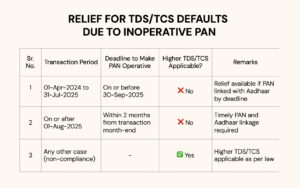
To mitigate hardships, CBDT has introduced two key relaxations for cases where PANs became operative due to Aadhaar linkage after the transaction dates:

No higher TDS/TCS liability will arise in the following two situations:

  1. Payments/Credits between April 1, 2024 and July 31, 2025

    ➤ Condition: PAN must be made operative on or before September 30, 2025.

  2. Payments/Credits on or after August 1, 2025

    ➤ Condition: PAN must be made operative within 2 months from the end of the month in which the amount was paid/credited.

In such cases, higher TDS/TCS under Section 206AA/206CC will not apply, and no default will be treated for the deductor/collector.

Summary Table:


Action Points:

• For deductors/collectors:

Review TDS/TCS statements, communicate with clients/vendors whose PAN was previously inoperative, and encourage prompt PAN–Aadhaar linkage.

• For taxpayers:

Check your PAN–Aadhaar linkage status immediately if there is any doubt.

Notes:

  • These reliefs are subject to PAN becoming operative through Aadhaar linkage, within the stipulated deadlines.
  • Other TDS/TCS provisions (under Chapter XVII-B or XVII-BB) must still be complied with.
  • This circular is a welcome move, ensuring that genuine cases are not penalized due to temporary PAN inoperativeness.

Final Thoughts

This circular reinforces the government’s intent to balance compliance with taxpayer convenience. While PAN-Aadhaar linkage remains mandatory, the latest relief provides much-needed protection for deductors/collectors from unjust demands, provided they meet the revised deadlines.

Download official circular from government by clicking here.

For assistance with PAN-Aadhaar linking or resolving TDS/TCS defaults, feel free to ask in comment section.

Disclaimer:

This article is for general informational purposes only and should not be considered professional advice. Please consult a qualified expert for advice tailored to your specific situation. The author and website owner are not liable for any errors or actions based on this content.
Luxury Items under the ambit of TCS – Income Tax

TCS on  luxury goods: Know the Rates, Rules & Applicability w.e.f April 22, 2025:

The Tax Collected at Source (TCS) provisions under the Income Tax Act, 1961, play a crucial role in ensuring tax compliance and transparency in high-value transactions. As per Section 206C, certain sellers are mandated to collect a specified percentage of tax from buyers at the time of sale of specified goods or receipt of sale consideration, provided the transaction exceeds prescribed thresholds.

Amendment in the section 206C which specifies the transactions on which TCS is applicable:

  • Finance Act 2024 (No. 2) has amended the provisions of section 206 (1F) to expand the scope of applicability of TCS provision to include other goods under the ambit of TCS in addition to existing applicability on sale of Car for value exceeding 10 lakh rupees.
  • Vide notification no 36/2025/F. No. 370142/11/2025-TPL dated 22-04-2025 Central government has notifed the following goods of the value exceeding 10 lakh rupees for collection of tax at source at 1% :
Sr. No. Nature of goods
1 any wrist watch
2 any art piece such as antiques, painting, sculpture
3 any collectibles such as coin, stamp
4 any yacht, rowing boat, canoe, helicopter
5 any pair of sunglasses
6 any bag such as handbag, purse
7 any pair of shoes
8 any sportswear and equipment such as golf kit, ski-wear
9 any home theatre system
10 any horse for horse racing in race clubs and horse for polo
  • The above amendment affects the ultra High Net Worth Individuals and traders or distributers of the above mentioned goods as TCS @ 1% will be collected by trader or distributer in addition to amount of goods so as to track the high value transaction by the Income Tax department.


TCS on Goods and Services: The Basics

The table outlines two scenarios for TCS collection on goods and services  including the criteria, applicable rates, sections of the Income Tax Act, and who it applies to. Let’s dive into the details:
 
A. TCS on Specified Goods:
No. Description of Goods TCS Rate Important Points to be considered
1 Alcoholic Liquor for human consumption 1% – No TCS is collected if goods are procured for the purpose of manufacturing, processing or producing articles or things or for the purposes of generation of power.

-Srap means waste and scrap from the manufacture or mechanical working of materials which is not usable as such.

– Applicable to seller if its turnover from business exceeds 1 crore in previous year.

2 Tendu leaves 5%
3 Timber obtained under a forest lease 2%
4 Timber obtained by any mode other than under a forest lease 2%
5 Any other forest produces not being timber or tendu leaves 2%
6 Scrap 1%
7 Minerals, being coal or lignite or iron ore 1%
8 Motor Vehicle 1% -Applicable if value of Car exceeds 10 lakhs

-Not applicable in case of sale of goods by Manufacturer to distributor

9 Luxury Goods – as mentioned in above para of article 1%

*Note – Applicability of TCS on sale of goods other than mentioned above for more than 50lakh during the year as mentioned  u/s. 206(1H)  has been omitted w.e.f. 1st April 2025.


B. TCS on specified services
Sr. No. Description of Service TCS Rate Important points to be considered
1. Remittance by Authorised dealer under LRS Scheme for medical and educational purpose 5% -Applicable if remittance amount exceeds 10 lakhs during the financial year.


-No TCS on remittance if loan is taken for educational purpose.


2. Remittance by Authorised dealer under LRS Scheme for other purpose 20% -Applicable if remittance amount exceeds 10 lakhs during the financial year.


3. Seller of Overseas Tour programme package

5%

20%

If overseas tour package in less than 10 lakh – 5%

– If overseas tour package exceeds 10 lakh – 20%


4. Service of Granting right or lease or license in any parking lot or toll plaza or mine or quarry to any person other than PSU 2% -mining and quarrying shall not include mining and quarrying of mineral oil (petroleum and natural gas)


Compliances Required for TCS Provisions

• Collect TCS at the Prescribed Time – TCS must be collected at the earlier of debiting the buyer’s account or receipt of payment.

• Timely Deposit of TCS – TCS collected must be deposited with the government by the 7th day of the following month (or by 30th April for collections in March)

• File Quarterly Returns – Sellers are required to file quarterly TCS returns using Form 27EQ within the specified deadlines (15th day of the following Quarterly (or by 15th May for Jan-March Quarter).

•Issue TCS Certificates – After filing returns, a TCS certificate (Form 27D) must be issued to the buyer within 15 days from filling of TCS Return, serving as proof for the buyer to claim tax credit.

Consequences for Not Collecting TCS under the Income Tax Act

• Penalty under Section 271CA – If a seller fails to collect TCS, a penalty equal to the amount of tax not collected may be imposed by the Joint Commissioner. However, if the seller can prove there was a reasonable cause for the failure, the penalty may be waived under Section 273B.

• Interest Liability – In addition to penalties, interest at 1% per month or part thereof is charged from the date the tax was collectible until it is actually collected and deposited with the government.

• Additional Penalties – Non-deposit or delayed deposit of TCS, as well as late filing of TCS returns, can attract further penalties and fines, including ₹100 per day for delayed return filing.

Conclusion

TCS provisions under the Income Tax Act, 1961, play a vital role in widening the tax base and promoting transparency in high-value transactions. Understanding the applicability, adhering to the prescribed compliances, and being aware of the consequences of non-compliance are essential for every business and professional dealing in specified goods and services. Timely collection, deposit, and reporting of TCS not only ensure legal compliance but also help avoid hefty penalties and interest liabilities.

By staying informed and proactive, you can ensure smooth transactions while fulfilling your tax responsibilities. Have questions about TCS Provisions? Drop them in the comments below, and let’s discuss!

Check out TCS Section 206C of the Income Tax Act, 1961.

Disclaimer:

This article is for general informational purposes only and should not be considered professional advice. Please consult a qualified expert for advice tailored to your specific situation. The author and website owner are not liable for any errors or actions based on this content.
TDS on House Rent Payments: Know the Rates, Rules & Applicability

TDS on House Rent Payments: Know the Rates, Rules & Applicability w.e.f April 1, 2025:

Tax Deducted at Source (TDS) is a mechanism in India where tax is deducted at the source of income, ensuring that the government collects tax on income as it is earned. When it comes to house rent, specific TDS rules apply under the Income Tax Act, particularly for individuals, Hindu Undivided Family (HUF), companies, and firms. In this blog, we’ll break down the TDS rates and criteria for house rent for Financial Year 2025-26, as outlined in the table below, helping you understand your obligations as a tenant or landlord.

TDS on House Rent: The Basics

The table outlines two key scenarios for TDS deduction on house rent, including the criteria, applicable rates, sections of the Income Tax Act, and who it applies to. Let’s dive into the details:
A. TDS on Rent Paid to a Resident Indians:
No. House Rent Criteria TDS Rate Section Tenant Applicability
1 Rent is more than ₹2.40 lacs per annum 10% 194-I – Company

– Firm

– Individual/HUF with business turnover more than ₹1 crore

– Individual/HUF with professional gross receipts more than ₹50 lacs

2 Rent is more than ₹50,000 per month 2% 194-IB – Individual/HUF with business turnover less than ₹1 crore

– Individual/HUF with professional gross receipts less than ₹50 lacs

Scenario 1: Rent Exceeding ₹2.40 Lacs Per Annum
• Criteria: If the annual rent paid exceeds ₹2,40,000, TDS must be deducted.
• TDS Rate: The applicable TDS rate is 10%.
• Section: This falls under Section 194-I of the Income Tax Act, which deals with TDS on rent payments.

• Applicability: This rule applies to:
a) Companies and firms, regardless of their income.
b) Individuals or HUFs who have a business turnover exceeding ₹1 crore in a financial year.
c) Individuals or HUFs with professional gross receipts exceeding ₹50 lacs in a financial year.

• Example: Suppose a company rents office space and pays ₹3,00,000 annually. Since the rent exceeds ₹2.40 lacs, the company must deduct 10% TDS, which amounts to ₹30,000, and pay the remaining ₹2,70,000 to the landlord. The deducted TDS must be deposited to the government, and the landlord can claim credit for this amount while filing their income tax return.

Scenario 2: Rent Exceeding ₹50,000 Per Month
• Criteria: If the monthly rent exceeds ₹50,000, TDS is applicable.
• TDS Rate: The TDS rate in this case is 2%.
• Section: This is covered under Section 194-IB of the Income Tax Act.

• Applicability: This rule applies to:
a) Individuals or HUFs with business turnover less than ₹1 crore.
b) Individuals or HUFs with professional gross receipts less than ₹50 lacs.

• Example: An individual pays ₹60,000 per month as rent for their apartment, totaling ₹7,20,000 annually. Since the monthly rent exceeds ₹50,000, they must deduct 2% TDS, which is ₹1,200 per month (₹14,400 annually). The remaining ₹58,800 is paid to the landlord each month. The tenant must deposit the TDS to the government and issue a TDS certificate (Form 16C) to the landlord.

Key Points to Understand

1) Threshold Limits: The ₹2.40 lacs per annum threshold (Section 194-I) is an annual limit, while the ₹50,000 per month threshold (Section 194-IB) is a monthly limit. Ensure you calculate the rent correctly to determine which section applies.

2) Who Deducts TDS? Under Section 194-I, companies, firms, and high-income individuals/HUFs are responsible for deducting TDS. Under Section 194-IB, individuals/HUFs with lower incomes (below the specified thresholds) are responsible, making it easier for the government to track rent payments by smaller taxpayers.

3) TDS Deposit and Compliance: The deducted TDS must be deposited to the government by the 7th of the following month (or by April 30th for TDS deducted in March). Additionally, tenants must issue TDS certificates to landlords—Form 16A for Section 194-I and Form 16C for Section 194-IB.

4) No TAN Requirement for Section 194-IB: Unlike Section 194-I, where a Tax Deduction Account Number (TAN) is required to deduct and deposit TDS, individuals under Section 194-IB can use their PAN to deduct and deposit TDS, simplifying the process for smaller taxpayers.

B. TDS on Rent Paid to Non-Resident Indians (NRIs)

When remitting rental payments to a Non-Resident Indian (NRI), Tax Deducted at Source (TDS) must be withheld at a rate of 30%, in addition to the applicable surcharge and a 4% cess. This TDS deduction is mandatory regardless of the rental amount, as there is no prescribed threshold for rent payments to NRIs. However, an NRI may apply for a certificate of nil or reduced TDS deduction if their taxable income in India falls below the basic exemption limit, subject to the provisions of the Income Tax Act.

What Happens If You Miss TDS?

TDS on house rent ensures that rental income is taxed at the source, reducing tax evasion. For tenants, deducting TDS is a legal obligation, and non-compliance can lead to penalties. For landlords, the TDS deducted can be claimed as a credit when filing their income tax returns, ensuring they aren’t taxed twice on the same income.

• Penalties: Non-deduction or late deduction may attract interest (1% per month) and fines equal to the TDS amount.
• Disallowance of Expenses: The rent paid may not be deductible as a business expense for the tenant.

Practical Tips for Tenants and Landlords

  • Tenants: Always check the rent amount and your income status to determine if TDS applies. Use online tools or consult a tax professional to calculate and deposit TDS correctly. Keep records of rent payments and TDS certificates issued.

  • Landlords: Ensure your tenants are aware of their TDS obligations. Provide your PAN to the tenant for TDS deduction and verify that the TDS amount is credited to your account when filing your returns.

Conclusion

Understanding TDS on house rent is crucial for both tenants and landlords in India. Whether you’re a company paying high rent or an individual renting a modest apartment, knowing the applicable TDS rates and sections can help you stay compliant with tax laws. The table above provides a clear snapshot of the rules, but if you’re unsure about your specific situation, it’s always a good idea to consult a tax expert.

By staying informed and proactive, you can ensure smooth rent transactions while fulfilling your tax responsibilities. Have questions about TDS on rent? Drop them in the comments below, and let’s discuss!

Check out TDS Section 194-I & 194I-B of the Income Tax Act, 1961.

Disclaimer:

This article is for general informational purposes only and should not be considered professional advice. Please consult a qualified expert for advice tailored to your specific situation. The author and website owner are not liable for any errors or actions based on this content.