Luxury Items under the ambit of TCS – Income Tax

TCS on  luxury goods: Know the Rates, Rules & Applicability w.e.f April 22, 2025:

The Tax Collected at Source (TCS) provisions under the Income Tax Act, 1961, play a crucial role in ensuring tax compliance and transparency in high-value transactions. As per Section 206C, certain sellers are mandated to collect a specified percentage of tax from buyers at the time of sale of specified goods or receipt of sale consideration, provided the transaction exceeds prescribed thresholds.

Amendment in the section 206C which specifies the transactions on which TCS is applicable:

  • Finance Act 2024 (No. 2) has amended the provisions of section 206 (1F) to expand the scope of applicability of TCS provision to include other goods under the ambit of TCS in addition to existing applicability on sale of Car for value exceeding 10 lakh rupees.
  • Vide notification no 36/2025/F. No. 370142/11/2025-TPL dated 22-04-2025 Central government has notifed the following goods of the value exceeding 10 lakh rupees for collection of tax at source at 1% :
Sr. No. Nature of goods
1 any wrist watch
2 any art piece such as antiques, painting, sculpture
3 any collectibles such as coin, stamp
4 any yacht, rowing boat, canoe, helicopter
5 any pair of sunglasses
6 any bag such as handbag, purse
7 any pair of shoes
8 any sportswear and equipment such as golf kit, ski-wear
9 any home theatre system
10 any horse for horse racing in race clubs and horse for polo
  • The above amendment affects the ultra High Net Worth Individuals and traders or distributers of the above mentioned goods as TCS @ 1% will be collected by trader or distributer in addition to amount of goods so as to track the high value transaction by the Income Tax department.


TCS on Goods and Services: The Basics

The table outlines two scenarios for TCS collection on goods and services  including the criteria, applicable rates, sections of the Income Tax Act, and who it applies to. Let’s dive into the details:
 
A. TCS on Specified Goods:
No. Description of Goods TCS Rate Important Points to be considered
1 Alcoholic Liquor for human consumption 1% – No TCS is collected if goods are procured for the purpose of manufacturing, processing or producing articles or things or for the purposes of generation of power.

-Srap means waste and scrap from the manufacture or mechanical working of materials which is not usable as such.

– Applicable to seller if its turnover from business exceeds 1 crore in previous year.

2 Tendu leaves 5%
3 Timber obtained under a forest lease 2%
4 Timber obtained by any mode other than under a forest lease 2%
5 Any other forest produces not being timber or tendu leaves 2%
6 Scrap 1%
7 Minerals, being coal or lignite or iron ore 1%
8 Motor Vehicle 1% -Applicable if value of Car exceeds 10 lakhs

-Not applicable in case of sale of goods by Manufacturer to distributor

9 Luxury Goods – as mentioned in above para of article 1%

*Note – Applicability of TCS on sale of goods other than mentioned above for more than 50lakh during the year as mentioned  u/s. 206(1H)  has been omitted w.e.f. 1st April 2025.


B. TCS on specified services
Sr. No. Description of Service TCS Rate Important points to be considered
1. Remittance by Authorised dealer under LRS Scheme for medical and educational purpose 5% -Applicable if remittance amount exceeds 10 lakhs during the financial year.


-No TCS on remittance if loan is taken for educational purpose.


2. Remittance by Authorised dealer under LRS Scheme for other purpose 20% -Applicable if remittance amount exceeds 10 lakhs during the financial year.


3. Seller of Overseas Tour programme package

5%

20%

If overseas tour package in less than 10 lakh – 5%

– If overseas tour package exceeds 10 lakh – 20%


4. Service of Granting right or lease or license in any parking lot or toll plaza or mine or quarry to any person other than PSU 2% -mining and quarrying shall not include mining and quarrying of mineral oil (petroleum and natural gas)


Compliances Required for TCS Provisions

• Collect TCS at the Prescribed Time – TCS must be collected at the earlier of debiting the buyer’s account or receipt of payment.

• Timely Deposit of TCS – TCS collected must be deposited with the government by the 7th day of the following month (or by 30th April for collections in March)

• File Quarterly Returns – Sellers are required to file quarterly TCS returns using Form 27EQ within the specified deadlines (15th day of the following Quarterly (or by 15th May for Jan-March Quarter).

•Issue TCS Certificates – After filing returns, a TCS certificate (Form 27D) must be issued to the buyer within 15 days from filling of TCS Return, serving as proof for the buyer to claim tax credit.

Consequences for Not Collecting TCS under the Income Tax Act

• Penalty under Section 271CA – If a seller fails to collect TCS, a penalty equal to the amount of tax not collected may be imposed by the Joint Commissioner. However, if the seller can prove there was a reasonable cause for the failure, the penalty may be waived under Section 273B.

• Interest Liability – In addition to penalties, interest at 1% per month or part thereof is charged from the date the tax was collectible until it is actually collected and deposited with the government.

• Additional Penalties – Non-deposit or delayed deposit of TCS, as well as late filing of TCS returns, can attract further penalties and fines, including ₹100 per day for delayed return filing.

Conclusion

TCS provisions under the Income Tax Act, 1961, play a vital role in widening the tax base and promoting transparency in high-value transactions. Understanding the applicability, adhering to the prescribed compliances, and being aware of the consequences of non-compliance are essential for every business and professional dealing in specified goods and services. Timely collection, deposit, and reporting of TCS not only ensure legal compliance but also help avoid hefty penalties and interest liabilities.

By staying informed and proactive, you can ensure smooth transactions while fulfilling your tax responsibilities. Have questions about TCS Provisions? Drop them in the comments below, and let’s discuss!

Check out TCS Section 206C of the Income Tax Act, 1961.

Disclaimer:

This article is for general informational purposes only and should not be considered professional advice. Please consult a qualified expert for advice tailored to your specific situation. The author and website owner are not liable for any errors or actions based on this content.

Section 80JJAA: Deduction for Employing New Employees, Conditions and Example

Last updated: 02 October 2026 · Written and reviewed by CA Meet Dhrangadhariya, CSM & Co LLP

Quick summary

  • Section 80JJAA gives a deduction of 30% of additional employee cost for three consecutive years to businesses subject to tax audit.
  • An additional employee earns up to ₹25,000 a month, works at least 240 days (150 for apparel, footwear and leather) and is in a recognised provident fund.
  • It is not limited to manufacturers, and it is allowed in both tax regimes.
  • From Tax Year 2026-27 it is section 146 of the Income-tax Act, 2025 and the accountant’s report is Form 34 (earlier Form 10DA).

Section 80JJAA rewards businesses that add jobs in the formal sector. A business subject to tax audit can deduct 30% of the cost of its additional employees, every year for three years. From Tax Year 2026-27 the provision is section 146 of the Income-tax Act, 2025. For FY 2025-26 (assessment year 2026-27) it is still section 80JJAA of the 1961 Act.

Who can claim?

An assessee whose accounts are required to be audited under section 44AB (section 63 of the 2025 Act) and whose gross total income includes business profits. The section does not limit the benefit to manufacturers or to any sector; many online guides wrongly say service businesses are excluded. The law has no such condition.

How much, and for how long?

The deduction is 30% of the additional employee cost incurred in the year. It is allowed for three consecutive years, beginning with the year in which the employment is provided. So a new employee hired in one year gives deductions in that year and the next two.

Who is an additional employee?

An employee employed in the year whose employment increases the total number of employees over the number on the last day of the preceding year, but not one:

  • whose total emoluments are more than ₹25,000 a month,
  • for whom the Government pays the entire contribution under the Employees’ Pension Scheme,
  • employed for less than 240 days in the year (150 days for a business making apparel, footwear or leather products), or
  • who does not participate in a recognised provident fund.

An employee who falls short of the days in the year of joining but completes the required days in the next year is treated as an additional employee of that next year.

What is additional employee cost?

It is the total emoluments paid or payable to the additional employees in the year. In the first year of a new business, the emoluments of all employees employed in that year count. For an existing business the cost is nil if:

  • the number of employees has not increased over the number on the last day of the preceding year, or
  • emoluments are paid otherwise than by account payee cheque, account payee draft, electronic clearing through a bank account or another prescribed electronic mode.

“Emoluments” means any sum paid or payable to an employee for employment, by whatever name called. It excludes the employer’s contribution to a pension, provident or other fund required by law, and lump sums on termination, retirement or voluntary retirement such as gratuity, severance pay, leave encashment and commutation of pension.

When is the deduction not allowed?

  • The business was formed by splitting up or reconstructing an existing business. The exception is a business formed by re-establishment, reconstruction or revival in the circumstances the Act allows.
  • The business was acquired by transfer from another person or through a business reorganisation.
  • The assessee does not furnish the accountant’s report before the specified date (the audit report date under section 44AB or section 63).

Accountant’s report: Form 10DA and Form 34

  • Up to FY 2025-26 the report is Form 10DA.
  • Under Rule 68 of the Income-tax Rules, 2026 the report required by section 146(3)(c) is Form 34. It is certified by a chartered accountant.

Example

A company with a tax audit had 40 employees on 31 March 2026. During FY 2026-27 it hires 10 people at ₹20,000 a month, each in a recognised provident fund and each working the full year. No one else is added and no one leaves.

Item Amount in ₹
Additional employee cost (10 x 20,000 x 12) 24,00,000
Deduction at 30% 7,20,000

The company claims ₹7,20,000 in each of the next three years (Tax Years 2026-27, 2027-28 and 2028-29) as long as the conditions are met for the cost of these employees. Hiring someone at ₹30,000 a month would not qualify, because that employee’s emoluments are above ₹25,000.

Which tax regime?

The deduction stays available in the new tax regime. Section 202 of the 2025 Act removes most Chapter VIII deductions in the new regime but keeps section 146, along with 124(1), 124(2) and 125(2).

Frequently asked questions

Who can claim section 80JJAA?

A business whose accounts are subject to tax audit (section 44AB, now section 63) and whose income includes business profits, in any sector. It is not limited to manufacturers.

How much is the deduction?

30% of the additional employee cost, allowed for three consecutive years starting with the year in which the employment is provided.

Which employees count as additional employees?

Employees whose total emoluments are up to ₹25,000 a month, who are in a recognised provident fund, who work at least 240 days in the year (150 days for apparel, footwear and leather), and whose employment raises the headcount over the last day of the preceding year.

Which form is needed?

Form 10DA up to FY 2025-26, and Form 34 under Rule 68 of the Income-tax Rules, 2026 from 01/04/2026, certified by a chartered accountant.

Is it available in the new tax regime?

Yes. Section 146 of the 2025 Act is one of the Chapter VIII deductions that stay allowed under section 202.

Official sources

Related reading

Disclaimer

This article is for general informational purposes only and should not be considered professional advice. Please consult a qualified expert for advice tailored to your specific situation. The author and website owner are not liable for any errors or actions based on this content.
Entertainment Allowance: Is It Still Deductible from Tax Year 2026-27?

Last updated: 21 July 2026 · Written and reviewed by CA Meet Dhrangadhariya, CSM & Co LLP

Quick summary

  • Under section 16(ii) of the 1961 Act, only Government employees could deduct entertainment allowance, in the old regime, limited to the least of ₹5,000, 20% of basic salary and the allowance received.
  • Private sector employees never got this deduction; the allowance was fully taxable for them.
  • The Income-tax Act, 2025 does not carry the deduction forward, so from Tax Year 2026-27 the allowance is taxable in full for everyone.
  • For FY 2025-26 (assessment year 2026-27) the old rule still applies to Government employees in the old regime.

Entertainment allowance is an amount an employer pays for entertaining visitors or clients on the employer’s behalf. It is part of salary and is taxable. For many years one narrow deduction existed for Government employees. The Income-tax Act, 2025 does not carry it forward.

The old rule: section 16(ii) of the 1961 Act

The allowance is first added to salary. A deduction is then allowed, but only to a Government employee in the old tax regime. The deduction is the least of:

  1. ₹5,000,
  2. 20% of the basic salary, and
  3. the entertainment allowance received.

Points to note:

  • The amount actually spent on entertainment makes no difference. The deduction is a fixed formula.
  • “Salary” for the 20% test excludes any allowance, benefit or perquisite, so it is in practice the basic pay.
  • The deduction depends on the allowance being paid as an entertainment allowance.
  • Private sector employees, and employees of statutory and local authorities, never got any deduction. The whole allowance was taxable for them.

Example (up to FY 2025-26, old regime)

A Government employee has a basic salary of ₹4,00,000 and receives an entertainment allowance of ₹40,000.

Test Amount in ₹
Fixed limit 5,000
20% of basic salary (20% of 4,00,000) 80,000
Allowance received 40,000
Deduction (the least) 5,000

The remaining ₹35,000 stays taxable as salary.

What the Income-tax Act, 2025 says

From Tax Year 2026-27, deductions from salary are listed in section 19 of the Income-tax Act, 2025. The list covers tax on employment (professional tax), the standard deduction, and the gratuity, pension commutation, retrenchment compensation, voluntary retirement and leave salary items. Entertainment allowance does not appear in it, and the Act does not mention the allowance anywhere else. So from Tax Year 2026-27 the whole entertainment allowance is taxable in every employee’s hands, whether in the government or the private sector.

New regime

The new regime never allowed this deduction. It allows the standard deduction of ₹75,000 and the few other items that survive in section 202.

What this means for payroll

A Government department paying entertainment allowance should stop allowing the ₹5,000 deduction in the TDS calculation for Tax Year 2026-27 onwards, and show the whole allowance as taxable salary.

Frequently asked questions

Who could claim a deduction for entertainment allowance?

Only Government employees, under section 16(ii) of the 1961 Act and only in the old tax regime. Private sector employees and employees of local authorities or statutory bodies could not.

What was the limit?

The least of ₹5,000, 20% of basic salary, and the entertainment allowance actually received. The amount spent is not relevant.

Is the deduction available for Tax Year 2026-27?

No. The list of deductions from salary in section 19 of the Income-tax Act, 2025 has no entry for entertainment allowance, so the whole allowance is taxable.

Does the allowance have to be called entertainment allowance?

Yes. The deduction depended on the employer paying it as an entertainment allowance.

Is it available in the new tax regime?

No. The new regime never allowed it, apart from the standard deduction.

Official sources

Disclaimer

This article is for general informational purposes only and should not be considered professional advice. Please consult a qualified expert for advice tailored to your specific situation. The author and website owner are not liable for any errors or actions based on this content.
AS 22 Accounting for Taxes on Income

Last updated: 10 September 2026 · Written and reviewed by CA Meet Dhrangadhariya, CSM & Co LLP

Quick summary

  • Profits in your accounts rarely match taxable profits, and AS 22 governs how the difference is accounted for.
  • Differences are either timing differences (they reverse in later years) or permanent differences (they never reverse).
  • Timing differences create deferred tax assets or deferred tax liabilities.
  • This guide covers when and how to apply AS 22, the deferred tax computation, and the comparison with Ind AS 12 and IFRIC 23.

How AS 22 is applied at a glance

1. Compare accounting income with taxable income
↓
2. Split the difference into timing differences (reversible) and permanent differences (not reversible)
↓
3. Ignore permanent differences, they create no deferred tax
↓
4. Taxable income higher than accounting income gives a deferred tax asset, recognised only with reasonable certainty (virtual certainty if there are losses or unabsorbed depreciation)
↓
5. Accounting income higher than taxable income gives a deferred tax liability
↓
6. Report tax expense as current tax plus deferred tax in the profit and loss statement

Profits as per your financial statements rarely match with your taxable profits. And it would be incorrect to ignore to account for the difference between these two profits. To govern the accounting for such differences, we cover the following topics  in this article w.r.t. AS 22 Accounting for Taxes on Income:

Introduction - Accounting Standard

Accounting Standard 22 has been prescribed by ICAI to be applied in accounting for taxes on income. This AS is applied to match the differences between accounting income and taxable income. 1. Accounting income is the net profit before tax for a period, as reported in the profit and loss statement. 2. Taxable income is the income on which income tax is payable, computed by applying provisions of the Income Tax Act, 1961 & Rules.

Types of differences and why they appear

The differences can be of two types:

Timing difference

Timing differences are those differences between accounting income and taxable income which can be reversed in one or more subsequent periods. For example, Depreciation allowed as per WDV method for computing taxable income and as per SLM method for computing accounting income.

Permanent difference

Permanent differences are those differences between accounting income and taxable income which cannot be reversed any subsequent period. For example, Donation paid in cash is disallowed in computing taxable income whereas it is allowed as expenditure while computing accounting income. There can be differences between accounting income and taxable income because of the following reasons:

  1. Expenses debited in profit and loss statement, but disallowed as per Income Tax Act 1961, while computing taxable income

  2. Provision for Bad/doubtful debts allowed while computing accounting income, but disallowed while computing taxable income

  3. Charging depreciation using different rates as per Companies Act 2013 and Income Tax Act 1961

  4. Any income recognized on an accrual basis in profit and loss statement but recognized on receipt basis in subsequent period for computing taxable income. In order to account for these kinds of differences, AS 22 needs to be applied.

When to apply AS 22 Accounting for Taxes on Income

Deferred Tax Liability formula

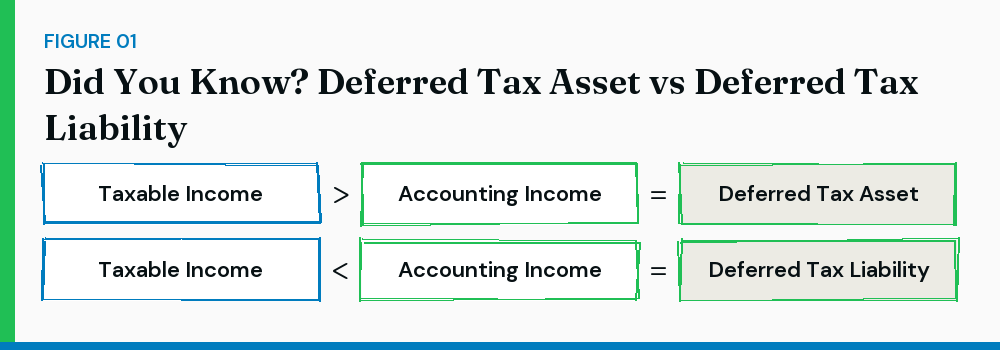
AS 22 needs to be applied when there are differences between taxable income and accounting income. If taxable income is greater than accounting income, then it will result in deferred tax asset. And if accounting income is greater than taxable income, then it will result in deferred tax liability.

When the difference is resulting in deferred tax asset, then it should be recognized only when there is a reasonable certainty of its realization. The recognition of deferred tax asset should be to the extent of the reasonable certainty of the expected realization. The reasonable certainty can be determined by making the realistic estimates of future profits based on the examination of profits and loss statement of earlier periods.

Say, an entity has unabsorbed depreciation or carry forward of losses. In such a case, deferred tax asset should be recognized to the extent there is a virtual certainty supported by convincing evidence. Virtual certainty is a matter of judgment of convincing evidence, which should be available in a concrete form at a particular date.

How to apply AS 22 Accounting for Taxes on Income

The application of AS 22 can be explained with the help of examples: Example of timing difference:

Particulars Year 1 Year 2 Year 3
Profit before tax (A) 100,000 200,000 180,000
Depreciation as per Companies Act (B) 25,000 25,000 25,000
Accounting income (A-B) 75,000 175,000 125,000
Depreciation as per Income tax Act (C) 50,000 0 10,000
Taxable income (A-C) 50,000 200,000 170,000
Timing difference (D) 25,000 -25,000 -15,000
Current tax @ 30% 15,000 60,000 51,000
Deferred tax (D * 30%) 7,500 -7,500 -4,500
Total tax expense 22,500 52,500 46,500
Profit after tax 52,500 122,500 78,500

Deferred tax computation

Particulars Year 1 Year 2 Year 3
Opening balance of timing difference 0 25,000 0
Addition 25,000 0 15,000
Deletion 0 25,000 0
Closing balance of timing difference 25,000 0 15,000
Deferred tax @ 30% 7,500 7,500 4,500
DTA/DTL Creation of DTL Reversal of DTL Creation of DTA
Journal Entry P&L A/c Dr. To DTL DTL Dr. To P&L A/c DTA Dr. To P&L A/c

Comparison between AS 22 and IND AS 12

Basis AS 22 Accounting for Taxes on Income IND AS 12 (Income taxes)
Recognition AS 22 recognized tax effect of differences between taxable income and accounting income. IND AS 12 recognized tax effect of differences between assets and/or liabilities and their tax base.
Approach AS 22 is based on profit or loss statement approach. IND AS 12 is based on balance sheet approach.
Differences The types of differences on which AS 22 is applied are timing differences and permanent differences. The types of differences on which IND AS 12 is applied are taxable temporary differences and deductible temporary differences. Permanent differences are not dealt in by this standard.
Recognition of Deferred tax asset/deductible temporary differences DTA is recognized only when and to the extent there is a reasonable certainty of its realization Deductible temporary differences are recognized to the extent of the probability of taxable profits in future periods.
Disclosure AS 22 deals with the disclosure of DTA/DTL in the balance sheet. IND AS 12 deals with the recognition of current or deferred tax as income or expense in profit and loss statement. It also deals with the disclosure of out of profit and loss transaction in the balance sheet as current or non-current assets/liability.
Revaluation of assets AS 22 does not cover the difference arising between taxable income and accounting income due to the revaluation of assets. IND AS 12 deals with the difference between carrying the amount of revalued asset and its tax base.
Goodwill AS 22 does not cover the difference arising due to goodwill arising a business combination. As per IND AS 12, the difference between carrying the amount of goodwill and its tax base (which will be NIL) is the taxable temporary difference. It does not allow the recognition of such difference because goodwill is measured as a residual and its recognition would increase the carrying amount of goodwill.
The concept of virtual certainty When an entity has unabsorbed depreciation or carry forward of losses then in such a case deferred tax asset should be to the extent there is a virtual certainty supported by convincing evidence. There is no concept of virtual certainty in IND AS 12. Deductible temporary differences are recognized to the extent of the probability of taxable profits in future periods.
Tax holiday AS 22 specifically provides guidance regarding recognition of deferred tax in the situations of Tax Holiday under Sections 80-IA, 80-IB, 10A and 10B of Income-tax Act. IND AS 12 does not specifically deal with the situations of the tax holiday.
Capital Loss AS 22 provides guidance regarding recognition of DTA in case of loss under the head of ‘capital gains’. IND AS 12 does not specifically provide for the same.

IFRIC 23

IFRIC 23 also provides for Uncertainty over Income Tax Treatments. It requires an entity to treat uncertain tax treatments depending on which method will be best suited for its resolution. The major difference between AS 22 and IFRIC 23 is that IFRIC 23 requires an entity, while determining the current and deferred income tax assets and liabilities, to make an assessment whether it is probable that taxation authority will accept an uncertain tax treatment.

If it is not probable, then entity should reflect that uncertainty through either expected value approach or most likely approach. IFRIC 23 will be applicable for annual reporting periods beginning on or after 01.01.2019.

Frequently asked questions

What is AS 22?

AS 22 is the Accounting Standard issued by ICAI that prescribes how taxes on income, including current tax and deferred tax, are accounted for in financial statements.

What is the difference between a timing difference and a permanent difference?

A timing difference arises in one period and reverses in later periods, for example depreciation under different methods. A permanent difference never reverses, for example an expense disallowed by the Income Tax Act.

Does AS 22 create deferred tax on permanent differences?

No. Deferred tax is recognised only for timing differences, not for permanent differences.

How is AS 22 different from Ind AS 12?

AS 22 applies to companies following the Companies (Accounting Standards) Rules and uses the income statement approach based on timing differences, while Ind AS 12 follows a balance sheet approach based on temporary differences.

Official sources

Related reading

Disclaimer

This article is for general informational purposes only and should not be considered professional advice. Please consult a qualified expert for advice tailored to your specific situation. The author and website owner are not liable for any errors or actions based on this content.
Indian Accounting Standard 12: Income Taxes

Last updated: 19 July 2026 · Written and reviewed by CA Meet Dhrangadhariya, CSM & Co LLP

Quick summary

  • Ind AS 12 prescribes how current tax and deferred tax are accounted for, using the balance sheet approach.
  • Deferred tax is recognised on temporary differences between the carrying amount of an asset or liability and its tax base.
  • Deferred tax liabilities are recognised on all taxable temporary differences, with limited exceptions such as initial recognition of goodwill.
  • Deferred tax assets are recognised only to the extent that future taxable profit will probably be available.

How Ind AS 12 deferred tax is worked out

1. Find the carrying amount of the asset or liability in the balance sheet
↓
2. Find its tax base
↓
3. Compute the temporary difference between the two
↓
4. Taxable temporary difference: recognise a deferred tax liability (apart from the exceptions)
↓
5. Deductible temporary difference: recognise a deferred tax asset only if future taxable profit is probable
↓
6. Measure at the tax rate expected when the asset is realised or the liability is settled
↓
7. Present and disclose the components of tax expense

Income taxes as per the Indian Accounting Standard 12 include both domestic and foreign taxes, which are based on taxable profits. It also includes withholding taxes.

Introduction

The objective of this standard is to prescribe the accounting treatment for income taxes. The principal issue in accounting for income taxes is how to account for current and future tax consequences of:

  • Future settlement of carrying amount of assets and liabilities that are recognised in the balance sheet of an organisation. If it is probable that the settlement of the carrying amount will result in a variance of tax amount which should then be recognised as deferred tax.
  • Events and transactions that are recognised in the current period. The treatment for the tax related to the events will be the same as the events.

Ind AS 12 is based on the Balance Sheet approach. It requires recognising tax consequences of the difference between the carrying amounts of assets and liabilities and their tax base.

What is Tax expense or Income?

Tax expense or Tax income is the aggregate amount included in the determination of profit or loss in respect of current tax and deferred tax. Current tax is the amount of income taxes payable/recoverable in respect of the current profit/ loss for a period.

Deferred Tax liability is the amount of income tax payable in future periods with respect to the taxable temporary differences.

Deferred tax asset is the income tax amount recoverable in future periods in respect to the deductible temporary differences, carry forward of unused tax losses, and carry forward of unused tax credits.

Temporary differences are the differences between the carrying amount of an asset or liability in the balance sheet and its tax base.

Tax Base of an asset or liability is the amount attributed to the asset or liability for tax purposes.

Recognition of current tax assets and current tax liabilities

  • Taxes to the extent unpaid for current and prior periods will be recognised as a liability. If the amount already paid for current and prior periods exceeds the actual amount due, then it will be recognised as an asset.
  • A tax loss that can be used to recover current tax of a previous period is recognised as an asset in the period in which tax loss occurred.

Recognition of deferred tax liabilities

Deferred tax liability will be recognised for all taxable temporary differences. However, the following are exceptions to the same:

  • The initial recognition of goodwill.
  • The initial recognition of an asset or liability in a transaction that is not a business combination and affects neither accounting profit nor taxable profit at the time of the transaction. A recent amendment to Ind AS 12 removes this exception where the transaction gives rise to equal taxable and deductible temporary differences (for example leases and decommissioning obligations). Check the current text of the standard for the applicable date.

Recognition of deferred tax assets

A deferred tax asset will be recognised for all the deductible temporary differences, provided it is probable that the taxable profit will be available for utilisation of deductible temporary differences. A deferred tax asset is not recognised if it arises from the initial recognition of an asset or liability in a transaction that is not a business combination and affects neither accounting profit nor taxable profit at the time of the transaction (subject to the amendment mentioned above).

Measurement of current and deferred tax assets/liabilities

Current tax assets or liability will be measured as the amount expected to be recovered or paid to the tax authorities at the tax rate and laws that have been enacted or subsequently enacted by the end of the reporting period. Deferred tax assets or liability will be measured at the expected tax rates in the period in which the asset is realised or liability paid based on the tax laws that have been enacted or subsequently enacted at the end of the reporting period.

Presentation of current and deferred tax assets and liabilities

An entity shall offset current tax assets and liabilities only if it is legally entitled to and it intends to settle on a net basis or to realise assets and settle liabilities simultaneously. It can offset deferred tax assets and liabilities if:

  • It has the legal right to offset current tax assets and liabilities.
  • The deferred tax assets and liabilities relate to the income taxes levied by the same taxation authorities on same entities or on entities that intend to settle current tax assets and liabilities on a net basis or to realise assets and settle liabilities simultaneously.

Disclosure of current and deferred tax assets and liabilities

The major components of tax expense or income will be disclosed separately.

Allocation

As per this standard, an entity must account for tax consequences in the same way as it accounts for the transactions and other events. Therefore, if the transaction and other events are recognised in profit and loss, then the related tax consequences should also be recognised in profit and loss. If the transaction and event is recognised outside profit and loss that is in other comprehensive income or directly in equity, then the tax consequence will also be recognised outside the profit and loss that is in other comprehensive income or directly in equity.

Frequently asked questions

What approach does Ind AS 12 follow?

Ind AS 12 follows the balance sheet approach. It recognises the tax consequences of differences between the carrying amount of assets and liabilities and their tax base.

What is a tax base?

The tax base of an asset or liability is the amount attributed to it for tax purposes.

When is a deferred tax asset recognised under Ind AS 12?

For deductible temporary differences, only when it is probable that taxable profit will be available against which they can be used.

How is Ind AS 12 different from AS 22?

AS 22 uses the income statement approach based on timing differences, while Ind AS 12 uses the balance sheet approach based on temporary differences.

Official sources

Related reading

Disclaimer

This article is for general informational purposes only and should not be considered professional advice. Please consult a qualified expert for advice tailored to your specific situation. The author and website owner are not liable for any errors or actions based on this content.
Section 80P: Deduction for Co-operative Societies, Activities and Limits

Last updated: 07 September 2026 · Written and reviewed by CA Meet Dhrangadhariya, CSM & Co LLP

Quick summary

  • Section 80P gives co-operative societies a deduction for profits from specified activities such as credit to members, marketing members’ produce and cottage industries.
  • Other activities are covered only up to ₹1,00,000 for a consumers’ society and ₹50,000 for any other society.
  • Co-operative banks (other than primary agricultural credit societies and primary agricultural and rural development banks) are excluded.
  • From Tax Year 2026-27 it is section 149 of the Income-tax Act, 2025, and it is not available if the society opts for the 22% or 15% concessional rate.

Co-operative societies serve their members rather than outside shareholders, and the Income-tax law gives them a deduction on the profits from the activities that serve those members. From Tax Year 2026-27 the provision is section 149 of the Income-tax Act, 2025. For FY 2025-26 (assessment year 2026-27) it is still section 80P of the 1961 Act.

Who is a co-operative society?

For the Act a co-operative society is one registered under the Co-operative Societies Act, 1912 or any State law on co-operative societies. Section 80P applies to a co-operative society that includes income from the activities below in its gross total income.

Activities and amounts allowed

Activity Deduction
Banking or providing credit facilities to members Whole of the profits attributable
Cottage industry Whole of the profits attributable
Marketing agricultural produce grown by members Whole of the profits attributable
Buying agricultural implements, seeds, livestock or other farm articles to supply to members Whole of the profits attributable
Processing members’ agricultural produce without the aid of power Whole of the profits attributable
Collective disposal of members’ labour Whole of the profits attributable
Fishing and allied activities (catching, curing, processing, storing or marketing fish, or buying materials for members) Whole of the profits attributable
Primary society supplying milk, oilseeds, cotton seed, cattle feed, fruits or vegetables grown by its members to a federal co-operative, the Government or local authority, or a Government company or statutory corporation Whole of the profits of that business
Any other activity Profits up to ₹1,00,000 for a consumers’ society, ₹50,000 for any other society
Interest or dividend on investments with another co-operative society Whole of that income
Letting of godowns or warehouses for storage, processing or marketing of commodities Whole of that income
Interest on securities and income from house property, for a society (other than a housing society, urban consumers’ society, transport society or a society doing power-aided manufacturing) whose gross total income is not more than ₹20,000 Whole of that income

Two points on this table:

  • For collective disposal of labour and for fishing, the deduction applies only if the society’s rules and bye-laws limit voting rights to individuals who contribute their labour or carry on fishing, co-operative credit societies that finance the society, and the State Government.
  • The Finance Act, 2026 added cotton seed and cattle feed to the produce list for primary societies, and made clear that the investment income covered is interest or dividends.

The limit for the last row is ₹20,000 under the Act. Some older write-ups say ₹25,000; the Act says ₹20,000.

Co-operative banks are excluded

The section does not apply to a co-operative bank unless it is a primary agricultural credit society or a primary co-operative agricultural and rural development bank (a society whose area is confined to a taluk and whose main object is long-term credit for agriculture and rural development). Whether a co-operative credit society is really a “co-operative bank” is a question of fact that has reached the courts, and a society that gives credit to its members only is in a different position from one that functions as a bank. Check your society’s position with a professional before claiming.

Interaction with other deductions

If the society also claims the profit-linked deduction for infrastructure and other undertakings (section 80-IA, section 138 of the 2025 Act), the section 80P deduction is worked out on the income left after that deduction.

Example

A co-operative society that is not a consumers’ society has the following profits for the year:

Source Profit in ₹ Deduction in ₹
Marketing of members’ agricultural produce 4,00,000 4,00,000
Other activity (not listed in the section) 1,50,000 50,000
Total 5,50,000 4,50,000

The society’s taxable income is ₹1,00,000, before any other adjustments.

The concessional rate option

A resident co-operative society can opt to pay tax at 22% under section 115BAD of the 1961 Act (section 203 of the 2025 Act). Under that option the society gives up Chapter VIII deductions, so section 80P (section 149) is not available. The 2025 Act keeps only section 146 (additional employee cost) and section 150 for such societies. The same applies to the 15% option for new manufacturing co-operatives (section 115BAE, section 204 of the 2025 Act). A society that does not opt in continues to claim section 149.

Section 150: a new deduction for federal co-operatives

Section 150 of the 2025 Act (inserted by the Finance Act, 2026) lets a federal co-operative deduct dividends from its investment in any company, to the extent that the amount arose from an investment recorded in its books on or before 31 January 2026 and was distributed to its members at least one month before the due date for filing the return. It does not apply to any tax year beginning on or after 1 April 2029.

Frequently asked questions

Who can claim section 80P?

A co-operative society whose income includes profits from the activities listed in the section, such as credit to members, cottage industry, marketing members’ produce and fishing.

Is a co-operative bank eligible?

No. The section does not apply to a co-operative bank unless it is a primary agricultural credit society or a primary co-operative agricultural and rural development bank.

How much is deductible for other activities?

Profits from activities not specifically listed are deductible up to ₹1,00,000 for a consumers’ co-operative society and ₹50,000 for any other society.

Can I claim 80P if I opt for the 22% rate?

No. The concessional regime for co-operative societies (section 115BAD of the 1961 Act, section 203 of the 2025 Act) bars Chapter VIII deductions other than additional employee cost (section 146) and the new section 150.

What is the section number from Tax Year 2026-27?

Section 149 of the Income-tax Act, 2025.

Official sources

Related reading

Disclaimer

This article is for general informational purposes only and should not be considered professional advice. Please consult a qualified expert for advice tailored to your specific situation. The author and website owner are not liable for any errors or actions based on this content.
Section 80RRB: Deduction for Royalty Income from Patents

Last updated: 14 August 2026 · Written and reviewed by CA Meet Dhrangadhariya, CSM & Co LLP

Quick summary

  • Section 80RRB gives a resident individual patentee a deduction of the lower of the royalty income and ₹3,00,000 on royalty from a patent registered on or after 01/04/2003.
  • The claimant must be the patentee, that is the true and first inventor recorded as patentee, including a joint patentee.
  • The certificate (Form 10CCE, now Form 37) must be filed with the return, and the deduction is available only in the old tax regime.
  • From Tax Year 2026-27 it is section 152 of the Income-tax Act, 2025.

An inventor who earns royalty from a patent gets a deduction under section 80RRB, up to ₹3,00,000 a year. From Tax Year 2026-27 the provision is section 152 of the Income-tax Act, 2025. For FY 2025-26 (assessment year 2026-27) it is still section 80RRB of the 1961 Act.

Who can claim?

An individual who:

  • is resident in India,
  • is a patentee, and
  • receives royalty on a patent registered on or after 1 April 2003 under the Patents Act, 1970, and has that royalty included in gross total income.

A patentee is the true and first inventor recorded as the patentee under the Patents Act, and this includes joint patentees recorded as true and first inventors. Someone who bought or licensed a patent is not a patentee. HUFs, companies and non-residents are out.

What counts as royalty?

Royalty on a patent means consideration for transferring any or all rights in the patent (including granting a licence), giving information about the working or use of the patent, using the patent, or services connected with these. It does not include consideration that is capital gains, or the price for selling a product made with a patented process or the patented article for commercial use. A non-returnable advance counts as a lump sum.

How much is the deduction?

The lower of the royalty income included in gross total income and ₹3,00,000. If a compulsory licence has been granted under the Patents Act, the royalty counted cannot be more than the royalty fixed by the Controller of Patents.

Royalty from abroad

Income from a source outside India counts only to the extent it is brought into India in convertible foreign exchange within six months from the end of the tax year in which it is earned, or within any further period the Reserve Bank of India or other competent authority allows. A certificate from the prescribed authority must be filed with the return.

Certificates and forms

  • Up to FY 2025-26: the certificate in Form 10CCE, signed by the prescribed authority, filed with the return.
  • Under the Income-tax Rules, 2026 (from 01/04/2026): Form 37 (Rule 71) is the certificate for the patent royalty, and Form 38 (Rule 72) is the certificate for income from outside India, which comes from the RBI or another authorised authority.

No double deduction

If a deduction has been allowed for a year on this income, the same income cannot be deducted under any other provision of the Act in any year.

Old regime only

The deduction is not allowed in the new tax regime. Section 202 of the 2025 Act disallows Chapter VIII deductions other than sections 124(1), 124(2), 125(2) and 146.

Example

Meera is a resident individual and the registered patentee of a process patent granted in 2018. In the year she receives ₹4,00,000 as royalty from a licensee and has spent ₹50,000 on professional fees related to earning it.

Item Amount in ₹
Royalty received 4,00,000
Less: expenses allowed 50,000
Royalty income in gross total income 3,50,000
Deduction under section 80RRB (lower of 3,50,000 and 3,00,000) 3,00,000
Income left after the deduction 50,000

Her ₹50,000 is taxed at her normal slab rates, along with any other income.

How it differs from section 80QQB

Basis Section 80QQB (section 151) Section 80RRB (section 152)
Income Royalty from books, in the exercise of the profession of an author Royalty from a registered patent
Claimant Resident individual author Resident individual patentee
Limit Lower of income and ₹3,00,000 Lower of income and ₹3,00,000
Certificate Form 10CCD, now Form 36 Form 10CCE, now Form 37
Regime Old regime only Old regime only

Frequently asked questions

Who can claim section 80RRB?

A resident individual who is a patentee and receives royalty on a patent registered under the Patents Act, 1970 on or after 01/04/2003. HUFs and non-residents cannot claim it.

How much is the deduction?

The lower of the royalty income and ₹3,00,000 in a year.

Who counts as a patentee?

The true and first inventor recorded as the patentee under the Patents Act, 1970, including joint patentees recorded as true and first inventors. A person who merely bought or licensed the patent does not qualify.

Does the sale of a patented product count as royalty?

No. Consideration for selling a product made with a patented process, or the patented article, for commercial use is excluded, as is anything that is capital gains.

Is it available in the new tax regime?

No. It is available only in the old tax regime.

Official sources

Disclaimer

This article is for general informational purposes only and should not be considered professional advice. Please consult a qualified expert for advice tailored to your specific situation. The author and website owner are not liable for any errors or actions based on this content.