Vibe Coding: How CAs Can Build Tools Without Being Tech Experts

Vibe Coding for Chartered Accountants: Building Smarter Tools Without Coding

For years, if a CA wanted custom software, there were only two options: hire an expensive developer or learn to code yourself. Neither was practical when you have audits to wrap up and deadlines to meet.

But that gap is closing.

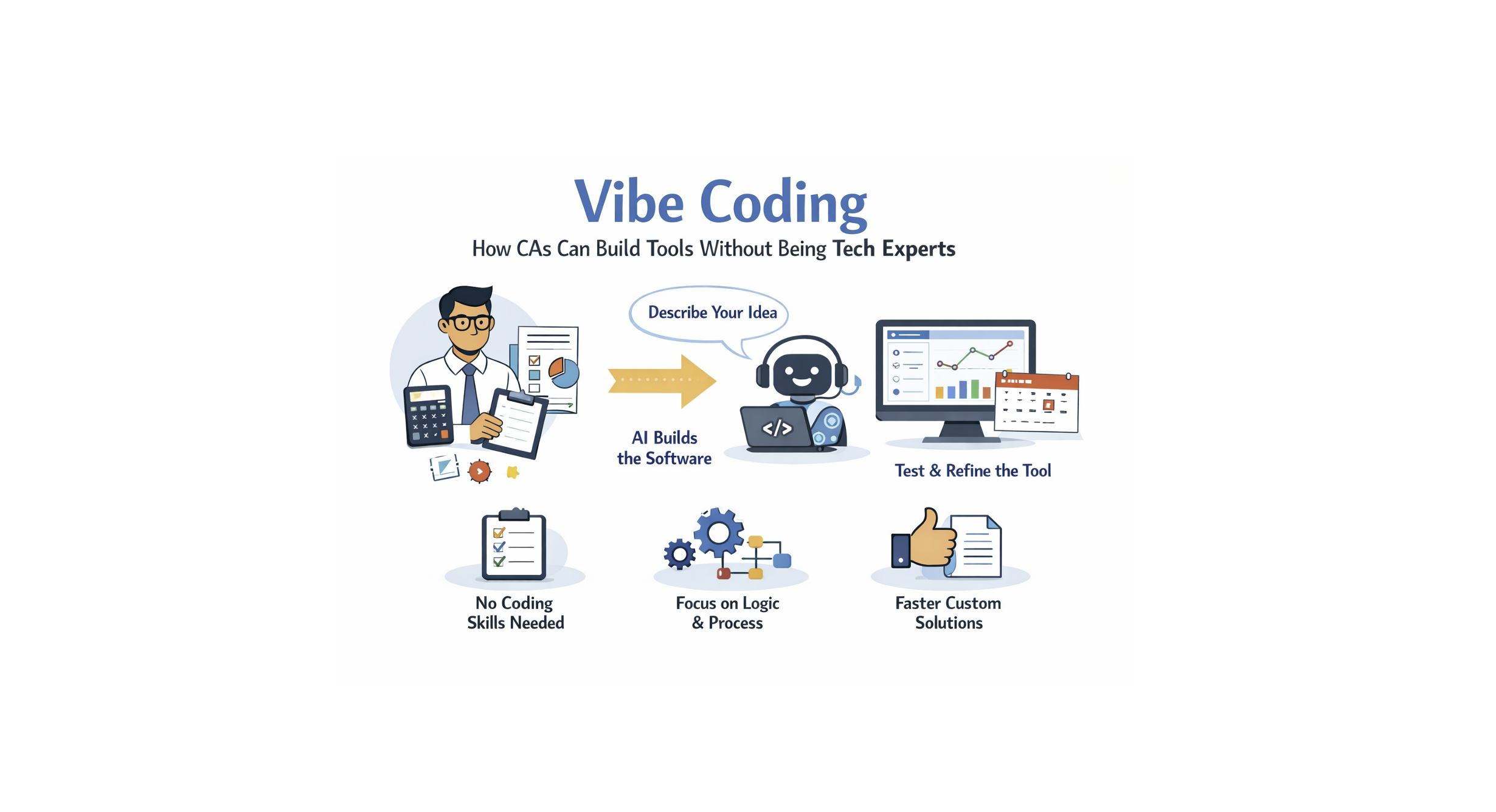
A new approach called vibe coding is changing how software gets built. It allows you to describe what you need in plain English, while AI handles the actual coding.

What is Vibe Coding?

Vibe coding isn’t about cutting corners. It is about shifting your effort from writing syntax to thinking clearly.

Instead of worrying about programming languages, you simply explain the logic. The AI generates the software, you test it, and then refine it. Since CAs are already trained in logic, process flow, and edge cases, this approach fits our skillset perfectly.

You focus on what the system should do, not how the computer speaks.

Why This Matters for Indian Firms

Most firms rely on expensive, rigid software that isn’t always tailored to our specific practice needs. With vibe coding, a CA can quickly build:

  • A simple tracker for GST, TDS, or Advance Tax due dates.

  • An internal audit checklist customized to your firm’s specific methodology.

  • A basic document tracker for client data.

  • Client-facing dashboards without waiting on an IT team.

You do not need to know Python or Java. You just need to know exactly what you want the result to look like

Tools CAs Can Use to Build These Solutions

You do not need a full tech stack or an IT team. Most vibe coded tools are built using simple, low friction platforms combined with AI.

1. ChatGPT or Similar AI Assistants

This is the core engine of vibe coding. You describe the logic, workflows, validations, and edge cases in plain English. The AI generates the code, formulas, or automation steps. You then review and refine it like you would review work from an article assistant.

2. Google Sheets or Excel (with AI help)

For many CA use cases, spreadsheets are more than enough. Using AI, you can build

• GST, TDS, and advance tax trackers

• Due date calendars with alerts

• Audit sampling sheets

• Client wise compliance dashboards

AI can write formulas, conditional formatting, and scripts without you knowing Excel coding.

3. Notion or Airtable

These are excellent for internal firm systems. With AI assistance, CAs can create

• Document trackers

• Internal audit checklists

• Client onboarding workflows

• Status dashboards

They are visual, easy to maintain, and ideal for firms moving away from scattered Excel files.

4. No Code Builders (Bubble, Glide, Softr)

If you want something client facing, these tools work well with AI guidance. You can build

• Simple client portals

• Upload dashboards

• Filing status trackers

AI helps generate logic, workflows, and validation rules while you focus on compliance accuracy.

5. Automation Tools (Zapier, Make)

These tools connect everything together. For example

• Auto reminder emails before due dates

• Moving clients from one status to another

• Creating tasks when documents are uploaded

AI helps you design the automation logic step by step.

6. PDF and Document Tools

Using AI with document tools, CAs can generate

• Automated checklists

• Standardised audit working papers

• Client wise summary reports

This saves hours spent on repetitive documentation.

Practical Tip for CAs

Start small.

Do not aim to replace your main software. Begin with one internal pain point like due date tracking or audit checklists. Build, test, refine, then expand.

Vibe coding works best when compliance logic comes from you and execution is delegated to AI. That balance keeps risk low and efficiency high.

How it Actually Works

Think of it like delegating work to a junior article who types very fast but needs clear instructions.

  1. Explain: You tell the AI, “I want a tool that tracks client due dates and highlights overdue items in red.”

  2. Verify: The AI explains its plan back to you to ensure it understood.

  3. Build & Test: It writes the code. You test it. If a button doesn’t work or a calculation is wrong, you simply say, “Fix the calculation for leap years,” and it corrects it.

Benefits for Clients and Auditees

Clients rarely care how a system is built; they care about clarity. Vibe-coded tools can help you offer:

  • Simpler portals for uploading documents.

  • Automated reminders for filings (so you don’t have to chase them manually).

  • Better transparency on audit status.

A Word of Caution

While this is powerful, do not trust it blindly.

AI makes mistakes. In our profession, a wrong calculation or a missed compliance date has legal consequences. Every tool you build this way must be tested thoroughly. Treat the AI’s output the same way you would treat a draft from a new intern. Review it carefully before relying on it.

The Bottom Line

Vibe coding isn’t about turning CAs into software engineers. It is about solving small firm headaches without heavy IT dependency. Even a small internal tool that saves five hours a month is a win for efficiency.

Ideally, this lets you spend less time wrestling with rigid software and more time on what matters: your expertise and your clients.

Disclaimer:

This article is for general informational purposes only and should not be considered professional advice. Please consult a qualified expert for advice tailored to your specific situation. The author and website owner are not liable for any errors or actions based on this content.

Understanding Tax on ₹12 Lakh Income in India (Tax Year 2025-26)

Understanding Tax on ₹12 Lakh Income in India (Tax Year 2025-26)

Income tax can be confusing, especially when new rules come into play. Budget 2025 brought one of the biggest changes in personal income tax in recent years. If you earn ₹12 lakh a year, here’s what you need to know about your tax liability under the Income Tax Act 2025.

What’s Changed in 2025

The government revised the income tax structure effective for financial year 2025-26 (assessment year 2026-27). A key feature is the higher rebate and adjusted slab rates to boost disposable income for individuals. 

How Tax Works on ₹12 Lakh

Under the new tax regime:

  • Income upto ₹12 lakh is eligible for a full tax rebate under Section 87A, which essentially reduces your tax liability to zero. 

  • This means a person earning ₹12 lakh in a year does not pay any income tax if they choose the new tax regime. 

Here’s the idea:

  • The slabs start at zero tax for the first part of income.

  • Even though regular slabs would tax portions of income above ₹4 lakh, the rebate cancels the tax completely up to ₹12 lakh. 

This change is a major relief for middle-income earners and increases take-home salary. 

What Salary Earners Should Know

If you’re a salaried employee:

  • You receive a standard deduction (around ₹75,000) before calculating taxable income. 

  • After standard deduction, your taxable income might effectively fall below ₹12 lakh even if your gross salary is slightly above that.

  • In practice, many salaried individuals earning up to ~₹12.75 lakh also pay zero tax because of this deduction plus the rebate. 

Choosing Between Old and New Regime

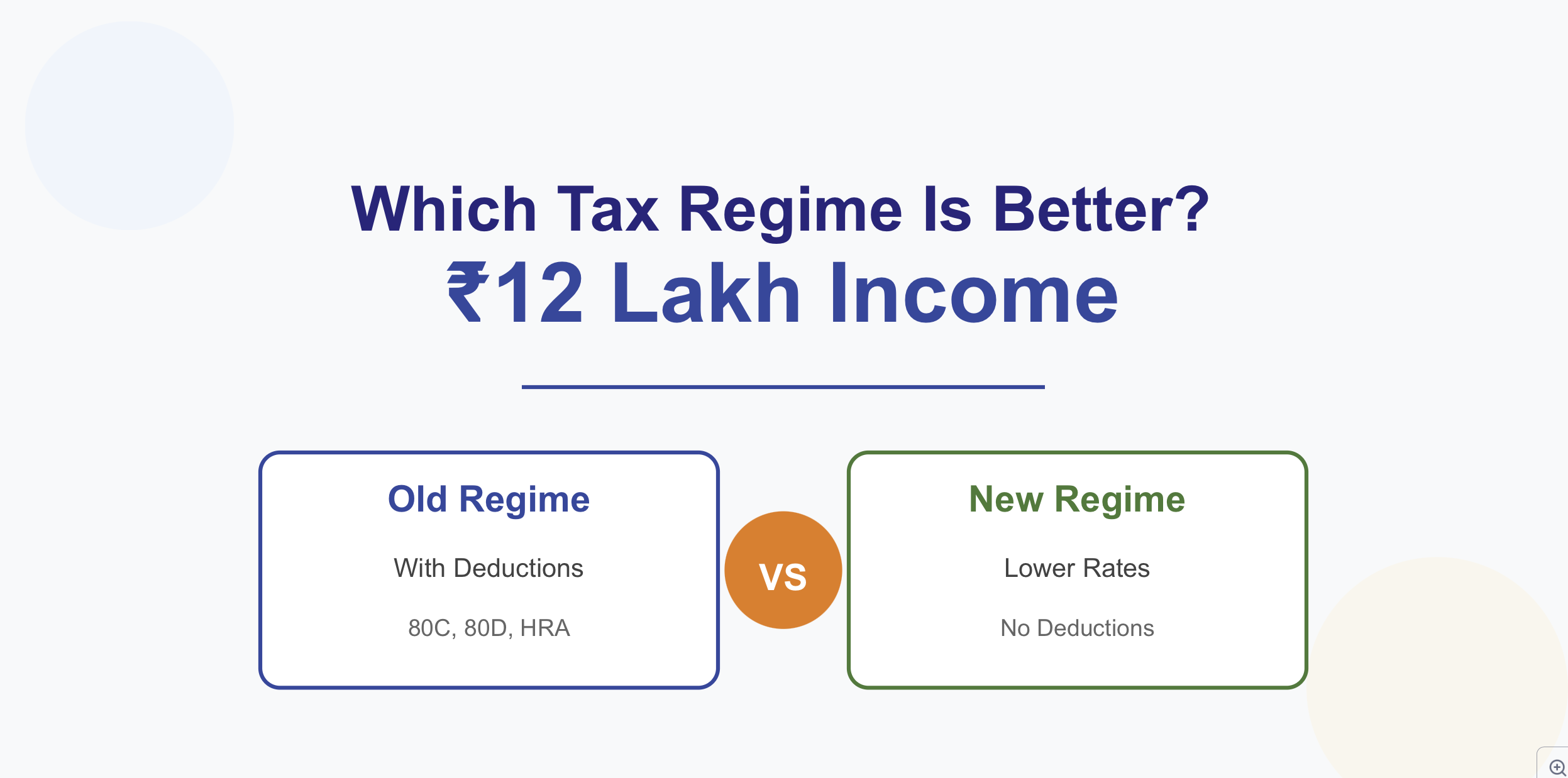
You can choose between the old tax regime (with exemptions and deductions like 80C, HRA, 80D) and the new simplified regime. For someone at ₹12 lakh:

  • Under the old regime, you will have tax liability after standard slabs and only enjoy exemptions you claim.

  • Under the new regime, the tax rebate wipes out tax up to ₹12 lakh, making it generally more beneficial for many people without heavy deductions. 

Example in Simple Terms

Imagine your gross salary is ₹12 lakh:

  1. You get standard deduction (₹75,000 for a salaried person).

  2. Your taxable income becomes ₹11,25,000.

  3. Section 87A rebate cancels your tax liability on that amount under the new regime.

  4. Final tax payable is zero.

This drastically increases your monthly take-home pay compared to previous years.

Comparison Chart: Old vs New Tax Regime on ₹12 Lakh Income

Particulars

Old Tax Regime

New Tax Regime (2025)

Gross Annual Income

₹12,00,000

₹12,00,000

Standard Deduction

₹50,000

₹75,000

Income After Standard Deduction

₹11,50,000

₹11,25,000

Other Deductions (80C, 80D, HRA etc.)

Assumed ₹1,50,000

Not Applicable

Taxable Income

₹10,00,000

₹11,25,000

Tax Before Rebate

₹1,12,500 approx

₹56,250 approx

Section 87A Rebate

Not Available

Available up to ₹12 lakh

Final Tax Payable

₹1,12,500 + cess

₹0

Best Suited For

People with high deductions

Most salaried individuals


Tax Calculator Example: New Tax Regime (₹12 Lakh)

Step 1: Gross Income

₹12,00,000

Step 2: Standard Deduction (Salaried)

₹75,000

Step 3: Taxable Income

₹12,00,000 − ₹75,000 = ₹11,25,000

Step 4: Tax as per slabs

Tax calculated as per new slab rates

Step 5: Section 87A Rebate

Since taxable income is below ₹12,00,000, entire tax is rebated

Final Tax Payable

₹0


Tax Calculator Example: Old Tax Regime (₹12 Lakh)

Assumptions

  • Standard deduction: ₹50,000

  • 80C deduction: ₹1,50,000

Taxable Income

₹12,00,000 − ₹50,000 − ₹1,50,000 = ₹10,00,000

Tax Calculation

  • Up to ₹2.5 lakh: Nil

  • ₹2.5 lakh to ₹5 lakh: 5% = ₹12,500

  • ₹5 lakh to ₹10 lakh: 20% = ₹1,00,000

Total Tax

₹1,12,500

Plus 4% cess = ₹4,500

Final Tax Payable

₹1,17,000 approx


Key Takeaways

  • Under the new tax regime, income up to ₹12 lakh is completely tax free due to Section 87A rebate.

  • Salaried employees can effectively earn up to ₹12.75 lakh with zero tax because of the higher standard deduction.

  • The old regime only benefits those with large deductions like home loan interest or major investments.

  • For most individuals earning ₹12 lakh, the new tax regime is clearly more beneficial.


Final Thoughts

The 2025 tax changes are designed to benefit middle-class taxpayers by reducing or eliminating tax on incomes up to ₹12 lakh. For many people with this income level, the best option is the new tax regime with the rebate, especially if you don’t have large deductions to claim. 

Always consider using a tax calculator or consulting a tax professional to determine what’s best for your individual financial situation.

Section 80IA: Deduction for Infrastructure and Power Undertakings (Status for Tax Year 2026-27)

Last updated: 23 July 2026 · Written and reviewed by CA Meet Dhrangadhariya, CSM & Co LLP

Quick summary

  • Section 80IA gave a 100% profit-linked deduction for 10 years to undertakings in infrastructure, power, telecom and industrial parks.
  • It is now a closed window: infrastructure and power undertakings had to start before 01/04/2017, and the other categories ended earlier.
  • Undertakings already claiming it can continue for their remaining years under section 138 of the Income-tax Act, 2025, calculated as under section 80-IA.
  • It is not available if you are in the new tax regime or pay tax at the 22% or 15% company rates. The audit report is Form 10CCB, and Form 32 from 01/04/2026.

Section 80IA of the 1961 Act gave a 100% deduction of profits for 10 years to undertakings in infrastructure, telecom, industrial parks, and power. It was designed to attract private money into these sectors. The start dates in the section have long passed, so today it matters only for undertakings that started earlier and are still within their 10 year claim.

What changes from Tax Year 2026-27?

The Income-tax Act, 2025 does not re-write section 80-IA. Section 138 simply says that where an assessee is eligible to claim the deduction for a tax year “as if the said Act had not been repealed”, the deduction is allowed, calculated as under section 80-IA and only for the years section 80-IA would have allowed. For FY 2025-26 (assessment year 2026-27) the claim is still made under section 80-IA of the 1961 Act.

Which businesses qualified, and when did they have to start?

Business Had to start Deduction
Infrastructure facility (road, toll road, bridge, rail system, highway project, water supply, irrigation, sanitation, sewerage, solid waste, port, airport, inland waterway) Operation and maintenance on or after 01/04/1995 and before 01/04/2017 100% of profits for 10 consecutive years
Telecom services (basic, cellular, radio paging, satellite, trunking, broadband, internet) 01/04/1995 to 31/03/2005 100% for the first 5 years and 30% for the next 5
Industrial park or SEZ notified by the Central Government 01/04/1997 to 31/03/2006 (industrial parks to 31/03/2011) 100% for 10 consecutive years
Power generation, or generation and distribution 01/04/1993 to 31/03/2017 100% for 10 consecutive years
New transmission or distribution network 01/04/1999 to 31/03/2017 100% for 10 consecutive years, on profits from the new lines only
Substantial renovation and modernisation of an existing network (at least 50% increase in plant and machinery) 01/04/2004 to 31/03/2017 100% for 10 consecutive years
Revival of a power generating plant by a notified Indian company formed before 30/11/2005 Begins generating, transmitting or distributing before 31/03/2011 100% for 10 consecutive years

Which 10 years?

The assessee can choose any 10 consecutive years out of the first 15 years, counted from the year the undertaking starts. For infrastructure facilities that are roads, bridges, rail systems, highway projects, or water supply, irrigation, sanitation, sewerage and solid waste projects, the window is 20 years. Ports, airports and inland waterways keep the 15 year window.

Because of the start-date cut offs, the last possible year of a claim is, at the latest, FY 2035-36 for the 20 year infrastructure category and FY 2030-31 for other infrastructure and power generation. Telecom, SEZ, industrial park and power plant revival claims have run out.

Conditions

  • Infrastructure: the enterprise must be owned by a company registered in India, a consortium of such companies, or a body set up under a Central or State Act. It must have an agreement with the Central or State Government, a local authority or a statutory body to develop, or operate and maintain, a new facility.
  • Telecom and power: the undertaking must not be formed by splitting up or reconstructing an existing business, and must not be formed by transferring used plant or machinery to the new business. Used machinery up to 20% of the total value of machinery does not count against this.
  • Profits: for working out the deduction, the eligible business is treated as the only source of income of the assessee in its first year and in each later year. The deduction cannot exceed the profits of the eligible business.
  • Audit: the accounts of the undertaking must be audited and the audit report furnished in the prescribed form. That is Form 10CCB up to FY 2025-26, and Form 32 (Rule 66) under the Income-tax Rules, 2026 from 01/04/2026.

Which tax regime?

  • An individual, HUF, AOP, BOI or artificial juridical person can claim it only in the old regime. The new regime (section 202 of the 2025 Act) removes it.
  • A company can claim it only if it pays tax under the normal provisions. The 22% and 15% regimes (sections 200 and 201 of the 2025 Act) keep only sections 146 and 148 from the deduction chapter.
  • A co-operative society under the concessional rate (section 203) also cannot claim it.

Why not a “Section 80TTB” or “80IA form”?

Some older write-ups tell industrial park developers to follow “Section 80TTB” and to file an “80IA form”. Both are wrong. Section 80TTB is the senior citizen interest deduction, and there is no form called an 80IA form; the audit report is the form named above.

Frequently asked questions

Can a new infrastructure project claim section 80IA today?

No. The section does not apply to an enterprise that starts developing or operating the infrastructure facility on or after 01/04/2017. Power generation and transmission had to start by 31/03/2017 as well.

How long does the deduction last?

100% of eligible profits for any 10 consecutive years out of the first 15 years (20 years for roads, bridges, rail systems, highway projects and water and sanitation projects), counted from the year the undertaking starts.

What happens from Tax Year 2026-27?

Section 138 of the Income-tax Act, 2025 lets an eligible undertaking keep claiming, with the deduction calculated and limited to the years that section 80-IA would have allowed.

Is it available in the new tax regime?

No. The new regime for individuals and others (section 202) and the 22% and 15% company regimes (sections 200 and 201) bar this deduction.

Which audit report is needed?

Form 10CCB up to FY 2025-26, and Form 32 (Rule 66) under the Income-tax Rules, 2026 from 01/04/2026.

Official sources

Disclaimer

This article is for general informational purposes only and should not be considered professional advice. Please consult a qualified expert for advice tailored to your specific situation. The author and website owner are not liable for any errors or actions based on this content.