
Verify Your PAN Name Before You Apply: Free TRACES PAN Verification for Income Tax, TDS, GST, ICEGATE and DSC

Last updated: 03 October 2026 · Reading time: 4 min

Quick summary

  • A name that does not match the PAN database is one of the most common reasons a registration or mapping gets stuck or rejected.
  • The TRACES website offers a free PAN Verification facility for individuals, using only the PAN, date of birth and a captcha.
  • Check it before applying for Income Tax or TDS registration, GST registration, ICEGATE registration or DSC mapping.
  • If the name is not aligned, correct the PAN record first, then proceed with the application.

Most registrations in India are validated against the PAN database. When you apply for Income Tax or TDS registration, GST registration, an ICEGATE account or a Digital Signature Certificate (DSC) mapping, the name you type in the form is compared with the name held against your PAN. If the two do not line up exactly, the application can be rejected, held back or sent for rework, and the delay usually costs more than the registration itself.

The simple fix is to check the PAN record before you apply. The TRACES portal of the Income Tax Department provides a ready tool for exactly this purpose.

The tool at a glance

  • Facility: PAN Verification (Individual) on the TRACES portal
  • Link: traces.tdscpc.gov.in/auth/pan-verification/individual-pan-verification
  • Details asked on the page: PAN, date of birth (or date of incorporation) and the verification code (captcha)
  • Cost: free of charge
  • Note shown by the portal: the date of Aadhaar-PAN linking is displayed where Aadhaar has been linked with the PAN after 1 July 2023

Why a name mismatch causes trouble

A PAN record is the base identity for almost every government registration. Differences that look minor to a person are treated as a mismatch by the system, for example:

  • The middle name is written in full on one document and as an initial on another.
  • The surname and first name are in a different order.
  • A spelling variation, a missing or extra space, or an abbreviation.
  • A name changed after marriage, or after a gazette or court order, that was never updated in the PAN record.

Where you should run this check first

  • Income Tax and TDS registration: the TAN, e-filing and TRACES profiles all depend on the PAN details being correct.
  • GST registration: the legal name of the proprietor or the person is validated against the PAN.
  • ICEGATE registration: required for import and export filings, and the PAN details must be consistent.
  • DSC mapping: the certificate holder’s name must be consistent with the PAN for the DSC to map to the account.

How to use it

  • Step 1. Open the TRACES PAN Verification page using the link above.
  • Step 2. Enter the PAN and the date of birth (for an individual) exactly as per your records.
  • Step 3. Type the verification code shown on the screen and submit.
  • Step 4. Compare what the portal shows with the name on your Aadhaar, bank account and the form you are about to file.
  • Step 5. If anything differs, get the PAN record corrected first. Only then start the registration.

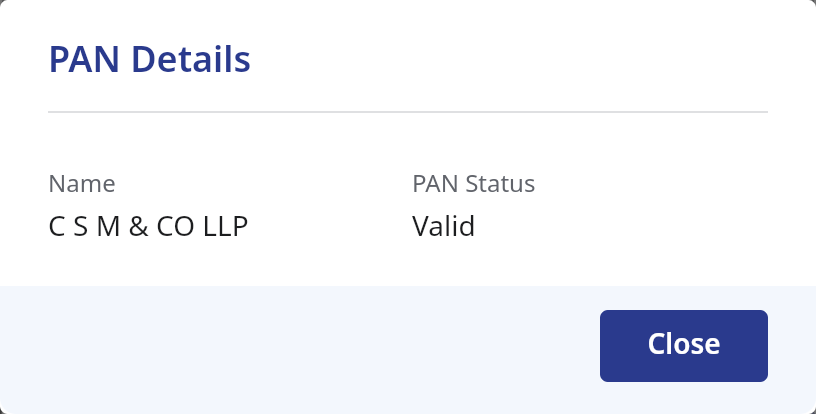
On submitting, the portal shows a “PAN Details” box with the name held against the PAN and the PAN status. Here is the result for our own firm’s PAN:
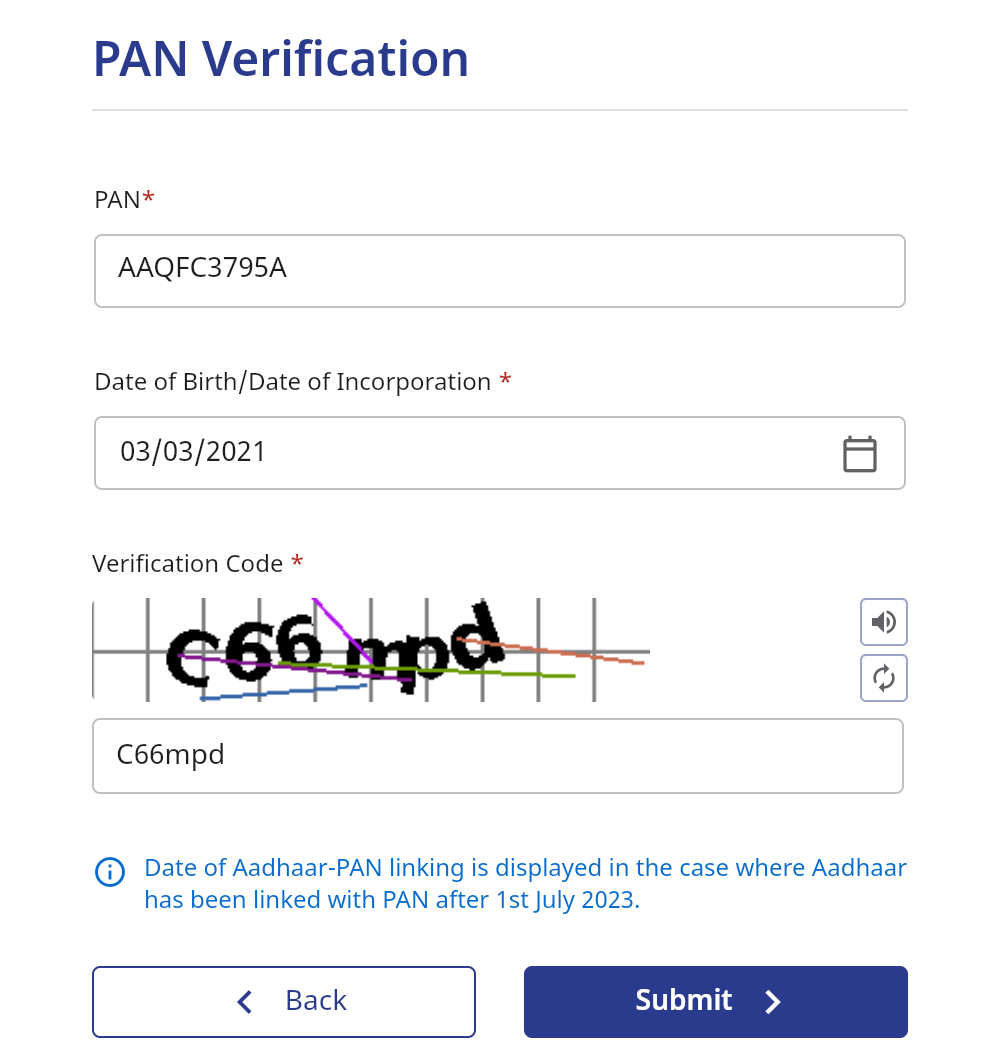
TRACES PAN Verification form filled with PAN, date of birth and verification code
Step 1: enter the PAN, the date of birth or incorporation, and the verification code, then click Submit.
TRACES PAN Details popup showing the name as C S M & CO LLP and PAN status as Valid
Step 2: the PAN Details box shows the name and PAN status as held in the database.

Notice how the database spells the name: C S M & CO LLP, with spaces between the letters and “CO” in capitals. This is exactly the kind of difference, compared with how we normally write “CSM & Co LLP”, that you should be aware of before filling a registration form.

Practical tips

  • Use the date of birth exactly as recorded for the PAN, not as written on some other document.
  • Keep the name identical across the PAN, the application form and the supporting documents.
  • Do this check for each person involved, such as directors, partners and authorised signatories, when the registration is for a firm or company.
  • Never share your PAN details or OTPs with anyone claiming to verify them for you. Use only the official government website.

Frequently asked questions

Do I need to log in to use this facility?

No. The page asks only for the PAN, date of birth and a captcha, as seen on the portal on 03/10/2026.

Is it only for Income Tax registrations?

No. It is useful before any registration that validates your PAN, including GST, ICEGATE and DSC mapping.

What if the name does not match?

Get the PAN record corrected through the official correction process, and wait for the update before applying for the registration.

Is there a separate check for companies and firms?

The page we reference is the individual PAN verification. For entities, verify the PAN of each individual involved and the entity details on the relevant portal.

How CSM & Co LLP can help

We handle Income Tax and TDS registrations, GST registration, ICEGATE and DSC related work for individuals, firms and companies. We run the PAN check before every application, so that name mismatches are fixed up front rather than after a rejection. Please reach out to our team and we will be happy to assist.

Disclaimer

This article is for general informational purposes only and should not be considered professional advice. Please consult a qualified expert for advice tailored to your specific situation. The author and website owner are not liable for any errors or actions based on this content.

ITR Filing Deadline for AY 2026-27 Extended to 21 November 2026 for Audit Cases

Last updated: 28 September 2026 · Reading time: 5 min

Quick summary

  • ITR filing due date for AY 2026-27 (audit cases) extended from 31 October 2026 to 21 November 2026.
  • Tax audit report specified date extended from 30 September 2026 to 21 October 2026.
  • Applies only to taxpayers whose accounts require audit under the Income-tax Act, 1961.
  • Taxpayers not covered under audit continue to follow their original due dates.

The Central Board of Direct Taxes (CBDT) has, vide Circular No. 7/2026 dated 28 September 2026 (F. No. 225/128/2026/ITA-II), extended the due date for filing Income Tax Returns for Assessment Year 2026-27, for taxpayers covered under clause (a) of Explanation 2 to sub-section (1) of Section 139 of the Income-tax Act, 1961, that is, taxpayers whose accounts are required to be audited.

Correspondingly, the specified date for furnishing the tax audit report for AY 2026-27 has also been extended. This gives audit cases extra time to complete the audit and file the return, but the timeline still needs to be planned carefully so nothing is rushed in the final week.

Notification at a glance

  • Assessment Year: 2026-27
  • Issued by: Central Board of Direct Taxes (CBDT)
  • ITR filing due date: extended from 31 October 2026 to 21 November 2026
  • Tax audit report specified date: extended from 30 September 2026 to 21 October 2026
  • Coverage: persons mentioned at S. No. 2 in the table below Explanation 2 to Section 139(1), that is, taxpayers whose accounts require audit
  • Official circular: Circular No. 7/2026 (PDF), Income Tax Department, Government of India
  • Source announcement: Income Tax India, official post

Revised due dates for AY 2026-27

Compliance Original due date Extended due date
Tax audit report (Section 44AB) 30 September 2026 21 October 2026
ITR filing, audit cases (Section 139(1)) 31 October 2026 21 November 2026

Who this applies to

This extension covers taxpayers whose accounts are required to be audited under the Income-tax Act, 1961, including companies, and individuals, firms and LLPs subject to tax audit under Section 44AB. It does not apply to taxpayers who are not covered under this audit provision, including most salaried individuals and small taxpayers filing ITR-1 or ITR-4; their original due date of 31 July 2026 (or as otherwise notified) remains unchanged.

Employer and taxpayer action checklist

  • Complete the audit first. Use the window up to 21 October 2026 to finish the statutory audit, finalise books, reconciliations and supporting schedules.
  • File the audit report on time. The tax audit report under Section 44AB must be uploaded by 21 October 2026, since the ITR cannot be filed correctly without it.
  • Do not wait till the last date to file the ITR. Once the audit report is filed, file the return at the earliest, rather than waiting until 21 November 2026.
  • Reconcile TDS and GST data in advance. Match Form 26AS, AIS and GSTR data with your books before filing, so the return is not revised later.
  • Keep pending notices and demands in hand. Any outstanding income tax notices should be addressed before filing, not after.

Consequences of missing the extended date

The extension applies only to the compliance dates listed above. If the ITR is still not filed by 21 November 2026 for an audit case, the usual late-filing consequences under the Income-tax Act, 1961 apply, including a late fee under Section 234F, interest under Section 234A on any unpaid tax, and denial of certain deductions and set-off of losses. Filing well ahead of the extended date is the only way to avoid this risk entirely.

Frequently asked questions

Does this extension apply to all taxpayers?

No. It applies only to taxpayers whose accounts require audit under the Income-tax Act, 1961, for AY 2026-27. Non-audit taxpayers must continue to follow their original due date.

Has the due date for non-audit taxpayers also changed?

No. This notification does not change the due date for individuals and entities not covered under the tax audit provisions.

Can the tax audit report be filed after 21 October 2026?

No. 21 October 2026 is now the specified date for furnishing the tax audit report for AY 2026-27. Filing it late attracts penalty under Section 271B, separately from any ITR late-filing consequence.

Should I still pay advance tax or self-assessment tax on time even though the filing date is extended?

Yes. The extension is for the return and audit report filing dates only. Any unpaid tax continues to attract interest under the applicable provisions if not paid before the original timelines.

Could the date be extended further?

CBDT has extended ITR due dates in past years closer to the original deadline as well. CSM & Co LLP will track any further CBDT notification and update clients directly if the date changes again, but it is safer to plan around 21 November 2026 rather than expect another extension.

How CSM & Co LLP can help

At CSM & Co LLP, Chartered Accountants, we handle tax audits, ITR filing and compliance tracking for businesses and professionals across Gujarat. As part of this, we regularly help clients with:

  • Completing the statutory tax audit and filing Form 3CA/3CB-3CD well before the specified date
  • Reconciling TDS credits, GST turnover and books before the return is filed
  • Filing the Income Tax Return accurately for companies, firms, LLPs and individuals subject to audit
  • Tracking CBDT notifications and deadline changes on your behalf, so nothing is missed

Please reach out to our team and we will be happy to assist.

Disclaimer

This article is for general informational purposes only and should not be considered professional advice. Please consult a qualified expert for advice tailored to your specific situation. The author and website owner are not liable for any errors or actions based on this content.
Gratuity: Rules, Formula and Income Tax Exemption (Tax Year 2026-27)

Last updated: 02 October 2026 · Written and reviewed by CA Meet Dhrangadhariya, CSM & Co LLP

Quick summary

  • Gratuity is payable on five years of continuous service (one year for fixed-term employees) at 15 days’ wages for each completed year, worked out as last monthly wages ÷ 26 × 15 × years.
  • The Code on Social Security, 2020 has been in force since 21/11/2025 and now governs gratuity; the ₹20 lakh ceiling is a notified amount, so check it before you rely on it.
  • Under the Income-tax Act, 2025 the exemption is in section 19(1): government employees get it in full, others get the least of the gratuity received, the notified limit (₹20 lakh) and the statutory formula.
  • The gratuity exemption is also available in the new tax regime.

Gratuity is a lump sum an employer pays for long service. Two questions come up every time: how much is payable, and how much of it escapes tax. This post answers both under the Code on Social Security, 2020 and the Income-tax Act, 2025.

Which law governs gratuity now

The Code on Social Security, 2020 repealed the Payment of Gratuity Act, 1972 (section 164(1)). The four labour codes were made effective from 21 November 2025 (PIB press release), and the Ministry of Labour has said gratuity under the Code applies from that date. Notifications made under the old Act, such as the ceiling, are deemed to continue under the corresponding provisions of the Code (section 164(2)(a)). Gratuity is now in sections 53 to 56 of the Code. Older articles that quote the 1972 Act describe the same scheme, but the section numbers have changed.

Eligibility and formula under section 53

  • Five years of continuous service is needed on superannuation, retirement, resignation, death or disablement. The five years are not needed on death or disablement.
  • Fixed-term employees are paid gratuity pro rata and do not need five years. The Ministry of Labour has clarified (FAQs of 16/03/2026) that a fixed-term employee is eligible after rendering one year of service under the contract. This covers employees engaged directly by the employer, not contract labour supplied by a contractor.
  • Rate: 15 days’ wages for every completed year of service or part of a year in excess of six months, on the wages last drawn.
  • Monthly-rated employees: the 15 days’ wages are the monthly wages last drawn ÷ 26 × 15.
  • Ceiling: the Central Government notifies the maximum (section 53(3)). The Ministry of Labour’s FAQs say it is currently ₹20 lakh.
  • Time to pay: within 30 days from the date gratuity becomes payable, with simple interest for delay (section 56(3) and (4)). The employer must work out the amount and give written notice even if you have not applied.
  • Nomination: if the employee dies, gratuity goes to the nominee or heirs.
  • Forfeiture: wholly or partly, only for wilful damage to property, riotous or violent conduct, or an offence involving moral turpitude committed during employment.

Gratuity = Last drawn monthly wages ÷ 26 × 15 × completed years

Example: monthly wages ₹40,000, service 8 years: 40,000 ÷ 26 × 15 × 8 = ₹1,84,615.

Under section 2(88) of the Code, “wages” are basic pay, dearness allowance and retaining allowance, and if the excluded allowances (house rent allowance, conveyance and others) are more than half of total remuneration, the excess is added back to wages. The Ministry of Labour’s FAQs say performance incentives, ESOPs and reimbursements are not wages, and that gratuity and retrenchment compensation are left out of the 50% test. If your pay structure keeps basic pay low, the gratuity base may now be higher than under the old 1972 Act, from 21/11/2025. Ask your employer how the base is worked out.

Is gratuity taxable?

Gratuity is part of salary (section 16(c) of the Income-tax Act, 2025). Section 19(1) then allows these deductions from it, in the order of the Table:

Who receives it Exempt amount
Death-cum-retirement gratuity under the Central Government pension rules or a similar government scheme (serial 3) The entire amount
Retiring gratuity under the defence services pension code (serial 4) The entire amount
Gratuity under the Payment of Gratuity Act, 1972, now the Code (serial 5) The amount received, limited to the amount worked out under section 4(2) and (3) of that Act, which gives the 15/26 formula and the ₹20 lakh ceiling
Any other gratuity on retirement, incapacity before retirement or termination (serial 6) The least of the actual gratuity, the notified amount (₹20 lakh) and half a month’s salary for each completed year

“Salary” for these purposes is basic pay plus dearness allowance, if the terms of employment provide for it. All other allowances and perquisites are left out (section 19(2)(b)).

Employees covered by the gratuity law (serial 5)

The exempt amount is the least of three figures:

  1. the gratuity actually received,
  2. the formula amount: last drawn salary ÷ 26 × 15 × completed years (a part year of more than six months counts as a year), and
  3. ₹20 lakh.

Example: last drawn basic plus DA is ₹1,00,000 a month, service is 19 years and 7 months, so 20 years are counted. Gratuity paid is ₹15,00,000.

  • Formula amount: 1,00,000 ÷ 26 × 15 × 20 = ₹11,53,846
  • Ceiling: ₹20,00,000
  • Received: ₹15,00,000
  • Exempt: ₹11,53,846. Taxable: ₹3,46,154, added to salary income.

Employees not covered (serial 6)

The exempt amount is the least of the gratuity received, ₹20 lakh and half a month’s salary for each completed year of service, where the salary is the average of the ten months before the month of the event (retirement, incapacity or termination). Only completed years count.

Example: average salary of the last ten months is ₹90,000, service is 25 years and 2 months, gratuity received is ₹14,00,000.

  • Half month’s salary: 90,000 × 1/2 × 25 = ₹11,25,000
  • Exempt: ₹11,25,000. Taxable: ₹2,75,000.

Gratuity from more than one employer

For serial 6, if you receive gratuity from more than one employer in a tax year, or received exempt gratuity in earlier years, the total exemption cannot exceed the notified limit reduced by what was already exempted (section 19(2)(a)). Keep a record of gratuity exempted in earlier jobs.

New tax regime

Of the section 19(1) Table, section 202(2) bars only serial number 1 (professional tax) in the new regime. The gratuity entries are not barred, so the gratuity exemption is available in both regimes.

Employer side

  • Contributions to an approved gratuity fund created under an irrevocable trust are deductible (section 29(1)(c)).
  • A provision for gratuity that has become payable during the tax year is deductible (section 29(1)(d)).
  • Gratuity paid during the employee’s lifetime is treated as salary (Schedule XI, Part B, paragraph 5). The income of an approved gratuity fund is itself exempt (Schedule VII).
  • TDS on the taxable part is deducted with other salary under section 392.

Gratuity and pension compared

Point Gratuity Pension
Payment One time, on leaving Monthly, for life
Paid by Employer Employer, a pension fund or the government
Condition Five years of continuous service (one for fixed-term) As per the scheme
Tax Exempt up to the limits above Taxable as salary when received (commuted lump sum has separate rules)

Things to check before you rely on this

  • The Income-tax Act, 2025 still names the Payment of Gratuity Act, 1972 in serial 5 and its section 4(2) and (3). Those sub-sections (15 days’ wages and the ceiling) are now section 53(2) and (3) of the Code, and section 164(2)(a) of the Code carries the old notifications forward, so the exemption works as described. A future amendment of the Income-tax Act may update the wording.
  • The ₹20 lakh ceiling is a notified amount, not a number in the Act. The labour ceiling dates from 29/03/2018 and the income-tax limit from S.O. 1213(E) of 08/03/2019. The Ministry of Labour still calls ₹20 lakh the current ceiling, and we found no newer notification. Check before you advise on a very large gratuity.

Frequently asked questions

Who is eligible for gratuity?

An employee who has completed continuous service of five years, on superannuation, retirement, resignation, death or disablement. Death and disablement do not need five years. A fixed-term employee is eligible after one year of service under the contract, with pro-rata gratuity.

What is the gratuity formula?

Last drawn monthly wages ÷ 26 × 15 × completed years of service. A part year of more than six months counts as a full year.

How much gratuity is tax free?

For a government employee, the whole amount. For an employee covered by the gratuity law, the least of the gratuity received, the amount worked out by the statutory formula and the notified ceiling (₹20 lakh). For others, the least of the gratuity received, the notified ceiling and half a month’s average salary for each completed year.

Is gratuity exempt in the new tax regime?

Yes. Section 202(2) bars section 19(1) serial number 1 (professional tax) in the new regime, but not the gratuity entries at serial numbers 3 to 6.

Is gratuity taxable at all?

Yes, to the extent it exceeds the exempt amount. It is part of salary (section 16), so the excess is taxed at your slab rate and TDS applies.

Can the employer forfeit gratuity?

Only in the cases the law allows: wilful damage to the employer’s property, riotous or violent conduct, or an offence involving moral turpitude committed during employment. Forfeiture can be whole or partial.

Official sources

Related reading

Disclaimer

This article is for general informational purposes only and should not be considered professional advice. Please consult a qualified expert for advice tailored to your specific situation. The author and website owner are not liable for any errors or actions based on this content.
Dearness Allowance (DA): Meaning, Tax Treatment and the 60% Rate from January 2026

Last updated: 13 August 2026 · Written and reviewed by CA Meet Dhrangadhariya, CSM & Co LLP

Quick summary

  • Dearness allowance (DA) is paid on top of basic pay to offset inflation. It is fully taxable as salary.
  • DA counts as “salary” for HRA, gratuity and leave encashment limits only if the terms of employment provide for it.
  • For Central Government employees and pensioners the Cabinet approved a 2% rise from 58% to 60% with effect from 01/01/2026, with arrears for January to March 2026.
  • Arrears of DA taxed in a later year can qualify for relief under section 157 by filing Form 39.

Dearness allowance (DA) is the part of pay that moves with the price level. It is paid by the Central and State Governments, public sector bodies and some private employers, as a percentage of basic pay, so that the real value of pay is not eaten away by inflation. Pensioners receive the same relief as dearness relief (DR).

The current rate for Central Government employees

The Union Cabinet approved an additional 2% DA and DR with effect from 01/01/2026, taking the rate from 58% to 60% of basic pay and pension. Employees and pensioners get arrears for January, February and March 2026 (SCC Online, 20/04/2026). The Centre revises DA twice a year, with effect from 1 January and 1 July, based on the All-India Consumer Price Index for industrial workers. State governments announce their own rates and dates.

For central employees the DA is paid on basic pay: a basic pay of ₹56,100 at 60% gives DA of ₹33,660 a month.

Tax treatment of DA

  • Taxable in full as salary. Under section 16 of the Income-tax Act, 2025, “salary” includes wages, and DA is part of wages. It has no exemption of its own. DR on pension is taxed as pension, which is also salary.
  • Report it as salary. It forms part of the salary shown in your TDS certificate (Form 130) and in the return, and should match your payslip.
  • Arrears. DA revised with retrospective effect is paid as arrears, for example the January to March 2026 arrears above. Taxed in the year of receipt, it can push you into a higher slab. If so, relief under section 157 is available by furnishing Form 39 (see our post on relief for arrears of salary).

Where DA counts as “salary” for other limits

Several limits are worked out on “salary” rather than on pay as a whole. The Act and Rules say that salary includes dearness allowance if the terms of employment so provide, and excludes all other allowances and perquisites:

Use Where
HRA exemption (old regime): 50% or 40% of salary, and rent paid less 10% of salary Rule 279
Gratuity: half a month’s salary for each completed year (employees not covered by the gratuity law) Section 19(2)(b)
Leave encashment: ten months’ average salary Section 19(2)(b)

If your terms of employment do not provide for DA to count, it is left out of these calculations. For a government employee the pay rules usually do count it. Check the appointment letter or the service rules rather than assume.

Example: basic pay ₹60,000 and DA ₹36,000 (60%), HRA received ₹30,000 a month, rent paid ₹35,000 a month, Mumbai, old regime. Salary for HRA is ₹96,000 (the terms of service include DA). The exempt HRA is the least of the HRA received (₹30,000), rent paid less 10% of salary (35,000 - 9,600 = ₹25,400) and 50% of salary (₹48,000), so ₹25,400 a month.

DA and HRA are different

Point Dearness allowance House rent allowance
Purpose Offsets rising prices Helps with rent
Paid to Government and public sector employees mainly, some private employers Most employers
Tax Fully taxable Exempt in part under the old regime, limited by Rule 279
Based on Basic pay Basic pay (and DA where the terms provide)

DA for pensioners

Pensioners get DR on the pension at the same rate as the Central DA, and the DR is taxed with the pension as salary.

Before you rely on this

  • The Cabinet decision is the source for the 60% rate. Confirm the rate from the Department of Expenditure order that applies to you, and from your State government’s order if you are a State employee.
  • The revision due from 01/07/2026 is expected to be announced later in the year, so the rate shown here may change with retrospective effect and arrears.

Frequently asked questions

What is dearness allowance?

An allowance paid on top of basic pay to compensate for rising prices. It is calculated as a percentage of basic pay and revised from time to time.

Is dearness allowance taxable?

Yes. It is wages, and so part of salary under section 16 of the Income-tax Act, 2025, and is fully taxable in the year it is due or received, subject to the usual deductions.

Is DA part of salary for HRA and gratuity?

Yes, if the terms of employment so provide. Rule 279 (HRA) and section 19(2)(b) (gratuity and leave encashment) both say “salary” includes dearness allowance if the terms of employment so provide, but excludes other allowances and perquisites.

What is the DA rate for Central Government employees now?

60% of basic pay from 01/01/2026, up from 58%, as approved by the Union Cabinet in April 2026. The revision due from 01/07/2026 had not been announced when this was checked on 06/10/2026.

Do private employees get DA?

Not as a rule. Government and public sector employees receive it. Some private employers and wage settlements also pay a dearness allowance or variable DA, and the same tax rules apply.

What is dearness relief?

The equivalent of DA for pensioners. It is paid on pension and is taxable as pension, which is part of salary.

Official sources

Related reading

Disclaimer

This article is for general informational purposes only and should not be considered professional advice. Please consult a qualified expert for advice tailored to your specific situation. The author and website owner are not liable for any errors or actions based on this content.
When No TDS Is Deducted: Form 121 (Old Form 15G and 15H), Exempt Payees and Personal-Purpose Payments under Section 393 (Tax Year 2026-27)

Last updated: 20 September 2026 · Written and reviewed by CA Meet Dhrangadhariya, CSM & Co LLP

Quick summary

  • A resident whose estimated total income for the year will be nil can give the payer a declaration in Form 121 under section 393(6) so that no tax is deducted on interest, dividend, units, rent, insurance commission, life insurance receipts and an accumulated provident fund balance; it replaces Forms 15G and 15H.
  • The declaration does not work for a person other than a resident individual aged 60 or more if the total of the income exceeds the maximum amount not chargeable to tax in the year (note to section 393(6)), and it is invalid without a valid PAN (section 397(2)(f)).
  • The payer gives each declaration a unique identification number, reports it in the quarterly statement whether or not tax was deducted, and must keep the declaration for seven years (Rule 211).
  • Other cases of no deduction include payments to the Government, RBI and certain corporations and mutual funds (section 393(5)), payments by individuals and HUFs for personal purposes to contractors and professionals, dividends of ₹10,000 or less paid to an individual by a non-cash mode, and e-commerce payments of up to ₹5 lakh to individuals and HUFs with a PAN or Aadhaar.

Tax is not deducted at source in every case. Section 393 of the Income-tax Act, 2025 (from 01/04/2026) lists payments and payees where there is no deduction, and lets a person claim receipt without deduction by giving a declaration to the payer. This post explains the declaration in Form 121 and the main no-deduction cases.

The declaration: section 393(6) and Rule 211

A person can receive certain incomes without deduction of tax if he gives the payer a written declaration in duplicate (in the prescribed form) that the tax on his estimated total income of the year in which the income is to be included will be nil.

Who can give it and for which income (section 393(6), Table)

Person Incomes covered
An individual who is a resident Accumulated balance due under section 392(7) (provident fund); insurance commission (Table Sl. No. 1(i)); rent (Table Sl. No. 2(ii)); income from units (4(i)); interest (5(i), (ii) and (iii)); sums under a life insurance policy (8(i)); dividend (7)
Any person who is not a company, a firm or the individual above The same incomes except provident fund balance and dividend: insurance commission, rent, units, interest, life insurance sums

Condition for people other than senior resident individuals

The declaration does not apply to a person (other than a resident individual who is 60 years or more at any time in the tax year) if the aggregate of the incomes of that kind credited, paid or likely to be credited or paid during the year exceeds the maximum amount not chargeable to tax (note to section 393(6)).

How the form works (Rule 211)

  1. The declaration is made in Form 121, electronically (after verification) or in paper form.
  2. The payer gives each declaration a unique identification number for the quarter.
  3. The payer reports the declarations in the quarterly statement (Rule 219) with the number, even if no tax was deducted that quarter.
  4. The authority can ask for the declaration up to seven years from the end of the tax year in which it was received.
  5. The payer delivers the declarations to the prescribed authority by the 7th of the month after the end of each quarter (section 393(7), as substituted by Finance Act 2026). From 01/04/2027 the declaration for units, interest on securities and dividend can also be filed electronically with a depository holding the securities (new clause 393(6)(b)).

PAN is compulsory

A declaration without a valid PAN is invalid, and the payer must deduct tax as if no declaration was given, at the higher rate under section 397(2) (section 397(2)(f) and (g)).

Payments where no tax is deducted (section 393(4) and (5))

Payment No deduction where
Contract payments (Table Sl. No. 6(i)) A goods carriage operator with ten or fewer carriages gives a declaration with PAN and the payer furnishes the particulars; or an individual or HUF pays exclusively for personal purposes
Professional and technical fees (6(iii)) Paid by an individual or HUF exclusively for personal purposes
Dividend (7) To LIC, GIC and its subsidiaries, other insurers, a business trust by an SPV, other notified persons; or to an individual by a mode other than cash if the total is ₹10,000 or less in the year
E-commerce payments (8(v)) To an individual or HUF e-commerce participant, if gross sales or services are up to ₹5 lakh in the year and the participant has given PAN or Aadhaar
Virtual digital asset (8(vi)) Consideration up to ₹50,000 in the year when paid by an individual or HUF with turnover up to ₹1 crore (business) or ₹50 lakh (profession) and no business income; ₹10,000 in other cases
Interest (5(ii), (iii)) Interest credited to banks and certain financial institutions; interest by co-operative societies to members or other societies; interest on deposits (other than time deposits made on or after 01/07/1995) with a banking company; deposits with primary agricultural credit societies; interest on Motor Accidents Claims Tribunal compensation; interest on zero coupon bonds of specified issuers; interest paid by a firm to a partner
Cash payments (393(3) Sl. No. 5) Payments to the Government, banks, post offices, business correspondents and white label ATM operators

No deduction at all from payments to the Government, the Reserve Bank of India, a corporation established by a Central Act that is exempt from income-tax, and a specified mutual fund (interest, dividend and other income), under section 393(5). Tax is also not deducted from interest paid by an Offshore Banking Unit to a non-resident (section 393(8)) or on payments to the NPS Trust (section 393(9)).

Other rules in section 393

  • Tax borne by the payer (section 393(10)): if the payer agrees to bear the tax, the income is grossed up so that the payee receives the net amount agreed.
  • Credit to a suspense account (section 393(11)): treated as credit to the payee, so the TDS duty arises.

Practical points

  1. Get Form 121 early in the year, and renew it each year.
  2. A senior citizen below the exemption limit can use it; other persons must check the maximum amount not chargeable to tax.
  3. Do not give a declaration if your total income will be taxable: the declaration is for nil tax only.
  4. Payers should keep the declaration and its number, and report it every quarter.

How CSM & Co LLP can help

We prepare declarations, review TDS exemptions for employers and payers, and file the TDS statements. Please reach out to our team and we will be happy to assist.

Frequently asked questions

What replaces Form 15G and Form 15H?

Form 121 under Rule 211 of the Income-tax Rules, 2026: the declaration under section 393(6) for receiving certain incomes without deduction of tax. Section 393(6) gives one declaration for the persons listed in the Table, instead of separate Forms 15G and 15H.

Who can give the declaration?

A resident individual, for an accumulated provident fund balance under section 392(7), insurance commission, rent under Table Sl. No. 2(ii), units, interest, life insurance receipts and dividend; and any person who is not a company, a firm or the individual above, for the income in clauses (a) to (f) of the first entry (section 393(6), Table). The declaration states that the tax on the person’s estimated total income of the year will be nil.

When does the declaration not work?

For a person other than a resident individual aged 60 or more at any time during the tax year, the declaration is not available if the aggregate of the income of that kind credited or paid or likely to be credited or paid in the year exceeds the maximum amount not chargeable to tax (note to section 393(6)). A declaration without a valid PAN is invalid, and the payer must then deduct tax under section 397(2) (section 397(2)(f) and (g)).

What must the payer do with the declaration?

Allot a unique identification number to each declaration received in a quarter, report the declarations in the quarterly TDS statement of that quarter (even if no tax was deducted), and keep the declaration so that it can be produced for verification for seven years from the end of the tax year in which it was received (Rule 211(3) to (5)). Section 393(7), as substituted by Finance Act 2026, requires the declarations to be delivered to the prescribed authority by the 7th of the month after the end of each quarter.

Is TDS deducted when an individual pays a contractor or professional for personal use?

No. No tax is deducted on payments to contractors (Table Sl. No. 6(i)) or fees for professional or technical services (Table Sl. No. 6(iii)) when credited or paid by an individual or HUF exclusively for personal purposes of the individual or a member of the HUF (section 393(4), Table Sl. Nos. 8(b) and 9).

Are there other no-deduction cases?

Yes: payments to the Government, the Reserve Bank, a corporation exempt under its Act, and specified mutual funds (section 393(5)); interest on deposits with a banking company other than time deposits made on or after 01/07/1995; interest on deposits with primary agricultural credit societies; interest on a Motor Accidents Claims Tribunal compensation to an individual (or up to ₹50,000 in the year to others); dividend of ₹10,000 or less to an individual paid by a mode other than cash; e-commerce payments to an individual or HUF up to ₹5 lakh of gross sales with PAN or Aadhaar; and VDA consideration up to ₹50,000 (or ₹10,000 in other cases) in the year (section 393(4)).

Official sources

Disclaimer

This article is for general informational purposes only and should not be considered professional advice. Please consult a qualified expert for advice tailored to your specific situation. The author and website owner are not liable for any errors or actions based on this content.
What is Income Tax? Meaning, Rules, Tax Slabs, Types and Tax Guide for Tax Year 2026-27

Last updated: 11 August 2026 · Written and reviewed by CA Meet Dhrangadhariya, CSM & Co LLP

Quick summary

  • Income tax is a direct tax on income, administered by the CBDT. Income up to 31 March 2026 is taxed under the 1961 Act and the Income-tax Act, 2025 applies from 1 April 2026.
  • The new regime is the default: nil tax up to ₹4 lakh, rising in steps to 30% above ₹24 lakh, with a ₹75,000 standard deduction and nil tax up to ₹12 lakh after the rebate.
  • Capital gains, lottery winnings and crypto income are taxed at special rates.
  • Choose the right ITR form, meet the due dates and pay tax through TDS, advance tax and self-assessment tax.

Income tax is the most important direct tax in India. It is charged on the income a person earns in a year, and it is administered by the Central Board of Direct Taxes (CBDT). Income earned up to 31 March 2026 (FY 2025-26, AY 2026-27) is taxed under the Income-tax Act, 1961. From 1 April 2026 a new law, the Income-tax Act, 2025, applies, and income is reported for a “Tax Year” (see our note on the Tax Year). Individuals can choose between the new and the old tax regime.

What is Income Tax?

Income tax is a tax on the income earned by a person in a year. The rate depends on the amount of income, the type of taxpayer and, for individuals, the regime chosen.

Who pays Income Tax?

The person who is liable to pay tax or any other sum under the Act is called the assessee. The Act recognises these kinds of persons:

  1. Individual
  2. Hindu Undivided Family (HUF)
  3. Company
  4. Firm, including a limited liability partnership (LLP)
  5. Association of Persons (AOP) or Body of Individuals (BOI)
  6. Local authority
  7. Artificial juridical person

The Income Tax Act

Under Article 265 of the Constitution, no tax can be levied or collected except under the authority of law. The rules for computing income, deductions, rates, surcharge, cess, due dates and penalties are in the Income-tax Act. After more than six decades of amendments the 1961 Act had become long and hard to follow, so the Income-tax Act, 2025 replaced it from 1 April 2026 with a simpler structure. Section numbers have changed, but most of the rates and rules are carried over.

The five heads of income

Income is computed under five heads: salary, income from house property, profits and gains of business or profession, capital gains, and income from other sources.

Income Tax Slab Rates

Individuals and HUFs are taxed on slab rates. The new regime is the default; an individual may opt for the old regime. Budget 2026 did not change the slab rates.

New tax regime

Total income Rate
Up to ₹4,00,000 Nil
₹4,00,001 to ₹8,00,000 5%
₹8,00,001 to ₹12,00,000 10%
₹12,00,001 to ₹16,00,000 15%
₹16,00,001 to ₹20,00,000 20%
₹20,00,001 to ₹24,00,000 25%
Above ₹24,00,000 30%
  • A standard deduction of ₹75,000 is allowed to salaried taxpayers and pensioners.
  • A rebate of up to ₹60,000 makes the tax nil for a total income up to ₹12 lakh (see rebate under section 87A).

Old tax regime (individuals below 60 years)

Total income Rate
Up to ₹2,50,000 Nil
₹2,50,001 to ₹5,00,000 5%
₹5,00,001 to ₹10,00,000 20%
Above ₹10,00,000 30%

The basic exemption limit is ₹3 lakh for resident senior citizens (60 to 79 years) and ₹5 lakh for resident super senior citizens (80 years and above) in the old regime. The standard deduction is ₹50,000 for salaried taxpayers and pensioners. The old regime allows many deductions and exemptions; the new regime allows very few.

Surcharge and cess

A surcharge is added to the tax of high-income individuals, and health and education cess of 4% is added on the tax plus surcharge. In the new regime the surcharge is capped at 25%.

Special tax rates

Income type Rate
Long-term capital gains on listed equity shares and equity mutual funds (held over 12 months) 12.5% on gains above ₹1.25 lakh in a year
Short-term capital gains on listed equity shares and equity mutual funds 20%
Long-term capital gains on other assets such as property and gold (held over 24 months) 12.5% without indexation
Winnings from lotteries, game shows, online games and betting 30% flat
Income from transfer of virtual digital assets (crypto assets) 30% flat

Debt mutual funds bought after 1 April 2023 and certain similar investments are taxed at your slab rate and not at the rates above.

Deductions

The following popular deductions are mainly available in the old regime:

  • Section 80C: up to ₹1.5 lakh for specified investments and payments.
  • Section 80CCD(1B): an additional ₹50,000 for contributions to the National Pension System.
  • Section 80D: health insurance premium and medical expenses.
  • Section 80E: interest on an education loan.
  • Section 24(b): interest on a home loan.
  • Sections 80TTA and 80TTB: interest on savings accounts, and for senior citizens interest from deposits.

The employer’s contribution to NPS under section 80CCD(2) is allowed in both regimes, up to 10% of salary in the old regime and 14% in the new regime. Under the Income-tax Act, 2025 these deductions carry new section numbers.

Income Tax Return (ITR)

Who need not file a return

  • A person whose total income is within the basic exemption limit (₹4 lakh in the new regime, ₹2.5 lakh in the old regime for those below 60) and who does not fall under the other mandatory filing cases.
  • A resident senior citizen aged 75 or more who has only pension and interest income from the same bank, where the bank deducts tax on the person’s declaration.

ITR forms

  • ITR-1: resident individuals with income up to ₹50 lakh from salary, one house property and other sources, and long-term capital gains under section 112A up to ₹1.25 lakh.
  • ITR-2: individuals and HUFs with capital gains, income above ₹50 lakh or no business income.
  • ITR-3: individuals and HUFs with business or professional income.
  • ITR-4: resident individuals, HUFs and firms (other than LLPs) opting for presumptive taxation, with income up to ₹50 lakh.
  • ITR-5: firms, LLPs, AOPs and BOIs.
  • ITR-6: companies other than those claiming exemption under section 11.
  • ITR-7: trusts and institutions under specified sections.

Documents to keep ready

Form 16, Form 26AS, the Annual Information Statement (AIS) and Taxpayer Information Summary (TIS), bank statements and interest certificates, proof of deductions, and your bank account details.

Due dates

The due dates are fixed each year and can be extended by the CBDT. For AY 2026-27 the usual dates were:

Taxpayer Due date
Individuals and others not requiring audit 31 July 2026
Taxpayers whose accounts require audit 31 October 2026, extended to 21 November 2026
Taxpayers with transfer pricing reports 30 November 2026

For the audit extension see our note on the ITR deadline extension for AY 2026-27. Late filing attracts a fee and interest.

How tax is paid

  • Tax deducted at source (TDS): the payer deducts tax from salary, interest, rent, professional fees and similar payments and deposits it with the government.
  • Advance tax: payable in instalments if the tax liability for the year is ₹10,000 or more: 15% by 15 June, 45% by 15 September, 75% by 15 December and 100% by 15 March. Taxpayers under presumptive taxation pay in one instalment by 15 March.
  • Self-assessment tax: any balance tax paid before filing the return.

Final Word

Income tax rules change often, especially around the move to the Income-tax Act, 2025. Choose the regime that suits you each year, keep your records ready, meet the due dates and take advice from a qualified professional where needed.

Frequently asked questions

What is income tax?

Income tax is a direct tax charged on the income a person earns in a year. In India it is administered by the Central Board of Direct Taxes and levied under the Income-tax Act.

Which tax regime is the default?

The new tax regime is the default. An individual can opt for the old regime, which allows deductions such as section 80C but has higher slab rates.

Is income up to ₹12 lakh really tax free?

In the new regime, a resident individual with total income up to ₹12 lakh pays no tax because of the section 87A rebate of up to ₹60,000. Salaried taxpayers get a further ₹75,000 standard deduction. Special-rate capital gains are not covered by the rebate.

What is the due date for filing an income tax return?

For AY 2026-27 the due date was 31 July 2026 for taxpayers not requiring audit, and 31 October 2026 for audit cases, extended to 21 November 2026. Due dates are fixed each year and can be extended.

Official sources

Related reading

Disclaimer

This article is for general informational purposes only and should not be considered professional advice. Please consult a qualified expert for advice tailored to your specific situation. The author and website owner are not liable for any errors or actions based on this content.
Section 80C of Income Tax Act: 80C Deduction List, Limit and Examples

Last updated: 11 August 2026 · Written and reviewed by CA Meet Dhrangadhariya, CSM & Co LLP

Quick summary

  • Section 80C lets individuals and HUFs deduct up to ₹1,50,000 a year from total income for specified savings and payments, in the old tax regime only.
  • The limit is a combined one: PPF, ELSS, EPF, life insurance, NSC, tax-saver FD, home loan principal, tuition fees and others together cannot exceed ₹1.5 lakh.
  • From Tax Year 2026-27 the provision sits in section 123 of the Income-tax Act, 2025; for FY 2025-26 (AY 2026-27) it is still section 80C of the 1961 Act.
  • NPS gives an extra ₹50,000 under section 80CCD(1B), so the total can reach ₹2 lakh.

How to claim the section 80C deduction

1. Choose eligible investments or payments in your own name
↓
2. Invest or pay before 31 March of the year
↓
3. Keep receipts, statements and premium certificates
↓
4. Declare the investments to your employer so TDS is adjusted
↓
5. Report the total in the deductions schedule of your ITR under the old regime

Section 80C is the most widely used tax-saving deduction. It allows individuals and Hindu undivided families (HUFs) to reduce their total income by up to ₹1,50,000 in a year by investing in, or paying for, specified items such as PPF, ELSS, life insurance, EPF, NSC, tax-saver fixed deposits, home loan principal and children’s tuition fees. It is available only under the old tax regime.

What is section 80C?

Section 80C is a deduction from gross total income, not from the tax itself. If your taxable income falls by ₹1.5 lakh, the tax saved is that amount multiplied by your slab rate (plus cess).

The limit is one combined limit. If you invest ₹60,000 in PPF, ₹50,000 in ELSS and pay ₹60,000 as life insurance premium, the total is ₹1,70,000 but only ₹1,50,000 is allowed.

Section 80C in the Income-tax Act, 2025

The Income-tax Act, 2025 applies from 01/04/2026, that is from Tax Year 2026-27. Income earned up to 31/03/2026 (FY 2025-26, assessment year 2026-27) is still taxed under the 1961 Act, so section 80C continues to apply to the return you file for that year. The deduction is retained in the new Act under section 123, read with Schedule XV, with the same ₹1.5 lakh limit and the same old regime condition.

Item Income-tax Act, 1961 Income-tax Act, 2025
Specified savings and payments Section 80C Section 123 read with Schedule XV
Pension fund contribution to LIC or an insurer Section 80CCC Section 123 read with Schedule XV
Employee’s NPS contribution Section 80CCD(1) Section 124 (within the combined limit)
Additional NPS contribution Section 80CCD(1B) Section 124(3)
Deductions chapter Chapter VI-A Chapter VIII

Section 80C list: what qualifies

  • Life insurance premium (for policies issued after 31/03/2012 the premium must not exceed 10% of the sum assured; 15% for a disabled person or specified diseases)
  • Public Provident Fund (PPF)
  • Employees’ Provident Fund (employee’s own contribution)
  • Equity Linked Savings Scheme (ELSS) mutual funds
  • National Savings Certificate (NSC)
  • Sukanya Samriddhi Yojana (SSY)
  • 5 year tax-saver fixed deposit with a bank or post office
  • Senior Citizens’ Savings Scheme (SCSS)
  • Unit Linked Insurance Plans (ULIPs)
  • Employee’s contribution to NPS under section 80CCD(1)
  • Repayment of home loan principal
  • Stamp duty and registration charges on buying a house
  • Tuition fees for full time education of up to two children in India (not development fees or donations)

A home loan principal or stamp duty deduction is reversed if the house is sold within 5 years of getting possession.

Maximum limit and the extra NPS deduction

Section What it covers Limit Inside the ₹1.5 lakh combined limit?
80C Investments and payments listed above ₹1,50,000 Yes
80CCC Contribution to a pension fund of an insurer ₹1,50,000 Yes
80CCD(1) Employee’s NPS contribution ₹1,50,000 Yes
80CCD(1B) Own contribution to NPS (including Atal Pension Yojana) ₹50,000 No, it is additional

So the largest deduction from these sections together is ₹2,00,000.

Popular 80C options compared

The rates below are the government-notified rates for October to December 2026. They are revised every quarter, so check the current rate before you invest.

Option Return Lock-in Risk
PPF 7.1% a year, interest tax-free 15 years Low
NSC 7.7% a year, interest taxable 5 years Low
Sukanya Samriddhi Yojana 8.2% a year, interest tax-free 21 years from opening (part withdrawal allowed after 18 for education or marriage) Low
SCSS (age 60 or more) 8.2% a year, interest taxable 5 years, extendable by 3 Low
Tax-saver FD Set by the bank, interest taxable 5 years Low
ELSS Market linked, no assured return 3 years High
ULIP Market linked 5 years Medium
EPF Declared yearly by EPFO Until retirement, with conditions Low

Gains on ELSS held more than a year are taxed at 12.5% on the amount above ₹1.25 lakh in a year.

Who can claim section 80C?

Only individuals and HUFs. Companies, firms and LLPs cannot. Some items, such as tuition fees and NPS, are for individuals only.

Example: how 80C saves tax

Mr A has a salary of ₹10,00,000 and other income of ₹1,00,000, and invests ₹1,50,000 in PPF. He is under the old regime.

Particulars With 80C Without 80C
Salary 10,00,000 10,00,000
Less: standard deduction (50,000) (50,000)
Other income 1,00,000 1,00,000
Gross total income 10,50,000 10,50,000
Less: section 80C (1,50,000) -
Taxable income 9,00,000 10,50,000
Tax including 4% cess 96,200 1,32,600

Section 80C saves Mr A ₹36,400. The old regime slabs are unchanged for Tax Year 2026-27.

How to claim section 80C

  1. Invest or pay before 31 March of the financial year.
  2. Keep proofs: deposit receipts, premium certificates, ELSS statements, fee receipts.
  3. Declare the investments to your employer so that less TDS is cut from salary.
  4. Report the total in the deductions schedule of your ITR. Your employer’s Form 16 may already show it.

Old regime or new regime?

The new regime has lower slab rates but does not allow 80C. If your total deductions (80C, 80D, HRA, home loan interest and others) are large, the old regime may still cost less. Work out both before choosing.

Tips to use section 80C well

  • Start early in the year instead of rushing in March.
  • Count what you already pay: EPF, life insurance premium, home loan principal and tuition fees may fill the limit without new investment.
  • Match the product to your goal: ELSS for long term growth, PPF or SSY for safety.
  • Use the extra ₹50,000 for NPS under section 80CCD(1B) if you have used the full ₹1.5 lakh.
  • Make the investment in your own name, unless the rule for that item allows a spouse or child.

Frequently asked questions

What is the maximum deduction under section 80C?

₹1,50,000 in a financial year, as a combined limit for all eligible investments and payments.

Is section 80C available in the new tax regime?

No. It can be claimed only if you opt for the old tax regime.

Who can claim section 80C?

Individuals and Hindu undivided families. Companies, firms and LLPs cannot.

What is the new section number of 80C?

Section 123 of the Income-tax Act, 2025, read with Schedule XV, applies from Tax Year 2026-27.

Can I claim more than ₹1.5 lakh?

Yes, up to ₹50,000 more for NPS contributions under section 80CCD(1B), which is outside the ₹1.5 lakh limit.

Official sources

Related reading

Disclaimer

This article is for general informational purposes only and should not be considered professional advice. Please consult a qualified expert for advice tailored to your specific situation. The author and website owner are not liable for any errors or actions based on this content.
TDS on Payments to Non-Residents and NRIs under Section 393(2): Rates in Force, Property Sale and Surcharge (Tax Year 2026-27)

Last updated: 11 August 2026 · Written and reviewed by CA Meet Dhrangadhariya, CSM & Co LLP

Quick summary

  • Payments to non-residents are covered by section 393(2) of the Income-tax Act, 2025 (old section 195): special rates for sportsmen, certain bonds and funds, and for everything else “rates in force”, which Part II of the First Schedule to the Finance Act 2026 sets: for a non-resident Indian 20% on investment income, 12.5% on long-term capital gains, 20% on short-term gains under section 196, 20% on royalty, fees for technical services and foreign currency interest, 30% on winnings and 30% on other income.
  • For other non-residents (not NRI) the rates are the same except the residual rate is 30% for non-company and 35% for a foreign company, with 10% on dividend referred to in section 207(1) and 20% on other dividend.
  • Where a tax treaty applies and the payee furnishes the residence certificate under section 159(8), the treaty rate applies for units of specified mutual funds and Foreign Institutional Investor income if lower than 20% (Note 2).
  • The tax is increased by surcharge calculated on the income, and a payer who doubts that the whole payment is chargeable can apply to the Assessing Officer in Form 129 to fix the taxable proportion (section 395(2)); a payee can seek a lower deduction certificate in Form 128.

When an Indian payer pays a non-resident a sum that is chargeable to tax in India, tax must be deducted at source. In the Income-tax Act, 2025 (from 01/04/2026) this is section 393(2), which replaces section 195 of the 1961 Act. The table in the section gives special rates for a few payments and says “rates in force” for most; the rate in force is fixed each year by the Finance Act.

How section 393(2) works

  • The payer deducts tax on the amount of the income or sum, at the rate in column E, at the earlier of credit and payment (section 393(2)(a) and (b)).
  • The table covers payments to a non-resident (and, for some items, a foreign company). Item 17, the main one, covers any interest (other than interest in items 2 to 5) or any other sum chargeable under the Act, not being salary, paid to a non-resident other than a company, or to a foreign company, at the rates in force.
  • The obligation applies to all payers, resident or non-resident, whether or not the non-resident payee has a residence, place of business, business connection or other presence in India (Note 3(b) to item 17).
  • Where interest is paid by the Government or a public sector bank or public financial institution (item 17), tax is deducted only at the time of payment (Note 3(a)).

Special rates in the table

Item Payment Rate
1 Income of a non-resident sportsman or entertainer who is not an Indian citizen, or a non-resident sports association or institution (section 211) 20%
2 Interest on foreign currency loans or long-term infrastructure bonds, 01/07/2012 to 30/06/2023, by an Indian company or business trust 5%
3 Interest on rupee denominated bonds issued before 01/07/2023 5%
4 Interest on long-term or rupee denominated bonds listed only on an IFSC exchange 4% (issued 01/04/2020 to 30/06/2023); 9% (issued on or after 01/07/2023)
5 Interest paid by an infrastructure debt fund 5%
6 Distributed income of a business trust to a non-resident unit holder 5% or 10% by type of income
10 and 15 Income from units of specified mutual funds, and income of a Foreign Institutional Investor from securities 20%, or the lower treaty rate where the payee furnishes the residence certificate under section 159(8) (Note 2)
11, 12 Offshore fund: income from units, and long-term capital gains 10%; 12.5%
13, 14 Interest, dividend and long-term capital gains on bonds or Global Depository Receipts 10%; 12.5%
16 Income of a specified fund 10%
17 Any other sum chargeable Rates in force

For interest in items 2 to 4, the deduction applies only on interest up to the amount at the rate approved by the Central Government (Note 1).

“Rates in force” for tax year 2026-27 (Finance Act 2026, First Schedule Part II)

Non-resident Indian (investment income, capital gains and others):

Income Rate
Investment income 20%
Long-term capital gains under section 214 or 197(4), and other long-term capital gains (not those in Schedule II items 14 and 17 relating to old section 10(36)) 12.5%
Long-term capital gains under section 198 above ₹1,25,000 12.5%
Short-term capital gains under section 196 20%
Interest payable by the Government or an Indian concern on money borrowed in foreign currency (other than items 2 to 5) 20%
Royalty or fees for technical services payable by the Government or an Indian concern under approved agreements (and royalty on copyright or software to a resident, as listed) 20%
Winnings from lotteries, games, horse races and net winnings from online games 30%
Dividend referred to in section 207(1) Table Sl. No. 2 10%
Other dividend 20%
Whole of the other income 30%

Other non-residents who are not companies: the same list for royalty, fees, winnings, capital gains and dividends, and 30% on the whole of the other income.

Foreign company: 20% on interest, royalty and fees under the cases above, 30% on winnings, 20% on short-term gains under section 196 and 12.5% on long-term gains, with 35% on the whole of the other income.

Surcharge

The tax deducted is increased by a surcharge on a non-resident individual, HUF, association of persons, body of individuals or artificial juridical person (other than where income is taxed under section 202): 10% where the income subject to deduction exceeds ₹50 lakh and up to ₹1 crore, 15% above ₹1 crore up to ₹2 crore, 25% above ₹2 crore up to ₹5 crore and 37% above ₹5 crore, with the surcharge on dividend income and capital gains under sections 196, 197 and 198 limited to 15%. Companies have their own table in Part II. Check the Schedule for the exact conditions for each class of payee.

Property sold by an NRI

The buyer deducts tax under item 17 at the rate for the type of gain: 12.5% on long-term capital gains and, it appears, the residual 30% rate on short-term gains on property (confirm for the case), plus surcharge. The text of the Act applies the rate to the sum chargeable, so a buyer who deducts on the whole sale price without a certificate may deduct much more than the tax on the actual gain. To avoid this, the payee can apply in Form 128 for a lower deduction certificate (section 395(1)), or the payer can apply in Form 129 for the taxable proportion (section 395(2)). A resident individual or HUF buyer does not need a TAN for this deduction (section 397(1)(c)(iii)).

Treaty relief and documents

The payee who wants a treaty rate must hold a certificate of residence from its government and furnish the information in Form 41 (section 159(8), Rule 75). The payer reports payments to non-residents in Form 145 and, where required, a certificate of an accountant in Form 146 (Rule 220). Deductions on non-residents are reported in Form 144 (quarterly statement; Rule 219).

Practical points

  1. Decide whether the sum is chargeable in India before deciding to deduct; use Form 129 if it is only partly so.
  2. Use the right rate for the payee’s category (NRI, other non-resident or foreign company) and the nature of the payment.
  3. Deposit the tax by the 7th of the next month and file Form 144 on time; the late fee under section 427 applies to late statements.
  4. Obtain the residence certificate and Form 41 before applying a treaty rate.

How CSM & Co LLP can help

We advise on deduction of tax on foreign payments, apply for lower deduction and taxable proportion certificates, and file Forms 144, 145 and 146. Please reach out to our team and we will be happy to assist.

Frequently asked questions

What is the TDS rate on an NRI’s sale of property?

Tax is deducted under section 393(2), Table Sl. No. 17, at the “rates in force”, which Part II of the First Schedule to the Finance Act 2026 sets as 12.5% for long-term capital gains on assets other than those covered by special rules, 20% for short-term capital gains under section 196 (equity shares and equity-oriented fund units on which securities transaction tax is paid), and, for short-term gains on property, it appears the residual “other income” rate of 30% applies (confirm for the case), increased by surcharge where the surcharge conditions are met. A payer or payee can apply for a certificate so that tax is deducted only on the gain.

Does the buyer of an NRI’s property need a TAN?

A resident individual or HUF who must deduct tax on consideration for the transfer of immovable property to a non-resident under section 393(2), Table Sl. No. 17 is exempt from applying for a TAN (section 397(1)(c)(iii)), but the deduction and deposit are still required.

What rate applies to royalty and fees for technical services paid to a foreign company?

For payments by the Government or an Indian concern under approved agreements, 20% where the agreement is made after 31 March 1976 (royalty and fees for technical services). For other foreign company income the residual rate is 35% on the whole of other income. Check the treaty, which can reduce the tax if the payee holds a residence certificate and furnishes the information in Form 41.

What if the whole payment is not income in India?

The payer can apply to the Assessing Officer in the prescribed form (Form 129, Rule 214) to determine the appropriate proportion of the sum chargeable to tax, and tax is deducted only on that proportion (section 395(2)).

Do foreign payers or non-residents also have to deduct tax?

Yes. The obligation to deduct tax under item 17 extends to all persons, resident or non-resident, whether or not the non-resident has a residence, place of business, business connection or other presence in India (section 393(2), Note 3(b)).

Can the payee get a lower rate?

Yes, by applying in Form 128 for a lower or nil deduction certificate (section 395(1), Rule 213). The payer must then deduct at the rate in the certificate for its validity (section 395(1)(c)).

Official sources

Related reading

Disclaimer

This article is for general informational purposes only and should not be considered professional advice. Please consult a qualified expert for advice tailored to your specific situation. The author and website owner are not liable for any errors or actions based on this content.
TDS and TCS Compliance under the Income-tax Act, 2025: TCS Rates, Due Dates, Quarterly Statements, PAN Rule and Late Fee (Tax Year 2026-27)

Last updated: 23 August 2026 · Written and reviewed by CA Meet Dhrangadhariya, CSM & Co LLP

Quick summary

  • Tax collected at source (TCS) is in section 394: 2% on liquor, tendu leaves, timber and forest produce, scrap, coal, lignite and iron ore, overseas tour packages and parking lots, toll plazas and mines, 1% on motor vehicles above ₹10 lakh, and on Liberalised Remittance Scheme remittances above ₹10 lakh 2% for education or medical treatment and 20% for other purposes (Finance Act 2026 cut several rates).
  • TDS and TCS must be deposited by the 7th of the next month (30th April for March, 30 days for property, rent of a non-specified person, contract and professional payments by individuals and VDA purchases through Form 141); quarterly statements go in Forms 138, 140, 143 and 144 by 31 July, 31 October, 31 January and 31 May.
  • A payee who does not give a valid PAN suffers deduction at the higher of the normal rate, rates in force, 5% (for goods and e-commerce) or 20%, and TCS at twice the rate or 5%, up to 20% (section 397(2)).
  • A late statement costs ₹200 a day, up to the tax deductible, payable before filing (section 427); certificates are issued under section 395(4) and lower-deduction certificates under section 395(1) on Form 128.

This post covers the other half of Chapter XIX-B: tax collected at source (TCS) in section 394, and the compliance for both TDS and TCS in sections 395 to 397, with the Rules that fix the due dates.

TCS rates (section 394(1))

Item Receipt Collected by Rate
1 Sale of alcoholic liquor for human consumption Seller 2% (was 1%)
2 Sale of tendu leaves Seller 2% (was 5%)
3 Sale of timber, or forest produce (other than tendu leaves) obtained under a forest lease Seller 2%
4 Sale of scrap Seller 2% (was 1%)
5 Sale of coal, lignite or iron ore Seller 2% (was 1%)
6 Sale consideration above ₹10 lakh for a motor vehicle or other goods notified by the Central Government Seller 1%
7 Liberalised Remittance Scheme remittance of ₹10 lakh or more in aggregate Authorised dealer 2% for education or medical treatment (was 5%); 20% for other purposes
8 Sale of an overseas tour programme package (including travel, hotel and related expenses) Seller 2% (earlier 5% up to ₹10 lakh and 20% above)
9 Use of a parking lot, toll plaza, mine or quarry for business (not mineral oil) Licensor or lessor 2%

The “was” figures are from the footnotes to section 394 as substituted by Finance Act 2026 from 01/04/2026.

Time and exceptions. TCS is collected at the earlier of debit to the buyer’s account and receipt of the amount (section 394(1)(c)). A resident buyer who declares that goods under items 1 to 5 are for manufacturing, processing, producing articles or generating power, and not for trading, is not charged TCS, and the seller sends a copy of the declaration to the Commissioner by the 7th of the following month (section 394(2) and (3)). The authorised dealer does not collect TCS on LRS where the overseas tour package TCS was collected by the seller, or the remittance is an education loan from a notified financial institution, or the buyer has already had tax deducted at source (section 394(4) and (5)).

Payment to the government (Rule 218)

Case Due date
Government office, without a challan Same day
Government office, with a challan Within seven days from the end of the month
Other deductors and collectors, tax deducted or collected in March 30th April
Other deductors and collectors, any other month 7th of the next month
Rent under Table Sl. No. 2(i), property transfer (3(i)), contract, professional fees and commission by an individual or HUF not a specified person (6(ii)), virtual digital asset purchases (8(vi)) Within thirty days from the end of the month, with the challan-cum-statement in Form 141
Quarterly payment in special cases approved by the Assessing Officer 7 July, 7 October, 7 January, 30 April

(Rule 218(1) to (4).)

Quarterly statements (section 397(3)(b), Rule 219)

Form Used for
138 Salary under section 392 (other than section 392(7)), and income of a specified senior citizen under Table Sl. No. 8(iii)
140 Section 392(7), section 393(1) (other than 8(iii)) and 393(3), for deductees other than those in Form 144
144 Sections 392(7), 393(2) and 393(3) for a deductee who is a non-resident (not being a company or foreign company) or a resident but not ordinarily resident
143 Section 394(1) (TCS)
142 Exchange’s statement on virtual digital asset transactions, where it pays the tax instead of the buyer

Due dates (Rule 219(4)): 31 July (quarter ending 30 June), 31 October (30 September), 31 January (31 December) and 31 May of the following financial year (31 March). A refund claim by the deductor is made in Form 139 (Rule 219(6)).

TAN and PAN rules (section 397(1) and (2))

  • Every deductor and collector must apply for a TAN (Forms 134 and 135) unless exempt, and quote it in challans, statements and certificates. TAN is not required for rent under Table Sl. No. 2(i), property transfer under 3(i), the ₹50 lakh individual and HUF payments under 6(ii), and certain other cases (section 397(1)(c)).
  • The payee must furnish a valid PAN. If not, tax is deducted at the higher of the rate in the provision, the rate in force, or 5% (goods purchase and e-commerce operator) or 20% (any other case); TCS is collected at the higher of twice the rate or 5%, not exceeding 20% (section 397(2)(b)).
  • A declaration under section 393(6) or 394(2) without a valid PAN is invalid, and a certificate application without PAN is refused (section 397(2)(f)).
  • The 20% rule does not apply to a non-resident (not a company) for interest on long-term bonds in section 393(2) Table Sl. Nos. 2 to 4, and TCS at the higher rate does not apply to a non-resident without a permanent establishment in India (section 397(2)(c) and (d)).

Certificates and lower deduction (section 395)

  • TDS and TCS certificates (section 395(4), Rule 215): Form 130 for salary, Forms 131 and 132 for other deduction, Form 133 for TCS.
  • Lower or nil deduction: the payee applies in Form 128 (Rule 213); the Assessing Officer or the prescribed authority issues a certificate valid for the period shown, and the payer then deducts at the rate in the certificate or not at all (section 395(1) and (6)).
  • Lower collection: a buyer, licensee or lessee can apply for a certificate for TCS at a lower rate (section 395(3)).
  • Non-resident payments: the payer can apply to the Assessing Officer to decide the proportion of the sum chargeable to tax under section 393(2) Table Sl. No. 17 (section 395(2), Form 129 under Rule 214).

Late fee and other consequences

  • Fee for a late statement: ₹200 for every day of delay, not more than the tax deductible or collectible, paid before the statement is delivered (section 427(1) and (2)). It replaces section 234E.
  • Correction statement: within two years from the end of the tax year in which the statement is required to be furnished (section 397(3)(f)).
  • Penalty: failure to deduct or pay: equal to the tax (section 448); failure to collect: equal to the tax (section 449). The deductor can be treated as an assessee in default (section 391(3)).
  • Credit to the payee: tax deducted is treated as income received by the payee, and credit follows the deductor’s statement (sections 390(5) and 396).

How CSM & Co LLP can help

We prepare TDS and TCS returns, deposits, certificates and corrections, and handle notices on defaults. Please reach out to our team and we will be happy to assist.

Frequently asked questions

What are the TCS rates for 2026-27?

Under section 394(1): 2% on sale of alcoholic liquor for human consumption, tendu leaves, timber and forest produce, scrap, coal, lignite or iron ore, overseas tour programme packages, and use of parking lot, toll plaza, mine or quarry; 1% on sale of a motor vehicle or other notified goods for more than ₹10 lakh; and on Liberalised Remittance Scheme remittances above ₹10 lakh through an authorised dealer, 2% for education or medical treatment and 20% for other purposes. Finance Act 2026 reduced liquor, tendu leaves, scrap, coal and ore (earlier 1% or 5%), the LRS education or medical rate (earlier 5%) and the overseas tour package rate (earlier 5% up to ₹10 lakh and 20% above).

When must TDS and TCS be deposited?

By the 7th of the month following the month of deduction or collection; for amounts deducted or collected in March, by 30th April (Rule 218(2)). For rent under Table Sl. No. 2(i), property transfer, contract and professional payments by an individual or HUF who is not a specified person, and virtual digital asset purchases, within thirty days from the end of the month, with the challan-cum-statement in Form 141 (Rule 218(3)). Government offices deposit on the same day without a challan or by the 7th with a challan (Rule 218(1)).

What are the due dates for the quarterly statements?

For the quarters ending 30 June, 30 September and 31 December, by 31 July, 31 October and 31 January; for the quarter ending 31 March, by 31 May of the following financial year (Rule 219(4)). Form 138 is for salary and senior citizen tax, Form 140 for payments other than salary to residents (and certain others), Form 144 for non-residents (other than companies) and residents not ordinarily resident, and Form 143 for TCS (Rule 219(1)).

What if the payee does not give a PAN?

Tax is deducted at the higher of the rate in the relevant provision, the rate in force, or 5% (goods purchase and e-commerce) or 20% in any other case; TCS is collected at the higher of twice the rate or 5%, not exceeding 20% (section 397(2)(b)). A declaration without a valid PAN becomes invalid (section 397(2)(f)). Non-resident exceptions are in section 397(2)(c) and (d).

What is the fee for a late TDS statement?

₹200 for every day of delay, not exceeding the tax deductible or collectible, and it must be paid before the statement is delivered (section 427(1) and (2)). A correction statement can be filed within two years from the end of the tax year in which the original statement was due (section 397(3)(f)).

Who issues TDS certificates and when can the rate be lowered?

Every deductor and collector issues a certificate of the tax deducted or collected, rate and other particulars, within the prescribed period (section 395(4)); the forms are 130 to 133 (Rule 215). A payee can apply for a lower or nil deduction certificate in Form 128 (section 395(1) and Rule 213), and a buyer can apply for lower TCS (section 395(3)).

Official sources

Disclaimer

This article is for general informational purposes only and should not be considered professional advice. Please consult a qualified expert for advice tailored to your specific situation. The author and website owner are not liable for any errors or actions based on this content.
TDS Rate Chart under Section 393 of the Income-tax Act, 2025: Rates and Thresholds for Payments to Residents (Tax Year 2026-27)

Last updated: 02 September 2026 · Written and reviewed by CA Meet Dhrangadhariya, CSM & Co LLP

Quick summary

  • From 01/04/2026 all tax deduction at source on payments to residents is in the table in section 393(1) of the Income-tax Act, 2025: 1% or 2% for contractors, 2% or 10% for rent, 1% on property of ₹50 lakh or more, 10% for professional fees and 2% for technical services, 10% on dividend, 0.1% on goods bought above ₹50 lakh, 1% on virtual digital assets and 10% on benefits or perquisites above ₹20,000.
  • Where the table says “rates in force” (interest, lottery and game winnings, insurance commission, interest on securities), the rate comes from Part II of the First Schedule to the Finance Act 2026: 10% for interest, 30% for winnings, and 2% for insurance commission.
  • Salary is covered separately in section 392 at the average rate on estimated income; the old section letters (194C, 194J and so on) no longer exist in the Act.
  • The payer must deduct at the earlier of credit and payment, and tax is deducted on the whole amount once the threshold is crossed (section 393(1)(a) to (c)).

Tax Deducted at Source (TDS) is tax that the payer deducts when paying certain income. In the Income-tax Act, 2025 (from 01/04/2026), the sections 192 to 206AA of the old Act are gathered in Chapter XIX-B. Section 392 covers salary, and section 393(1) has one table for payments to residents. This post gives that table, with the old section numbers for reference.

How deduction works (section 393(1))

  • The payer deducts tax on the entire amount once the amount (or the total of amounts) exceeds the threshold in column D, at the rate in column D (section 393(1)(a) and (b)).
  • Tax is deducted at the earlier of the credit of the sum to the payee’s account and payment by cash, cheque, draft or any other mode (section 393(1)(c)).
  • The table is subject to the no-deduction rules, declarations and other provisions in sub-sections (4), (5), (6), (8) and (9).
  • A “specified person” is any person other than an individual or HUF, or an individual or HUF whose turnover exceeded ₹1 crore in business or ₹50 lakh in profession in the preceding tax year (section 2(37)).

The table for payments to residents

Table item Payment Old section Rate Threshold
1(i) Insurance commission 194D Rates in force (2% for a resident other than a company, per the Finance Act) ₹20,000
1(ii) Commission or brokerage (other than insurance) by a specified person 194H 2% ₹20,000
2(i) Rent by a person who is not a specified person 194-IB 2% ₹50,000 for a month or part of a month
2(ii) Rent by a specified person 194-I 2% for machinery, plant or equipment; 10% for land, building, furniture or fittings ₹50,000 for a month or part of a month
3(i) Consideration for transfer of immovable property (other than agricultural land) 194-IA 1% of the higher of consideration or stamp duty value ₹50 lakh (on consideration or stamp duty value)
3(ii) Consideration (not in kind) under a joint development agreement under section 67(14) 194-IC 10% Nil
3(iii) Compensation or consideration for compulsory acquisition of immovable property (other than agricultural land) 194LA 10% ₹5,00,000
4(i) Income in respect of units of specified mutual funds and the specified undertaking or company 194K 10% ₹10,000
4(ii) to (iv) Business trust, investment fund and securitisation trust income to unitholders and investors 194LBA, 194LBB, 194LBC 10% Nil
5(i) Interest on securities 193 Rates in force (10%) ₹10,000
5(ii) Interest (other than on securities) by a bank, co-operative bank or post office 194A Rates in force (10%) ₹1,00,000 for a senior citizen; ₹50,000 for others
5(iii) Interest (other than on securities) by other specified persons 194A Rates in force (10%) ₹10,000
6(i) Contract work, including supply of labour, by a designated person 194C 1% (individual or HUF contractor); 2% (others) ₹30,000 per sum; ₹1,00,000 in aggregate
6(ii) Contract work, professional fees, commission or brokerage by an individual or HUF who is not a specified person 194M 2% ₹50 lakh
6(iii) Fees for professional services, technical services, director’s remuneration not taxed as salary, royalty and certain other sums by a specified person 194J 10%; 2% for technical services (not professional), film royalty and call centres ₹50,000 (nil for director fees)
7 Dividend declared by a domestic company 194 10% Nil
8(i) Sum under a life insurance policy (including bonus) not exempt 194DA 2% of the income in the sum ₹1,00,000
8(ii) Purchase of goods by a buyer, on the sum exceeding ₹50 lakh 194Q 0.1% As per Note 1 (₹50 lakh)
8(iii) Total income of a specified senior citizen (75 or more with pension and interest from the same bank) by a specified bank 194P Rates in force As applicable
8(iv) Benefit or perquisite from business or profession of a resident, by a specified person 194R 10% of the value ₹20,000
8(v) Sale of goods or services by an e-commerce participant, by an e-commerce operator 194O 0.1% of the gross amount Nil
8(vi) Consideration for transfer of a virtual digital asset 194S 1% Nil

Other payments to any person (section 393(3))

Table item Payment Old section Rate Threshold
1 Winnings from a lottery, crossword puzzle, card game, gambling or betting 194B Rates in force (30%) ₹10,000 in a single transaction
2 Net winnings from an online game 194BA Rates in force (30%) As per Note 1 (net winnings in the user account)
3 Winnings from a horse race by a bookmaker or licence holder 194BB Rates in force (30%) ₹10,000 in a single transaction
4 Commission, remuneration or prize on lottery tickets 194G 2% ₹20,000
5 Cash withdrawal from accounts by a banking company, co-operative bank or post office 194N 2% ₹1 crore (₹3 crore for a co-operative society recipient)
6 Amount under the scheme for deposit-linked section 80CCA(2)(a) 194EE 10% ₹2,500
7 Salary, remuneration, commission, bonus or interest paid to a partner by a firm 194T 10% ₹20,000

Salary and provident fund (section 392)

  • Salary: the payer deducts tax at the average rate on the estimated income under the head salaries for the year, taking into account other income and losses the employee declares (section 392(1) and (4)).
  • Provident fund: the Employees’ Provident Fund Scheme trustees deduct 10% where an accumulated balance of ₹50,000 or more is taxable (section 392(7)).

Rates fixed by the Finance Act (where the table says “rates in force”)

Part II of the First Schedule to the Finance Act 2026 gives, for a person other than a company who is resident in India: 10% on interest other than interest on securities, 30% on winnings from lotteries, puzzles, card games and other games (other than online games), horse races and net winnings from online games, 2% on insurance commission, 10% on interest on listed debentures, local authority and government securities, and 10% on any other income. For a domestic company, the rate is 10% on interest and on any other income, and 30% on winnings.

Practical points

  1. Check “specified person” first. It decides whether rent is at 2% flat or at 2% and 10%, and whether the professional fee threshold or the ₹50 lakh rule applies.
  2. Property purchase: the buyer deducts 1% on the higher of the price and the stamp duty value when either is ₹50 lakh or more.
  3. Thresholds are annual (aggregate of the year) unless the table says a single payment or a month.
  4. Deposit on time and file the quarterly statement (Forms 138, 140, 144) with the due dates in the Rules.
  5. Check the no-deduction cases in section 393(4), the declaration in section 393(6) and the lower deduction certificate (Form 128).

How CSM & Co LLP can help

We handle TDS compliance for businesses and employers, including rate checks, deposit, statements, certificates and notices. Please reach out to our team and we will be happy to assist.

Frequently asked questions

Where are the TDS provisions in the 2025 Act?

In Chapter XIX-B. Section 392 deals with salary, section 393(1) with payments to residents (the table in this post), section 393(2) with payments to non-residents, section 393(3) with payments to any person (winnings, cash withdrawals, payments to partners and similar), section 393(4) to (9) with no-deduction cases, declarations and lower deduction, and sections 394 and 395 and later with collection, certificates and statements.

Is the rate for interest 10%?

Section 393(1) Table Sl. No. 5 says the rate for interest is “rates in force”. For the tax year 2026-27 Part II of the First Schedule to the Finance Act 2026 fixes it at 10% for a resident other than a company (interest other than interest on securities and interest on listed debentures, local authority securities and government securities, which are also 10%) and 10% for a domestic company.

Who is a “specified person” for TDS?

Any person other than an individual or HUF, and an individual or HUF whose total sales, gross receipts or turnover from business exceed ₹1 crore (or ₹50 lakh for profession) in the preceding tax year (section 2(37)). An individual or HUF below those limits is not a “specified person”.

What are the thresholds for contractors and professionals?

Contractors: ₹30,000 for a single payment or ₹1,00,000 in aggregate, at 1% (individual or HUF contractor) or 2% (others), when a designated person pays (Sl. No. 6(i)). Fees for professional services, technical services, royalty and director fees by a specified person: ₹50,000 (nil for director fees), at 10%, or 2% for technical services that are not professional services, certain film royalty and call centres (Sl. No. 6(iii)). An individual or HUF who is not a specified person pays 2% on contract work, professional fees and commission only when the sum exceeds ₹50 lakh in the year (Sl. No. 6(ii)).

Are the old section letters such as 194C and 194J still used?

Not in the Income-tax Act, 2025, which has table items instead (for example section 393(1), Table Sl. No. 6(i) for contract payments). The old letters are still widely used in practice and in older documents, so this post shows them as a reference..

Is there a penalty for not deducting?

Yes. Failure to deduct or pay attracts a penalty equal to the tax (section 448), and the payer can be treated as an assessee in default (section 391(3)); consult the interest, fee and disallowance provisions for the other consequences.

Official sources

Disclaimer

This article is for general informational purposes only and should not be considered professional advice. Please consult a qualified expert for advice tailored to your specific situation. The author and website owner are not liable for any errors or actions based on this content.