Gratuity: Rules, Formula and Income Tax Exemption (Tax Year 2026-27)

Last updated: 02 October 2026 · Written and reviewed by CA Meet Dhrangadhariya, CSM & Co LLP

Quick summary

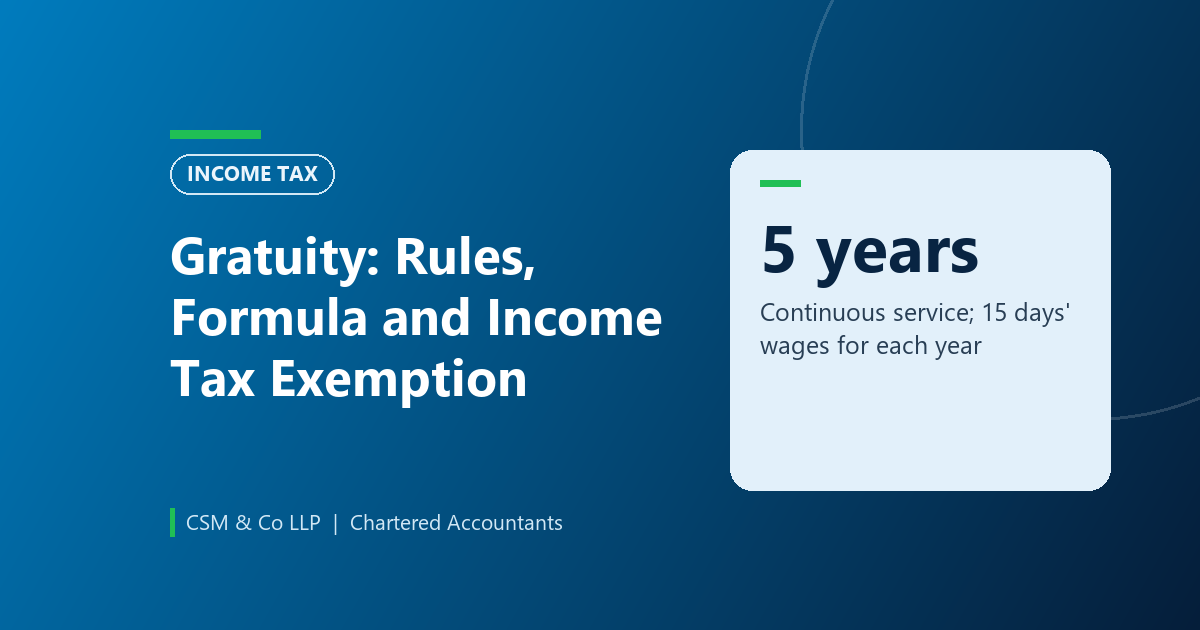
  • Gratuity is payable on five years of continuous service (one year for fixed-term employees) at 15 days’ wages for each completed year, worked out as last monthly wages ÷ 26 × 15 × years.
  • The Code on Social Security, 2020 has been in force since 21/11/2025 and now governs gratuity; the ₹20 lakh ceiling is a notified amount, so check it before you rely on it.
  • Under the Income-tax Act, 2025 the exemption is in section 19(1): government employees get it in full, others get the least of the gratuity received, the notified limit (₹20 lakh) and the statutory formula.
  • The gratuity exemption is also available in the new tax regime.

Gratuity is a lump sum an employer pays for long service. Two questions come up every time: how much is payable, and how much of it escapes tax. This post answers both under the Code on Social Security, 2020 and the Income-tax Act, 2025.

Which law governs gratuity now

The Code on Social Security, 2020 repealed the Payment of Gratuity Act, 1972 (section 164(1)). The four labour codes were made effective from 21 November 2025 (PIB press release), and the Ministry of Labour has said gratuity under the Code applies from that date. Notifications made under the old Act, such as the ceiling, are deemed to continue under the corresponding provisions of the Code (section 164(2)(a)). Gratuity is now in sections 53 to 56 of the Code. Older articles that quote the 1972 Act describe the same scheme, but the section numbers have changed.

Eligibility and formula under section 53

  • Five years of continuous service is needed on superannuation, retirement, resignation, death or disablement. The five years are not needed on death or disablement.
  • Fixed-term employees are paid gratuity pro rata and do not need five years. The Ministry of Labour has clarified (FAQs of 16/03/2026) that a fixed-term employee is eligible after rendering one year of service under the contract. This covers employees engaged directly by the employer, not contract labour supplied by a contractor.
  • Rate: 15 days’ wages for every completed year of service or part of a year in excess of six months, on the wages last drawn.
  • Monthly-rated employees: the 15 days’ wages are the monthly wages last drawn ÷ 26 × 15.
  • Ceiling: the Central Government notifies the maximum (section 53(3)). The Ministry of Labour’s FAQs say it is currently ₹20 lakh.
  • Time to pay: within 30 days from the date gratuity becomes payable, with simple interest for delay (section 56(3) and (4)). The employer must work out the amount and give written notice even if you have not applied.
  • Nomination: if the employee dies, gratuity goes to the nominee or heirs.
  • Forfeiture: wholly or partly, only for wilful damage to property, riotous or violent conduct, or an offence involving moral turpitude committed during employment.

Gratuity = Last drawn monthly wages ÷ 26 × 15 × completed years

Example: monthly wages ₹40,000, service 8 years: 40,000 ÷ 26 × 15 × 8 = ₹1,84,615.

Under section 2(88) of the Code, “wages” are basic pay, dearness allowance and retaining allowance, and if the excluded allowances (house rent allowance, conveyance and others) are more than half of total remuneration, the excess is added back to wages. The Ministry of Labour’s FAQs say performance incentives, ESOPs and reimbursements are not wages, and that gratuity and retrenchment compensation are left out of the 50% test. If your pay structure keeps basic pay low, the gratuity base may now be higher than under the old 1972 Act, from 21/11/2025. Ask your employer how the base is worked out.

Is gratuity taxable?

Gratuity is part of salary (section 16(c) of the Income-tax Act, 2025). Section 19(1) then allows these deductions from it, in the order of the Table:

Who receives it Exempt amount
Death-cum-retirement gratuity under the Central Government pension rules or a similar government scheme (serial 3) The entire amount
Retiring gratuity under the defence services pension code (serial 4) The entire amount
Gratuity under the Payment of Gratuity Act, 1972, now the Code (serial 5) The amount received, limited to the amount worked out under section 4(2) and (3) of that Act, which gives the 15/26 formula and the ₹20 lakh ceiling
Any other gratuity on retirement, incapacity before retirement or termination (serial 6) The least of the actual gratuity, the notified amount (₹20 lakh) and half a month’s salary for each completed year

“Salary” for these purposes is basic pay plus dearness allowance, if the terms of employment provide for it. All other allowances and perquisites are left out (section 19(2)(b)).

Employees covered by the gratuity law (serial 5)

The exempt amount is the least of three figures:

  1. the gratuity actually received,
  2. the formula amount: last drawn salary ÷ 26 × 15 × completed years (a part year of more than six months counts as a year), and
  3. ₹20 lakh.

Example: last drawn basic plus DA is ₹1,00,000 a month, service is 19 years and 7 months, so 20 years are counted. Gratuity paid is ₹15,00,000.

  • Formula amount: 1,00,000 ÷ 26 × 15 × 20 = ₹11,53,846
  • Ceiling: ₹20,00,000
  • Received: ₹15,00,000
  • Exempt: ₹11,53,846. Taxable: ₹3,46,154, added to salary income.

Employees not covered (serial 6)

The exempt amount is the least of the gratuity received, ₹20 lakh and half a month’s salary for each completed year of service, where the salary is the average of the ten months before the month of the event (retirement, incapacity or termination). Only completed years count.

Example: average salary of the last ten months is ₹90,000, service is 25 years and 2 months, gratuity received is ₹14,00,000.

  • Half month’s salary: 90,000 × 1/2 × 25 = ₹11,25,000
  • Exempt: ₹11,25,000. Taxable: ₹2,75,000.

Gratuity from more than one employer

For serial 6, if you receive gratuity from more than one employer in a tax year, or received exempt gratuity in earlier years, the total exemption cannot exceed the notified limit reduced by what was already exempted (section 19(2)(a)). Keep a record of gratuity exempted in earlier jobs.

New tax regime

Of the section 19(1) Table, section 202(2) bars only serial number 1 (professional tax) in the new regime. The gratuity entries are not barred, so the gratuity exemption is available in both regimes.

Employer side

  • Contributions to an approved gratuity fund created under an irrevocable trust are deductible (section 29(1)(c)).
  • A provision for gratuity that has become payable during the tax year is deductible (section 29(1)(d)).
  • Gratuity paid during the employee’s lifetime is treated as salary (Schedule XI, Part B, paragraph 5). The income of an approved gratuity fund is itself exempt (Schedule VII).
  • TDS on the taxable part is deducted with other salary under section 392.

Gratuity and pension compared

Point Gratuity Pension
Payment One time, on leaving Monthly, for life
Paid by Employer Employer, a pension fund or the government
Condition Five years of continuous service (one for fixed-term) As per the scheme
Tax Exempt up to the limits above Taxable as salary when received (commuted lump sum has separate rules)

Things to check before you rely on this

  • The Income-tax Act, 2025 still names the Payment of Gratuity Act, 1972 in serial 5 and its section 4(2) and (3). Those sub-sections (15 days’ wages and the ceiling) are now section 53(2) and (3) of the Code, and section 164(2)(a) of the Code carries the old notifications forward, so the exemption works as described. A future amendment of the Income-tax Act may update the wording.
  • The ₹20 lakh ceiling is a notified amount, not a number in the Act. The labour ceiling dates from 29/03/2018 and the income-tax limit from S.O. 1213(E) of 08/03/2019. The Ministry of Labour still calls ₹20 lakh the current ceiling, and we found no newer notification. Check before you advise on a very large gratuity.

Frequently asked questions

Who is eligible for gratuity?

An employee who has completed continuous service of five years, on superannuation, retirement, resignation, death or disablement. Death and disablement do not need five years. A fixed-term employee is eligible after one year of service under the contract, with pro-rata gratuity.

What is the gratuity formula?

Last drawn monthly wages ÷ 26 × 15 × completed years of service. A part year of more than six months counts as a full year.

How much gratuity is tax free?

For a government employee, the whole amount. For an employee covered by the gratuity law, the least of the gratuity received, the amount worked out by the statutory formula and the notified ceiling (₹20 lakh). For others, the least of the gratuity received, the notified ceiling and half a month’s average salary for each completed year.

Is gratuity exempt in the new tax regime?

Yes. Section 202(2) bars section 19(1) serial number 1 (professional tax) in the new regime, but not the gratuity entries at serial numbers 3 to 6.

Is gratuity taxable at all?

Yes, to the extent it exceeds the exempt amount. It is part of salary (section 16), so the excess is taxed at your slab rate and TDS applies.

Can the employer forfeit gratuity?

Only in the cases the law allows: wilful damage to the employer’s property, riotous or violent conduct, or an offence involving moral turpitude committed during employment. Forfeiture can be whole or partial.

Official sources

Related reading

Disclaimer

This article is for general informational purposes only and should not be considered professional advice. Please consult a qualified expert for advice tailored to your specific situation. The author and website owner are not liable for any errors or actions based on this content.

Dearness Allowance (DA): Meaning, Tax Treatment and the 60% Rate from January 2026

Last updated: 13 August 2026 · Written and reviewed by CA Meet Dhrangadhariya, CSM & Co LLP

Quick summary

  • Dearness allowance (DA) is paid on top of basic pay to offset inflation. It is fully taxable as salary.
  • DA counts as “salary” for HRA, gratuity and leave encashment limits only if the terms of employment provide for it.
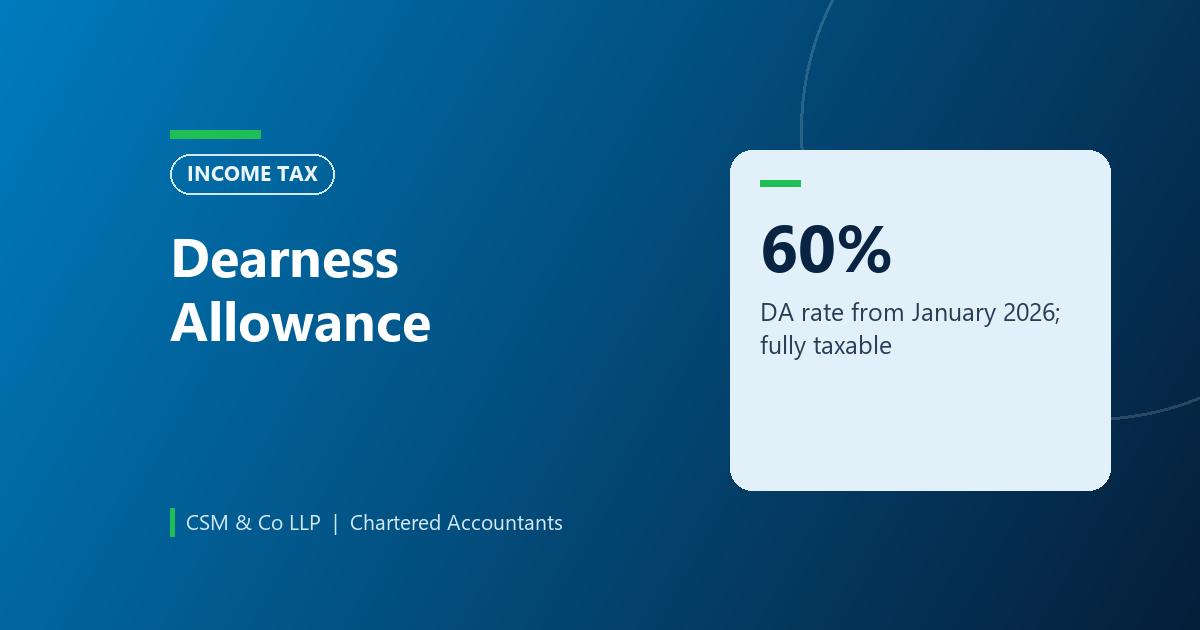
  • For Central Government employees and pensioners the Cabinet approved a 2% rise from 58% to 60% with effect from 01/01/2026, with arrears for January to March 2026.
  • Arrears of DA taxed in a later year can qualify for relief under section 157 by filing Form 39.

Dearness allowance (DA) is the part of pay that moves with the price level. It is paid by the Central and State Governments, public sector bodies and some private employers, as a percentage of basic pay, so that the real value of pay is not eaten away by inflation. Pensioners receive the same relief as dearness relief (DR).

The current rate for Central Government employees

The Union Cabinet approved an additional 2% DA and DR with effect from 01/01/2026, taking the rate from 58% to 60% of basic pay and pension. Employees and pensioners get arrears for January, February and March 2026 (SCC Online, 20/04/2026). The Centre revises DA twice a year, with effect from 1 January and 1 July, based on the All-India Consumer Price Index for industrial workers. State governments announce their own rates and dates.

For central employees the DA is paid on basic pay: a basic pay of ₹56,100 at 60% gives DA of ₹33,660 a month.

Tax treatment of DA

  • Taxable in full as salary. Under section 16 of the Income-tax Act, 2025, “salary” includes wages, and DA is part of wages. It has no exemption of its own. DR on pension is taxed as pension, which is also salary.
  • Report it as salary. It forms part of the salary shown in your TDS certificate (Form 130) and in the return, and should match your payslip.
  • Arrears. DA revised with retrospective effect is paid as arrears, for example the January to March 2026 arrears above. Taxed in the year of receipt, it can push you into a higher slab. If so, relief under section 157 is available by furnishing Form 39 (see our post on relief for arrears of salary).

Where DA counts as “salary” for other limits

Several limits are worked out on “salary” rather than on pay as a whole. The Act and Rules say that salary includes dearness allowance if the terms of employment so provide, and excludes all other allowances and perquisites:

Use Where
HRA exemption (old regime): 50% or 40% of salary, and rent paid less 10% of salary Rule 279
Gratuity: half a month’s salary for each completed year (employees not covered by the gratuity law) Section 19(2)(b)
Leave encashment: ten months’ average salary Section 19(2)(b)

If your terms of employment do not provide for DA to count, it is left out of these calculations. For a government employee the pay rules usually do count it. Check the appointment letter or the service rules rather than assume.

Example: basic pay ₹60,000 and DA ₹36,000 (60%), HRA received ₹30,000 a month, rent paid ₹35,000 a month, Mumbai, old regime. Salary for HRA is ₹96,000 (the terms of service include DA). The exempt HRA is the least of the HRA received (₹30,000), rent paid less 10% of salary (35,000 - 9,600 = ₹25,400) and 50% of salary (₹48,000), so ₹25,400 a month.

DA and HRA are different

Point Dearness allowance House rent allowance
Purpose Offsets rising prices Helps with rent
Paid to Government and public sector employees mainly, some private employers Most employers
Tax Fully taxable Exempt in part under the old regime, limited by Rule 279
Based on Basic pay Basic pay (and DA where the terms provide)

DA for pensioners

Pensioners get DR on the pension at the same rate as the Central DA, and the DR is taxed with the pension as salary.

Before you rely on this

  • The Cabinet decision is the source for the 60% rate. Confirm the rate from the Department of Expenditure order that applies to you, and from your State government’s order if you are a State employee.
  • The revision due from 01/07/2026 is expected to be announced later in the year, so the rate shown here may change with retrospective effect and arrears.

Frequently asked questions

What is dearness allowance?

An allowance paid on top of basic pay to compensate for rising prices. It is calculated as a percentage of basic pay and revised from time to time.

Is dearness allowance taxable?

Yes. It is wages, and so part of salary under section 16 of the Income-tax Act, 2025, and is fully taxable in the year it is due or received, subject to the usual deductions.

Is DA part of salary for HRA and gratuity?

Yes, if the terms of employment so provide. Rule 279 (HRA) and section 19(2)(b) (gratuity and leave encashment) both say “salary” includes dearness allowance if the terms of employment so provide, but excludes other allowances and perquisites.

What is the DA rate for Central Government employees now?

60% of basic pay from 01/01/2026, up from 58%, as approved by the Union Cabinet in April 2026. The revision due from 01/07/2026 had not been announced when this was checked on 06/10/2026.

Do private employees get DA?

Not as a rule. Government and public sector employees receive it. Some private employers and wage settlements also pay a dearness allowance or variable DA, and the same tax rules apply.

What is dearness relief?

The equivalent of DA for pensioners. It is paid on pension and is taxable as pension, which is part of salary.

Official sources

Related reading

Disclaimer

This article is for general informational purposes only and should not be considered professional advice. Please consult a qualified expert for advice tailored to your specific situation. The author and website owner are not liable for any errors or actions based on this content.
Sign-On Bonus Repaid to the Old Employer: Can You Deduct It From Salary? (ITAT Chennai)

Last updated: 03 August 2026 · Written and reviewed by CA Meet Dhrangadhariya, CSM & Co LLP

Quick summary

  • A sign-on bonus is salary and is taxed when you receive it.
  • In S.S.N. Ravi v ACIT (ITAT Chennai, 06/05/2016), an employee who repaid a ₹25 lakh sign-on bonus to his old employer on leaving early was not allowed to reduce his taxable salary by that amount.
  • The Tribunal held that the bonus was a revenue receipt, he left voluntarily, and the Act has no provision to deduct such a repayment from salary.
  • Section 19 of the Income-tax Act, 2025 lists the deductions from salary, and a repaid bonus is not one of them.

A sign-on bonus is a payment to attract you to a job. Most contracts add a clawback: if you leave within a year, you repay it. The tax question that follows is a hard one. You were taxed on the bonus when you got it. Can you reduce your taxable salary when you pay it back?

The tax position on receipt

A sign-on bonus is paid by the employer because of the employment. That makes it salary. Section 16 of the Income-tax Act, 2025 says salary includes wages, fees or commission, perquisites and profits in lieu of salary, and a joining bonus falls in these. The employer deducts TDS under section 392 when it pays the bonus.

The case: S.S.N. Ravi v ACIT

Forum and date: Income Tax Appellate Tribunal, Chennai, order dated 06/05/2016, I.T.A. No. 933/Mds/2015, assessment year 2008-09.

Facts

  • The taxpayer joined Barclays in November 2006 and received a sign-on bonus of ₹25 lakh in FY 2006-07, which he included in his income of that year.
  • The bonus was repayable if he left within one year.
  • He left on 31/10/2007, before the year was complete, and moved to Deutsche Bank. Deutsche Bank paid him ₹25 lakh, which he used to repay Barclays.
  • In his return for FY 2007-08 he reduced his salary by ₹25 lakh. The Assessing Officer added it back.

Decision. The Tribunal dismissed the appeal. In short:

  • The sign-on bonus is a revenue receipt of the nature of employment income.
  • The employee left voluntarily; he was not terminated.
  • Section 17(1) of the 1961 Act made no provision for reducing salary by a refund of the bonus.
  • The amount that the new employer paid to cover the repayment could not be treated as compensation for the lost bonus.
  • The ₹25 lakh could not be reduced from taxable income.

The position under the Income-tax Act, 2025

The 2025 Act has the same structure. Section 19(1) lists the deductions from salary: professional tax, the standard deduction, the retirement exemptions (gratuity, commutation of pension, leave encashment and similar) and compensation items. A repayment of a bonus is not in that list.

The ruling is a Tribunal order on its facts, in a case where the employee left voluntarily and a new employer paid the sum. Do not treat it as settling every repayment: a different fact pattern could be argued differently.

Practical points

  1. Read the clawback clause before you sign. Check the repayment period and whether the repayment is of the gross amount or of the amount net of tax.
  2. If your new employer reimburses the repayment, remember that the reimbursement is a payment from an employer, so expect it to be taxed as salary, with no deduction for the amount you repay.
  3. Take advice before claiming a deduction for a repaid bonus. If you claim it, keep the contract, the repayment proof and the old employer’s acknowledgement.

Frequently asked questions

Is a sign-on bonus taxable?

Yes. It is a payment from the employer in connection with employment, so it is salary under section 16 of the Income-tax Act, 2025 and taxed in the year you receive it, with TDS.

Can I deduct a sign-on bonus that I repay to my old employer?

The Chennai Tribunal held that you cannot reduce your taxable salary by a repaid sign-on bonus when the employee left voluntarily. The Act does not provide a deduction for the repayment.

Does it matter that my new employer reimbursed the repayment?

In S.S.N. Ravi the new employer paid the employee the amount to repay. The Tribunal treated it as a revenue receipt, not a capital receipt, and the employee was taxed on it as well.

Which case is this?

S.S.N. Ravi, Chennai v ACIT, ITAT Chennai, order dated 06/05/2016, I.T.A. No. 933/Mds/2015, assessment year 2008-09.

What should I do before signing a sign-on bonus clause?

Read the clawback terms and ask who bears the tax if you have to repay. If a new employer will reimburse the repayment, ask for advice on how that payment will be taxed in your hands.

Official sources

Disclaimer

This article is for general informational purposes only and should not be considered professional advice. Please consult a qualified expert for advice tailored to your specific situation. The author and website owner are not liable for any errors or actions based on this content.
Conveyance Allowance: Exemption Limit, Calculation and Eligibility

Last updated: 06 August 2026 · Written and reviewed by CA Meet Dhrangadhariya, CSM & Co LLP

Quick summary

  • Conveyance allowance is exempt to the extent of the amount you actually spend on travel in the performance of your official duties, in both the old and the new tax regime.
  • It applies only if your employer does not give you a free conveyance, and the part not spent is taxable.
  • The old ₹1,600 a month fixed exemption is not conveyance allowance: it was a transport allowance for commuting and ended in FY 2018-19.
  • From Tax Year 2026-27 the rule is in Schedule III of the Income-tax Act, 2025 and Rule 280(1)(d) of the Income-tax Rules, 2026.

Conveyance allowance is paid to an employee to meet the cost of travel done in the course of official work, such as visiting clients or sites. It is exempt from tax up to what you actually spend on such travel. There is no fixed rupee limit.

Where is this in the law?

Up to FY 2025-26 it was section 10(14)(i) of the Income-tax Act, 1961 and Rule 2BB(1)(b). From Tax Year 2026-27 it is in Schedule III of the Income-tax Act, 2025 (Table Sl. No. 12), with Rule 280(1)(d) of the Income-tax Rules, 2026 describing it as an allowance granted to meet the expenditure on conveyance in performance of duties of an office or employment of profit, where no free conveyance is provided by the employer.

How much is exempt?

The lower of:

  • the allowance you receive, and
  • the amount you actually spend on conveyance for official duties.

The unspent part is taxable as salary. Keep records of your official journeys, such as a log, fuel bills, tickets or cab receipts, as your employer may ask for them.

The ₹1,600 myth

Many articles say conveyance allowance is exempt up to ₹1,600 a month (₹19,200 a year). That figure belonged to the transport allowance for commuting between home and office, which was withdrawn from FY 2018-19 when the standard deduction was introduced. It is not a conveyance allowance limit. A fixed monthly “conveyance” amount that you use only to commute to work is therefore taxable.

Conveyance allowance vs transport allowance

Basis Conveyance allowance Transport allowance
Purpose Travel while doing the job Travel between home and office
Exemption Actual expense, up to the allowance Only for disabled employees and transport business employees
Regimes Both old and new Disability: both. Transport business: old only

Who is eligible?

Any employee who has to travel for official work, and whose employer does not provide a free conveyance. If the employer gives a company car or free transport, no exemption is allowed.

Reporting

Your employer applies the exemption in Form 16, based on the declaration and proof you give. In your return, show the exempt and taxable parts in the salary schedule.

Old regime or new regime?

Conveyance allowance (for travel in the performance of duties) is one of the few allowances that continue to be exempt in the new regime. Under section 202 of the Income-tax Act, 2025 and Rule 280(3), the new regime keeps the exemption for allowances for travel on tour or transfer, daily charges, conveyance in duties and, for a disabled employee, the transport allowance.

Frequently asked questions

What is the exemption limit for conveyance allowance?

There is no fixed limit. The exemption is the actual amount you spend on conveyance in performing your duties, up to the allowance you receive.

Is conveyance allowance taxable?

The part you do not spend on official travel is taxable as salary. A fixed allowance you use for commuting is taxable.

Is it available in the new tax regime?

Yes. It is one of the allowances that remain exempt in the new tax regime.

Is conveyance allowance the same as transport allowance?

No. Conveyance allowance is for travel in performing duties. Transport allowance is for travel between home and office.

Can I claim it if my employer gives a company car?

No. It applies only where no free conveyance is provided by the employer.

Official sources

Related reading

Disclaimer

This article is for general informational purposes only and should not be considered professional advice. Please consult a qualified expert for advice tailored to your specific situation. The author and website owner are not liable for any errors or actions based on this content.

WhatsApp