Gratuity: Rules, Formula and Income Tax Exemption (Tax Year 2026-27)

Last updated: 02 October 2026 · Written and reviewed by CA Meet Dhrangadhariya, CSM & Co LLP

Quick summary

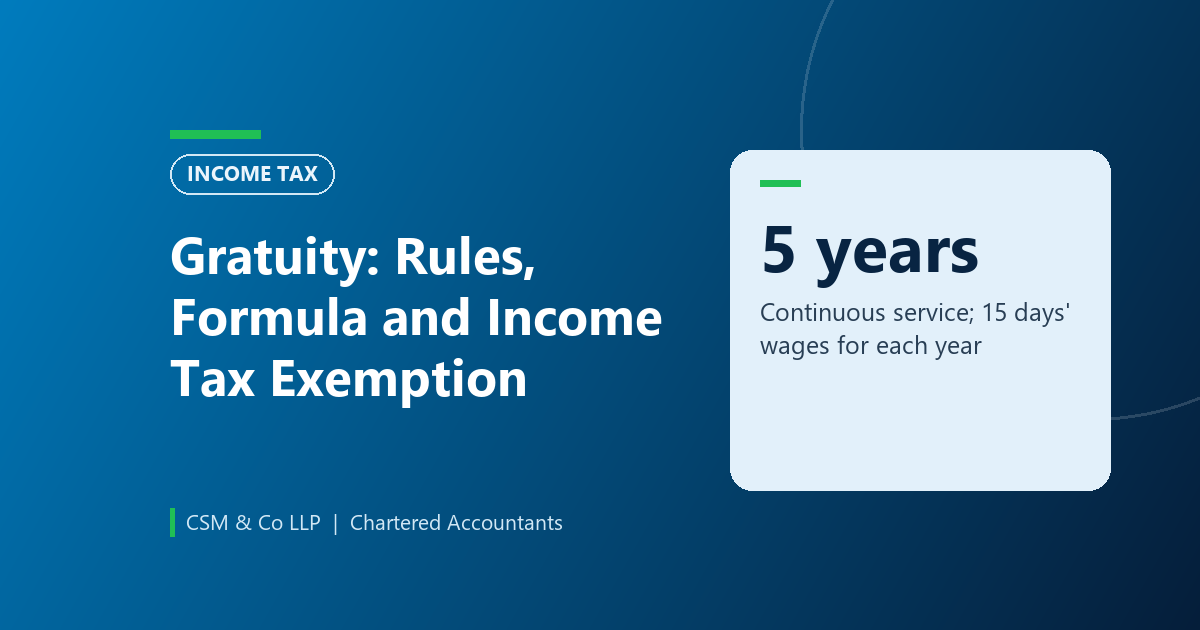
  • Gratuity is payable on five years of continuous service (one year for fixed-term employees) at 15 days’ wages for each completed year, worked out as last monthly wages ÷ 26 × 15 × years.
  • The Code on Social Security, 2020 has been in force since 21/11/2025 and now governs gratuity; the ₹20 lakh ceiling is a notified amount, so check it before you rely on it.
  • Under the Income-tax Act, 2025 the exemption is in section 19(1): government employees get it in full, others get the least of the gratuity received, the notified limit (₹20 lakh) and the statutory formula.
  • The gratuity exemption is also available in the new tax regime.

Gratuity is a lump sum an employer pays for long service. Two questions come up every time: how much is payable, and how much of it escapes tax. This post answers both under the Code on Social Security, 2020 and the Income-tax Act, 2025.

Which law governs gratuity now

The Code on Social Security, 2020 repealed the Payment of Gratuity Act, 1972 (section 164(1)). The four labour codes were made effective from 21 November 2025 (PIB press release), and the Ministry of Labour has said gratuity under the Code applies from that date. Notifications made under the old Act, such as the ceiling, are deemed to continue under the corresponding provisions of the Code (section 164(2)(a)). Gratuity is now in sections 53 to 56 of the Code. Older articles that quote the 1972 Act describe the same scheme, but the section numbers have changed.

Eligibility and formula under section 53

  • Five years of continuous service is needed on superannuation, retirement, resignation, death or disablement. The five years are not needed on death or disablement.
  • Fixed-term employees are paid gratuity pro rata and do not need five years. The Ministry of Labour has clarified (FAQs of 16/03/2026) that a fixed-term employee is eligible after rendering one year of service under the contract. This covers employees engaged directly by the employer, not contract labour supplied by a contractor.
  • Rate: 15 days’ wages for every completed year of service or part of a year in excess of six months, on the wages last drawn.
  • Monthly-rated employees: the 15 days’ wages are the monthly wages last drawn ÷ 26 × 15.
  • Ceiling: the Central Government notifies the maximum (section 53(3)). The Ministry of Labour’s FAQs say it is currently ₹20 lakh.
  • Time to pay: within 30 days from the date gratuity becomes payable, with simple interest for delay (section 56(3) and (4)). The employer must work out the amount and give written notice even if you have not applied.
  • Nomination: if the employee dies, gratuity goes to the nominee or heirs.
  • Forfeiture: wholly or partly, only for wilful damage to property, riotous or violent conduct, or an offence involving moral turpitude committed during employment.

Gratuity = Last drawn monthly wages ÷ 26 × 15 × completed years

Example: monthly wages ₹40,000, service 8 years: 40,000 ÷ 26 × 15 × 8 = ₹1,84,615.

Under section 2(88) of the Code, “wages” are basic pay, dearness allowance and retaining allowance, and if the excluded allowances (house rent allowance, conveyance and others) are more than half of total remuneration, the excess is added back to wages. The Ministry of Labour’s FAQs say performance incentives, ESOPs and reimbursements are not wages, and that gratuity and retrenchment compensation are left out of the 50% test. If your pay structure keeps basic pay low, the gratuity base may now be higher than under the old 1972 Act, from 21/11/2025. Ask your employer how the base is worked out.

Is gratuity taxable?

Gratuity is part of salary (section 16(c) of the Income-tax Act, 2025). Section 19(1) then allows these deductions from it, in the order of the Table:

Who receives it Exempt amount
Death-cum-retirement gratuity under the Central Government pension rules or a similar government scheme (serial 3) The entire amount
Retiring gratuity under the defence services pension code (serial 4) The entire amount
Gratuity under the Payment of Gratuity Act, 1972, now the Code (serial 5) The amount received, limited to the amount worked out under section 4(2) and (3) of that Act, which gives the 15/26 formula and the ₹20 lakh ceiling
Any other gratuity on retirement, incapacity before retirement or termination (serial 6) The least of the actual gratuity, the notified amount (₹20 lakh) and half a month’s salary for each completed year

“Salary” for these purposes is basic pay plus dearness allowance, if the terms of employment provide for it. All other allowances and perquisites are left out (section 19(2)(b)).

Employees covered by the gratuity law (serial 5)

The exempt amount is the least of three figures:

  1. the gratuity actually received,
  2. the formula amount: last drawn salary ÷ 26 × 15 × completed years (a part year of more than six months counts as a year), and
  3. ₹20 lakh.

Example: last drawn basic plus DA is ₹1,00,000 a month, service is 19 years and 7 months, so 20 years are counted. Gratuity paid is ₹15,00,000.

  • Formula amount: 1,00,000 ÷ 26 × 15 × 20 = ₹11,53,846
  • Ceiling: ₹20,00,000
  • Received: ₹15,00,000
  • Exempt: ₹11,53,846. Taxable: ₹3,46,154, added to salary income.

Employees not covered (serial 6)

The exempt amount is the least of the gratuity received, ₹20 lakh and half a month’s salary for each completed year of service, where the salary is the average of the ten months before the month of the event (retirement, incapacity or termination). Only completed years count.

Example: average salary of the last ten months is ₹90,000, service is 25 years and 2 months, gratuity received is ₹14,00,000.

  • Half month’s salary: 90,000 × 1/2 × 25 = ₹11,25,000
  • Exempt: ₹11,25,000. Taxable: ₹2,75,000.

Gratuity from more than one employer

For serial 6, if you receive gratuity from more than one employer in a tax year, or received exempt gratuity in earlier years, the total exemption cannot exceed the notified limit reduced by what was already exempted (section 19(2)(a)). Keep a record of gratuity exempted in earlier jobs.

New tax regime

Of the section 19(1) Table, section 202(2) bars only serial number 1 (professional tax) in the new regime. The gratuity entries are not barred, so the gratuity exemption is available in both regimes.

Employer side

  • Contributions to an approved gratuity fund created under an irrevocable trust are deductible (section 29(1)(c)).
  • A provision for gratuity that has become payable during the tax year is deductible (section 29(1)(d)).
  • Gratuity paid during the employee’s lifetime is treated as salary (Schedule XI, Part B, paragraph 5). The income of an approved gratuity fund is itself exempt (Schedule VII).
  • TDS on the taxable part is deducted with other salary under section 392.

Gratuity and pension compared

Point Gratuity Pension
Payment One time, on leaving Monthly, for life
Paid by Employer Employer, a pension fund or the government
Condition Five years of continuous service (one for fixed-term) As per the scheme
Tax Exempt up to the limits above Taxable as salary when received (commuted lump sum has separate rules)

Things to check before you rely on this

  • The Income-tax Act, 2025 still names the Payment of Gratuity Act, 1972 in serial 5 and its section 4(2) and (3). Those sub-sections (15 days’ wages and the ceiling) are now section 53(2) and (3) of the Code, and section 164(2)(a) of the Code carries the old notifications forward, so the exemption works as described. A future amendment of the Income-tax Act may update the wording.
  • The ₹20 lakh ceiling is a notified amount, not a number in the Act. The labour ceiling dates from 29/03/2018 and the income-tax limit from S.O. 1213(E) of 08/03/2019. The Ministry of Labour still calls ₹20 lakh the current ceiling, and we found no newer notification. Check before you advise on a very large gratuity.

Frequently asked questions

Who is eligible for gratuity?

An employee who has completed continuous service of five years, on superannuation, retirement, resignation, death or disablement. Death and disablement do not need five years. A fixed-term employee is eligible after one year of service under the contract, with pro-rata gratuity.

What is the gratuity formula?

Last drawn monthly wages ÷ 26 × 15 × completed years of service. A part year of more than six months counts as a full year.

How much gratuity is tax free?

For a government employee, the whole amount. For an employee covered by the gratuity law, the least of the gratuity received, the amount worked out by the statutory formula and the notified ceiling (₹20 lakh). For others, the least of the gratuity received, the notified ceiling and half a month’s average salary for each completed year.

Is gratuity exempt in the new tax regime?

Yes. Section 202(2) bars section 19(1) serial number 1 (professional tax) in the new regime, but not the gratuity entries at serial numbers 3 to 6.

Is gratuity taxable at all?

Yes, to the extent it exceeds the exempt amount. It is part of salary (section 16), so the excess is taxed at your slab rate and TDS applies.

Can the employer forfeit gratuity?

Only in the cases the law allows: wilful damage to the employer’s property, riotous or violent conduct, or an offence involving moral turpitude committed during employment. Forfeiture can be whole or partial.

Official sources

Related reading

Disclaimer

This article is for general informational purposes only and should not be considered professional advice. Please consult a qualified expert for advice tailored to your specific situation. The author and website owner are not liable for any errors or actions based on this content.

PF and ESIC Compliance for Employers under the Code on Social Security: Registration, Deduction, Interest, Damages and Penalties

Last updated: 09 October 2026 · Written and reviewed by CA Meet Dhrangadhariya, CSM & Co LLP

Quick summary

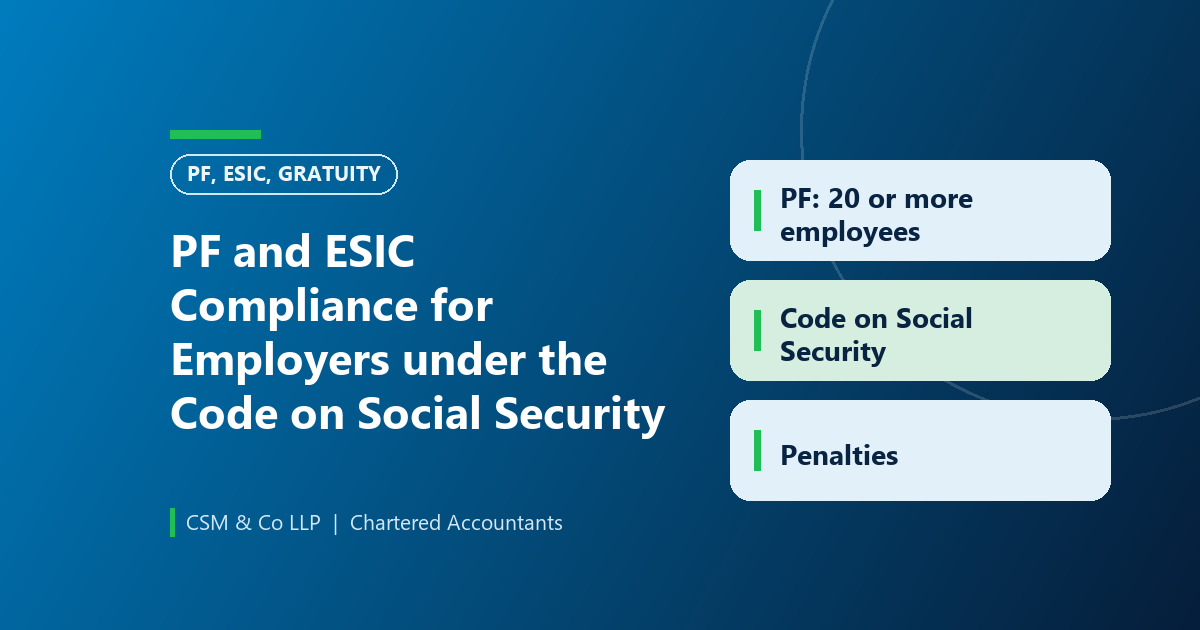
  • The Code on Social Security, 2020 (in force from 21/11/2025) replaced the EPF Act, 1952 and the ESI Act, 1948. PF applies to establishments with 20 or more employees and ESI to establishments with 10 or more persons.
  • An establishment already registered under an earlier labour law need not register again; that registration is treated as registration under the Code.
  • An employer who deducts the employee share from wages and does not deposit it faces imprisonment of at least one year (up to three years) and a fine of Rs 1 lakh. Other defaults carry two months to six months and Rs 50,000.
  • Delay attracts simple interest at the notified rate and damages up to the amount of arrears, after a hearing.

Since 21/11/2025 an employer’s PF and ESI duties come from the Code on Social Security, 2020. The Code repealed the Employees’ Provident Funds and Miscellaneous Provisions Act, 1952 and the Employees’ State Insurance Act, 1948 (and seven other laws). The schemes, rates and wage ceilings continue as notified, but the penalty and procedure rules below are now from the Code itself.

When does each scheme apply?

The First Schedule to the Code says:

Scheme Applies to
Employees’ Provident Fund (Chapter III) Every establishment in which twenty or more employees are employed
Employees’ State Insurance (Chapter IV) Every establishment in which ten or more persons are employed, other than a seasonal factory. A notified hazardous or life threatening occupation is covered even with a single employee

For the head count, employees earning above the notified wage ceiling are also counted. An employer and the majority of employees can agree to bring a smaller establishment under the PF chapter by applying to the Central Provident Fund Commissioner, and the Government can extend the Code to establishments above a notified size.

Registration

Every establishment to which the Code applies registers electronically or otherwise, within the time and in the manner prescribed (section 3). An establishment already registered under any other Central labour law does not have to register again, and that registration is treated as registration under the Code. An establishment that is closing down can apply to cancel the registration.

Wages: what the contribution is calculated on

The Code defines “wages” in section 2(88) as basic pay, dearness allowance and retaining allowance, with listed exclusions (statutory bonus, house rent allowance, conveyance allowance, overtime, commission, the employer’s PF contribution, gratuity and retirement payments). If the exclusions add up to more than one-half of total remuneration (or the percentage notified), the excess is added back to wages. Check your pay structure against this cap, because it can raise both PF and ESI contributions.

Who pays what

  • The employer pays both the employer’s and the employee’s contribution for every employee, whether employed directly or through a contractor.
  • The employer may recover the employee’s contribution only by deduction from wages, only for the period it relates to and not more than the employee’s share.
  • The employer’s contribution cannot be deducted from wages or recovered from the employee in any way.
  • Sums deducted from wages are deemed to be entrusted to the employer for the purpose of paying the contribution.
  • For contract workers, the principal employer pays and recovers the amount from the contractor, who in turn may recover only the employee’s share from the worker’s wages.
  • Employees must establish identity through Aadhaar for registration and for claiming benefits or withdrawing funds (section 142).

If you pay late or do not pay

Consequence What the Code says
Interest (section 127) Simple interest at the rate notified by the Central Government, from the date the amount became due till actual payment
Damages (section 128) Up to the amount of arrears, levied by the PF Commissioner or ESIC Director General (or authorised officer), after giving the employer an opportunity of being heard
Failure to pay employee share that was deducted (section 133(i)(a)) Imprisonment of at least one year, up to three years, and a fine of Rs 1 lakh
Failure to pay any other contribution (section 133(i)(b)) Imprisonment of at least two months, up to six months, and a fine of Rs 50,000
Deducting the employer’s share from wages, or failing to file a return Fine up to Rs 50,000
Obstructing an inspector, or failing to produce records Imprisonment up to six months or fine up to Rs 50,000, or both
Repeat offence (section 134) Imprisonment up to two years and fine of Rs 2 lakh; for repeat non-payment of contributions, at least two years, up to three, and fine of Rs 3 lakh

In the case of a company, every person directly in charge of the conduct of its business, as well as the company, is deemed guilty (section 135). The court can impose a lesser jail term for adequate and special reasons recorded in the judgment, and offences can be compounded as the Code provides.

A practical checklist

  1. Count employees, including those above the wage ceiling, to see whether PF (20) and ESI (10) apply.
  2. Keep the registration number from the old law in your records; it carries over.
  3. Recalculate wages under the Code definition and check the one-half rule.
  4. Deposit both shares on time, every month, for contract workers too.
  5. File returns and keep registers ready for the inspector.

Points to check

  • This post follows the Code as published on India Code. Rates, the wage ceiling, interest rate and filing dates are fixed by rules, regulations and notifications issued under the Code, so check those before relying on a figure.
  • Penalty amounts and imprisonment terms are the maximums and minimums written in the Code; the actual order depends on the court.

Frequently asked questions

When does PF apply to an establishment?

Chapter III (Employees’ Provident Fund) applies to every establishment in which twenty or more employees are employed. Employees earning above the wage ceiling are counted for this head count.

When does ESI apply?

Chapter IV applies to every establishment in which ten or more persons are employed, other than a seasonal factory, and to a notified hazardous establishment even with one employee.

Do I have to register again under the Code?

An establishment already registered under any other Central labour law is not required to register again; its registration is deemed to be registration under the Code. A new establishment registers electronically as prescribed.

Can I deduct the employer share from wages?

No. The employer can recover only the employee’s contribution, by deduction from wages for the period it relates to, and the employer’s contribution cannot be recovered from the employee in any way.

What if the deducted employee contribution is not deposited?

The sum deducted is treated as entrusted to the employer. Failure to pay it is punishable with imprisonment of at least one year, up to three years, and a fine of Rs 1 lakh.

What are the interest and damages for late payment?

Simple interest at the rate notified by the Central Government from the due date to the date of payment, and damages up to the amount of arrears, levied after the employer has been heard.

Can the employer use a contractor to pay PF and ESI?

The principal employer pays the employer’s and employee’s share for contract workers and then recovers the amount from the contractor.

Official sources

Related reading

Disclaimer

This article is for general informational purposes only and should not be considered professional advice. Please consult a qualified expert for advice tailored to your specific situation. The author and website owner are not liable for any errors or actions based on this content.
Maternity Leave in India: 26 Weeks Paid Leave, Eligibility and Rules under the Code on Social Security

Last updated: 09 October 2026 · Written and reviewed by CA Meet Dhrangadhariya, CSM & Co LLP

Quick summary

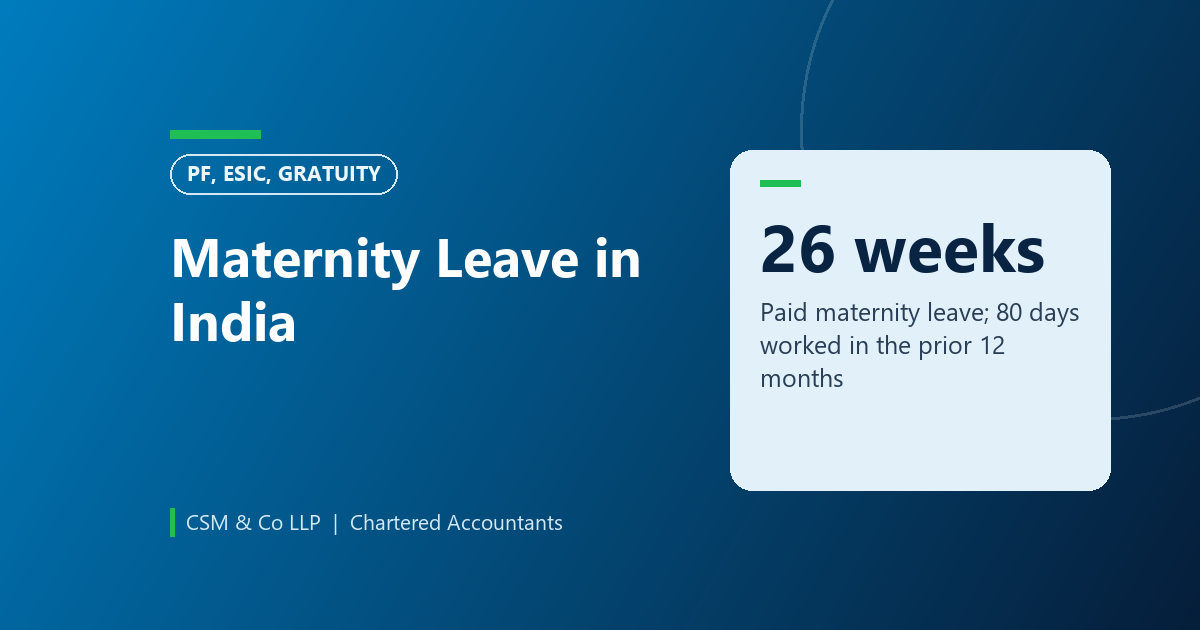
  • A woman who has worked at least 80 days in the 12 months before her expected delivery date is entitled to paid maternity leave at the average daily wage of the three calendar months before she goes on leave.
  • Leave is 26 weeks (not more than 8 weeks before delivery) and 12 weeks for a woman who already has two or more surviving children.
  • Adoptive and commissioning mothers get 12 weeks from the day the child is handed over (child below three months).
  • The Maternity Benefit Act, 1961 stands repealed and its rules now sit in sections 59 to 72 of the Code on Social Security, 2020 (Chapter VI), in force from 21/11/2025.

For decades maternity leave was governed by the Maternity Benefit Act, 1961. From 21/11/2025 the Code on Social Security, 2020 came into force and its Chapter VI now carries the maternity benefit provisions. The headline entitlements did not change: 26 weeks of paid leave, job protection, a crèche and the option of working from home.

Who is eligible?

A woman who has worked for at least 80 days in the 12 months immediately before her expected date of delivery (section 60(2)). Days of lay-off and holidays with wages declared by law count towards the 80 days.

How much leave?

Situation Paid leave
First or second child 26 weeks (not more than 8 weeks before the expected delivery)
Woman with two or more surviving children 12 weeks (not more than 6 weeks before the expected delivery)
Tubectomy operation 2 weeks from the day of the operation (section 65(2))
Adoptive mother (child below three months) 12 weeks from the date the child is handed over
Commissioning mother 12 weeks from the date the child is handed over
Miscarriage or medical termination of pregnancy 6 weeks from the day of the miscarriage or termination

An employer cannot make a woman work during the six weeks immediately after delivery, miscarriage or termination.

What is paid?

Leave is paid at the average daily wage for the period of actual absence: the average of her wages for the days worked in the three calendar months before she goes on leave, subject to the minimum wage (section 60(1)). Every woman entitled to maternity benefit also gets a medical bonus of Rs 3,500, or the amount the Central Government notifies, if the employer does not provide pre-natal confinement and post-natal care free of charge (section 64).

Other rights

  • Job protection: it is unlawful to dismiss her, or to change her conditions of service to her disadvantage, because of absence under this Chapter. Dismissal during pregnancy does not take away the benefit, except for gross misconduct as prescribed. She can appeal within 60 days (section 68).
  • Extra leave for illness: up to one month more on proof of illness arising out of pregnancy, delivery, premature birth, miscarriage or termination (section 65(3)).
  • Nursing breaks: two breaks a day, in addition to the rest interval, until the child is 15 months old (section 66).
  • Work from home: where the nature of work allows, the employer may let her work from home after the leave, on terms agreed with her.
  • Crèche: an establishment with 50 or more employees (or the number prescribed) must provide a crèche within the prescribed distance, which may be shared with other establishments. The mother may make four visits a day, including her rest interval (section 67).
  • Light work: on her request, a pregnant woman cannot be given arduous work or work needing long hours of standing in the month before the last six weeks before delivery, nor during any part of those six weeks she does not take as leave (section 59).
  • Notice and payment: she gives written notice stating the date from which she will be absent. Failure to give notice does not take away the benefit. The amount for the period before delivery is paid in advance on proof of pregnancy, and the balance within 48 hours of proof of delivery (section 62).

Does it apply to every employer?

Under the First Schedule to the Code, Chapter VI applies to every factory, mine and plantation (including those of Government), to every shop or establishment in which ten or more employees are employed, or were employed on any day of the preceding twelve months, and to other shops or establishments notified by the appropriate Government.

What employers should do

  • Display an abstract of Chapter VI and the rules, in the local language, where women are employed (section 71).
  • Tell every woman in writing and electronically, when she is first appointed, about every benefit under the Chapter (section 67(2)).
  • Keep a record of days worked, lay-off and paid holidays for the 80 day test.
  • Make no deduction from wages for nursing breaks or because a pregnant woman is given lighter work (section 69).

Frequently asked questions

How many weeks of maternity leave is a woman entitled to?

26 weeks for the first two children, of which not more than 8 weeks can be taken before the expected delivery. For a third or later child it is 12 weeks.

Who is eligible?

A woman who has actually worked for at least 80 days in the 12 months immediately before her expected date of delivery.

How much is paid during maternity leave?

The average daily wage for the period of absence, which is worked out on the wages of the period before the leave begins.

What is the maternity leave for adoption?

12 weeks from the date the child is handed over, for a woman who lawfully adopts a child below three months and for a commissioning mother.

What leave is given for a miscarriage?

Six weeks of paid leave from the day of the miscarriage or medical termination of pregnancy, on proof.

Is a crèche compulsory?

An establishment with 50 or more employees must provide a crèche within the prescribed distance, and the mother may visit it four times a day, including the rest interval.

Does the Act apply to small establishments?

The maternity benefit chapter applies to establishments with 10 or more employees on any day of the previous 12 months, and to factories, mines and plantations as listed in the Code.

Official sources

Disclaimer

This article is for general informational purposes only and should not be considered professional advice. Please consult a qualified expert for advice tailored to your specific situation. The author and website owner are not liable for any errors or actions based on this content.

WhatsApp