Gujarat Minimum Wages Revised (01 April 2026 to 30 September 2026): What Employers Must Do

Last updated: 15 July 2026 · Reading time: 6 min

Quick summary

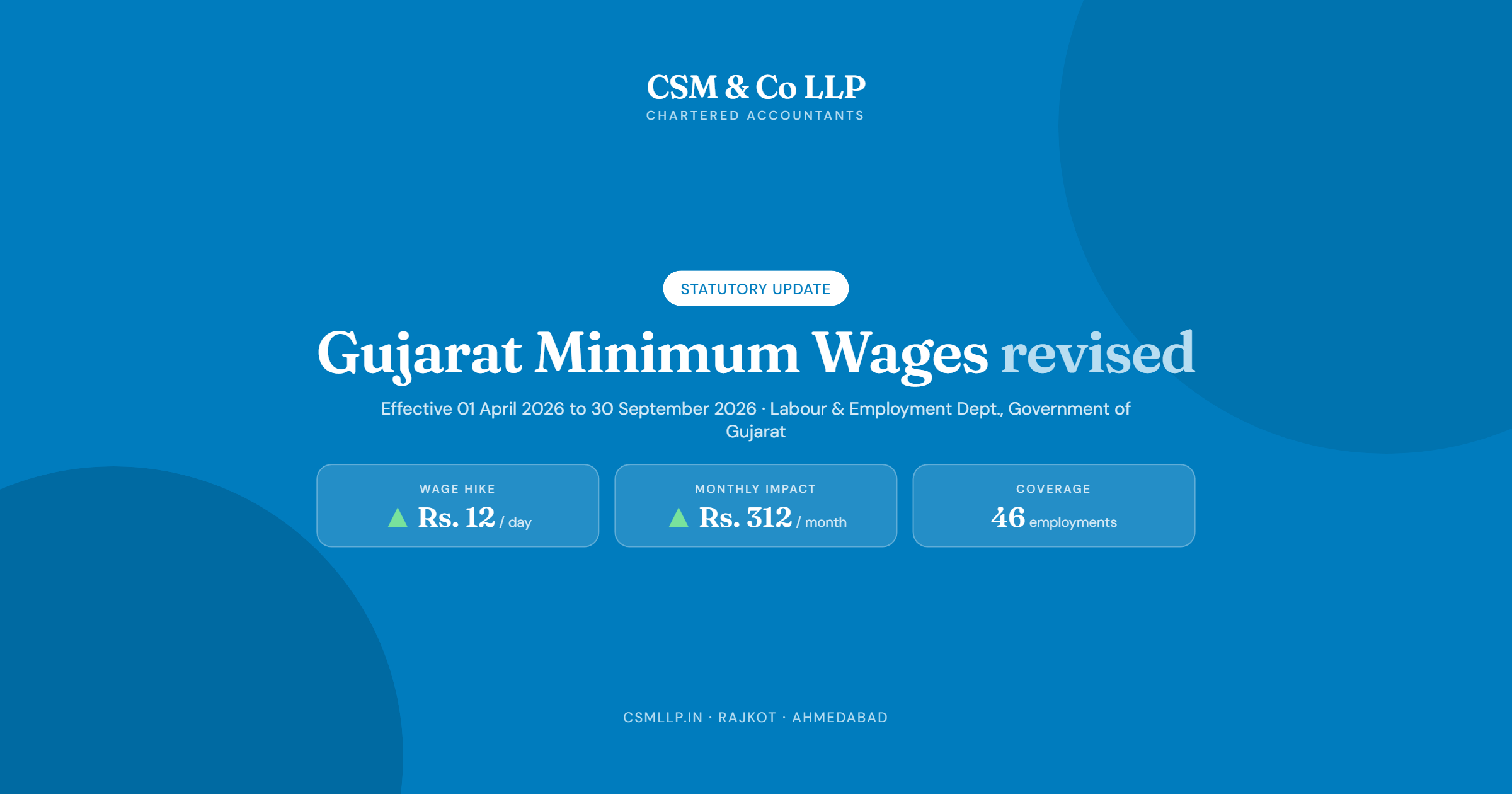
  • Gujarat minimum wages hiked by Rs. 12 per day (approx. Rs. 312 per month).
  • Effective 01 April 2026 to 30 September 2026.
  • Applies to 46 scheduled employments, factories, ship-breaking work and sweeping & cleaning work.
  • Employers must revise payroll, wage registers and notice boards from the April 2026 wage cycle.

The Labour & Employment Department, Government of Gujarat has notified a revision in minimum wages applicable across the State. The revised rates are effective for the six-month cycle 01 April 2026 to 30 September 2026.

Every employer in Gujarat covered under the Minimum Wages Act, 1948 must reflect these revised rates in wages payable from the April 2026 wage cycle onwards. Non-compliance carries penal, financial and reputational risk — and is a common finding during labour inspections and internal audits.

Notification at a glance

  • Effective period: 01 April 2026 to 30 September 2026
  • Notification reference: ક્રમાંક: પ.લ.મ.૬/ટ.૩/૨૦૨૬/૧૪૨ થી ૧૬૪, dated 01-04-2026
  • Issued by: Labour & Employment Department, Government of Gujarat
  • Wage revision: +Rs. 12 per day / +Rs. 312 per month
  • Coverage: 46 scheduled employments, factories & ship-breaking work, and sweeping & cleaning work

Revised daily minimum wage rates (in Rupees)

The “Per day” figure is what an employer must pay a worker per working day. It is the sum of Basic and V.D.A.

Scheduled employment / Factory / Ship-breaking work

Category Zone Basic V.D.A. Per day Per month
Skilled Zone I 474.00 60.50 534.50 13,897
Semi-skilled Zone I 462.00 60.50 522.50 13,585
Unskilled Zone I 452.00 60.50 512.50 13,325
Skilled Zone II 462.00 60.50 522.50 13,585
Semi-skilled Zone II 452.00 60.50 512.50 13,325
Unskilled Zone II 441.00 60.50 501.50 13,039

Sweeping & cleaning work

Zone equivalent Basic V.D.A. Per day Per month
Zone I equivalent 452.00 60.50 512.50 13,325
Zone II equivalent 441.00 60.50 501.50 13,039

Zone classification

  • Zone I: All Municipal Corporations and Municipalities in Gujarat.
  • Zone II: All other areas in Gujarat not covered under Zone I.

Worker category definitions

  • Unskilled: Simple duties requiring the operation of simple tools or machines and little or no independent judgement.
  • Semi-skilled: Work of a defined routine nature; the requirement is judgement of a limited scope, not skill.
  • Skilled: Working efficiently while exercising considerable independent judgement, with thorough knowledge of the trade.
  • Highly skilled: Working efficiently and supervising the work of skilled workers.

Understanding V.D.A. (Variable Dearness Allowance)

V.D.A., also called the Special Allowance or Dearness Allowance, is a component that is revised periodically based on movement in the Consumer Price Index (CPI). For this cycle, V.D.A. is Rs. 60.50 per day uniformly across all categories and zones.

It must be paid over and above the basic minimum wage, or, at the employer’s option, merged into the basic — provided the total payable to the worker is not less than the notified minimum “Per day” rate.

Employer compliance checklist

  1. Update payroll master. Revise the daily and monthly rates against each worker in the payroll system with effect from 01 April 2026.
  2. Reclassify workers correctly. Confirm each worker is tagged to the correct Zone (I or II) and skill category. Misclassification is one of the most common findings in labour inspections.
  3. Wage register & wage slip. Ensure Form XVII (wage register) and Form XIX (wage slip) reflect the revised Basic and V.D.A. components separately.
  4. Statutory deductions. Review the downstream impact on ESIC, EPF, Professional Tax and Labour Welfare Fund contributions where these are computed on gross wages.
  5. Contract labour & outsourced staff. Cross-check that contractors and manpower agencies engaged by the establishment are also paying the revised minimum. The principal employer’s liability under the Contract Labour (Regulation & Abolition) Act, 1970 continues.
  6. Notice board. Update the notice of rates of wages displayed at the workplace, as required under Section 18 of the Act.
  7. Retain the notification. Keep a copy of the Gujarat notification on file for inspection.

Penalty for non-compliance

Under the Minimum Wages Act, 1948 (read with the Code on Wages, 2019, once fully notified), paying less than the notified minimum wage is a punishable offence. The Authority may also direct the employer to pay the shortfall to the workers along with compensation, which may extend to ten times the amount of such shortfall. In practice, the financial exposure from back-wages, compensation and interest can far exceed the statutory fine — which is why periodic internal audits of payroll compliance are worth the investment.


Frequently asked questions

Is the “Per day” rate gross or net?

The “Per day” rate is the gross statutory minimum payable to the worker for a working day. Statutory deductions such as EPF, ESIC and PT continue to apply on top of this, per the respective statutes.

Is V.D.A. mandatory over and above Basic?

Yes. V.D.A. must be paid in addition to the Basic wage, or merged into the Basic, so long as the total is not less than the notified “Per day” rate. Paying only the Basic component (without V.D.A.) is non-compliance.

Does this notification apply to contract workers?

Yes. Contract workers engaged through a manpower vendor or licensed contractor are entitled to the same minimum wage. The principal employer remains liable if the contractor defaults.

Is a worker in Vadodara Municipal Corporation limits in Zone I or Zone II?

Vadodara Municipal Corporation is a Municipal Corporation, so it falls under Zone I. Areas outside the Corporation limits generally fall under Zone II — refer to the notification for the specific area boundaries.

What if the worker is paid a monthly salary that already exceeds the minimum monthly figure?

Compliance is measured on the “Per day” rate. If the monthly salary divided by the number of working days in the wage period is at least equal to the notified “Per day” rate, the employer is compliant. Ensure this holds even in months with fewer working days.

Does the revision apply to apprentices and trainees?

Apprentices covered under the Apprentices Act, 1961 are governed by that Act’s stipend rates. Trainees not covered by the Apprentices Act are treated as workers and are entitled to the minimum wage.

How CSM & Co LLP can help

At CSM & Co LLP, Chartered Accountants, we work with employers across Gujarat on Internal Audit, Tax and MIS Dashboards. As part of these engagements, we regularly cover payroll and labour law compliance areas including:

  • Reviewing the payroll register for correct application of the revised Gujarat minimum wages
  • Auditing contractor and manpower vendor wage compliance for the current cycle
  • Assessing exposure under ESIC, EPF, Professional Tax and Labour Welfare Fund
  • Building a periodic MIS dashboard for tracking labour law compliance and payroll KPIs

Please reach out to our team and we will be happy to assist.

Disclaimer

The rates and provisions summarised above are based on the notification issued by the Labour & Employment Department, Government of Gujarat. While every effort has been made to ensure accuracy, employers are advised to refer to the official Gujarat Government notification (ક્રમાંક: પ.લ.મ.૬/ટ.૩/૨૦૨૬/૧૪૨ થી ૧૬૪, dated 01-04-2026) for the authoritative text before acting. This post is for general information and does not constitute legal or professional advice.

EPF vs EPS: Differences in Contribution, Withdrawal, Pension and Tax

Last updated: 09 October 2026 · Written and reviewed by CA Meet Dhrangadhariya, CSM & Co LLP

Quick summary

  • EPF is your retirement savings (12% from you, 12% from the employer, with interest). EPS is a pension scheme funded only by the employer.
  • Out of the employer’s 12%, 8.33% goes to EPS (on wages up to Rs 15,000, so at most Rs 1,250 a month) and the rest, 3.67%, goes to EPF.
  • EPF pays a lump sum with interest. EPS pays a monthly pension from age 58, or a one-time withdrawal benefit if you leave before 10 years of service.
  • Since the EPFO decision of 13/10/2025, premature final settlement of EPF needs 12 months of unemployment (earlier two months) and EPS withdrawal 36 months.

Both the Employees’ Provident Fund (EPF) and the Employees’ Pension Scheme (EPS) run under the Employees’ Provident Funds and Miscellaneous Provisions Act, 1952 and are managed by the EPFO. They are two parts of the same deduction on your payslip, but they do different jobs: EPF is a savings pot that you take as a lump sum, EPS is a pension.

What is EPF?

Both you and your employer contribute 12% of your wages (basic salary plus dearness allowance) to your EPF account every month. The balance earns interest declared by the government each year, and you can take the whole amount at retirement. Of the employer’s 12%, only part reaches this account, as explained below.

What is EPS?

EPS pays a monthly pension to the member after retirement, and to the family on the member’s death. You do not contribute to it. It is funded from the employer’s 12%: 8.33% of wages goes to EPS and the remaining 3.67% goes to EPF.

EPF and EPS side by side

Point EPF EPS
Your contribution 12% of wages Nil
Employer contribution 3.67% of wages 8.33% of wages (wages counted up to Rs 15,000, so at most Rs 1,250 a month)
Interest Yes, declared every year No interest, it is a pension entitlement
What you receive Lump sum of contributions plus interest Monthly pension, or a withdrawal benefit if service is under 10 years
Pension age Not applicable 58 years (reduced early pension possible from 50)
Who is covered Employees of covered establishments; wages up to Rs 15,000 are compulsory, above that by joint option Members who joined before 58 and whose wages are counted up to the ceiling

Withdrawal rules after the October 2025 changes

On 13/10/2025 the EPFO Central Board of Trustees decided to simplify withdrawals. As reported at the time:

  • Partial withdrawals are merged into three heads (essential needs, housing, special circumstances), with a uniform minimum service of 12 months.
  • Premature final settlement of the EPF balance now needs 12 months of unemployment, earlier two months.
  • Final withdrawal of the pension (EPS) balance now needs 36 months, earlier two months.
  • 25% of contributions is to be kept as a minimum balance in the account.

Reports from mid-2026 say the Government has since notified the EPF Scheme, 2026 (stated to be effective from 29/06/2026) to give effect to these changes. Reports differ on the exact waiting period for the balance on leaving a job, so read the current text of the Scheme and EPFO circulars on the EPFO website before you apply. Retirement at 58 is unchanged.

Tax on EPF and EPS

  • Interest on EPF: tax free on your contributions up to Rs 2.5 lakh a year (Rs 5 lakh if there is no employer contribution). Interest on the excess is taxable every year.
  • Employer contribution: the employer’s contribution to EPF, NPS and superannuation together above Rs 7.5 lakh a year is taxed as a perquisite in your hands.
  • Withdrawal before five years of continuous service: TDS applies on the taxable part if the amount is more than Rs 50,000. Withdrawal after five years is not taxed.
  • EPS pension: taxable as salary in the year you receive it.
  • Section 80C: your EPF contribution qualifies only if you choose the old tax regime.

Which one matters to you?

If you plan to leave a job before 10 years, check your EPS service on the passbook and decide between the withdrawal benefit and carrying the service forward with a scheme certificate. For long-term savings, EPF is the bigger balance. If your wages are above Rs 15,000, ask whether your employer contributes on the actual wage or on Rs 15,000.

Frequently asked questions

Do I contribute to EPS?

No. EPS is funded by the employer’s share only (8.33% of wages, with wages counted up to Rs 15,000 a month). Your own 12% goes entirely to EPF.

How much of the employer’s 12% goes to EPS?

8.33% of wages goes to EPS and the balance 3.67% goes to EPF. For wages above Rs 15,000 the EPS part is capped at Rs 1,250 a month unless the higher pension option was exercised.

Does EPS earn interest?

No. EPS builds service and pensionable salary, not a balance. EPF earns interest declared by the government every year.

At what age does EPS pension start?

At 58. A reduced early pension is possible from age 50, as long as you have 10 years of service.

Can I withdraw the EPS amount if I leave a job early?

If you have less than 10 years of service you can take a withdrawal benefit, or get a scheme certificate to carry the service to the next employer. Final pension withdrawal now needs 36 months out of employment.

Is EPF interest taxable?

Interest on your own contributions up to Rs 2.5 lakh a year is tax free (Rs 5 lakh if there is no employer contribution). Interest on the part above the limit is taxable.

Official sources

Disclaimer

This article is for general informational purposes only and should not be considered professional advice. Please consult a qualified expert for advice tailored to your specific situation. The author and website owner are not liable for any errors or actions based on this content.

PF and ESIC Compliance for Employers under the Code on Social Security: Registration, Deduction, Interest, Damages and Penalties

Last updated: 09 October 2026 · Written and reviewed by CA Meet Dhrangadhariya, CSM & Co LLP

Quick summary

  • The Code on Social Security, 2020 (in force from 21/11/2025) replaced the EPF Act, 1952 and the ESI Act, 1948. PF applies to establishments with 20 or more employees and ESI to establishments with 10 or more persons.
  • An establishment already registered under an earlier labour law need not register again; that registration is treated as registration under the Code.
  • An employer who deducts the employee share from wages and does not deposit it faces imprisonment of at least one year (up to three years) and a fine of Rs 1 lakh. Other defaults carry two months to six months and Rs 50,000.
  • Delay attracts simple interest at the notified rate and damages up to the amount of arrears, after a hearing.

Since 21/11/2025 an employer’s PF and ESI duties come from the Code on Social Security, 2020. The Code repealed the Employees’ Provident Funds and Miscellaneous Provisions Act, 1952 and the Employees’ State Insurance Act, 1948 (and seven other laws). The schemes, rates and wage ceilings continue as notified, but the penalty and procedure rules below are now from the Code itself.

When does each scheme apply?

The First Schedule to the Code says:

Scheme Applies to
Employees’ Provident Fund (Chapter III) Every establishment in which twenty or more employees are employed
Employees’ State Insurance (Chapter IV) Every establishment in which ten or more persons are employed, other than a seasonal factory. A notified hazardous or life threatening occupation is covered even with a single employee

For the head count, employees earning above the notified wage ceiling are also counted. An employer and the majority of employees can agree to bring a smaller establishment under the PF chapter by applying to the Central Provident Fund Commissioner, and the Government can extend the Code to establishments above a notified size.

Registration

Every establishment to which the Code applies registers electronically or otherwise, within the time and in the manner prescribed (section 3). An establishment already registered under any other Central labour law does not have to register again, and that registration is treated as registration under the Code. An establishment that is closing down can apply to cancel the registration.

Wages: what the contribution is calculated on

The Code defines “wages” in section 2(88) as basic pay, dearness allowance and retaining allowance, with listed exclusions (statutory bonus, house rent allowance, conveyance allowance, overtime, commission, the employer’s PF contribution, gratuity and retirement payments). If the exclusions add up to more than one-half of total remuneration (or the percentage notified), the excess is added back to wages. Check your pay structure against this cap, because it can raise both PF and ESI contributions.

Who pays what

  • The employer pays both the employer’s and the employee’s contribution for every employee, whether employed directly or through a contractor.
  • The employer may recover the employee’s contribution only by deduction from wages, only for the period it relates to and not more than the employee’s share.
  • The employer’s contribution cannot be deducted from wages or recovered from the employee in any way.
  • Sums deducted from wages are deemed to be entrusted to the employer for the purpose of paying the contribution.
  • For contract workers, the principal employer pays and recovers the amount from the contractor, who in turn may recover only the employee’s share from the worker’s wages.
  • Employees must establish identity through Aadhaar for registration and for claiming benefits or withdrawing funds (section 142).

If you pay late or do not pay

Consequence What the Code says
Interest (section 127) Simple interest at the rate notified by the Central Government, from the date the amount became due till actual payment
Damages (section 128) Up to the amount of arrears, levied by the PF Commissioner or ESIC Director General (or authorised officer), after giving the employer an opportunity of being heard
Failure to pay employee share that was deducted (section 133(i)(a)) Imprisonment of at least one year, up to three years, and a fine of Rs 1 lakh
Failure to pay any other contribution (section 133(i)(b)) Imprisonment of at least two months, up to six months, and a fine of Rs 50,000
Deducting the employer’s share from wages, or failing to file a return Fine up to Rs 50,000
Obstructing an inspector, or failing to produce records Imprisonment up to six months or fine up to Rs 50,000, or both
Repeat offence (section 134) Imprisonment up to two years and fine of Rs 2 lakh; for repeat non-payment of contributions, at least two years, up to three, and fine of Rs 3 lakh

In the case of a company, every person directly in charge of the conduct of its business, as well as the company, is deemed guilty (section 135). The court can impose a lesser jail term for adequate and special reasons recorded in the judgment, and offences can be compounded as the Code provides.

A practical checklist

  1. Count employees, including those above the wage ceiling, to see whether PF (20) and ESI (10) apply.
  2. Keep the registration number from the old law in your records; it carries over.
  3. Recalculate wages under the Code definition and check the one-half rule.
  4. Deposit both shares on time, every month, for contract workers too.
  5. File returns and keep registers ready for the inspector.

Points to check

  • This post follows the Code as published on India Code. Rates, the wage ceiling, interest rate and filing dates are fixed by rules, regulations and notifications issued under the Code, so check those before relying on a figure.
  • Penalty amounts and imprisonment terms are the maximums and minimums written in the Code; the actual order depends on the court.

Frequently asked questions

When does PF apply to an establishment?

Chapter III (Employees’ Provident Fund) applies to every establishment in which twenty or more employees are employed. Employees earning above the wage ceiling are counted for this head count.

When does ESI apply?

Chapter IV applies to every establishment in which ten or more persons are employed, other than a seasonal factory, and to a notified hazardous establishment even with one employee.

Do I have to register again under the Code?

An establishment already registered under any other Central labour law is not required to register again; its registration is deemed to be registration under the Code. A new establishment registers electronically as prescribed.

Can I deduct the employer share from wages?

No. The employer can recover only the employee’s contribution, by deduction from wages for the period it relates to, and the employer’s contribution cannot be recovered from the employee in any way.

What if the deducted employee contribution is not deposited?

The sum deducted is treated as entrusted to the employer. Failure to pay it is punishable with imprisonment of at least one year, up to three years, and a fine of Rs 1 lakh.

What are the interest and damages for late payment?

Simple interest at the rate notified by the Central Government from the due date to the date of payment, and damages up to the amount of arrears, levied after the employer has been heard.

Can the employer use a contractor to pay PF and ESI?

The principal employer pays the employer’s and employee’s share for contract workers and then recovers the amount from the contractor.

Official sources

Related reading

Disclaimer

This article is for general informational purposes only and should not be considered professional advice. Please consult a qualified expert for advice tailored to your specific situation. The author and website owner are not liable for any errors or actions based on this content.

How to Reach the ₹1,50,000 Section 80C Limit Without New Investments

Last updated: 30 July 2026 · Written and reviewed by CA Meet Dhrangadhariya, CSM & Co LLP

Quick summary

  • You may already be near the ₹1.5 lakh section 80C limit through payments you make anyway: EPF, life insurance premium, home loan principal, children’s tuition fees, and stamp duty on a house.
  • Add up these items first, then invest only the gap, if any.
  • Section 80C is available only in the old tax regime and is section 123 of the Income-tax Act, 2025 from Tax Year 2026-27.
  • Declare the items to your employer in Form 124 (earlier Form 12BB) so TDS is adjusted.

How to check your 80C position

1. Note your EPF contribution for the year
↓
2. Add home loan principal repaid and stamp duty if you bought a house
↓
3. Add children’s tuition fees (up to two children)
↓
4. Add life insurance premiums that qualify
↓
5. Subtract the total from ₹1,50,000 and invest only the balance

Every March someone suggests that you must invest in a tax-saving scheme to use up section 80C. Before you do, check what you have already paid during the year. Many ordinary payments qualify, and you may have used most of the ₹1,50,000 limit without any new investment.

Section 80C works only in the old tax regime. From Tax Year 2026-27 it is section 123 of the Income-tax Act, 2025, with the same ₹1.5 lakh limit.

Step by step

  1. Employees’ Provident Fund. Your own contribution to EPF during the year counts. Check your salary slip or EPF passbook. For many salaried people this alone is a large amount.
  2. Home loan principal. The principal part of your EMIs counts. Your lender’s certificate shows it.
  3. Stamp duty and registration. If you bought a house, the stamp duty and registration charges paid in that year count.
  4. Children’s tuition fees. Tuition fees for full time education of up to two children in India count, including playschool and preschool fees if they are tuition fees. Development fees, donations and transport do not.
  5. Life insurance premium. Premiums on a policy for yourself, your spouse or your children count. The premium should be within 10% of the sum assured for policies issued after 31/03/2012 (15% for a disabled person or specified diseases).
  6. Employee’s NPS contribution under section 80CCD(1) also counts within the same limit.
  7. Add them up and subtract the total from ₹1,50,000. The result is the balance of the limit.
  8. Invest only the balance, if any, in a product that suits your risk and your time horizon, such as PPF, ELSS, NSC, a 5 year tax-saver FD, Senior Citizens’ Savings Scheme or Sukanya Samriddhi Yojana.

Example

Priya’s EPF contribution is ₹72,000. She repaid ₹48,000 of home loan principal and paid ₹20,000 of tuition fees for one child. The total is ₹1,40,000, so only ₹10,000 of the limit is left. She does not need to invest ₹1.5 lakh in ELSS.

Who can claim?

Individuals (resident or non-resident) and Hindu undivided families can claim section 80C. Companies, firms and LLPs cannot.

How to claim

Give your employer a declaration in Form 124 (earlier Form 12BB) with proofs, so that less TDS is deducted. EPF is usually already known to the employer. If you did not declare it, you can claim the deduction when you file your return, as long as you are in the old regime and file on time.

What not to do

  • Do not buy a product only because the limit is unfilled. Choose it for the return, lock-in and risk.
  • Do not forget that a home loan principal or stamp duty claim is reversed if you sell the house within five years of getting possession.
  • Do not assume this works in the new tax regime. If you move to the new regime, 80C is lost altogether, so compare your total tax first.

Frequently asked questions

Can I reach the section 80C limit without investing?

Often, yes. EPF, life insurance premium, home loan principal, tuition fees and stamp duty can already add up to ₹1.5 lakh.

Do I need to invest more once the limit is reached?

No. The deduction is capped at ₹1.5 lakh, so extra investment under 80C does not reduce tax further.

Is my EPF counted?

Yes, your own contribution to the Employees’ Provident Fund counts.

Which tuition fees count?

Tuition fees for full time education of up to two children in India. Development fees and donations do not count.

Is 80C available in the new tax regime?

No. It is available only in the old tax regime.

Official sources

Related reading

Disclaimer

This article is for general informational purposes only and should not be considered professional advice. Please consult a qualified expert for advice tailored to your specific situation. The author and website owner are not liable for any errors or actions based on this content.

WhatsApp