Tax-Free Income in India: Complete List for Tax Year 2026-27

Last updated: 15 September 2026 · Written and reviewed by CA Meet Dhrangadhariya, CSM & Co LLP

Quick summary

  • The Income-tax Act, 2025 lists tax-free income in Schedule II (for everyone) and Schedule III (for eligible persons), with salary items in section 19 and gifts in section 92.
  • Agricultural income, Sukanya Samriddhi payouts, PPF and EPF within the interest limits, most life insurance maturity, gratuity and VRS compensation within limits are tax-free.
  • Several Schedule III items, such as LTA and special allowances, are lost in the new tax regime.
  • Tax-free income must still be reported in the return.

Some income does not form part of your total income at all. It is not taxed and no deduction has to be claimed for it. In the Income-tax Act, 2025, which applies from 1 April 2026, this list sits mainly in Schedule II (income not to be included in total income) and Schedule III (income of eligible persons), with salary related receipts in section 19 and gifts in section 92. For FY 2025-26 the corresponding list is in section 10 of the 1961 Act.

Exemption and deduction are different

An exemption keeps the income out of total income, so you only report it. A deduction is taken from income that has been included, and is allowed only up to its limit. Standard deduction, section 80C and similar items are deductions, not exemptions.

Schedule II: tax-free for everyone

Income Conditions and limits
Agricultural income No condition. It is still counted to fix the tax rate on other income if it exceeds ₹5,000
Life insurance maturity or other payout, including bonus Policy issued 01/04/2003 to 31/03/2012: premium up to 20% of sum assured. 01/04/2012 to 31/03/2013: up to 10%. 01/04/2013 to 31/01/2021: up to 15% for a special policy and 10% for others. From 01/04/2023: below 15% (special policy) or 10% (others), and for ULIPs total yearly premium below ₹2,50,000, for other policies below ₹5,00,000 across all policies. Keyman policies and the sum under section 127(4) are not exempt. A death claim is exempt
Payment from a statutory provident fund or notified fund Interest on contributions made on or after 01/04/2021 is taxable if the yearly contribution is above ₹5,00,000 (no employer contribution) or ₹2,50,000 (other cases)
Accumulated balance of a recognised provident fund (EPF) To the extent provided in the Act; the same ₹2,50,000 and ₹5,00,000 interest limits apply
Sukanya Samriddhi Account payouts No limit
National Pension System payout On closure or opting out, up to 60% of the amount payable.
Agniveer Corpus Fund payout Whole amount
Approved superannuation fund payments On death, retirement or incapacity, and certain refunds
Scholarships Granted to meet the cost of education
Awards and rewards Instituted in the public interest by the Government or approved by it
Interest on notified Central Government securities, bonds, savings certificates and deposits As notified
Gold Deposit Bond and Gold Monetisation Scheme interest Whole amount
Interest on local authority and State pooled finance entity bonds As notified
Transfer of units of the Unit Scheme, 1964 On or after 01/04/2002
Unified Pension Scheme payouts Up to 60% of the individual corpus on retirement, and the notified lump sum

Schedule III: tax-free for eligible persons

Income Who and conditions
Sums received by a member from a Hindu undivided family Paid out of family income, and not covered by section 99(3) and (4)
Partner’s share of profit Firm separately assessed, in the profit sharing ratio. Salary and interest from the firm are taxable
Compensation for a disaster from the Government or local authority Where no deduction was earlier allowed for the loss
NPS partial withdrawal Up to 25% of the contributions made by the subscriber
Daily allowance and constituency allowance of MPs and members of State Legislatures Whole amount
Leave travel concession (LTA) Up to the prescribed journeys and amount actually spent. Not available in the new regime
Allowances and perquisites paid by the Government outside India Citizen of India serving outside India
Tax paid by the employer on a non-monetary perquisite At the employer’s option
Special allowance for actual expenditure (serial 11), and the prescribed allowances in serial numbers 12 and 13 (Rule 280) Within the limits of the Income-tax Rules, 2026. Mostly not available in the new regime
Income of Scheduled Tribe members in notified areas, and of Sikkimese See the separate post on section 10(26)

Salary related receipts (section 19)

Receipt Tax-free limit
Death-cum-retirement gratuity of government employees Entire amount
Gratuity under the Payment of Gratuity Act, 1972 As calculated under section 4(2) and (3) of that Act, up to ₹20,00,000
Other gratuity Least of the actual amount, the notified limit, and half a month’s average salary of the last ten months for each completed year of service
Commutation of pension Government employees: entire amount. Others: one-third of the pension where gratuity is received, or one-half where it is not
Retrenchment compensation to a workman Least of the compensation, the amount under section 25F(b) of the Industrial Disputes Act, 1947, and the notified amount (not less than ₹50,000)
Voluntary retirement compensation Up to ₹5,00,000
Leave encashment on retirement Government employees: entire amount. Others: least of the cash equivalent of leave (up to 30 days a year of service), ten months’ average salary, the notified limit and the amount received

“Salary” for gratuity and leave encashment means basic pay plus dearness allowance if the terms of employment provide for it, and no other allowance or perquisite. The ceilings are fixed by Central Government notification: ₹20,00,000 for gratuity (notifications of 29 March 2018 and 8 March 2019) and ₹25,00,000 for leave encashment on retirement of a non-government employee (Notification 31/2023, from 1 April 2023). Check that no later notification has changed them. Employees who change jobs should also note that the gratuity limit is a lifetime figure reduced by gratuity already exempted in earlier years.

Gifts (section 92)

Money or property received without consideration is taxable if it totals more than ₹50,000 in a year (for property bought for less than its value, if the shortfall exceeds ₹50,000). It is not taxable at all when it comes from a relative, on the occasion of the individual’s marriage, under a will or by inheritance, in contemplation of death, from a local authority, from a registered non-profit organisation (with exceptions), through certain transactions not treated as transfers, or from an individual to a trust created solely for the benefit of a relative.

New tax regime

Section 202 of the 2025 Act removes some of these when the new regime applies: the Schedule III items at serial numbers 5, 6, 7, 8, 11 and 17, and the prescribed allowances at serial numbers 12 and 13, along with professional tax and a few other deductions. Schedule II items, section 19 receipts, and gifts are not touched. The family pension deduction is ₹25,000 in the new regime and ₹15,000 otherwise, each limited to one-third of the pension.

Tax-free income is not the same as the basic exemption limit

Income up to the basic exemption limit is simply not taxed at the slab rates. The limit is ₹4,00,000 under section 202 (new regime), and in the old regime ₹2,50,000 below age 60, ₹3,00,000 for resident seniors and ₹5,00,000 for resident super seniors. On top of that, a resident individual gets a rebate: ₹60,000 where total income does not exceed ₹12,00,000 (new regime, section 156), and ₹12,500 where it does not exceed ₹5,00,000 (old regime).

Report exempt income

Show exempt income in the exempt income schedule of the return. The department matches it with Form 26AS, AIS and the Taxpayer Information Summary, and an unreported receipt causes mismatches.

Frequently asked questions

Where does the Income-tax Act 2025 list tax-free income?

In Schedule II (income not included in total income of anyone), Schedule III (for eligible persons), section 19 (salary related receipts such as gratuity and leave encashment) and section 92(3) (gifts that are not taxed).

Is life insurance maturity tax-free?

Mostly. A policy issued on or after 01/04/2023 qualifies if the premium is below 10% of the sum assured (15% for special policies) and, for non-ULIP policies, the aggregate annual premium is below ₹5,00,000. A death claim is tax-free.

Is PPF interest tax-free?

Yes, with a limit. Interest on contributions above ₹2,50,000 a year (₹5,00,000 where the employer makes no contribution) made on or after 01/04/2021 is taxable.

Are gifts taxable?

Money or property received without consideration above ₹50,000 in a year is taxable, unless it is from a relative, on marriage, by will or inheritance, in contemplation of death, or from certain institutions.

Do tax-free incomes go in the return?

Yes. Exempt income is reported in the exempt income schedule, even though it is not taxed.

Official sources

Related reading

Disclaimer

This article is for general informational purposes only and should not be considered professional advice. Please consult a qualified expert for advice tailored to your specific situation. The author and website owner are not liable for any errors or actions based on this content.

Section 80JJAA: Deduction for Employing New Employees, Conditions and Example

Last updated: 02 October 2026 · Written and reviewed by CA Meet Dhrangadhariya, CSM & Co LLP

Quick summary

  • Section 80JJAA gives a deduction of 30% of additional employee cost for three consecutive years to businesses subject to tax audit.
  • An additional employee earns up to ₹25,000 a month, works at least 240 days (150 for apparel, footwear and leather) and is in a recognised provident fund.
  • It is not limited to manufacturers, and it is allowed in both tax regimes.
  • From Tax Year 2026-27 it is section 146 of the Income-tax Act, 2025 and the accountant’s report is Form 34 (earlier Form 10DA).

Section 80JJAA rewards businesses that add jobs in the formal sector. A business subject to tax audit can deduct 30% of the cost of its additional employees, every year for three years. From Tax Year 2026-27 the provision is section 146 of the Income-tax Act, 2025. For FY 2025-26 (assessment year 2026-27) it is still section 80JJAA of the 1961 Act.

Who can claim?

An assessee whose accounts are required to be audited under section 44AB (section 63 of the 2025 Act) and whose gross total income includes business profits. The section does not limit the benefit to manufacturers or to any sector; many online guides wrongly say service businesses are excluded. The law has no such condition.

How much, and for how long?

The deduction is 30% of the additional employee cost incurred in the year. It is allowed for three consecutive years, beginning with the year in which the employment is provided. So a new employee hired in one year gives deductions in that year and the next two.

Who is an additional employee?

An employee employed in the year whose employment increases the total number of employees over the number on the last day of the preceding year, but not one:

  • whose total emoluments are more than ₹25,000 a month,
  • for whom the Government pays the entire contribution under the Employees’ Pension Scheme,
  • employed for less than 240 days in the year (150 days for a business making apparel, footwear or leather products), or
  • who does not participate in a recognised provident fund.

An employee who falls short of the days in the year of joining but completes the required days in the next year is treated as an additional employee of that next year.

What is additional employee cost?

It is the total emoluments paid or payable to the additional employees in the year. In the first year of a new business, the emoluments of all employees employed in that year count. For an existing business the cost is nil if:

  • the number of employees has not increased over the number on the last day of the preceding year, or
  • emoluments are paid otherwise than by account payee cheque, account payee draft, electronic clearing through a bank account or another prescribed electronic mode.

“Emoluments” means any sum paid or payable to an employee for employment, by whatever name called. It excludes the employer’s contribution to a pension, provident or other fund required by law, and lump sums on termination, retirement or voluntary retirement such as gratuity, severance pay, leave encashment and commutation of pension.

When is the deduction not allowed?

  • The business was formed by splitting up or reconstructing an existing business. The exception is a business formed by re-establishment, reconstruction or revival in the circumstances the Act allows.
  • The business was acquired by transfer from another person or through a business reorganisation.
  • The assessee does not furnish the accountant’s report before the specified date (the audit report date under section 44AB or section 63).

Accountant’s report: Form 10DA and Form 34

  • Up to FY 2025-26 the report is Form 10DA.
  • Under Rule 68 of the Income-tax Rules, 2026 the report required by section 146(3)(c) is Form 34. It is certified by a chartered accountant.

Example

A company with a tax audit had 40 employees on 31 March 2026. During FY 2026-27 it hires 10 people at ₹20,000 a month, each in a recognised provident fund and each working the full year. No one else is added and no one leaves.

Item Amount in ₹
Additional employee cost (10 x 20,000 x 12) 24,00,000
Deduction at 30% 7,20,000

The company claims ₹7,20,000 in each of the next three years (Tax Years 2026-27, 2027-28 and 2028-29) as long as the conditions are met for the cost of these employees. Hiring someone at ₹30,000 a month would not qualify, because that employee’s emoluments are above ₹25,000.

Which tax regime?

The deduction stays available in the new tax regime. Section 202 of the 2025 Act removes most Chapter VIII deductions in the new regime but keeps section 146, along with 124(1), 124(2) and 125(2).

Frequently asked questions

Who can claim section 80JJAA?

A business whose accounts are subject to tax audit (section 44AB, now section 63) and whose income includes business profits, in any sector. It is not limited to manufacturers.

How much is the deduction?

30% of the additional employee cost, allowed for three consecutive years starting with the year in which the employment is provided.

Which employees count as additional employees?

Employees whose total emoluments are up to ₹25,000 a month, who are in a recognised provident fund, who work at least 240 days in the year (150 days for apparel, footwear and leather), and whose employment raises the headcount over the last day of the preceding year.

Which form is needed?

Form 10DA up to FY 2025-26, and Form 34 under Rule 68 of the Income-tax Rules, 2026 from 01/04/2026, certified by a chartered accountant.

Is it available in the new tax regime?

Yes. Section 146 of the 2025 Act is one of the Chapter VIII deductions that stay allowed under section 202.

Official sources

Related reading

Disclaimer

This article is for general informational purposes only and should not be considered professional advice. Please consult a qualified expert for advice tailored to your specific situation. The author and website owner are not liable for any errors or actions based on this content.
Entertainment Allowance: Is It Still Deductible from Tax Year 2026-27?

Last updated: 21 July 2026 · Written and reviewed by CA Meet Dhrangadhariya, CSM & Co LLP

Quick summary

  • Under section 16(ii) of the 1961 Act, only Government employees could deduct entertainment allowance, in the old regime, limited to the least of ₹5,000, 20% of basic salary and the allowance received.
  • Private sector employees never got this deduction; the allowance was fully taxable for them.
  • The Income-tax Act, 2025 does not carry the deduction forward, so from Tax Year 2026-27 the allowance is taxable in full for everyone.
  • For FY 2025-26 (assessment year 2026-27) the old rule still applies to Government employees in the old regime.

Entertainment allowance is an amount an employer pays for entertaining visitors or clients on the employer’s behalf. It is part of salary and is taxable. For many years one narrow deduction existed for Government employees. The Income-tax Act, 2025 does not carry it forward.

The old rule: section 16(ii) of the 1961 Act

The allowance is first added to salary. A deduction is then allowed, but only to a Government employee in the old tax regime. The deduction is the least of:

  1. ₹5,000,
  2. 20% of the basic salary, and
  3. the entertainment allowance received.

Points to note:

  • The amount actually spent on entertainment makes no difference. The deduction is a fixed formula.
  • “Salary” for the 20% test excludes any allowance, benefit or perquisite, so it is in practice the basic pay.
  • The deduction depends on the allowance being paid as an entertainment allowance.
  • Private sector employees, and employees of statutory and local authorities, never got any deduction. The whole allowance was taxable for them.

Example (up to FY 2025-26, old regime)

A Government employee has a basic salary of ₹4,00,000 and receives an entertainment allowance of ₹40,000.

Test Amount in ₹
Fixed limit 5,000
20% of basic salary (20% of 4,00,000) 80,000
Allowance received 40,000
Deduction (the least) 5,000

The remaining ₹35,000 stays taxable as salary.

What the Income-tax Act, 2025 says

From Tax Year 2026-27, deductions from salary are listed in section 19 of the Income-tax Act, 2025. The list covers tax on employment (professional tax), the standard deduction, and the gratuity, pension commutation, retrenchment compensation, voluntary retirement and leave salary items. Entertainment allowance does not appear in it, and the Act does not mention the allowance anywhere else. So from Tax Year 2026-27 the whole entertainment allowance is taxable in every employee’s hands, whether in the government or the private sector.

New regime

The new regime never allowed this deduction. It allows the standard deduction of ₹75,000 and the few other items that survive in section 202.

What this means for payroll

A Government department paying entertainment allowance should stop allowing the ₹5,000 deduction in the TDS calculation for Tax Year 2026-27 onwards, and show the whole allowance as taxable salary.

Frequently asked questions

Who could claim a deduction for entertainment allowance?

Only Government employees, under section 16(ii) of the 1961 Act and only in the old tax regime. Private sector employees and employees of local authorities or statutory bodies could not.

What was the limit?

The least of ₹5,000, 20% of basic salary, and the entertainment allowance actually received. The amount spent is not relevant.

Is the deduction available for Tax Year 2026-27?

No. The list of deductions from salary in section 19 of the Income-tax Act, 2025 has no entry for entertainment allowance, so the whole allowance is taxable.

Does the allowance have to be called entertainment allowance?

Yes. The deduction depended on the employer paying it as an entertainment allowance.

Is it available in the new tax regime?

No. The new regime never allowed it, apart from the standard deduction.

Official sources

Disclaimer

This article is for general informational purposes only and should not be considered professional advice. Please consult a qualified expert for advice tailored to your specific situation. The author and website owner are not liable for any errors or actions based on this content.
AS 22 Accounting for Taxes on Income

Last updated: 10 September 2026 · Written and reviewed by CA Meet Dhrangadhariya, CSM & Co LLP

Quick summary

  • Profits in your accounts rarely match taxable profits, and AS 22 governs how the difference is accounted for.
  • Differences are either timing differences (they reverse in later years) or permanent differences (they never reverse).
  • Timing differences create deferred tax assets or deferred tax liabilities.
  • This guide covers when and how to apply AS 22, the deferred tax computation, and the comparison with Ind AS 12 and IFRIC 23.

How AS 22 is applied at a glance

1. Compare accounting income with taxable income
↓
2. Split the difference into timing differences (reversible) and permanent differences (not reversible)
↓
3. Ignore permanent differences, they create no deferred tax
↓
4. Taxable income higher than accounting income gives a deferred tax asset, recognised only with reasonable certainty (virtual certainty if there are losses or unabsorbed depreciation)
↓
5. Accounting income higher than taxable income gives a deferred tax liability
↓
6. Report tax expense as current tax plus deferred tax in the profit and loss statement

Profits as per your financial statements rarely match with your taxable profits. And it would be incorrect to ignore to account for the difference between these two profits. To govern the accounting for such differences, we cover the following topics  in this article w.r.t. AS 22 Accounting for Taxes on Income:

Introduction - Accounting Standard

Accounting Standard 22 has been prescribed by ICAI to be applied in accounting for taxes on income. This AS is applied to match the differences between accounting income and taxable income. 1. Accounting income is the net profit before tax for a period, as reported in the profit and loss statement. 2. Taxable income is the income on which income tax is payable, computed by applying provisions of the Income Tax Act, 1961 & Rules.

Types of differences and why they appear

The differences can be of two types:

Timing difference

Timing differences are those differences between accounting income and taxable income which can be reversed in one or more subsequent periods. For example, Depreciation allowed as per WDV method for computing taxable income and as per SLM method for computing accounting income.

Permanent difference

Permanent differences are those differences between accounting income and taxable income which cannot be reversed any subsequent period. For example, Donation paid in cash is disallowed in computing taxable income whereas it is allowed as expenditure while computing accounting income. There can be differences between accounting income and taxable income because of the following reasons:

  1. Expenses debited in profit and loss statement, but disallowed as per Income Tax Act 1961, while computing taxable income

  2. Provision for Bad/doubtful debts allowed while computing accounting income, but disallowed while computing taxable income

  3. Charging depreciation using different rates as per Companies Act 2013 and Income Tax Act 1961

  4. Any income recognized on an accrual basis in profit and loss statement but recognized on receipt basis in subsequent period for computing taxable income. In order to account for these kinds of differences, AS 22 needs to be applied.

When to apply AS 22 Accounting for Taxes on Income

Deferred Tax Liability formula

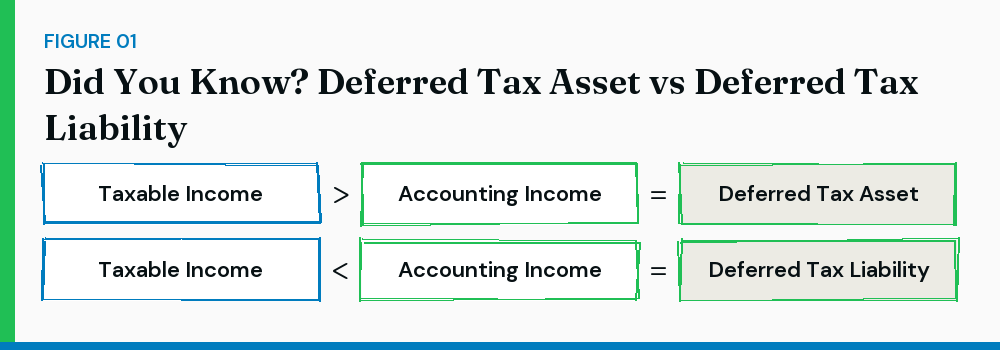
AS 22 needs to be applied when there are differences between taxable income and accounting income. If taxable income is greater than accounting income, then it will result in deferred tax asset. And if accounting income is greater than taxable income, then it will result in deferred tax liability.

When the difference is resulting in deferred tax asset, then it should be recognized only when there is a reasonable certainty of its realization. The recognition of deferred tax asset should be to the extent of the reasonable certainty of the expected realization. The reasonable certainty can be determined by making the realistic estimates of future profits based on the examination of profits and loss statement of earlier periods.

Say, an entity has unabsorbed depreciation or carry forward of losses. In such a case, deferred tax asset should be recognized to the extent there is a virtual certainty supported by convincing evidence. Virtual certainty is a matter of judgment of convincing evidence, which should be available in a concrete form at a particular date.

How to apply AS 22 Accounting for Taxes on Income

The application of AS 22 can be explained with the help of examples: Example of timing difference:

Particulars Year 1 Year 2 Year 3
Profit before tax (A) 100,000 200,000 180,000
Depreciation as per Companies Act (B) 25,000 25,000 25,000
Accounting income (A-B) 75,000 175,000 125,000
Depreciation as per Income tax Act (C) 50,000 0 10,000
Taxable income (A-C) 50,000 200,000 170,000
Timing difference (D) 25,000 -25,000 -15,000
Current tax @ 30% 15,000 60,000 51,000
Deferred tax (D * 30%) 7,500 -7,500 -4,500
Total tax expense 22,500 52,500 46,500
Profit after tax 52,500 122,500 78,500

Deferred tax computation

Particulars Year 1 Year 2 Year 3
Opening balance of timing difference 0 25,000 0
Addition 25,000 0 15,000
Deletion 0 25,000 0
Closing balance of timing difference 25,000 0 15,000
Deferred tax @ 30% 7,500 7,500 4,500
DTA/DTL Creation of DTL Reversal of DTL Creation of DTA
Journal Entry P&L A/c Dr. To DTL DTL Dr. To P&L A/c DTA Dr. To P&L A/c

Comparison between AS 22 and IND AS 12

Basis AS 22 Accounting for Taxes on Income IND AS 12 (Income taxes)
Recognition AS 22 recognized tax effect of differences between taxable income and accounting income. IND AS 12 recognized tax effect of differences between assets and/or liabilities and their tax base.
Approach AS 22 is based on profit or loss statement approach. IND AS 12 is based on balance sheet approach.
Differences The types of differences on which AS 22 is applied are timing differences and permanent differences. The types of differences on which IND AS 12 is applied are taxable temporary differences and deductible temporary differences. Permanent differences are not dealt in by this standard.
Recognition of Deferred tax asset/deductible temporary differences DTA is recognized only when and to the extent there is a reasonable certainty of its realization Deductible temporary differences are recognized to the extent of the probability of taxable profits in future periods.
Disclosure AS 22 deals with the disclosure of DTA/DTL in the balance sheet. IND AS 12 deals with the recognition of current or deferred tax as income or expense in profit and loss statement. It also deals with the disclosure of out of profit and loss transaction in the balance sheet as current or non-current assets/liability.
Revaluation of assets AS 22 does not cover the difference arising between taxable income and accounting income due to the revaluation of assets. IND AS 12 deals with the difference between carrying the amount of revalued asset and its tax base.
Goodwill AS 22 does not cover the difference arising due to goodwill arising a business combination. As per IND AS 12, the difference between carrying the amount of goodwill and its tax base (which will be NIL) is the taxable temporary difference. It does not allow the recognition of such difference because goodwill is measured as a residual and its recognition would increase the carrying amount of goodwill.
The concept of virtual certainty When an entity has unabsorbed depreciation or carry forward of losses then in such a case deferred tax asset should be to the extent there is a virtual certainty supported by convincing evidence. There is no concept of virtual certainty in IND AS 12. Deductible temporary differences are recognized to the extent of the probability of taxable profits in future periods.
Tax holiday AS 22 specifically provides guidance regarding recognition of deferred tax in the situations of Tax Holiday under Sections 80-IA, 80-IB, 10A and 10B of Income-tax Act. IND AS 12 does not specifically deal with the situations of the tax holiday.
Capital Loss AS 22 provides guidance regarding recognition of DTA in case of loss under the head of ‘capital gains’. IND AS 12 does not specifically provide for the same.

IFRIC 23

IFRIC 23 also provides for Uncertainty over Income Tax Treatments. It requires an entity to treat uncertain tax treatments depending on which method will be best suited for its resolution. The major difference between AS 22 and IFRIC 23 is that IFRIC 23 requires an entity, while determining the current and deferred income tax assets and liabilities, to make an assessment whether it is probable that taxation authority will accept an uncertain tax treatment.

If it is not probable, then entity should reflect that uncertainty through either expected value approach or most likely approach. IFRIC 23 will be applicable for annual reporting periods beginning on or after 01.01.2019.

Frequently asked questions

What is AS 22?

AS 22 is the Accounting Standard issued by ICAI that prescribes how taxes on income, including current tax and deferred tax, are accounted for in financial statements.

What is the difference between a timing difference and a permanent difference?

A timing difference arises in one period and reverses in later periods, for example depreciation under different methods. A permanent difference never reverses, for example an expense disallowed by the Income Tax Act.

Does AS 22 create deferred tax on permanent differences?

No. Deferred tax is recognised only for timing differences, not for permanent differences.

How is AS 22 different from Ind AS 12?

AS 22 applies to companies following the Companies (Accounting Standards) Rules and uses the income statement approach based on timing differences, while Ind AS 12 follows a balance sheet approach based on temporary differences.

Official sources

Related reading

Disclaimer

This article is for general informational purposes only and should not be considered professional advice. Please consult a qualified expert for advice tailored to your specific situation. The author and website owner are not liable for any errors or actions based on this content.
Indian Accounting Standard 12: Income Taxes

Last updated: 19 July 2026 · Written and reviewed by CA Meet Dhrangadhariya, CSM & Co LLP

Quick summary

  • Ind AS 12 prescribes how current tax and deferred tax are accounted for, using the balance sheet approach.
  • Deferred tax is recognised on temporary differences between the carrying amount of an asset or liability and its tax base.
  • Deferred tax liabilities are recognised on all taxable temporary differences, with limited exceptions such as initial recognition of goodwill.
  • Deferred tax assets are recognised only to the extent that future taxable profit will probably be available.

How Ind AS 12 deferred tax is worked out

1. Find the carrying amount of the asset or liability in the balance sheet
↓
2. Find its tax base
↓
3. Compute the temporary difference between the two
↓
4. Taxable temporary difference: recognise a deferred tax liability (apart from the exceptions)
↓
5. Deductible temporary difference: recognise a deferred tax asset only if future taxable profit is probable
↓
6. Measure at the tax rate expected when the asset is realised or the liability is settled
↓
7. Present and disclose the components of tax expense

Income taxes as per the Indian Accounting Standard 12 include both domestic and foreign taxes, which are based on taxable profits. It also includes withholding taxes.

Introduction

The objective of this standard is to prescribe the accounting treatment for income taxes. The principal issue in accounting for income taxes is how to account for current and future tax consequences of:

  • Future settlement of carrying amount of assets and liabilities that are recognised in the balance sheet of an organisation. If it is probable that the settlement of the carrying amount will result in a variance of tax amount which should then be recognised as deferred tax.
  • Events and transactions that are recognised in the current period. The treatment for the tax related to the events will be the same as the events.

Ind AS 12 is based on the Balance Sheet approach. It requires recognising tax consequences of the difference between the carrying amounts of assets and liabilities and their tax base.

What is Tax expense or Income?

Tax expense or Tax income is the aggregate amount included in the determination of profit or loss in respect of current tax and deferred tax. Current tax is the amount of income taxes payable/recoverable in respect of the current profit/ loss for a period.

Deferred Tax liability is the amount of income tax payable in future periods with respect to the taxable temporary differences.

Deferred tax asset is the income tax amount recoverable in future periods in respect to the deductible temporary differences, carry forward of unused tax losses, and carry forward of unused tax credits.

Temporary differences are the differences between the carrying amount of an asset or liability in the balance sheet and its tax base.

Tax Base of an asset or liability is the amount attributed to the asset or liability for tax purposes.

Recognition of current tax assets and current tax liabilities

  • Taxes to the extent unpaid for current and prior periods will be recognised as a liability. If the amount already paid for current and prior periods exceeds the actual amount due, then it will be recognised as an asset.
  • A tax loss that can be used to recover current tax of a previous period is recognised as an asset in the period in which tax loss occurred.

Recognition of deferred tax liabilities

Deferred tax liability will be recognised for all taxable temporary differences. However, the following are exceptions to the same:

  • The initial recognition of goodwill.
  • The initial recognition of an asset or liability in a transaction that is not a business combination and affects neither accounting profit nor taxable profit at the time of the transaction. A recent amendment to Ind AS 12 removes this exception where the transaction gives rise to equal taxable and deductible temporary differences (for example leases and decommissioning obligations). Check the current text of the standard for the applicable date.

Recognition of deferred tax assets

A deferred tax asset will be recognised for all the deductible temporary differences, provided it is probable that the taxable profit will be available for utilisation of deductible temporary differences. A deferred tax asset is not recognised if it arises from the initial recognition of an asset or liability in a transaction that is not a business combination and affects neither accounting profit nor taxable profit at the time of the transaction (subject to the amendment mentioned above).

Measurement of current and deferred tax assets/liabilities

Current tax assets or liability will be measured as the amount expected to be recovered or paid to the tax authorities at the tax rate and laws that have been enacted or subsequently enacted by the end of the reporting period. Deferred tax assets or liability will be measured at the expected tax rates in the period in which the asset is realised or liability paid based on the tax laws that have been enacted or subsequently enacted at the end of the reporting period.

Presentation of current and deferred tax assets and liabilities

An entity shall offset current tax assets and liabilities only if it is legally entitled to and it intends to settle on a net basis or to realise assets and settle liabilities simultaneously. It can offset deferred tax assets and liabilities if:

  • It has the legal right to offset current tax assets and liabilities.
  • The deferred tax assets and liabilities relate to the income taxes levied by the same taxation authorities on same entities or on entities that intend to settle current tax assets and liabilities on a net basis or to realise assets and settle liabilities simultaneously.

Disclosure of current and deferred tax assets and liabilities

The major components of tax expense or income will be disclosed separately.

Allocation

As per this standard, an entity must account for tax consequences in the same way as it accounts for the transactions and other events. Therefore, if the transaction and other events are recognised in profit and loss, then the related tax consequences should also be recognised in profit and loss. If the transaction and event is recognised outside profit and loss that is in other comprehensive income or directly in equity, then the tax consequence will also be recognised outside the profit and loss that is in other comprehensive income or directly in equity.

Frequently asked questions

What approach does Ind AS 12 follow?

Ind AS 12 follows the balance sheet approach. It recognises the tax consequences of differences between the carrying amount of assets and liabilities and their tax base.

What is a tax base?

The tax base of an asset or liability is the amount attributed to it for tax purposes.

When is a deferred tax asset recognised under Ind AS 12?

For deductible temporary differences, only when it is probable that taxable profit will be available against which they can be used.

How is Ind AS 12 different from AS 22?

AS 22 uses the income statement approach based on timing differences, while Ind AS 12 uses the balance sheet approach based on temporary differences.

Official sources

Related reading

Disclaimer

This article is for general informational purposes only and should not be considered professional advice. Please consult a qualified expert for advice tailored to your specific situation. The author and website owner are not liable for any errors or actions based on this content.
Section 80P: Deduction for Co-operative Societies, Activities and Limits

Last updated: 07 September 2026 · Written and reviewed by CA Meet Dhrangadhariya, CSM & Co LLP

Quick summary

  • Section 80P gives co-operative societies a deduction for profits from specified activities such as credit to members, marketing members’ produce and cottage industries.
  • Other activities are covered only up to ₹1,00,000 for a consumers’ society and ₹50,000 for any other society.
  • Co-operative banks (other than primary agricultural credit societies and primary agricultural and rural development banks) are excluded.
  • From Tax Year 2026-27 it is section 149 of the Income-tax Act, 2025, and it is not available if the society opts for the 22% or 15% concessional rate.

Co-operative societies serve their members rather than outside shareholders, and the Income-tax law gives them a deduction on the profits from the activities that serve those members. From Tax Year 2026-27 the provision is section 149 of the Income-tax Act, 2025. For FY 2025-26 (assessment year 2026-27) it is still section 80P of the 1961 Act.

Who is a co-operative society?

For the Act a co-operative society is one registered under the Co-operative Societies Act, 1912 or any State law on co-operative societies. Section 80P applies to a co-operative society that includes income from the activities below in its gross total income.

Activities and amounts allowed

Activity Deduction
Banking or providing credit facilities to members Whole of the profits attributable
Cottage industry Whole of the profits attributable
Marketing agricultural produce grown by members Whole of the profits attributable
Buying agricultural implements, seeds, livestock or other farm articles to supply to members Whole of the profits attributable
Processing members’ agricultural produce without the aid of power Whole of the profits attributable
Collective disposal of members’ labour Whole of the profits attributable
Fishing and allied activities (catching, curing, processing, storing or marketing fish, or buying materials for members) Whole of the profits attributable
Primary society supplying milk, oilseeds, cotton seed, cattle feed, fruits or vegetables grown by its members to a federal co-operative, the Government or local authority, or a Government company or statutory corporation Whole of the profits of that business
Any other activity Profits up to ₹1,00,000 for a consumers’ society, ₹50,000 for any other society
Interest or dividend on investments with another co-operative society Whole of that income
Letting of godowns or warehouses for storage, processing or marketing of commodities Whole of that income
Interest on securities and income from house property, for a society (other than a housing society, urban consumers’ society, transport society or a society doing power-aided manufacturing) whose gross total income is not more than ₹20,000 Whole of that income

Two points on this table:

  • For collective disposal of labour and for fishing, the deduction applies only if the society’s rules and bye-laws limit voting rights to individuals who contribute their labour or carry on fishing, co-operative credit societies that finance the society, and the State Government.
  • The Finance Act, 2026 added cotton seed and cattle feed to the produce list for primary societies, and made clear that the investment income covered is interest or dividends.

The limit for the last row is ₹20,000 under the Act. Some older write-ups say ₹25,000; the Act says ₹20,000.

Co-operative banks are excluded

The section does not apply to a co-operative bank unless it is a primary agricultural credit society or a primary co-operative agricultural and rural development bank (a society whose area is confined to a taluk and whose main object is long-term credit for agriculture and rural development). Whether a co-operative credit society is really a “co-operative bank” is a question of fact that has reached the courts, and a society that gives credit to its members only is in a different position from one that functions as a bank. Check your society’s position with a professional before claiming.

Interaction with other deductions

If the society also claims the profit-linked deduction for infrastructure and other undertakings (section 80-IA, section 138 of the 2025 Act), the section 80P deduction is worked out on the income left after that deduction.

Example

A co-operative society that is not a consumers’ society has the following profits for the year:

Source Profit in ₹ Deduction in ₹
Marketing of members’ agricultural produce 4,00,000 4,00,000
Other activity (not listed in the section) 1,50,000 50,000
Total 5,50,000 4,50,000

The society’s taxable income is ₹1,00,000, before any other adjustments.

The concessional rate option

A resident co-operative society can opt to pay tax at 22% under section 115BAD of the 1961 Act (section 203 of the 2025 Act). Under that option the society gives up Chapter VIII deductions, so section 80P (section 149) is not available. The 2025 Act keeps only section 146 (additional employee cost) and section 150 for such societies. The same applies to the 15% option for new manufacturing co-operatives (section 115BAE, section 204 of the 2025 Act). A society that does not opt in continues to claim section 149.

Section 150: a new deduction for federal co-operatives

Section 150 of the 2025 Act (inserted by the Finance Act, 2026) lets a federal co-operative deduct dividends from its investment in any company, to the extent that the amount arose from an investment recorded in its books on or before 31 January 2026 and was distributed to its members at least one month before the due date for filing the return. It does not apply to any tax year beginning on or after 1 April 2029.

Frequently asked questions

Who can claim section 80P?

A co-operative society whose income includes profits from the activities listed in the section, such as credit to members, cottage industry, marketing members’ produce and fishing.

Is a co-operative bank eligible?

No. The section does not apply to a co-operative bank unless it is a primary agricultural credit society or a primary co-operative agricultural and rural development bank.

How much is deductible for other activities?

Profits from activities not specifically listed are deductible up to ₹1,00,000 for a consumers’ co-operative society and ₹50,000 for any other society.

Can I claim 80P if I opt for the 22% rate?

No. The concessional regime for co-operative societies (section 115BAD of the 1961 Act, section 203 of the 2025 Act) bars Chapter VIII deductions other than additional employee cost (section 146) and the new section 150.

What is the section number from Tax Year 2026-27?

Section 149 of the Income-tax Act, 2025.

Official sources

Related reading

Disclaimer

This article is for general informational purposes only and should not be considered professional advice. Please consult a qualified expert for advice tailored to your specific situation. The author and website owner are not liable for any errors or actions based on this content.
Section 80RRB: Deduction for Royalty Income from Patents

Last updated: 14 August 2026 · Written and reviewed by CA Meet Dhrangadhariya, CSM & Co LLP

Quick summary

  • Section 80RRB gives a resident individual patentee a deduction of the lower of the royalty income and ₹3,00,000 on royalty from a patent registered on or after 01/04/2003.
  • The claimant must be the patentee, that is the true and first inventor recorded as patentee, including a joint patentee.
  • The certificate (Form 10CCE, now Form 37) must be filed with the return, and the deduction is available only in the old tax regime.
  • From Tax Year 2026-27 it is section 152 of the Income-tax Act, 2025.

An inventor who earns royalty from a patent gets a deduction under section 80RRB, up to ₹3,00,000 a year. From Tax Year 2026-27 the provision is section 152 of the Income-tax Act, 2025. For FY 2025-26 (assessment year 2026-27) it is still section 80RRB of the 1961 Act.

Who can claim?

An individual who:

  • is resident in India,
  • is a patentee, and
  • receives royalty on a patent registered on or after 1 April 2003 under the Patents Act, 1970, and has that royalty included in gross total income.

A patentee is the true and first inventor recorded as the patentee under the Patents Act, and this includes joint patentees recorded as true and first inventors. Someone who bought or licensed a patent is not a patentee. HUFs, companies and non-residents are out.

What counts as royalty?

Royalty on a patent means consideration for transferring any or all rights in the patent (including granting a licence), giving information about the working or use of the patent, using the patent, or services connected with these. It does not include consideration that is capital gains, or the price for selling a product made with a patented process or the patented article for commercial use. A non-returnable advance counts as a lump sum.

How much is the deduction?

The lower of the royalty income included in gross total income and ₹3,00,000. If a compulsory licence has been granted under the Patents Act, the royalty counted cannot be more than the royalty fixed by the Controller of Patents.

Royalty from abroad

Income from a source outside India counts only to the extent it is brought into India in convertible foreign exchange within six months from the end of the tax year in which it is earned, or within any further period the Reserve Bank of India or other competent authority allows. A certificate from the prescribed authority must be filed with the return.

Certificates and forms

  • Up to FY 2025-26: the certificate in Form 10CCE, signed by the prescribed authority, filed with the return.
  • Under the Income-tax Rules, 2026 (from 01/04/2026): Form 37 (Rule 71) is the certificate for the patent royalty, and Form 38 (Rule 72) is the certificate for income from outside India, which comes from the RBI or another authorised authority.

No double deduction

If a deduction has been allowed for a year on this income, the same income cannot be deducted under any other provision of the Act in any year.

Old regime only

The deduction is not allowed in the new tax regime. Section 202 of the 2025 Act disallows Chapter VIII deductions other than sections 124(1), 124(2), 125(2) and 146.

Example

Meera is a resident individual and the registered patentee of a process patent granted in 2018. In the year she receives ₹4,00,000 as royalty from a licensee and has spent ₹50,000 on professional fees related to earning it.

Item Amount in ₹
Royalty received 4,00,000
Less: expenses allowed 50,000
Royalty income in gross total income 3,50,000
Deduction under section 80RRB (lower of 3,50,000 and 3,00,000) 3,00,000
Income left after the deduction 50,000

Her ₹50,000 is taxed at her normal slab rates, along with any other income.

How it differs from section 80QQB

Basis Section 80QQB (section 151) Section 80RRB (section 152)
Income Royalty from books, in the exercise of the profession of an author Royalty from a registered patent
Claimant Resident individual author Resident individual patentee
Limit Lower of income and ₹3,00,000 Lower of income and ₹3,00,000
Certificate Form 10CCD, now Form 36 Form 10CCE, now Form 37
Regime Old regime only Old regime only

Frequently asked questions

Who can claim section 80RRB?

A resident individual who is a patentee and receives royalty on a patent registered under the Patents Act, 1970 on or after 01/04/2003. HUFs and non-residents cannot claim it.

How much is the deduction?

The lower of the royalty income and ₹3,00,000 in a year.

Who counts as a patentee?

The true and first inventor recorded as the patentee under the Patents Act, 1970, including joint patentees recorded as true and first inventors. A person who merely bought or licensed the patent does not qualify.

Does the sale of a patented product count as royalty?

No. Consideration for selling a product made with a patented process, or the patented article, for commercial use is excluded, as is anything that is capital gains.

Is it available in the new tax regime?

No. It is available only in the old tax regime.

Official sources

Disclaimer

This article is for general informational purposes only and should not be considered professional advice. Please consult a qualified expert for advice tailored to your specific situation. The author and website owner are not liable for any errors or actions based on this content.
TDS on House Rent Payments: Know the Rates, Rules & Applicability

TDS on House Rent Payments: Know the Rates, Rules & Applicability w.e.f April 1, 2025:

Tax Deducted at Source (TDS) is a mechanism in India where tax is deducted at the source of income, ensuring that the government collects tax on income as it is earned. When it comes to house rent, specific TDS rules apply under the Income Tax Act, particularly for individuals, Hindu Undivided Family (HUF), companies, and firms. In this blog, we’ll break down the TDS rates and criteria for house rent for Financial Year 2025-26, as outlined in the table below, helping you understand your obligations as a tenant or landlord.

TDS on House Rent: The Basics

The table outlines two key scenarios for TDS deduction on house rent, including the criteria, applicable rates, sections of the Income Tax Act, and who it applies to. Let’s dive into the details:
A. TDS on Rent Paid to a Resident Indians:
No. House Rent Criteria TDS Rate Section Tenant Applicability
1 Rent is more than ₹2.40 lacs per annum 10% 194-I – Company

– Firm

– Individual/HUF with business turnover more than ₹1 crore

– Individual/HUF with professional gross receipts more than ₹50 lacs

2 Rent is more than ₹50,000 per month 2% 194-IB – Individual/HUF with business turnover less than ₹1 crore

– Individual/HUF with professional gross receipts less than ₹50 lacs

Scenario 1: Rent Exceeding ₹2.40 Lacs Per Annum
• Criteria: If the annual rent paid exceeds ₹2,40,000, TDS must be deducted.
• TDS Rate: The applicable TDS rate is 10%.
• Section: This falls under Section 194-I of the Income Tax Act, which deals with TDS on rent payments.

• Applicability: This rule applies to:
a) Companies and firms, regardless of their income.
b) Individuals or HUFs who have a business turnover exceeding ₹1 crore in a financial year.
c) Individuals or HUFs with professional gross receipts exceeding ₹50 lacs in a financial year.

• Example: Suppose a company rents office space and pays ₹3,00,000 annually. Since the rent exceeds ₹2.40 lacs, the company must deduct 10% TDS, which amounts to ₹30,000, and pay the remaining ₹2,70,000 to the landlord. The deducted TDS must be deposited to the government, and the landlord can claim credit for this amount while filing their income tax return.

Scenario 2: Rent Exceeding ₹50,000 Per Month
• Criteria: If the monthly rent exceeds ₹50,000, TDS is applicable.
• TDS Rate: The TDS rate in this case is 2%.
• Section: This is covered under Section 194-IB of the Income Tax Act.

• Applicability: This rule applies to:
a) Individuals or HUFs with business turnover less than ₹1 crore.
b) Individuals or HUFs with professional gross receipts less than ₹50 lacs.

• Example: An individual pays ₹60,000 per month as rent for their apartment, totaling ₹7,20,000 annually. Since the monthly rent exceeds ₹50,000, they must deduct 2% TDS, which is ₹1,200 per month (₹14,400 annually). The remaining ₹58,800 is paid to the landlord each month. The tenant must deposit the TDS to the government and issue a TDS certificate (Form 16C) to the landlord.

Key Points to Understand

1) Threshold Limits: The ₹2.40 lacs per annum threshold (Section 194-I) is an annual limit, while the ₹50,000 per month threshold (Section 194-IB) is a monthly limit. Ensure you calculate the rent correctly to determine which section applies.

2) Who Deducts TDS? Under Section 194-I, companies, firms, and high-income individuals/HUFs are responsible for deducting TDS. Under Section 194-IB, individuals/HUFs with lower incomes (below the specified thresholds) are responsible, making it easier for the government to track rent payments by smaller taxpayers.

3) TDS Deposit and Compliance: The deducted TDS must be deposited to the government by the 7th of the following month (or by April 30th for TDS deducted in March). Additionally, tenants must issue TDS certificates to landlords—Form 16A for Section 194-I and Form 16C for Section 194-IB.

4) No TAN Requirement for Section 194-IB: Unlike Section 194-I, where a Tax Deduction Account Number (TAN) is required to deduct and deposit TDS, individuals under Section 194-IB can use their PAN to deduct and deposit TDS, simplifying the process for smaller taxpayers.

B. TDS on Rent Paid to Non-Resident Indians (NRIs)

When remitting rental payments to a Non-Resident Indian (NRI), Tax Deducted at Source (TDS) must be withheld at a rate of 30%, in addition to the applicable surcharge and a 4% cess. This TDS deduction is mandatory regardless of the rental amount, as there is no prescribed threshold for rent payments to NRIs. However, an NRI may apply for a certificate of nil or reduced TDS deduction if their taxable income in India falls below the basic exemption limit, subject to the provisions of the Income Tax Act.

What Happens If You Miss TDS?

TDS on house rent ensures that rental income is taxed at the source, reducing tax evasion. For tenants, deducting TDS is a legal obligation, and non-compliance can lead to penalties. For landlords, the TDS deducted can be claimed as a credit when filing their income tax returns, ensuring they aren’t taxed twice on the same income.

• Penalties: Non-deduction or late deduction may attract interest (1% per month) and fines equal to the TDS amount.
• Disallowance of Expenses: The rent paid may not be deductible as a business expense for the tenant.

Practical Tips for Tenants and Landlords

  • Tenants: Always check the rent amount and your income status to determine if TDS applies. Use online tools or consult a tax professional to calculate and deposit TDS correctly. Keep records of rent payments and TDS certificates issued.

  • Landlords: Ensure your tenants are aware of their TDS obligations. Provide your PAN to the tenant for TDS deduction and verify that the TDS amount is credited to your account when filing your returns.

Conclusion

Understanding TDS on house rent is crucial for both tenants and landlords in India. Whether you’re a company paying high rent or an individual renting a modest apartment, knowing the applicable TDS rates and sections can help you stay compliant with tax laws. The table above provides a clear snapshot of the rules, but if you’re unsure about your specific situation, it’s always a good idea to consult a tax expert.

By staying informed and proactive, you can ensure smooth rent transactions while fulfilling your tax responsibilities. Have questions about TDS on rent? Drop them in the comments below, and let’s discuss!

Check out TDS Section 194-I & 194I-B of the Income Tax Act, 1961.

Disclaimer:

This article is for general informational purposes only and should not be considered professional advice. Please consult a qualified expert for advice tailored to your specific situation. The author and website owner are not liable for any errors or actions based on this content.

The Importance of Effective Audit Planning in Internal Audits

The Importance of Effective Audit Planning in Internal Audits

Introduction

Audit planning is a fundamental aspect of the internal audit function. A well-structured audit plan ensures that the internal audit aligns with an organization’s objectives, assesses risks efficiently, and allocates resources optimally. A lack of planning can lead to incomplete audits, overlooked risks, and ineffective compliance measures.

This blog provides an in-depth look at the key components of an internal audit plan, based on the internal audit checklist, covering aspects such as risk assessment, resource allocation, and governance.

Key Components of an Internal Audit Plan

1. Internal Audit Charter and Terms of Engagement

An internal audit charter outlines the scope, objectives, and authority of the internal audit function. It serves as the foundation of the audit process.

• Risk: Without a well-defined audit charter, audits may not align with the organization’s overall objectives.

• Control Measures: A documented audit process should be established, listing step-by-step procedures to develop an annual audit plan.

• Testing Parameters: Ensure that the auditing plan covers all required areas and adheres to the annual audit planning process.

2. Business Knowledge Development

Understanding the business and regulatory environment is essential for auditors to identify key risks.

• Risk: Lack of business knowledge can lead to oversight of crucial risk elements.

• Control Measures: Internal audit teams should engage with internal and external stakeholders to stay updated on industry developments.

• Testing Parameters: Verify interactions and research conducted by the audit team to ensure business knowledge is current.

3. Defining the Audit Universe

An audit universe includes all auditable entities, such as business units, processes, and legal entities.

• Risk: Missing key risk areas in the internal audit plan can result in financial and operational setbacks.

• Control Measures: Organizations must maintain an up-to-date audit universe and review it periodically.

• Testing Parameters: Assess the availability, risk rating, and periodic updates of the audit universe.

4. Linkage with Enterprise Risk Management (ERM)

Integrating the audit plan with the ERM framework ensures that key business risks are effectively monitored.

• Risk: If the audit planning process is not aligned with ERM, critical risks may not be addressed.

• Control Measures: Input from the ERM team should be factored into the audit planning process.

• Testing Parameters: Verify whether ERM inputs are utilized in formulating the overall audit plan.

5. Independent Risk Assessment for Auditable Units

Each business unit or process should undergo an independent risk assessment to prioritize high-risk areas.

• Risk: Failure to conduct a risk assessment can result in inadequate audit coverage.

• Control Measures: Conduct independent risk assessments of each unit and allocate resources accordingly.

• Testing Parameters: Review methodologies used for risk assessments and verify coverage scope.

6. Resource and Time Allocation

Audit efficiency depends on proper allocation of skilled auditors and sufficient time for review.

• Risk: Inadequate resource allocation can lead to ineffective audits.

• Control Measures: Allocate resources based on the complexity and risk profile of each auditable unit.

• Testing Parameters: Assess the adequacy of time and resource allocation in covering all high-risk areas.

7. Audit Plan Approval Process

The audit plan should be approved by the Audit Committee and the Board to ensure alignment with organizational priorities.

• Risk: Lack of governance approval can lead to misalignment with business strategies.

• Control Measures: Audit plans should be reviewed and approved at multiple levels.

• Testing Parameters: Examine minutes of Audit Committee meetings to verify audit plan discussions and approvals.

8. Periodic Review of the Audit Plan

A periodic review of the audit plan ensures that it remains relevant and adaptable to emerging risks.

• Risk: An outdated audit plan can derail audit objectives.

• Control Measures: The Chief Audit Executive should conduct regular reviews to align the plan with business changes.

• Testing Parameters: Evaluate periodic reviews to confirm alignment with the company’s strategic objectives.

Conclusion

A comprehensive audit planning process is vital for ensuring effective risk management, regulatory compliance, and operational efficiency. By incorporating structured risk assessment, stakeholder engagement, and robust governance measures, organizations can enhance their internal audit effectiveness.

For Chartered Accountants, following a detailed audit checklist and ensuring periodic reviews of the audit plan can significantly improve the quality and reliability of internal audits. By implementing these best practices, businesses can strengthen their financial and operational resilience while maintaining transparency and accountability.

Would you like additional insights on implementing this checklist in your organization? Share your thoughts in the comments! 🚀

Disclaimer:

This article is for general informational purposes only and should not be considered professional advice. Please consult a qualified expert for advice tailored to your specific situation. The author and website owner are not liable for any errors or actions based on this content.

The Role of Artificial Intelligence (AI) in Internal Auditing: Transforming Risk and Compliance

Last updated: 09 October 2026 · Written and reviewed by CA Meet Dhrangadhariya, CSM & Co LLP

Quick summary

  • AI is best used for the repetitive, data heavy parts of an internal audit: extraction, matching, full population testing and anomaly flags
  • The auditor still owns the scope, the judgment and the conclusion; an AI flag is a lead to examine, not an audit finding
  • Key risks are wrong or biased output, poor data quality, confidential data leaving the company and weak documentation of how a result was reached
  • Start small: one process, clean data, a written human review step and a record of what the tool did
  • Check whether the company is required to have an internal audit under section 138 of the Companies Act, 2013 before planning the scope

A safe way to introduce AI in an internal audit

1. Pick one process with clean, repeatable data
↓
2. Define the risk and the test in plain words
↓
3. Run the AI tool on the full population
↓
4. Auditor reviews every flag and samples what was not flagged
↓
5. Document the tool, data, settings and reviewer
↓
6. Report findings and agree actions with management

Introduction

Internal auditing has always been about one question: are the company’s controls working, and are the risks that matter being managed? What has changed is the volume of data an auditor must look at. A mid sized company can post lakhs of entries in a year, and testing a sample of 25 or 60 of them leaves most of the population unexamined.

Artificial Intelligence (AI) helps close that gap. Tools can read documents, match transactions, score risk and flag anomalies across the whole population. This article explains where AI genuinely helps in an internal audit, where it does not, the risks to control, and a practical way to start.

Where AI helps an internal audit

1. Routine tasks: extraction, matching and reconciliation

Much of audit time goes into collecting and tidying data. AI can:

  • Read invoices, receipts, challans and contracts and pull out dates, amounts, GSTINs and terms
  • Match bank statements with the books, or purchase orders with invoices and goods receipts
  • Check whether an entry follows the company’s policy or a standard format

Illustrative example: A manufacturing company has 18,000 bank lines a month. A matching tool pairs most of them automatically and leaves a short list of unmatched or part matched items. The auditor spends time on the exceptions, such as a payment that cleared twice, instead of ticking the matches.

2. Risk assessment and full population testing

Instead of a small random sample, analytics can test every entry against a rule or look for entries that behave differently from the rest. Typical tests:

  • Entries posted on holidays, at odd hours or just below an approval limit
  • Round amounts, repeated amounts and out of sequence documents
  • Vendors with the same bank account or address as an employee
  • Sudden changes in a ledger’s pattern compared with earlier months

Illustrative example: A finance company ranks its loan accounts by early warning signals such as delayed instalments and frequent restructuring requests. The audit team then picks the highest ranked branches for field work instead of choosing by rotation.

3. Fraud detection

Fraud rarely announces itself; it shows up as small oddities repeated many times. AI can help to:

  • Flag duplicate or split invoices
  • Spot unusual refund, discount or credit note patterns by location or user
  • Compare expense claims with travel, attendance and policy limits

Illustrative example: A retail chain’s refund data shows one store with far more refunds than stores of similar size, mostly at closing time and mostly approved by the same user. The flag leads to a review of the bills and CCTV, which is how the actual explanation, genuine or not, is found. The tool pointed to the place; the auditor found the facts.

4. Compliance and regulatory monitoring

AI can help keep checklists current and test them:

  • Tracking changes in GST, TDS, labour and company law and mapping them to the company’s checklists
  • Comparing GSTR-2B with the purchase register and flagging mismatches
  • Alerting the team when a due date or a threshold is approaching

Treat the output as a prompt to check the law, not as the law. Tools can be out of date, and a wrong rate or section carried into a report is the auditor’s error.

5. Document review with natural language processing (NLP)

NLP lets a tool read long documents and find what matters:

  • Missing or unusual clauses in vendor and customer contracts
  • Terms that differ from the approved template, such as payment terms or indemnity
  • Policy documents that do not match what is actually followed

Illustrative example: An audit team asks a tool to list every vendor contract without a confidentiality or termination clause. The team then reads the short list in full, instead of reading hundreds of contracts to find a few.

What AI does not do

  • It does not decide the audit scope or what is material
  • It does not understand the business reason behind an unusual entry
  • It can give a confident answer that is wrong, and it cannot always explain how it got there
  • It cannot take responsibility for the conclusion. That stays with the auditor and the firm

Auditing the AI itself: a growing part of the internal auditor’s role

AI is not only a tool for the auditor. Companies now use it in fraud detection, credit scoring, expense approval and customer screening, and internal audit is increasingly asked to give assurance over those systems too. This moves the role from reviewing outcomes to also reviewing the process behind them. A useful review covers:

  • Governance: who owns the model, who approved it, and who can change it
  • Data inputs: whether the data is complete, accurate, current and lawfully used
  • Training and validation: how the model was built and tested, and whether it is re-tested when the business or data changes
  • Bias and fairness: whether results differ unreasonably across groups, branches or customer types
  • Transparency: whether the company can explain, in plain words, why the system flagged or rejected an item
  • Human oversight: which decisions a person must review, and whether that review actually happens
  • Monitoring and incidents: logs, error tracking, and what happens when the model is wrong

Internal auditors do not need to build models, but they do need to work with IT, compliance and data teams and to ask for evidence on each of these points.

Risks and the controls to put in place

Risk What can go wrong Control
Wrong or invented output A tool states a figure, section or clause that does not exist Trace every flag to source documents before reporting
Poor data quality Duplicate masters, missing fields and wrong mapping give false flags and miss real ones Clean and reconcile the data first; record completeness checks
Confidential data Client data sent to a public tool or stored outside India without approval Use approved tools under a written agreement; remove personal data where possible
Personal data Employee and customer data processed without a lawful basis Follow the Digital Personal Data Protection Act, 2023 and the client’s data policy
Bias and blind spots Models trained on past data repeat past patterns Also test a sample of items the tool did not flag
Weak documentation Nobody can later explain what the tool did Keep the tool name and version, settings, data period, output and reviewer in the working papers
Over reliance Staff stop questioning the result Define the reviewer’s role and sign off every automated test

How to start: a practical approach

  1. Choose one process with repeatable data, such as bank reconciliation, payables or expense claims
  2. Write the test in plain words first (for example, “payments to the same bank account under two vendor names”) and only then build or buy the tool
  3. Run it on the full population and also keep a small manual sample to compare
  4. Review every flag and record the conclusion, including the false alarms; the false alarm rate tells you how useful the test is
  5. Document the work so a reviewer or another team can repeat it
  6. Agree actions with management and follow up, like any other internal audit finding
  7. Train the team on the basics of data, prompts and the limits of the tools before widening the use

Is an internal audit required for your company?

Section 138 of the Companies Act, 2013 read with Rule 13 of the Companies (Accounts) Rules, 2014 requires an internal auditor for listed companies and for prescribed unlisted public and private companies, based on paid up capital, turnover, borrowings and deposits in the preceding financial year. Check the current thresholds for your company, and re-check them every year as the company grows. Even where it is not mandatory, many owners choose an internal audit for control and fraud prevention.

How CSM & Co LLP can help

Our internal audit team can help you:

  • Design a risk based internal audit plan and decide where analytics adds value
  • Run full population tests on payables, receivables, payroll, expenses and GST data
  • Review contracts and policies against your approved templates
  • Set up documentation and review steps so that tool based audit work stands up to scrutiny

Please reach out to our team and we will be happy to assist.

Frequently asked questions

Will AI replace internal auditors?

No. AI can read, match and flag very large volumes of data, but scoping the audit, judging whether a flag is a real control failure, talking to management and giving a conclusion remain the auditor’s work. The skill that grows in value is knowing how to question the tool’s output.

Is an internal audit mandatory for every company?

No. Section 138 of the Companies Act, 2013 read with Rule 13 of the Companies (Accounts) Rules, 2014 makes it mandatory for listed companies and for prescribed unlisted public and private companies based on paid up capital, turnover, borrowings and deposits. Please check the current thresholds for your company before deciding scope.

Can an AI flag be reported as an audit finding?

Not by itself. A flag is a lead. The auditor should trace it to the source documents, understand the business reason and confirm the control gap before it goes into a report.

Is it safe to upload company data to a public AI chatbot?

Usually not. Invoices, contracts, payroll and customer data are confidential, and the Digital Personal Data Protection Act, 2023 also applies to personal data. Use tools approved by the client, under a written agreement, or run them inside the client’s own environment.

Do small and mid sized companies benefit from AI in internal audit?

Yes, often for simple things first: matching bank statements to books, finding duplicate invoices, checking expense claims against policy and testing every entry instead of a sample. These need good spreadsheets and clean data more than expensive software.

Official sources

Related reading

Cited in

This article is cited in the reference list of "The Role of AI in Fraud Detection: Are Financial Institutions Using the Most Effective Systems?" (Hoje Jo, Hien Bui and Damon Moreland), Journal of Finance Issues, Vol. 23, No. 2 (2025). View the journal article.

Disclaimer

This article is for general informational purposes only and should not be considered professional advice. Please consult a qualified expert for advice tailored to your specific situation. The author and website owner are not liable for any errors or actions based on this content.