Last updated: 09 October 2026 · Written and reviewed by CA Meet Dhrangadhariya, CSM & Co LLP
Quick summary
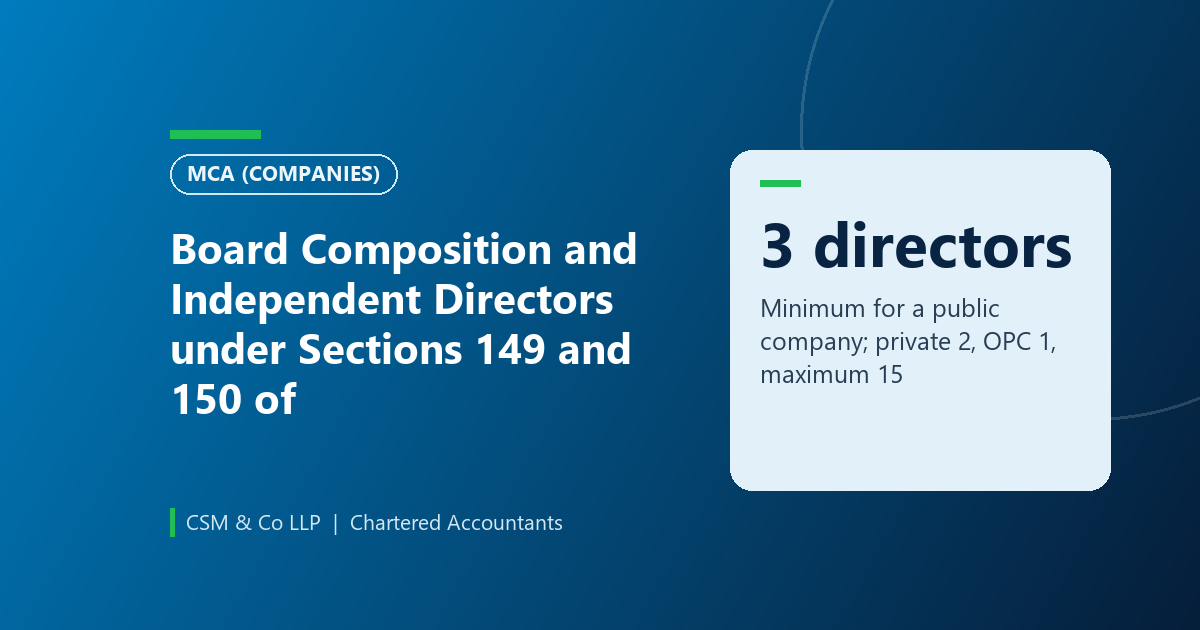
- A public company needs at least three directors, a private company two and a One Person Company one, with a maximum of fifteen (more with a special resolution). Every company needs at least one director who stays in India for 182 days or more in the financial year.
- A listed public company must have at least one-third of its directors as independent directors, with any fraction rounded up to one.
- An independent director is not an MD, whole-time director or nominee director, is not a promoter or related to one, has no material pecuniary or employment ties, and must give a declaration of independence at the first Board meeting and every year.
- The term is up to five consecutive years, with one re-appointment by special resolution, and then a three year cooling off. Liability is limited to acts with his knowledge, consent or connivance, or where he did not act diligently.
Section 149 sets the shape of a company’s Board: how many directors, how many must be independent, and what “independent” means. Section 150 deals with how independent directors are selected.
Number of directors (section 149(1) to (3))
| Company | Minimum | Maximum |
|---|---|---|
| Public company | 3 | 15 |
| Private company | 2 | 15 |
| One Person Company | 1 | 15 |
- A company may appoint more than fifteen directors after passing a special resolution.
- The Board must consist of individuals.
- Classes of companies prescribed by the Rules must have at least one woman director.
- Resident director: every company must have at least one director who stays in India for a total of not less than 182 days during the financial year. For a newly incorporated company, the requirement applies proportionately at the end of the financial year of incorporation.
Independent directors (section 149(4))
Every listed public company must have at least one-third of the total number of directors as independent directors, and a fraction is rounded up to one. For example, a Board of seven needs three independent directors. The Central Government may prescribe a minimum number of independent directors for other classes of public companies.
Who is an independent director (section 149(6))
An independent director means a director other than a managing director, whole-time director or nominee director, who meets all of these tests:
- Integrity and expertise: in the Board’s opinion, a person of integrity with relevant expertise and experience.
- Promoters and relations: is not and was not a promoter of the company or its holding, subsidiary or associate company, and is not related to promoters or directors of the company or of its holding, subsidiary or associate company.
- Money: has no pecuniary relationship with the company, its holding, subsidiary or associate company, or their promoters or directors, other than remuneration as director or a transaction not exceeding 10% of his total income (or the prescribed amount), during the two immediately preceding financial years or the current financial year.
- Relatives: none of his relatives (a) holds securities or an interest in the company group above a face value of Rs 50 lakh or 2% of paid-up capital (or a higher prescribed sum) during that period; (b) is indebted to the company group or its promoters or directors above the prescribed amount; (c) has given a guarantee or security for a third person’s debts to the company group above the prescribed amount; or (d) has any other pecuniary transaction or relationship with the company group amounting to 2% or more of its gross turnover or total income.
- Employment and professional ties: neither he nor any relative holds or has held the position of KMP or been an employee of the company group in any of the three financial years before the appointment (a relative’s employment during the preceding three years is not a bar); has been an employee, proprietor or partner in the preceding three years of the company’s firm of auditors, company secretaries in practice or cost auditors, or of any legal or consulting firm that had transactions with the group of 10% or more of that firm’s gross turnover; holds together with his relatives 2% or more of the total voting power; or is a chief executive or director of a non-profit organisation that receives 25% or more of its receipts from the company, its promoters, directors or group companies, or that holds 2% or more of the voting power.
- Any other prescribed qualification.
A nominee director is a director nominated by a financial institution under any law or agreement, or appointed by any Government or any other person to represent its interests.
Declaration of independence (section 149(7))
Every independent director gives a declaration that he meets the criteria at the first Board meeting in which he participates, then at the first Board meeting of every financial year, and whenever there is a change in circumstances that may affect his status.
Term (section 149(10), (11) and (13))
- Up to five consecutive years on the Board of a company.
- Re-appointment for a further term needs a special resolution and disclosure in the Board’s report.
- No independent director can hold office for more than two consecutive terms, and he is eligible for appointment again only after three years from ceasing to be an independent director. During those three years he cannot be appointed or associated with the company in any other capacity, directly or indirectly.
- Any tenure on the date the Act commenced is not counted as a term.
- The rotation rules for retirement by rotation in section 152(6) and (7) do not apply to independent directors.
Remuneration (section 149(9))
An independent director is not entitled to any stock option. He may receive the sitting fee under section 197(5), reimbursement of expenses for attending Board and other meetings, and profit related commission approved by the members. If the company has no profits or inadequate profits, he may receive remuneration, other than the sitting fee, in accordance with Schedule V.
Limited liability (section 149(12))
An independent director, and a non-executive director who is not a promoter or KMP, is liable only for acts of omission or commission by the company that occurred with his knowledge (attributable through Board processes) and with his consent or connivance, or where he had not acted diligently.
Conduct
The company and independent directors must follow the code in Schedule IV (section 149(8)).
Selection (section 150)
- An independent director may be selected from a data bank of eligible and willing persons maintained by a body notified by the Central Government. The responsibility of due diligence before selecting a person from the data bank lies with the company.
- The appointment is approved by the company in general meeting, as provided in section 152(2), and the explanatory statement to the notice must give the justification for choosing the appointee.
A short checklist for the company
- Count the directors against the minimum and maximum for your class of company; check the 182 day resident director and the woman director requirement for your class.
- If listed, calculate one-third (rounded up) of the Board and plan the independent director appointments in time.
- Collect the section 149(7) declaration at the first meeting of each financial year.
- Track each independent director’s tenure and the three year cooling-off after two terms.
- Record in the explanatory statement why the appointee was chosen, and the data bank search.
Points to check
- This post follows the Companies Act as published on India Code, including its amendments up to the footnotes in that edition. The classes of companies required to have a woman director or independent directors, the prescribed amounts in the independence tests, the data bank rules and Schedules IV and V are in the Rules and Schedules, which were not reviewed in detail.
- Listed companies must also comply with SEBI’s listing regulations, which carry further requirements on independent directors and committees.
Frequently asked questions
What is the minimum number of directors?
Three for a public company, two for a private company and one for a One Person Company. The maximum is fifteen, and a company can appoint more than fifteen after passing a special resolution.
Is a resident director required?
Yes. Every company must have at least one director who stays in India for a total of not less than 182 days during the financial year. For a newly incorporated company this applies proportionately at the end of the financial year of incorporation.
How many independent directors must a listed company have?
At least one-third of the total number of directors, with any fraction rounded off to one, in a listed public company. The Central Government may prescribe a minimum number of independent directors for other classes of public companies.
Who is an independent director?
A director other than a managing director, whole-time director or nominee director, who in the Board’s opinion has integrity and relevant expertise and experience, and who meets the tests in section 149(6): not a promoter or related to promoters or directors, no material pecuniary relationship, no relevant relatives’ holdings or transactions, and no past employment or professional connection with the company group within three years.
What is the term of an independent director?
Up to five consecutive years, with re-appointment for a second term on a special resolution and disclosure in the Board’s report. No independent director can hold office for more than two consecutive terms, and is eligible again only after three years, during which he cannot be associated with the company in any other capacity.
Is an independent director entitled to stock options?
No. He can receive sitting fees, reimbursement of expenses and, if the members approve, profit related commission; where the company has no profits or inadequate profits, remuneration in accordance with Schedule V.
When is an independent director liable?
Only in respect of acts of omission or commission by the company which occurred with his knowledge, attributable through Board processes, and with his consent or connivance, or where he had not acted diligently. The same protection applies to a non-executive director who is not a promoter or KMP.
Official sources
Related reading
- Board Meetings under Sections 173 to 175 of the Companies Act, 2013: Number, Notice, Quorum and Resolution by Circulation
- Duties of Directors, Directorship Limit and Vacation of Office: Sections 165 to 168 of the Companies Act, 2013
Disclaimer
This article is for general informational purposes only and should not be considered professional advice. Please consult a qualified expert for advice tailored to your specific situation. The author and website owner are not liable for any errors or actions based on this content.

