Last updated: 11 July 2026 · Written and reviewed by CA Meet Dhrangadhariya, CSM & Co LLP
Quick summary
- Deferred tax is the tax effect of timing differences between book profit and taxable profit. It is an accounting item, not a separate tax.
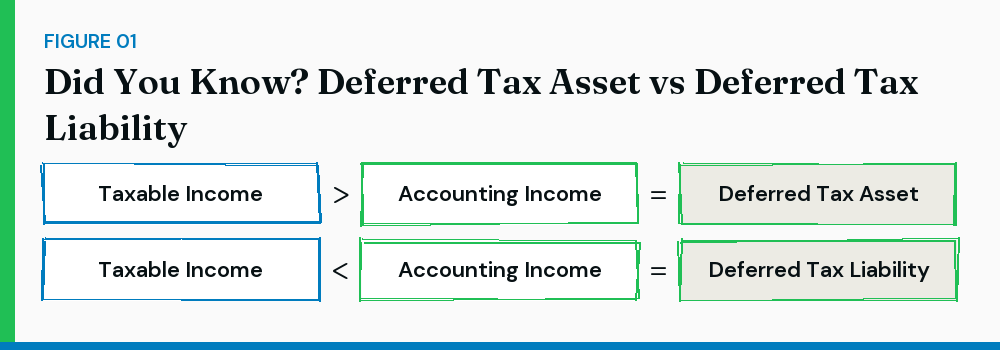
- Book profit higher than taxable profit creates a deferred tax liability (DTL). Taxable profit higher than book profit creates a deferred tax asset (DTA).
- Permanent differences, such as penalties, create no deferred tax.
- DTA on losses and unabsorbed depreciation needs virtual certainty; the note also covers MAT, tax holidays, presentation and worked examples.
How deferred tax arises
Deferred tax is an accounting item, covered under IND AS 12 - Income Taxes. It is the tax benefit that can be availed in the future years or the additional liability needing to be paid in the future years, depending on the various factors. Deferred tax arises as a result of temporary differences between income as per books of accounts and income as per income tax computation.
When the income computed as per income tax act is greater than profits calculated as per accounting standards, the difference between those two result in Deferred Tax Asset (DTA). Else, the difference is treated as Deferred Tax Liability (DTL).
Note: from 1 April 2026 the Income-tax Act, 2025 replaces the Income-tax Act, 1961 and section numbers have changed. Section numbers quoted below are those of the 1961 Act.
What is Deferred Tax?
The tax effect due to the temporary timing differences is termed as deferred tax which literally refers to the taxes postponed. Deferred tax is recognized only on temporary timing differences.
Timing Difference
- Company derives its book profits from the financial statements prepared in accordance with the rules of the Companies Act and calculates its taxable profit based on provision of the Income Tax Act.
- There is a difference between the book profit and taxable profit, because of certain items which are specifically allowed or disallowed for tax purposes each year.
- This difference between the book and the taxable income or expense arises from items that are treated differently for book and tax purposes. It can be of two kinds:
- Timing (temporary) difference: arises in one period and reverses in a later period, for example depreciation charged at different rates in books and for tax.
- Permanent difference: never reverses, for example a penalty that is never allowed as a deduction. It creates no deferred tax.
Types of Deferred Tax
Deferred tax are classified into two:
- Deferred Tax Liability
- Deferred Tax Asset
Deferred Tax Liability
When the accounting income is more than the taxable income, the tax payable now is lower than the tax on the book profit. The company pays less tax now and more tax in future, so the difference is a liability.
For example, higher depreciation claimed for tax than in the books, or income recognised in the books that becomes taxable only in a later year.
Deferred Tax Asset
When the taxable income is more than the accounting income, the company pays more tax now than the book profit suggests. It expects to pay less tax in future, so the difference is an asset.
For example, higher depreciation in the books than for tax, provision for doubtful debts, gratuity and leave encashment (allowed for tax only when paid or written off), advance income that is taxed on receipt but recognised in the books later, and notional losses disallowed under the Income Tax Act.
A tabular explanation of the above concepts is provided below for easy reference:
| S No | Entity Profit Status | Entity - Current | Entity - Future | Effect |
|---|---|---|---|---|
| 1 | Book profit higher than the Taxable profit | Pay less tax now | Pay more tax in future | Creates Deferred Tax Liability (DTL) |
| 2 | Book profit is less than the Taxable profit | Pay more tax now | Pay less tax in future | Creates Deferred Tax Asset (DTA) |
Example of Deferred Tax Asset and Liability
DTA - Suppose, book profit of an entity before taxes is Rs 1,000 and this includes provision for bad debts of Rs.200.
For the purpose of tax profit, bad debts will be allowed in future when it’s actually written off. Hence taxable income after this disallowance will be Rs. 1200 and let’s say income tax rate is 20% then the entity will pay taxes on Rs. 1200 i.e (1200*20%) Rs. 240.
If bad debts were not disallowed, entity would have paid tax on Rs. 1000 amounting Rs 200 i.e 1000*20%. For the additional Rs. 40 which is already paid now, we have to create DTA. Entry for recording the DTA is as under:
- Deferred Tax Asset Dr 40
- To Deferred Tax Expense Cr 40
(Being DTA of Rs. 40 accounted in the books)
DTL - Common example of DTL would be depreciation. When the depreciation rate as per the Income tax act is higher than the depreciation rate as per the Companies act (generally in the initial years), entity will end up paying less tax for the current period. This will create deferred tax liability in the books:
There are no DTA or DTL provisions made for permanent differences. E.g. Fines and penalties which are part of book profits but are not allowed for tax purposes.
Deferred tax implications on Unabsorbed Depreciation and Carry Forward of Losses
- With respect to timing differences related to unabsorbed depreciation or carry forward losses, DTA is recognized only when the company reliably estimates sufficient future taxable income.
- This test for virtual certainty has to be done every year on balance sheet date and if the condition is not fulfilled, such DTA/DTL should be written off.
While computing future taxable income, only profits pertaining to business and profession should be considered and not the income from other sources.
Example for Virtual Certainty
- A projection of future profits prepared by an entity based on the future restructuring, sales estimation, future capital expenditure past experience etc., which are submitted to banks for loan is concrete evidence for virtual certainty.
- But virtual certainty cannot be convincing if it’s only based on some binding export order which has the risk of cancellation anytime.
- Virtual certainty must be based on projections that are more likely in future.
Presentation in Financial Statements
DTA is presented under non-current assets and DTL under the head non-current liability. Both DTA and DTL can be adjusted with each other provided they are legally enforceable by law and there is an intention to settle the asset and liability on a net basis.
Illustration on DTA/DTL Calculation
Let’s understand how DTA/DTL is created in books with a simple example (amount in lacs):
| Particulars | For Book | For Tax | Difference | (DTA)/DTL @30% |
|---|---|---|---|---|
| Income | 1000 | 800 | 200 | |
| Opening Balance of (DTA)/DTL | - | - | - | - |
| Depreciation | 100 | 200 | 100 | 30 |
| Sales Tax payable | 50 | 0 | (50) | (15) |
| Leave encashment | 200 | 100 | (100) | (30) |
| Closing balance of (DTA)/DTL | - | - | - | (15) |
Current tax on Taxable income is 800*30% = 240
Deferred tax as per above = (15)
Net tax effect = 225
*The 30% rate is used only for illustration. Use the rate that actually applies to the entity for the year, for example the lower rates under sections 115BAA and 115BAB for companies, or the slab rates for individuals.
Effect on Tax Holiday With Respect To DTA/ DTL
A tax holiday is a benefit that exempts the profits of certain undertakings for a fixed period. A current example is section 10AA for units in Special Economic Zones, which is available only to units that began activity on or before 31 March 2020. The older holidays under sections 10A and 10B have been phased out.
Deferred tax (DT) from the timing difference that reverses during the tax holiday period should not be recognised during the enterprise’s tax holiday period. DT related to the timing difference that reverses after the tax holiday has to be recognised in the year of origination.
Illustration for Tax Holiday
A Ltd. is an undertaking whose profits are exempt for a tax holiday period that ends after Year 5. It has a timing difference on account of depreciation as follows: (Assume tax rate is 30%)
| Year | Timing Difference - Depreciation |
|---|---|
| 1 | 2 lakhs |
| 2 | 3 lakhs |
In the case of tax-free companies, deferred tax liability is not recognised, for the timing differences that originate and reverse in the tax holiday period. Deferred tax liability is created only when the timing differences originate in the tax holiday period and reverse after the tax holiday. Adjustments are done on the basis of the FIFO method.
Suppose in the above example of the Rs 200,000, Rs 80,000 reverses within the tax holiday period, so DTL is created only on the balance. DTL will be created as given below:
| Year | Timing difference | DTL @ 30% |
|---|---|---|
| 1 | 120,000 (200,000-80,000) | 36,000 |
| 2 | 300,000* | 90,000 |
*Fully reversed after the tax holiday period. The total DTL balance at the end of the second year will be 126,000.
Effect of DTA/DTL on MAT
MAT is Minimum Alternate Tax which a company is required to pay if its tax payable as per normal provision of the income tax act is less than the tax computed at 15% of the book profit (plus surcharge and cess; the rate was 18.5% before AY 2020-21). MAT is levied under section 115JB of the income tax act; companies that opt for the concessional regimes under sections 115BAA and 115BAB do not pay MAT and it is calculated using the entity’s book profit as under: Book profit is increased by the following:
- Income tax paid or provision
- An amount carried to any reserve
- Provisions made for unascertained liabilities
- Deferred tax provision etc
And it is decreased by the following:
- Amount withdrawn from any reserve or provision
- Depreciation debited to P&L (except revaluation depreciation)
- Lower of Loss brought forward or unabsorbed depreciation
- Deferred tax credited to P&L etc.
There are controversies if deferred tax liability debited to P&L should be added to the book income for the purpose of MAT calculation. Kolkata Tribunal in Balrampur Chini’s case has held that the deferred tax liability should not be added back whereas the Chennai Tribunal in Prime Textiles Ltd case has held otherwise.
“Deferred tax charge is not a provision for tax but is a provision for tax effect for difference between taxable income and accounting income and further that deferred tax charge cannot be termed as income-tax paid or payable, which has to be paid out of the profit earned. Reserves mentioned in Section 115JB are different, it can be unilaterally transferred back to P&L account or can be utilised for issuing bonus shares etc. However, amounts created towards deferred tax charge cannot be so transferred or utilized”
“The Chennai Tribunal observed that AS-22 is mandatory as per Section 211(3) of the Companies Act, 1956, however, the same is not notified by the Central Government under Section 145(2) of the IT Act. Moreover, the deferred tax liability cannot be considered as ascertained liability and therefore, assessing officer has every power to make adjustment on this account as it cannot be termed as tinkering of audited accounts prepared in accordance with the provisions of the Companies Act.”
These rulings show that tribunals have taken different views. Check the current wording of Explanation 1 to section 115JB, and the equivalent provision of the Income-tax Act, 2025, before relying on either view.
Whether MAT credit can be considered as a Deferred Tax Asset per AS 22?
- As per AS 22, deferred tax assets and liability arise due to the difference between book income & taxable income and do not rise on account of tax expense itself.
- MAT does not give rise to any difference between book income and taxable income.
- It is not appropriate to consider MAT credit as a deferred tax asset in accordance with AS 22.
- MAT credit is separately recognized as an asset (MAT credit entitlement) in the books, not as a Deferred Tax Asset.
- Under Ind AS 12, unused tax credits, which include MAT credit, can be recognised as a deferred tax asset to the extent it is probable they will be used. The answer therefore differs between AS 22 and Ind AS 12.
Key takeaways
- Deferred tax is an accounting concept and not a direct tax provision, this might arise because of difference in the accounting profit and taxable profits.
- Deferred tax liability would arise when a company would pay less tax at present but expected to pay higher taxes in future.
- Timing (temporary) differences between book income and taxable income create deferred taxes, whereas permanent differences do not result in a DTA or DTL.
Final Word
Deferred tax is often mistaken for a tax concept, but it is actually an accounting concept that reflects the tax impact arising from differences in the treatment of items under financial statements and tax records.
Frequently asked questions
What is the difference between DTA and DTL?
A deferred tax liability arises when book profit is higher than taxable profit, so less tax is paid now and more later. A deferred tax asset arises when taxable profit is higher than book profit, so more tax is paid now and less later.
Is deferred tax created on permanent differences?
No. Only timing (temporary) differences that reverse in later periods create deferred tax. Items such as penalties that are never allowed for tax create no DTA or DTL.
Can a company recognise a deferred tax asset on carried forward losses?
Under AS 22 only when there is virtual certainty, supported by convincing evidence, of sufficient future taxable income. The test is repeated at every balance sheet date.
Is MAT credit a deferred tax asset?
Under AS 22 it is shown separately as MAT credit entitlement and not as a deferred tax asset. Under Ind AS 12 unused tax credits can be recognised as a deferred tax asset if their use is probable.
Official sources
- ICAI: Accounting Standard (AS) 22
- MCA: Indian Accounting Standard 12, Income Taxes
- Income Tax Department: Minimum Alternate Tax
Related reading
Disclaimer
This article is for general informational purposes only and should not be considered professional advice. Please consult a qualified expert for advice tailored to your specific situation. The author and website owner are not liable for any errors or actions based on this content.