Relief on Salary Arrears: Section 157(1) (Earlier Section 89(1)), Rule 73 and Form 39

Last updated: 31 July 2026 · Written and reviewed by CA Meet Dhrangadhariya, CSM & Co LLP

Quick summary

  • If you receive salary arrears, advance salary or family pension arrears and pay a higher rate of tax because of it, you can claim relief under section 157(1) of the Income-tax Act, 2025, earlier section 89(1).
  • Relief is the extra tax caused by the arrears in the year of receipt, less the tax the same arrears would have caused in the years they relate to, if the first is bigger.
  • From 01/04/2026 the claim is made in Form 39 (earlier Form 10E), under Rule 73 of the Income-tax Rules, 2026, by the return due date, or to the employer.
  • The same rule gives relief on gratuity of 5 years or more of service, retrenchment compensation and commuted pension.

Arrears are salary for earlier years that you receive in a later year. Because tax rates rise with income, receiving three years of arrears in one year can push you into a higher slab. The law corrects for this by giving relief. From Tax Year 2026-27 it is section 157(1) of the Income-tax Act, 2025, the calculation is in Rule 73 of the Income-tax Rules, 2026, and the claim form is Form 39. Up to FY 2025-26 it is section 89(1), Rule 21A and Form 10E.

When does the relief apply?

When your total income for the year of receipt is taxed at a higher rate than it would otherwise have been, because of receipts such as:

  • salary received in arrears or in advance, or family pension in arrears (the “additional salary”),
  • gratuity for past service of five years or more,
  • retrenchment compensation (where Rule 73 provides), and
  • commutation of pension.

For other receipts, the Board may allow relief it considers fit.

How is relief on arrears calculated? (Rule 73)

Relief is A minus B, if A is more than B.

  1. Work out which tax years the additional salary relates to, and how much relates to each.
  2. A, the extra tax in the year of receipt: tax on total income of the year of receipt, less tax on that income reduced by the arrears.
  3. B, the tax the arrears would have attracted in the years they relate to: for each such year, tax on the total income of that year increased by the arrears for that year, less tax on the total income of that year as it stood. Add up the figures for all the years.
  4. If A is more than B, the difference is your relief. If B is the same or more, there is no relief.

Example

Meena’s total income for FY 2026-27 is ₹10,00,000, which includes ₹2,00,000 of arrears relating to FY 2025-26. Her income for FY 2025-26 was ₹6,00,000.

Step Tax in ₹ (old regime slabs, before cess)
Tax on ₹10,00,000 in FY 2026-27 1,12,500
Tax on ₹8,00,000 (without the arrears) 72,500
A: extra tax in FY 2026-27 40,000
Tax on ₹8,00,000 in FY 2025-26 (income plus arrears) 72,500
Tax on ₹6,00,000 in FY 2025-26 32,500
B: tax the arrears would have attracted in FY 2025-26 40,000
Relief (A minus B) Nil

Here the slab rate is the same in both years, so the arrears cost the same tax either way and no relief arises. Relief appears when the earlier year’s income was low enough that the arrears would have been taxed at a lower rate there. Rebate under section 156 and cess are also taken into account in a real computation, which these figures leave out.

Relief on gratuity

For gratuity received for past service, the relief is the gratuity multiplied by the excess of the average tax rate in the year of receipt over a blended average of the two or three earlier years:

  • Service of 5 years or more but under 15 years: compare the average rate on total income including the gratuity in the year of receipt with the average of the rates for the two preceding years, each computed on that year’s income plus half of the gratuity.
  • Service of 15 years or more: compare with the average of the rates for the three preceding years, each computed on that year’s income plus one third of the gratuity.
  • Relief is allowed only if the average rate in the year of receipt is higher.

Commutation of pension and retrenchment compensation follow the same pattern with their own fractions in the rule.

Form 39 and how to claim

  • To claim relief under section 157(1), furnish the particulars in Form 39 on or before the due date for filing the return of income (section 263(1)(c)).
  • A Government servant or an employee of a company, co-operative society, local authority, university, institution, association or body can instead give the particulars to the person who pays the salary, so that the employer allows the relief in deducting tax.
  • Form 39 replaces Form 10E. The form asks for the tax years to which the additional salary relates, the amount for each year, the total income and tax payable for each year with and without the arrears, and the relief worked out.
  • Up to FY 2025-26, Form 10E is filed online on the e-filing portal under e-File, Income tax forms, File Income Tax Forms, in the tab for persons not having business or professional income. A return claiming relief without the form may get a notice saying the relief has not been allowed.

Things to remember

  • Keep the arrears statement from your employer and the computation for each year to which the arrears relate.
  • Relief reduces tax; it does not reduce income. The relief is shown in the return.
  • Arrears are taxed in the year of receipt, not the year they relate to. The relief is how the law evens it out.

Frequently asked questions

What is relief under section 89(1)?

Relief for the extra tax you pay because arrears or advance salary, or arrears of family pension, bump you into a higher rate in the year you receive them.

What is the section number from Tax Year 2026-27?

Section 157(1) of the Income-tax Act, 2025, with the calculation in Rule 73 of the Income-tax Rules, 2026.

Which form do I file?

Form 39 from 01/04/2026. Up to FY 2025-26 it is Form 10E.

When must the form be filed?

On or before the due date for the return under section 263(1)(c). A salaried employee can also give the particulars to the person who pays the salary.

Can I get relief on gratuity or commuted pension?

Yes. Rule 73 also gives relief on gratuity for past service of 5 years or more, retrenchment compensation and commutation of pension, where the extra receipt pushes your rate up.

Official sources

Disclaimer

This article is for general informational purposes only and should not be considered professional advice. Please consult a qualified expert for advice tailored to your specific situation. The author and website owner are not liable for any errors or actions based on this content.

Form 12BA and Form 12BAA: Replaced by Form 123 and Form 122 from 01/04/2026

Last updated: 02 October 2026 · Written and reviewed by CA Meet Dhrangadhariya, CSM & Co LLP

Quick summary

  • Form 12BA, the employer’s statement of perquisites, is Form 123 under the Income-tax Rules, 2026. It is needed when salary is more than ₹1,50,000; below that the details go in the relevant columns of Form 130 (the new Form 16).
  • Form 12BAA, the employee’s statement of other income and tax deducted, is Form 122, and it also covers salary from other employers.
  • Perquisites are valued under Rule 15, and the details are in Rule 204.
  • Some websites say Form 12BA became Form 122; the Rules show it became Form 123.

Two forms matter when an employer works out tax on salary: the employer’s statement of perquisites and the employee’s statement of other income. Both have new numbers from 1 April 2026 under the Income-tax Rules, 2026. Up to FY 2025-26 they remain Form 12BA and Form 12BAA.

Form 12BA is now Form 123

Form 123 is the “statement showing particulars of perquisites, other fringe benefits or amenities and profits in lieu of salary with value thereof”. Under Rule 204(2), the person who pays the salary must give the employee a statement of the correct and complete particulars of perquisites or profits in lieu of salary, and their value:

  • in the relevant columns of Form 130 (the TDS certificate for salary, earlier Form 16), if the salary for the tax year is not more than ₹1,50,000; or
  • in Form 123, if the salary is more than ₹1,50,000.

“Salary” here has the meaning given in Rule 15: dearness allowance counts if the terms of employment provide for it, and other allowances and perquisites do not.

Some websites say Form 12BA has been replaced by Form 122. That is not what the Rules say. Form 122 is a different statement, described below.

What Form 123 contains

  • Part A: the employer’s name, address, PAN, TAN, email and contact number, and the employee’s name, designation, PAN, whether the employee is a director or a person with a substantial interest in the company (for a company employer), and the employee’s income under the head Salaries other than from perquisites, and the tax year.
  • Part B: the valuation of each perquisite under Rule 15, with three columns: the value as per the rules, the amount recovered from the employee, and the amount chargeable to tax (the first less the second). The rows start with accommodation, cars and other automotive conveyance, sweeper, gardener, watchman or personal attendant, gas, electricity and water, interest free or concessional loans, and continue through the other items in Rule 15. See our post on perquisites for the values.

Form 12BAA is now Form 122

Form 122 is what the employee gives the person who deducts tax on salary, so that tax is worked out on the right figure. Under Rule 204(1) the employee may furnish:

  1. salary due or received from any other employer or employers in the tax year (the details once given in Form 12B when you change jobs),
  2. any loss under the head Income from house property for the year,
  3. income under any other head, other than a loss, and
  4. any tax already deducted or collected at source on those incomes.

The employer takes these into account when deducting tax, which avoids short deduction in the year.

Form 124 for evidence of claims

The employee’s claims for HRA, LTA, interest on a housing loan and Chapter VIII deductions go in Form 124 (Rule 205), which replaces Form 12BB. See our post on Form 124.

Practical points

  • An employee who joins mid-year gives the new employer the salary and tax details of the previous employer in Form 122.
  • The employer checks each perquisite in Form 123 against Rule 15. Several limits rose from 1 April 2026 (free meals ₹200 a meal, gifts ₹15,000, loans ₹2,00,000), so payroll software needs updating.
  • Keep Form 130, Form 123 and Form 122 together; they support the figures in the return.

Frequently asked questions

Which form replaces Form 12BA?

Form 123 under Rule 204(2)(b) of the Income-tax Rules, 2026, from 01/04/2026.

When is Form 123 needed?

When the salary paid or payable to the employee for the tax year is more than ₹1,50,000. If it is ₹1,50,000 or less, the details of perquisites go in the relevant columns of Form 130, the TDS certificate for salary.

What is Form 122?

The statement the employee gives the employer for deducting tax: salary from other employers, house property loss, income from other heads, and tax already deducted or collected (Rule 204(1)). It covers what Forms 12B and 12BAA did.

Who fills Form 123?

The employer, giving the value of each perquisite as per Rule 15, the amount recovered from the employee and the amount chargeable to tax.

What is salary for this test?

The same as in Rule 15: it includes dearness allowance if the terms of employment provide for it, and excludes other allowances and perquisites.

Official sources

Related reading

Disclaimer

This article is for general informational purposes only and should not be considered professional advice. Please consult a qualified expert for advice tailored to your specific situation. The author and website owner are not liable for any errors or actions based on this content.
Understanding Tax on ₹12 Lakh Income in India (Tax Year 2025-26)

Understanding Tax on ₹12 Lakh Income in India (Tax Year 2025-26)

Income tax can be confusing, especially when new rules come into play. Budget 2025 brought one of the biggest changes in personal income tax in recent years. If you earn ₹12 lakh a year, here’s what you need to know about your tax liability under the Income Tax Act 2025.

What’s Changed in 2025

The government revised the income tax structure effective for financial year 2025-26 (assessment year 2026-27). A key feature is the higher rebate and adjusted slab rates to boost disposable income for individuals. 

How Tax Works on ₹12 Lakh

Under the new tax regime:

  • Income upto ₹12 lakh is eligible for a full tax rebate under Section 87A, which essentially reduces your tax liability to zero. 

  • This means a person earning ₹12 lakh in a year does not pay any income tax if they choose the new tax regime. 

Here’s the idea:

  • The slabs start at zero tax for the first part of income.

  • Even though regular slabs would tax portions of income above ₹4 lakh, the rebate cancels the tax completely up to ₹12 lakh. 

This change is a major relief for middle-income earners and increases take-home salary. 

What Salary Earners Should Know

If you’re a salaried employee:

  • You receive a standard deduction (around ₹75,000) before calculating taxable income. 

  • After standard deduction, your taxable income might effectively fall below ₹12 lakh even if your gross salary is slightly above that.

  • In practice, many salaried individuals earning up to ~₹12.75 lakh also pay zero tax because of this deduction plus the rebate. 

Choosing Between Old and New Regime

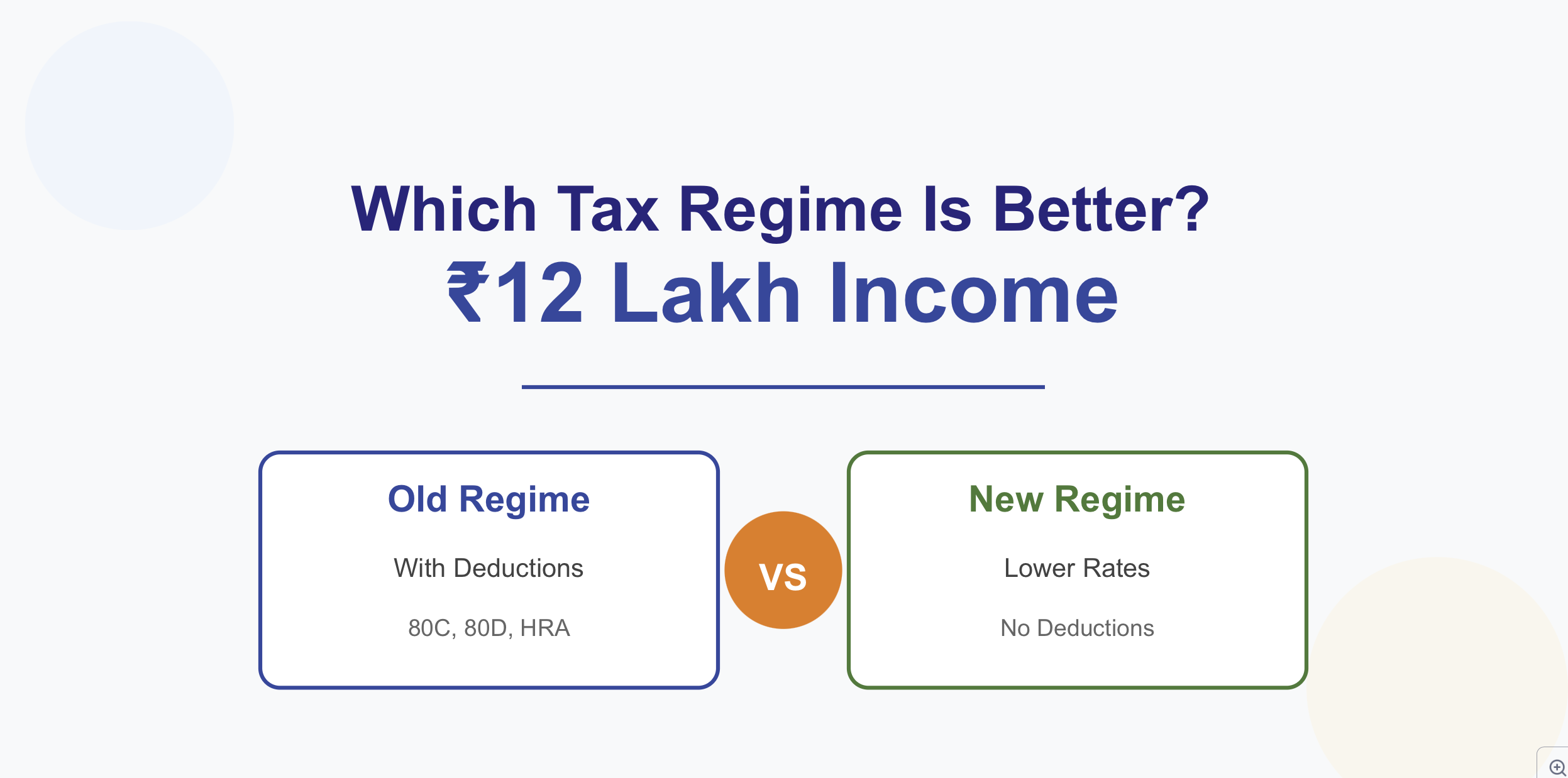
You can choose between the old tax regime (with exemptions and deductions like 80C, HRA, 80D) and the new simplified regime. For someone at ₹12 lakh:

  • Under the old regime, you will have tax liability after standard slabs and only enjoy exemptions you claim.

  • Under the new regime, the tax rebate wipes out tax up to ₹12 lakh, making it generally more beneficial for many people without heavy deductions. 

Example in Simple Terms

Imagine your gross salary is ₹12 lakh:

  1. You get standard deduction (₹75,000 for a salaried person).

  2. Your taxable income becomes ₹11,25,000.

  3. Section 87A rebate cancels your tax liability on that amount under the new regime.

  4. Final tax payable is zero.

This drastically increases your monthly take-home pay compared to previous years.

Comparison Chart: Old vs New Tax Regime on ₹12 Lakh Income

Particulars

Old Tax Regime

New Tax Regime (2025)

Gross Annual Income

₹12,00,000

₹12,00,000

Standard Deduction

₹50,000

₹75,000

Income After Standard Deduction

₹11,50,000

₹11,25,000

Other Deductions (80C, 80D, HRA etc.)

Assumed ₹1,50,000

Not Applicable

Taxable Income

₹10,00,000

₹11,25,000

Tax Before Rebate

₹1,12,500 approx

₹56,250 approx

Section 87A Rebate

Not Available

Available up to ₹12 lakh

Final Tax Payable

₹1,12,500 + cess

₹0

Best Suited For

People with high deductions

Most salaried individuals


Tax Calculator Example: New Tax Regime (₹12 Lakh)

Step 1: Gross Income

₹12,00,000

Step 2: Standard Deduction (Salaried)

₹75,000

Step 3: Taxable Income

₹12,00,000 − ₹75,000 = ₹11,25,000

Step 4: Tax as per slabs

Tax calculated as per new slab rates

Step 5: Section 87A Rebate

Since taxable income is below ₹12,00,000, entire tax is rebated

Final Tax Payable

₹0


Tax Calculator Example: Old Tax Regime (₹12 Lakh)

Assumptions

  • Standard deduction: ₹50,000

  • 80C deduction: ₹1,50,000

Taxable Income

₹12,00,000 − ₹50,000 − ₹1,50,000 = ₹10,00,000

Tax Calculation

  • Up to ₹2.5 lakh: Nil

  • ₹2.5 lakh to ₹5 lakh: 5% = ₹12,500

  • ₹5 lakh to ₹10 lakh: 20% = ₹1,00,000

Total Tax

₹1,12,500

Plus 4% cess = ₹4,500

Final Tax Payable

₹1,17,000 approx


Key Takeaways

  • Under the new tax regime, income up to ₹12 lakh is completely tax free due to Section 87A rebate.

  • Salaried employees can effectively earn up to ₹12.75 lakh with zero tax because of the higher standard deduction.

  • The old regime only benefits those with large deductions like home loan interest or major investments.

  • For most individuals earning ₹12 lakh, the new tax regime is clearly more beneficial.


Final Thoughts

The 2025 tax changes are designed to benefit middle-class taxpayers by reducing or eliminating tax on incomes up to ₹12 lakh. For many people with this income level, the best option is the new tax regime with the rebate, especially if you don’t have large deductions to claim. 

Always consider using a tax calculator or consulting a tax professional to determine what’s best for your individual financial situation.

How the New Perquisite Rules Affect Your Salary Package (Notification 133/2025)

CBDT Notification No. 133/2025: Key Amendments under Section 17(2) of the Income-tax Act:

Comparison: Old Rule vs Amended Rule (2025)

Provision Amended Limit
(w.e.f. 18 Aug 2025)
Earlier Limit
Section 17(2)(iii)(c)

Taxability of perquisites for high-salaried employees

₹4,00,000

(salary income threshold)

₹50,000

(salary income threshold)

Proviso (vi) to Section 17(2)

Exemption for medical treatment abroad (travel condition)

₹8,00,000

(gross total income limit)

₹2,00,000

(gross total income limit)

Understanding Section 17(2)(iii)(c) & Proviso (vi) of the Income-tax Act, 1961

The Income-tax Act, 1961 lays down clear definitions of “salary,” “perquisites,” and “profits in lieu of salary.” Among these, Section 17(2) specifically defines perquisites. Over the years, perquisites have become a focal point in taxation, as they include various benefits provided by employers to employees apart from regular salary.

In this blog, we’ll break down Section 17(2)(iii)(c) and the Proviso (vi) to Section 17(2), examine their implications, and look at the latest amendments introduced in August 2025.


Section 17(2)(iii)(c): Value of Benefits or Amenities

According to Section 17(2)(iii), the value of any benefit or amenity granted free of cost or at a concessional rate is considered a perquisite. It applies in three scenarios:

  1. To a director of a company (clause a)

  2. To an employee holding substantial interest in the company (clause b)

  3. To any other employee whose income under the head “Salaries” (excluding non-monetary benefits) exceeds the prescribed threshold (clause c)

  • Earlier, this threshold was ₹50,000. However, as per the Income-tax (Twenty Second Amendment) Rules, 2025 notified via Notification No. 133/2025 dated 18th August 2025, the new threshold has been revised to ₹4,00,000 .
  • This means that only employees whose salary income (excluding perquisites) exceeds ₹4 lakh will have the value of employer-provided amenities taxed as perquisites.

Key Points:

  • Benefits like free housing, concessional loans, or luxury facilities will not be taxed as perquisites unless the employee’s salary income crosses ₹4 lakh.

  • Commuting facilities (like a company car used for home-to-office travel) remain outside the perquisite scope under this clause.


Proviso (vi) to Section 17(2): Medical Treatment Abroad

The provisos to Section 17(2) carve out certain exemptions where benefits provided by employers are not treated as taxable perquisites.

Under Proviso (vi), the following expenses are exempt from perquisite taxation if incurred by the employer:

  1. Medical treatment of the employee or family abroad

  2. Travel and stay abroad of the employee or family for such medical treatment

  3. Travel and stay abroad of one attendant accompanying the patient

Conditions for exemption:

  • The expenditure on medical treatment and stay abroad is exempt only to the extent permitted by the RBI.

  • The expenditure on travel abroad is exempt only if the employee’s gross total income (before including this expenditure) does not exceed the prescribed limit.

Previously, this limit was ₹2,00,000. But as per the as per the Income-tax (Twenty Second Amendment) Rules, 2025 notified via Notification No. 133/2025 dated 18th August 2025, for the purposes of Proviso (vi) to Section 17(2), the prescribed gross total income shall now be ₹8,00,000 .

This revision significantly broadens the scope of employees who can claim exemption for medical expenditure abroad.


Practical Implications of 2025 Amendment

For employees:

  • The perquisite taxation threshold under Section 17(2)(iii)(c) has increased from ₹50,000 to ₹4 lakh, reducing the tax burden on middle-income employees receiving non-monetary benefits.
  • For medical treatment abroad, the exemption limit has expanded fourfold from ₹2 lakh to ₹8 lakh, allowing more employees to claim relief.

For employers:

  • Salary structuring becomes more flexible — many perquisites will now escape taxation for employees with salaries below ₹4 lakh.
  • Medical support abroad provided by employers can now benefit a larger pool of employees without additional tax liability.

Conclusion

Section 17(2)(iii)(c) ensures that high-income employees pay tax on perks and benefits beyond their core salary, but the 2025 amendment has made the threshold more realistic by raising it to ₹4 lakh. Similarly, Proviso (vi) reflects the humane side of tax law, and the recent upward revision of the exemption limit to ₹8 lakh provides welcome relief for employees facing genuine medical needs abroad.

These changes balance the government’s aim of preventing tax-free luxury perks with providing much-needed support in health-related scenarios.

Read the source of this post by clicking here (Section 17 & Notification No. 133/2025)

Disclaimer:

This article is for general informational purposes only and should not be considered professional advice. Please consult a qualified expert for advice tailored to your specific situation. The author and website owner are not liable for any errors or actions based on this content.


Car Provided by the Employer: Perquisite Value Under Rule 15 (Tax Year 2026-27)

Last updated: 06 September 2026 · Written and reviewed by CA Meet Dhrangadhariya, CSM & Co LLP

Quick summary

  • A car used wholly for official duties has no taxable value if the employer keeps journey records and a certificate.
  • A car also used privately is valued per month at ₹5,000 (plus ₹3,000 for a chauffeur) up to 1.6 litres or for an electric vehicle, and ₹7,000 (plus ₹3,000) above 1.6 litres, where the employer pays the running costs.
  • If you meet the running costs, the figures are ₹2,000 and ₹3,000, each plus ₹3,000 for a chauffeur.
  • These are the Rule 15(3) figures of the Income-tax Rules, 2026, up from ₹1,800, ₹2,400, ₹600 and ₹900 under the old Rule 3.

A car given to you by your employer can be a tax-free business tool or a taxable perquisite, depending on how you use it. From Tax Year 2026-27 the values are in Rule 15(3), Table II of the Income-tax Rules, 2026. For FY 2025-26 the old Rule 3 figures apply (₹1,800 and ₹2,400 where the employer meets the costs, ₹600 and ₹900 where you do, and ₹900 for a driver).

Value per calendar month (Table II)

Situation Car up to 1.6 litres, or electric vehicle Car above 1.6 litres
Car owned or hired by the employer, used wholly and exclusively for official duties No value, if the records below are kept No value, if the records below are kept
Car owned or hired by the employer, used only for private use, running costs met by the employer Actual expenditure on running and maintenance in the tax year, including the chauffeur’s pay, plus wear and tear, less what you pay Same
Used partly for duty and partly for private use, running costs met or reimbursed by the employer ₹5,000 (plus ₹3,000 if a chauffeur is provided) ₹7,000 (plus ₹3,000 if a chauffeur is provided)
Used partly for duty and partly for private use, private running costs met by you ₹2,000 (plus ₹3,000 if a chauffeur is provided) ₹3,000 (plus ₹3,000 if a chauffeur is provided)

Normal wear and tear is 10% a year of the cost of the car.

Employee owned car

If you own the car and the employer meets or reimburses the running and maintenance costs (including a chauffeur):

  • Wholly official use: no value, with the same records.
  • Partly official, partly private use: the actual expenditure of the employer, less the amount in the mixed-use row above (₹5,000 or ₹7,000 including the chauffeur add-on where applicable), if the conditions are met.
  • Another automotive conveyance (such as a motorcycle) that you own: for partly official use, the actual expenditure less ₹3,000 a month.

Records that remove the value

For wholly official use, or to claim a higher official amount, two conditions apply:

  1. The employer keeps full details of journeys for official purposes: date, destination, mileage and the expenditure.
  2. The employer gives a certificate that the expenditure was incurred wholly and exclusively for official duties.

If you can show that the official use costs more than the standard deduction in the table, the value is the actual amount the employer pays, less the higher official amount, on the same two conditions.

More than one car

If the employer provides more than one car for your use or your household’s use, one car is valued at the mixed use rate and every other car at the private use rule, which is the actual expenditure plus wear and tear.

Home to office

The cost of a vehicle used for your journey between home and the office is not a perquisite at all (section 17(2)(e) of the Act).

Example

An employee gets a petrol car of 1.4 litres from the employer for office and personal use. The employer pays the fuel and a chauffeur’s pay.

Item Amount in ₹
Value per month (₹5,000 plus ₹3,000 for the chauffeur) 8,000
Value for 12 months 96,000

The ₹96,000 is added to salary. The employee’s tax on it is at the slab rate. If the same car were 1.8 litres, the monthly value would be ₹10,000. For an electric car the 1.6 litre column applies whatever the size.

A caution on lease and salary restructuring schemes

Some employers offer a car lease deducted from your pay. The lease payment is not exempt just because it sits on the payslip. The car’s perquisite value is added to your salary under the table above, and what the employee gains depends on the tax slab, not on the label. Work out both sides before agreeing.

Frequently asked questions

Is a company car taxable?

Only if it is used for private purposes. Used wholly and exclusively for official duties it has no value, if the employer keeps details of journeys and gives a certificate.

How is a car for mixed use valued?

Per month, ₹5,000 (plus ₹3,000 if a chauffeur is provided) for a car up to 1.6 litres or an electric vehicle, and ₹7,000 (plus ₹3,000) for a bigger car, where the employer pays the running costs. If you pay them yourself, ₹2,000 or ₹3,000 (plus ₹3,000 for a chauffeur).

How is a car used only for private purposes valued?

At the actual expenditure on running and maintenance in the year, including the chauffeur’s pay, plus 10% a year of the cost of the car for wear and tear, less any amount you pay.

What if the employer provides two cars?

One car is valued at the mixed use rate and each other car at the private use rule.

Are electric vehicles treated differently?

Yes. An electric vehicle is valued at the lower figure (the up to 1.6 litre column) whatever its power.

Official sources

Related reading

Disclaimer

This article is for general informational purposes only and should not be considered professional advice. Please consult a qualified expert for advice tailored to your specific situation. The author and website owner are not liable for any errors or actions based on this content.
Perquisites in Income Tax: Types, Valuation and Taxability for Tax Year 2026-27

Last updated: 12 September 2026 · Written and reviewed by CA Meet Dhrangadhariya, CSM & Co LLP

Quick summary

  • A perquisite is a benefit your employer gives you because of your job, and it is taxed as salary at the value fixed by Rule 15 of the Income-tax Rules, 2026.
  • The 2026 Rules raised several limits: free meals ₹200 per meal, gifts ₹15,000 a year, interest-free loans ₹2,00,000, school fees ₹3,000 per child a month, and the salary test for non-director employees ₹4,00,000.
  • Rent-free accommodation is valued at 10%, 7.5% or 5% of salary by city size, and hotel accommodation at 24% of salary.
  • Employer contributions above ₹7,50,000 a year to PF, NPS and superannuation are also a perquisite.

Salary is more than the money in your bank account. A house, a car, a cheap loan, free meals or shares given by your employer because of your job are perquisites, and they are taxed as part of salary. From Tax Year 2026-27 the definition is in section 17 of the Income-tax Act, 2025 and the valuation is in Rule 15 of the Income-tax Rules, 2026. For FY 2025-26 the 1961 Act and Rule 3 apply, with lower limits.

What counts as a perquisite? (section 17(1))

  • the value of rent-free accommodation, and of accommodation at a concessional rent above the rent you pay,
  • a benefit or amenity given free or at a concessional rate by a company to a director or a person with a substantial interest in it, or by any employer to an employee whose salary income in cash is more than ₹4,00,000 (Rule 17; it was ₹50,000),
  • the value of shares or specified securities, including sweat equity, allotted free or at a concession,
  • any other benefit or amenity prescribed,
  • an obligation of yours that the employer pays, such as your personal bills,
  • life insurance or annuity premium paid by the employer, other than for a recognised provident fund, approved superannuation fund or deposit-linked insurance fund, and
  • the employer’s contribution above ₹7,50,000 in a tax year, taken together for the recognised provident fund, the NPS and an approved superannuation fund, and the yearly accretion on that excess.

What is not a perquisite? (section 17(2))

  • Medical treatment of the employee or family in a hospital maintained by the employer.
  • Medical expenses paid by the employer in Government, local authority or approved hospitals, and for prescribed diseases in hospitals approved by the Chief Commissioner (Rule 18).
  • The employer’s share of health insurance premium under an approved scheme, and the premium you pay that the employer reimburses.
  • The cost of a vehicle used for the journey between home and the office.
  • Medical treatment abroad and travel and stay abroad for the patient and one attendant, to the extent permitted by the RBI (and for travel, only if gross total income is within the prescribed limit).

Rent-free and concessional accommodation (Rule 15(2))

Case Value
Government employee in Government accommodation Licence fee set by the Government, less rent paid
Employer owns it: city with population above 40 lakh (2011 census) 10% of salary for the period occupied, less rent paid
Employer owns it: city between 15 and 40 lakh 7.5% of salary, less rent paid
Employer owns it: other areas 5% of salary, less rent paid
Employer rents or leases it Lower of the rent paid by the employer and 10% of salary, less rent paid by the employee
Hotel accommodation Lower of the hotel charges and 24% of salary, less rent paid. Nil for up to 15 days in all on a transfer

Further points: if the accommodation is furnished, add 10% a year of the cost of the furniture and appliances (or the actual hire charges). If the same accommodation continues for more than one tax year, the value cannot rise above the first year’s value adjusted by the Cost Inflation Index. On a transfer, if you keep the old accommodation, only the lower-valued one counts for up to 90 days. Temporary accommodation at a mining, oil, project, dam or power site (up to 1,000 sq ft, at least eight kilometres from municipal limits, or in a remote area) is excluded.

Motor car

A car provided for personal use has a value for each month in Table II of Rule 15(3): ₹5,000 (plus ₹3,000 for a chauffeur) for a car up to 1.6 litres or an electric vehicle, and ₹7,000 (plus ₹3,000) above 1.6 litres, where the employer meets the running costs; ₹2,000 and ₹3,000 (each plus ₹3,000 for a chauffeur) where you meet the running costs. A car used wholly for official duties has no value if journey records and the employer’s certificate are kept. The full table is in our separate post on cars provided by employers.

Services, utilities and education (Table III)

Benefit Value
Sweeper, gardener, watchman or personal attendant Salary paid for those services, less what you pay
Gas, electricity or water bought from an outside agency The amount the employer pays, less what you pay
Gas, electricity or water from the employer’s own resources Manufacturing cost per unit, less what you pay
Free or concessional education, in general Employer’s expenditure, less what you pay
Education in the employer’s own school, or free education in another institution Cost of similar education nearby, less what you pay, only where the value is more than ₹3,000 per child per month (it was ₹1,000)
Free travel by a transport employer (not an airline or the railways) The value offered to the public, less what you pay

Other benefits (Table IV)

Benefit Value and exemption
Interest-free or concessional loan Interest at the State Bank of India rate on the first day of the year for the same type of loan, on the maximum monthly balance, less interest you pay. No value if the loans total ₹2,00,000 or less (it was ₹20,000), or if they are for medical treatment of the diseases in Rule 18 (to the extent not reimbursed by insurance)
Holiday travel, stay and other expenses paid by the employer The employer’s expense. For an official tour extended into a vacation, only the vacation part. LTA under Rule 277 is outside this
Free food and non-alcoholic drinks The employer’s expense, less what you pay. No value for up to ₹200 per meal (it was ₹50) at the office or through vouchers usable only at eating places, for tea or snacks in working hours, or for free food in a remote area or offshore installation
Gift, voucher or token The amount of the gift. Nil if the total in the tax year is below ₹15,000 (it was ₹5,000)
Credit card expenses, including fees, paid or reimbursed by the employer The amount, less what you pay. No value for expenses wholly for official purposes with records and the employer’s certificate
Club expenses and fees The employer’s expense, less what you pay. Initial fee for corporate membership is excluded. No value if wholly for business and facilities are open to all employees
Use of a movable asset (not a laptop, computer, tablet or mobile phone) 10% a year of its cost, or the rent paid by the employer, less what you pay
Transfer of a movable asset to the employee Cost less wear and tear (50% a year for computers and electronics, 20% for motor cars, 10% for other assets, each on the reducing balance method), less what you pay
Any other benefit Cost to the employer at arm’s length, less what you pay. Telephone and mobile phone expenses are excluded

Shares and stock options

The value of specified securities or sweat equity shares allotted free or at a concession is taxed as a perquisite on the date the option is exercised. For a listed share, the fair market value is the average of the opening and closing price on the exchange with the highest volume on that date, and where there was no trading, the closing price on the nearest earlier date. Unlisted shares are valued under the method in the rule. See our posts on ESOP taxation.

Tax paid by the employer

Where the employer pays the tax on a non-monetary perquisite at its option, that tax is itself not added to your income (Schedule III, Sl. No. 10).

Example

Priya’s salary for the rule is ₹10,00,000. Her employer, in a city with 20 lakh population (2011 census), provides unfurnished accommodation it owns, and she pays no rent. She also gets a ₹4,00,000 interest-free loan that is outstanding for the year and a ₹12,000 gift voucher at Diwali.

Item Taxable value
Accommodation: 7.5% of ₹10,00,000 ₹75,000
Loan: interest at the SBI rate on ₹4,00,000 (the loan is above ₹2,00,000), less nil interest paid Interest at the SBI rate for that type of loan
Gift voucher: ₹12,000 is below ₹15,000 Nil

Keep records

The employer shows perquisites in the salary statement and in the Form 16 of the employee. Employees should check each figure against the valuation rule, because wrong valuation, such as using the old ₹50 per meal limit, over-states income.

Frequently asked questions

What is a perquisite?

A benefit or amenity given by the employer because of the employment, for example rent-free housing, a car for personal use, a loan at a low rate, or shares. It is taxed as part of salary.

How is rent-free accommodation valued?

If the employer owns it: 10% of salary in cities with population above 40 lakh (2011 census), 7.5% in cities between 15 and 40 lakh, and 5% elsewhere, less rent paid. If the employer rents it: the lower of the rent paid and 10% of salary, less rent paid by you.

When is an employer loan taxable?

When the interest-free or low-interest loans total more than ₹2,00,000. The value is interest at the State Bank of India rate on the maximum monthly balance, less interest you pay. Loans for specified diseases are not taxed.

Are free meals taxable?

Not if the value is within ₹200 per meal at the office or through vouchers usable only at eating places, or if it is tea or snacks in working hours.

Are gifts from the employer taxable?

Gifts, vouchers or tokens are taxable only if their total in the tax year is ₹15,000 or more. Cash gifts are always salary.

Official sources

Related reading

Disclaimer

This article is for general informational purposes only and should not be considered professional advice. Please consult a qualified expert for advice tailored to your specific situation. The author and website owner are not liable for any errors or actions based on this content.
Tax-Free Income in India: Complete List for Tax Year 2026-27

Last updated: 15 September 2026 · Written and reviewed by CA Meet Dhrangadhariya, CSM & Co LLP

Quick summary

  • The Income-tax Act, 2025 lists tax-free income in Schedule II (for everyone) and Schedule III (for eligible persons), with salary items in section 19 and gifts in section 92.
  • Agricultural income, Sukanya Samriddhi payouts, PPF and EPF within the interest limits, most life insurance maturity, gratuity and VRS compensation within limits are tax-free.
  • Several Schedule III items, such as LTA and special allowances, are lost in the new tax regime.
  • Tax-free income must still be reported in the return.

Some income does not form part of your total income at all. It is not taxed and no deduction has to be claimed for it. In the Income-tax Act, 2025, which applies from 1 April 2026, this list sits mainly in Schedule II (income not to be included in total income) and Schedule III (income of eligible persons), with salary related receipts in section 19 and gifts in section 92. For FY 2025-26 the corresponding list is in section 10 of the 1961 Act.

Exemption and deduction are different

An exemption keeps the income out of total income, so you only report it. A deduction is taken from income that has been included, and is allowed only up to its limit. Standard deduction, section 80C and similar items are deductions, not exemptions.

Schedule II: tax-free for everyone

Income Conditions and limits
Agricultural income No condition. It is still counted to fix the tax rate on other income if it exceeds ₹5,000
Life insurance maturity or other payout, including bonus Policy issued 01/04/2003 to 31/03/2012: premium up to 20% of sum assured. 01/04/2012 to 31/03/2013: up to 10%. 01/04/2013 to 31/01/2021: up to 15% for a special policy and 10% for others. From 01/04/2023: below 15% (special policy) or 10% (others), and for ULIPs total yearly premium below ₹2,50,000, for other policies below ₹5,00,000 across all policies. Keyman policies and the sum under section 127(4) are not exempt. A death claim is exempt
Payment from a statutory provident fund or notified fund Interest on contributions made on or after 01/04/2021 is taxable if the yearly contribution is above ₹5,00,000 (no employer contribution) or ₹2,50,000 (other cases)
Accumulated balance of a recognised provident fund (EPF) To the extent provided in the Act; the same ₹2,50,000 and ₹5,00,000 interest limits apply
Sukanya Samriddhi Account payouts No limit
National Pension System payout On closure or opting out, up to 60% of the amount payable.
Agniveer Corpus Fund payout Whole amount
Approved superannuation fund payments On death, retirement or incapacity, and certain refunds
Scholarships Granted to meet the cost of education
Awards and rewards Instituted in the public interest by the Government or approved by it
Interest on notified Central Government securities, bonds, savings certificates and deposits As notified
Gold Deposit Bond and Gold Monetisation Scheme interest Whole amount
Interest on local authority and State pooled finance entity bonds As notified
Transfer of units of the Unit Scheme, 1964 On or after 01/04/2002
Unified Pension Scheme payouts Up to 60% of the individual corpus on retirement, and the notified lump sum

Schedule III: tax-free for eligible persons

Income Who and conditions
Sums received by a member from a Hindu undivided family Paid out of family income, and not covered by section 99(3) and (4)
Partner’s share of profit Firm separately assessed, in the profit sharing ratio. Salary and interest from the firm are taxable
Compensation for a disaster from the Government or local authority Where no deduction was earlier allowed for the loss
NPS partial withdrawal Up to 25% of the contributions made by the subscriber
Daily allowance and constituency allowance of MPs and members of State Legislatures Whole amount
Leave travel concession (LTA) Up to the prescribed journeys and amount actually spent. Not available in the new regime
Allowances and perquisites paid by the Government outside India Citizen of India serving outside India
Tax paid by the employer on a non-monetary perquisite At the employer’s option
Special allowance for actual expenditure (serial 11), and the prescribed allowances in serial numbers 12 and 13 (Rule 280) Within the limits of the Income-tax Rules, 2026. Mostly not available in the new regime
Income of Scheduled Tribe members in notified areas, and of Sikkimese See the separate post on section 10(26)

Salary related receipts (section 19)

Receipt Tax-free limit
Death-cum-retirement gratuity of government employees Entire amount
Gratuity under the Payment of Gratuity Act, 1972 As calculated under section 4(2) and (3) of that Act, up to ₹20,00,000
Other gratuity Least of the actual amount, the notified limit, and half a month’s average salary of the last ten months for each completed year of service
Commutation of pension Government employees: entire amount. Others: one-third of the pension where gratuity is received, or one-half where it is not
Retrenchment compensation to a workman Least of the compensation, the amount under section 25F(b) of the Industrial Disputes Act, 1947, and the notified amount (not less than ₹50,000)
Voluntary retirement compensation Up to ₹5,00,000
Leave encashment on retirement Government employees: entire amount. Others: least of the cash equivalent of leave (up to 30 days a year of service), ten months’ average salary, the notified limit and the amount received

“Salary” for gratuity and leave encashment means basic pay plus dearness allowance if the terms of employment provide for it, and no other allowance or perquisite. The ceilings are fixed by Central Government notification: ₹20,00,000 for gratuity (notifications of 29 March 2018 and 8 March 2019) and ₹25,00,000 for leave encashment on retirement of a non-government employee (Notification 31/2023, from 1 April 2023). Check that no later notification has changed them. Employees who change jobs should also note that the gratuity limit is a lifetime figure reduced by gratuity already exempted in earlier years.

Gifts (section 92)

Money or property received without consideration is taxable if it totals more than ₹50,000 in a year (for property bought for less than its value, if the shortfall exceeds ₹50,000). It is not taxable at all when it comes from a relative, on the occasion of the individual’s marriage, under a will or by inheritance, in contemplation of death, from a local authority, from a registered non-profit organisation (with exceptions), through certain transactions not treated as transfers, or from an individual to a trust created solely for the benefit of a relative.

New tax regime

Section 202 of the 2025 Act removes some of these when the new regime applies: the Schedule III items at serial numbers 5, 6, 7, 8, 11 and 17, and the prescribed allowances at serial numbers 12 and 13, along with professional tax and a few other deductions. Schedule II items, section 19 receipts, and gifts are not touched. The family pension deduction is ₹25,000 in the new regime and ₹15,000 otherwise, each limited to one-third of the pension.

Tax-free income is not the same as the basic exemption limit

Income up to the basic exemption limit is simply not taxed at the slab rates. The limit is ₹4,00,000 under section 202 (new regime), and in the old regime ₹2,50,000 below age 60, ₹3,00,000 for resident seniors and ₹5,00,000 for resident super seniors. On top of that, a resident individual gets a rebate: ₹60,000 where total income does not exceed ₹12,00,000 (new regime, section 156), and ₹12,500 where it does not exceed ₹5,00,000 (old regime).

Report exempt income

Show exempt income in the exempt income schedule of the return. The department matches it with Form 26AS, AIS and the Taxpayer Information Summary, and an unreported receipt causes mismatches.

Frequently asked questions

Where does the Income-tax Act 2025 list tax-free income?

In Schedule II (income not included in total income of anyone), Schedule III (for eligible persons), section 19 (salary related receipts such as gratuity and leave encashment) and section 92(3) (gifts that are not taxed).

Is life insurance maturity tax-free?

Mostly. A policy issued on or after 01/04/2023 qualifies if the premium is below 10% of the sum assured (15% for special policies) and, for non-ULIP policies, the aggregate annual premium is below ₹5,00,000. A death claim is tax-free.

Is PPF interest tax-free?

Yes, with a limit. Interest on contributions above ₹2,50,000 a year (₹5,00,000 where the employer makes no contribution) made on or after 01/04/2021 is taxable.

Are gifts taxable?

Money or property received without consideration above ₹50,000 in a year is taxable, unless it is from a relative, on marriage, by will or inheritance, in contemplation of death, or from certain institutions.

Do tax-free incomes go in the return?

Yes. Exempt income is reported in the exempt income schedule, even though it is not taxed.

Official sources

Related reading

Disclaimer

This article is for general informational purposes only and should not be considered professional advice. Please consult a qualified expert for advice tailored to your specific situation. The author and website owner are not liable for any errors or actions based on this content.
Entertainment Allowance: Is It Still Deductible from Tax Year 2026-27?

Last updated: 21 July 2026 · Written and reviewed by CA Meet Dhrangadhariya, CSM & Co LLP

Quick summary

  • Under section 16(ii) of the 1961 Act, only Government employees could deduct entertainment allowance, in the old regime, limited to the least of ₹5,000, 20% of basic salary and the allowance received.
  • Private sector employees never got this deduction; the allowance was fully taxable for them.
  • The Income-tax Act, 2025 does not carry the deduction forward, so from Tax Year 2026-27 the allowance is taxable in full for everyone.
  • For FY 2025-26 (assessment year 2026-27) the old rule still applies to Government employees in the old regime.

Entertainment allowance is an amount an employer pays for entertaining visitors or clients on the employer’s behalf. It is part of salary and is taxable. For many years one narrow deduction existed for Government employees. The Income-tax Act, 2025 does not carry it forward.

The old rule: section 16(ii) of the 1961 Act

The allowance is first added to salary. A deduction is then allowed, but only to a Government employee in the old tax regime. The deduction is the least of:

  1. ₹5,000,
  2. 20% of the basic salary, and
  3. the entertainment allowance received.

Points to note:

  • The amount actually spent on entertainment makes no difference. The deduction is a fixed formula.
  • “Salary” for the 20% test excludes any allowance, benefit or perquisite, so it is in practice the basic pay.
  • The deduction depends on the allowance being paid as an entertainment allowance.
  • Private sector employees, and employees of statutory and local authorities, never got any deduction. The whole allowance was taxable for them.

Example (up to FY 2025-26, old regime)

A Government employee has a basic salary of ₹4,00,000 and receives an entertainment allowance of ₹40,000.

Test Amount in ₹
Fixed limit 5,000
20% of basic salary (20% of 4,00,000) 80,000
Allowance received 40,000
Deduction (the least) 5,000

The remaining ₹35,000 stays taxable as salary.

What the Income-tax Act, 2025 says

From Tax Year 2026-27, deductions from salary are listed in section 19 of the Income-tax Act, 2025. The list covers tax on employment (professional tax), the standard deduction, and the gratuity, pension commutation, retrenchment compensation, voluntary retirement and leave salary items. Entertainment allowance does not appear in it, and the Act does not mention the allowance anywhere else. So from Tax Year 2026-27 the whole entertainment allowance is taxable in every employee’s hands, whether in the government or the private sector.

New regime

The new regime never allowed this deduction. It allows the standard deduction of ₹75,000 and the few other items that survive in section 202.

What this means for payroll

A Government department paying entertainment allowance should stop allowing the ₹5,000 deduction in the TDS calculation for Tax Year 2026-27 onwards, and show the whole allowance as taxable salary.

Frequently asked questions

Who could claim a deduction for entertainment allowance?

Only Government employees, under section 16(ii) of the 1961 Act and only in the old tax regime. Private sector employees and employees of local authorities or statutory bodies could not.

What was the limit?

The least of ₹5,000, 20% of basic salary, and the entertainment allowance actually received. The amount spent is not relevant.

Is the deduction available for Tax Year 2026-27?

No. The list of deductions from salary in section 19 of the Income-tax Act, 2025 has no entry for entertainment allowance, so the whole allowance is taxable.

Does the allowance have to be called entertainment allowance?

Yes. The deduction depended on the employer paying it as an entertainment allowance.

Is it available in the new tax regime?

No. The new regime never allowed it, apart from the standard deduction.

Official sources

Disclaimer

This article is for general informational purposes only and should not be considered professional advice. Please consult a qualified expert for advice tailored to your specific situation. The author and website owner are not liable for any errors or actions based on this content.