RSU vs ESOP vs Sweat Equity Shares: Differences and Tax Treatment (2026-27)

Last updated: 18 August 2026 · Written and reviewed by CA Meet Dhrangadhariya, CSM & Co LLP

Quick summary

  • An ESOP is a right to buy shares at a fixed price; an RSU is a promise of shares for no payment once vesting conditions are met; sweat equity shares are issued at a discount or for know-how or similar value.
  • All three are taxed the same way under section 17(1)(d): fair market value on allotment less what you paid is a perquisite taxed as salary.
  • After that, the FMV becomes your cost of acquisition and the holding period runs from allotment; long-term gains on unlisted and foreign shares are taxed at 12.5% without indexation.
  • Company law differs: sweat equity is locked in for three years and capped, while ESOPs need a minimum one year between grant and vesting.

Companies share their ownership with employees in three common ways: employee stock options (ESOPs), restricted stock units (RSUs) and sweat equity shares. They look similar in an offer letter, but they differ in what you pay, when you get the shares and the company law rules behind them. The tax follows one pattern for all three.

What each one is

ESOP. The company grants you an option, a right but not an obligation, to apply for shares at a fixed price after the vesting period. You decide whether to exercise. Market price matters: if it is below the exercise price on the exercise date, you simply let the option lapse.

RSU. The company promises a number of shares, free of cost, once conditions are met. The conditions can be time-based (stay for a period), milestone-based (a target is reached) or both. If you leave before vesting, the RSUs are normally cancelled. RSUs are common with listed and foreign parent companies.

Sweat equity shares. Shares issued by a company to its employees or directors at a discount or for consideration other than cash, for providing know-how, intellectual property rights or value additions. They are allotted directly, not through an option.

Comparison

Point ESOP RSU Sweat equity shares
Nature Right to buy at a fixed price Promise of shares for no payment Shares issued at a discount or for non-cash value
Payment by employee Exercise price in cash Nothing Discounted price, or none
Employee’s choice Can choose not to exercise Receives the shares on vesting Receives the shares on allotment
Companies Act definition Section 2(37) and Rule 12 Not defined separately; Indian companies usually run RSUs under the employee stock option framework, so check the plan document Section 2(88) and section 54, Rule 8
Statutory lock-in None, company decides None, company decides Three years from allotment (Rule 8)
Statutory cap Not set by the Rules Not set by the Rules 15% of existing paid-up equity capital or ₹5 crore of issue value, whichever is higher, in a year, and 25% of paid-up equity capital in total (Rule 8(4)); relaxed for start-ups recognised by DPIIT for up to ten years from incorporation
Minimum vesting One year between grant and first vesting (Rule 12) As per plan Not applicable

The Companies Act points are from Rules 8 and 12 of the Companies (Share Capital and Debentures) Rules, 2014, checked against the text as amended up to 2020. They apply to a company other than a listed company that is not required to follow the SEBI regulations; a listed company follows the SEBI regulations on employee benefits and sweat equity instead. Both Rules require a special resolution. Rule 12 also excludes promoters, the promoter group and directors holding more than 10% from ESOPs, a restriction that does not apply to DPIIT-recognised start-ups for up to ten years from incorporation. Sweat equity is valued by a registered valuer (Rule 8(6)). The Rules are amended from time to time, so confirm the current text.

Income tax: one pattern for all three

Section 17(1)(d) of the Income-tax Act, 2025 taxes the value of any specified security or sweat equity shares allotted or transferred, directly or indirectly, by the current or a former employer, free of cost or at a concessional rate. The value is the fair market value less the amount you paid or that was recovered from you (section 17(4)(h)).

Point ESOP RSU Sweat equity
Taxed at Exercise of the option Allotment of the shares on vesting Allotment
Perquisite FMV less exercise price The whole FMV (you paid nothing) FMV less the price you paid
Head Salaries, TDS under section 392 Salaries, TDS under section 392 Salaries, TDS under section 392

For the valuation rules (listed and unlisted shares, merchant banker, the 180 day window) and the eligible start-up deferral, see our post on ESOP taxation.

Foreign parent company shares

Rule 15(6) values a listed share as the average of the opening and closing price on a recognised stock exchange, and that term means a recognised Indian exchange. A share listed only abroad is, on the wording, “not listed on a recognised stock exchange”, which points to a merchant banker’s valuation under Rule 15(6)(d). The Rules do not say that the foreign market price can be used. In practice, employers and advisers commonly use the closing price on the foreign exchange on the vesting date, because a public quote exists. That is a convention, not a rule, so ask your employer which method it applies and keep the working. A merchant banker’s certificate is the safest support if the amount is large.

A value in a foreign currency is converted at the telegraphic transfer buying rate of the State Bank of India (Rules 206 and 207). For salary, the rate is that of the last day of the month before the month in which the salary is due, and for the sale of the shares (capital gains), the last day of the month before the month of transfer. The conversion dates are therefore different for the perquisite and for the sale.

On sale: capital gains

  • Cost of acquisition: the FMV taken as the perquisite (section 73, Table serial 4).
  • Holding period: from the date of allotment.
Shares Short-term if held for Short-term gain Long-term gain
Listed in India, sold on an exchange with STT paid 12 months or less 20% 12.5% on the gain above ₹1,25,000 in the year
Unlisted Indian shares 24 months or less Slab rates 12.5% without indexation
Foreign shares 24 months or less Slab rates 12.5% without indexation

Some articles show a 20% long-term rate for unlisted shares. For tax year 2026-27 the Act says 12.5% (section 197).

Example (RSU of a foreign parent): 100 RSUs vest and are allotted on 10/06/2026 when each share has an FMV of ₹2,000. Perquisite = ₹2,00,000 (nothing was paid), taxed as salary. You sell all 100 shares after 25 months at ₹2,600 each. Gain = (2,600 - 2,000) × 100 = ₹60,000, long-term, taxed at 12.5% without indexation = ₹7,500 plus cess (the ₹1,25,000 exemption applies only to listed Indian equity sold with STT).

Which is better

It depends on the company and your risk appetite.

  • An RSU is simpler: you pay nothing and have value whenever the shares have value, but you pay income tax on the whole value at vesting.
  • An ESOP needs your cash to exercise and may expire worthless, but the exercise price is fixed, so a large rise in the share price benefits you, and you choose when to trigger the tax.
  • Sweat equity is usually for founders and key people who bring know-how or intellectual property; the three year lock-in matters.

Employers rarely give you a choice, so the practical task is to know the tax at the moment the shares reach you and to keep money ready for it.

Frequently asked questions

What is the difference between RSU and ESOP?

An ESOP gives you the right, not the obligation, to buy shares at a fixed price after vesting. An RSU is a promise of shares at no cost once the vesting conditions are met, so you do not pay to receive them.

How are RSUs taxed in India?

When the shares are allotted to you, their fair market value less any amount you paid (usually nil) is a perquisite taxed as salary under section 17(1)(d), with TDS. Later, the gain over that value is a capital gain.

Are sweat equity shares taxed differently?

No. Section 17(1)(d) covers any specified security or sweat equity shares allotted free of cost or at a concessional rate. The tax on sale follows the same capital gains rules.

Is there any tax if I never exercise my ESOP?

No. A right that is not exercised is not taxed.

What is the lock-in for sweat equity shares?

Three years from allotment under Rule 8 of the Companies (Share Capital and Debentures) Rules, 2014. ESOP shares have no statutory lock-in; the company decides.

Which is better, an RSU or an ESOP?

Neither is better for every employee. An RSU always has value if the shares have value, because you pay nothing. An ESOP can give a bigger gain if the share price rises well above the exercise price, but you must pay to exercise and the options are worthless if the price stays below the exercise price.

Official sources

Disclaimer

This article is for general informational purposes only and should not be considered professional advice. Please consult a qualified expert for advice tailored to your specific situation. The author and website owner are not liable for any errors or actions based on this content.

Telephone and Internet Allowance: Is It Taxable?

Last updated: 28 September 2026 · Written and reviewed by CA Meet Dhrangadhariya, CSM & Co LLP

Quick summary

  • When the employer reimburses or pays your telephone and mobile phone expenses, the payment is not taxed as a perquisite.
  • A fixed telephone or internet allowance paid in your salary, without bills, is part of salary and is taxable.
  • There is no separate rupee limit for the reimbursement in the rule, but it should be for official use and reasonable for your role.
  • The perquisite rule is the same in the old and new tax regimes.

With work from home and hybrid working, many employers pay for telephone and internet. Whether the payment is taxable depends on how it is paid: as a fixed allowance in your salary, or as a reimbursement of the bills you submit.

Reimbursement of bills

When the employer pays or reimburses the actual cost of your telephone or mobile phone bills, the benefit is not taxed as a perquisite. The perquisite valuation rules (rule 3 of the Income-tax Rules, 1962, and the corresponding rule in the Income-tax Rules, 2026) value “any other benefit or amenity” provided by the employer but exclude expenses on telephones, including a mobile phone.

  • Keep the bills in your own name, or as your employer asks.
  • The use should be for official work.
  • There is no limit in the rule on the reimbursement amount, but your employer will usually fix a reasonable cap by your role.

Fixed allowance

If the employer pays a fixed amount every month, for example ₹1,500 as “telephone and internet allowance”, with no bills, it is part of your salary and is taxed at your slab rate. The exemption for reimbursement is not available.

What about internet and broadband?

The rule is worded around telephones, including mobile phones. Employers commonly extend the same treatment to broadband and mobile data used for work. If you get a reimbursement for broadband, follow your employer’s policy and keep the bills and the employer’s certificate that it was for official use.

Old or new regime?

The same treatment applies in both regimes, because it is a perquisite valuation rule and not an exemption that the new regime withdraws.

Example

Ms K gets ₹1,200 a month fixed as “mobile and internet allowance”. It is taxable salary of ₹14,400 a year. Her colleague submits his actual mobile bills of ₹1,200 a month to the company, which reimburses them. The reimbursement is not taxed.

Tips

  • Prefer a reimbursement structure if your employer offers it, as it is the more tax-efficient route.
  • Do not claim a reimbursement for personal use or for bills you did not pay.
  • Keep copies of bills, as the employer or the department may ask for them.

Frequently asked questions

Is a telephone allowance taxable?

A fixed telephone allowance paid with your salary is taxable. A reimbursement of your actual phone bills by the employer is not taxed as a perquisite.

Is there a limit on tax-free reimbursement?

The rules do not set a rupee limit. It should be for official use and reasonable for your job.

Is internet or broadband covered?

The rules refer to expenses on telephones, including a mobile phone. Many employers treat broadband used for work in the same way, so check how your employer treats it and keep the bills.

Does it depend on the tax regime?

No. Perquisite valuation applies to both the old and the new regime.

Official sources

Disclaimer

This article is for general informational purposes only and should not be considered professional advice. Please consult a qualified expert for advice tailored to your specific situation. The author and website owner are not liable for any errors or actions based on this content.
Superannuation Fund: How It Works and Tax Treatment (Tax Year 2026-27)

Last updated: 01 October 2026 · Written and reviewed by CA Meet Dhrangadhariya, CSM & Co LLP

Quick summary

  • A superannuation fund is a trust set up by an employer to pay annuities or pensions to employees on retirement, incapacity or death; only an approved fund gets the tax benefits.
  • The employer’s contribution to an approved fund, together with the employer’s PF and NPS contributions, is tax free up to ₹7.5 lakh a year; anything above it is a taxable perquisite (section 17(1)(h)).
  • An employee’s own contribution is a section 123 deduction within the ₹1.5 lakh limit, in the old regime only.
  • Payments on death, and in commutation of an annuity on retirement or incapacity, are exempt (Schedule II, serial 8). A lump sum on leaving the job is taxed, with tax deducted at the average rate of the last three years.

A superannuation fund is a company pension arrangement. The employer sets up a trust, puts money into it each year, and the fund pays an annuity or pension to the employee after retirement. It is part of the cost to company (CTC) for many employees, so it matters to know what is taxed and what is not.

What the law requires of the fund

The Income-tax Act, 2025 gives benefits only to an approved superannuation fund. Under Schedule XI, Part B, the approving authority (a Commissioner) approves a fund that meets these conditions:

  • it is established under an irrevocable trust in connection with a trade or undertaking carried on in India, with at least 90% of the employees employed in India;
  • its sole purpose is to provide annuities for employees on retirement at or after a specified age, on incapacity before retirement, or for the widows, children or dependants on death;
  • the employer contributes to the fund; and
  • all annuities, pensions and other benefits are payable only in India.

The trustees apply to the Assessing Officer in Form 188 (Rule 313 of the Income-tax Rules, 2026). The income of an approved superannuation fund is itself exempt (Schedule VII, serial 23).

Types of plans

  • Defined benefit: the benefit is fixed by a formula (service, salary, age) and the employer carries the investment risk.
  • Defined contribution: the contribution is fixed and the benefit depends on what the fund earns, so the employee carries the investment risk.

At retirement the fund buys an annuity from an insurer. Common options are an annuity for life, for life with a guaranteed period of 5, 10 or 15 years, for life with return of the purchase price, or jointly for husband and wife.

Tax on the employer’s contribution

The employer’s contribution to an approved fund is not taxed in the employee’s hands, up to a combined limit. Under section 17(1)(h) the total of the employer’s contributions in a tax year to:

  1. a recognised provident fund,
  2. the pension scheme referred to in section 124(1) (the notified scheme, NPS), and
  3. an approved superannuation fund

is a perquisite only to the extent it is more than ₹7,50,000. The yearly interest, dividend or similar accretion on that excess is also a perquisite (section 17(1)(i), worked out under Rule 16).

Example: the employer pays ₹4,00,000 into the provident fund, ₹2,50,000 into NPS and ₹2,00,000 into the superannuation fund in the year. The total is ₹8,50,000. ₹1,00,000 is taxable as a perquisite.

If the employer instead pays a life insurance premium or buys an annuity for you, it is taxable as a perquisite, except where it goes to an approved superannuation fund, a recognised provident fund or the deposit-linked insurance fund (section 17(1)(g)).

Tax on the employee’s contribution

The employee’s own contribution to an approved superannuation fund is one of the items that qualify under section 123 (paragraph 1(g) of Schedule XV). With the other qualifying items such as provident fund and life insurance it must stay within ₹1,50,000. Section 202(2) bars Chapter VIII deductions in the new regime, so this deduction is available only in the old regime.

Tax on the money paid out

Payment Treatment
Paid on the death of a member Exempt
Lump sum in lieu of or in commutation of an annuity on retirement at or after the specified age, or on incapacity before retirement Exempt
Refund of contributions on the death of a member Exempt
Refund of contributions to an employee leaving service otherwise than by retirement or incapacity Exempt only up to contributions made before the Act’s commencement and interest on them, so in practice taxable
Transfer to the employee’s account in the notified pension scheme (NPS) Exempt
Annuity or pension received later Taxable as salary (section 16(b))
Employer’s contribution and interest paid to the employee on leaving service Taxable as profits in lieu of salary (section 18(1)(c)(ii)), with tax deducted by the trustees at the average rate of the previous three years (Schedule XI, Part B, paragraph 7)

The exempt payments are listed at serial 8 of Schedule II.

The trustees must report to the tax department each such payment made during an employee’s lifetime, within two months of the end of the financial year, giving the contribution repaid and the tax deducted.

What the employer gets

The employer’s contribution to an approved superannuation fund is deductible as an expense of business (section 29(1)(a)), subject to the limits the rules set for approval. The employer also reports its payments to the fund in the salary statement (Schedule XI, Part B, paragraph 8).

Superannuation or retirement

They are not the same thing. Retirement is leaving work at a certain age. Superannuation is a fund that helps pay for life after that.

Before you rely on this

  • Whether a payout is “in commutation of an annuity” depends on the fund rules and the insurer’s documents. Ask for a written note of how the payment is described.
  • The refund of contributions on leaving service (serial 8(d)) is exempt only up to contributions made before the Act’s commencement, so check how your fund’s payout is split between your own and the employer’s money.

Frequently asked questions

What is a superannuation fund?

A trust set up by an employer, usually with an insurer, to provide annuities or pensions to employees on retirement at a specified age, on incapacity before retirement, and to dependants on death. The employer must contribute to it.

Is the employer’s contribution taxable for the employee?

Not up to ₹7.5 lakh in a tax year. That limit covers the employer’s contributions to a recognised provident fund, the notified pension scheme (NPS) and the approved superannuation fund together. The excess, and the yearly interest or dividend on it, is a taxable perquisite.

Can I claim the employee’s contribution as a deduction?

Yes, under section 123 (Schedule XV, paragraph 1(g)) within the overall limit of ₹1,50,000 with the other qualifying items, but only in the old tax regime.

Is the pension from a superannuation fund taxable?

An annuity or pension is salary (section 16(b)) and is taxed when received. The lump sum paid in commutation of an annuity on retirement at or after the specified age, or on incapacity, is exempt.

What if I leave the job and withdraw the money?

The employer’s contribution and interest paid to you during your lifetime on leaving service is taxable, and the trustees deduct tax at the average rate you paid over the previous three years (or your period in the fund if shorter). Your own contribution is not taxed again.

Is a fund approved automatically?

No. The trustees apply to the Assessing Officer in Form 188 and the approving authority (a Commissioner) grants approval if the fund satisfies the conditions in Schedule XI, Part B of the Act. Only an approved fund gets the benefits described here.

Official sources

Related reading

Disclaimer

This article is for general informational purposes only and should not be considered professional advice. Please consult a qualified expert for advice tailored to your specific situation. The author and website owner are not liable for any errors or actions based on this content.
Form 12BA and Form 12BAA: Replaced by Form 123 and Form 122 from 01/04/2026

Last updated: 02 October 2026 · Written and reviewed by CA Meet Dhrangadhariya, CSM & Co LLP

Quick summary

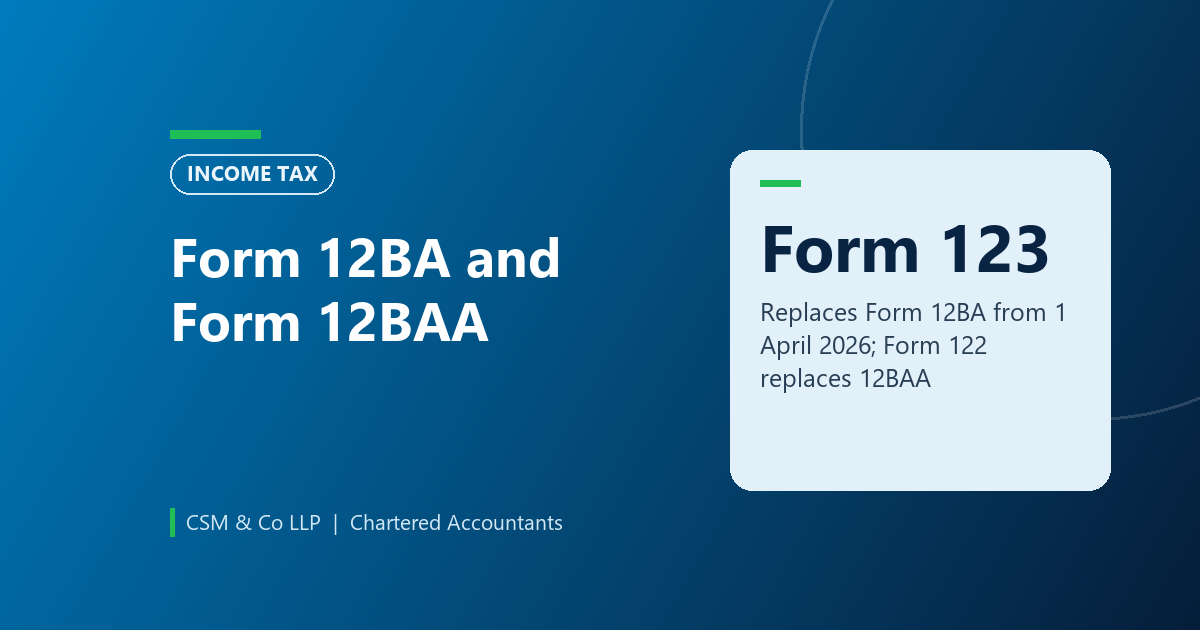
  • Form 12BA, the employer’s statement of perquisites, is Form 123 under the Income-tax Rules, 2026. It is needed when salary is more than ₹1,50,000; below that the details go in the relevant columns of Form 130 (the new Form 16).
  • Form 12BAA, the employee’s statement of other income and tax deducted, is Form 122, and it also covers salary from other employers.
  • Perquisites are valued under Rule 15, and the details are in Rule 204.
  • Some websites say Form 12BA became Form 122; the Rules show it became Form 123.

Two forms matter when an employer works out tax on salary: the employer’s statement of perquisites and the employee’s statement of other income. Both have new numbers from 1 April 2026 under the Income-tax Rules, 2026. Up to FY 2025-26 they remain Form 12BA and Form 12BAA.

Form 12BA is now Form 123

Form 123 is the “statement showing particulars of perquisites, other fringe benefits or amenities and profits in lieu of salary with value thereof”. Under Rule 204(2), the person who pays the salary must give the employee a statement of the correct and complete particulars of perquisites or profits in lieu of salary, and their value:

  • in the relevant columns of Form 130 (the TDS certificate for salary, earlier Form 16), if the salary for the tax year is not more than ₹1,50,000; or
  • in Form 123, if the salary is more than ₹1,50,000.

“Salary” here has the meaning given in Rule 15: dearness allowance counts if the terms of employment provide for it, and other allowances and perquisites do not.

Some websites say Form 12BA has been replaced by Form 122. That is not what the Rules say. Form 122 is a different statement, described below.

What Form 123 contains

  • Part A: the employer’s name, address, PAN, TAN, email and contact number, and the employee’s name, designation, PAN, whether the employee is a director or a person with a substantial interest in the company (for a company employer), and the employee’s income under the head Salaries other than from perquisites, and the tax year.
  • Part B: the valuation of each perquisite under Rule 15, with three columns: the value as per the rules, the amount recovered from the employee, and the amount chargeable to tax (the first less the second). The rows start with accommodation, cars and other automotive conveyance, sweeper, gardener, watchman or personal attendant, gas, electricity and water, interest free or concessional loans, and continue through the other items in Rule 15. See our post on perquisites for the values.

Form 12BAA is now Form 122

Form 122 is what the employee gives the person who deducts tax on salary, so that tax is worked out on the right figure. Under Rule 204(1) the employee may furnish:

  1. salary due or received from any other employer or employers in the tax year (the details once given in Form 12B when you change jobs),
  2. any loss under the head Income from house property for the year,
  3. income under any other head, other than a loss, and
  4. any tax already deducted or collected at source on those incomes.

The employer takes these into account when deducting tax, which avoids short deduction in the year.

Form 124 for evidence of claims

The employee’s claims for HRA, LTA, interest on a housing loan and Chapter VIII deductions go in Form 124 (Rule 205), which replaces Form 12BB. See our post on Form 124.

Practical points

  • An employee who joins mid-year gives the new employer the salary and tax details of the previous employer in Form 122.
  • The employer checks each perquisite in Form 123 against Rule 15. Several limits rose from 1 April 2026 (free meals ₹200 a meal, gifts ₹15,000, loans ₹2,00,000), so payroll software needs updating.
  • Keep Form 130, Form 123 and Form 122 together; they support the figures in the return.

Frequently asked questions

Which form replaces Form 12BA?

Form 123 under Rule 204(2)(b) of the Income-tax Rules, 2026, from 01/04/2026.

When is Form 123 needed?

When the salary paid or payable to the employee for the tax year is more than ₹1,50,000. If it is ₹1,50,000 or less, the details of perquisites go in the relevant columns of Form 130, the TDS certificate for salary.

What is Form 122?

The statement the employee gives the employer for deducting tax: salary from other employers, house property loss, income from other heads, and tax already deducted or collected (Rule 204(1)). It covers what Forms 12B and 12BAA did.

Who fills Form 123?

The employer, giving the value of each perquisite as per Rule 15, the amount recovered from the employee and the amount chargeable to tax.

What is salary for this test?

The same as in Rule 15: it includes dearness allowance if the terms of employment provide for it, and excludes other allowances and perquisites.

Official sources

Related reading

Disclaimer

This article is for general informational purposes only and should not be considered professional advice. Please consult a qualified expert for advice tailored to your specific situation. The author and website owner are not liable for any errors or actions based on this content.
Perquisites in Income Tax: Types, Valuation and Taxability for Tax Year 2026-27

Last updated: 12 September 2026 · Written and reviewed by CA Meet Dhrangadhariya, CSM & Co LLP

Quick summary

  • A perquisite is a benefit your employer gives you because of your job, and it is taxed as salary at the value fixed by Rule 15 of the Income-tax Rules, 2026.
  • The 2026 Rules raised several limits: free meals ₹200 per meal, gifts ₹15,000 a year, interest-free loans ₹2,00,000, school fees ₹3,000 per child a month, and the salary test for non-director employees ₹4,00,000.
  • Rent-free accommodation is valued at 10%, 7.5% or 5% of salary by city size, and hotel accommodation at 24% of salary.
  • Employer contributions above ₹7,50,000 a year to PF, NPS and superannuation are also a perquisite.

Salary is more than the money in your bank account. A house, a car, a cheap loan, free meals or shares given by your employer because of your job are perquisites, and they are taxed as part of salary. From Tax Year 2026-27 the definition is in section 17 of the Income-tax Act, 2025 and the valuation is in Rule 15 of the Income-tax Rules, 2026. For FY 2025-26 the 1961 Act and Rule 3 apply, with lower limits.

What counts as a perquisite? (section 17(1))

  • the value of rent-free accommodation, and of accommodation at a concessional rent above the rent you pay,
  • a benefit or amenity given free or at a concessional rate by a company to a director or a person with a substantial interest in it, or by any employer to an employee whose salary income in cash is more than ₹4,00,000 (Rule 17; it was ₹50,000),
  • the value of shares or specified securities, including sweat equity, allotted free or at a concession,
  • any other benefit or amenity prescribed,
  • an obligation of yours that the employer pays, such as your personal bills,
  • life insurance or annuity premium paid by the employer, other than for a recognised provident fund, approved superannuation fund or deposit-linked insurance fund, and
  • the employer’s contribution above ₹7,50,000 in a tax year, taken together for the recognised provident fund, the NPS and an approved superannuation fund, and the yearly accretion on that excess.

What is not a perquisite? (section 17(2))

  • Medical treatment of the employee or family in a hospital maintained by the employer.
  • Medical expenses paid by the employer in Government, local authority or approved hospitals, and for prescribed diseases in hospitals approved by the Chief Commissioner (Rule 18).
  • The employer’s share of health insurance premium under an approved scheme, and the premium you pay that the employer reimburses.
  • The cost of a vehicle used for the journey between home and the office.
  • Medical treatment abroad and travel and stay abroad for the patient and one attendant, to the extent permitted by the RBI (and for travel, only if gross total income is within the prescribed limit).

Rent-free and concessional accommodation (Rule 15(2))

Case Value
Government employee in Government accommodation Licence fee set by the Government, less rent paid
Employer owns it: city with population above 40 lakh (2011 census) 10% of salary for the period occupied, less rent paid
Employer owns it: city between 15 and 40 lakh 7.5% of salary, less rent paid
Employer owns it: other areas 5% of salary, less rent paid
Employer rents or leases it Lower of the rent paid by the employer and 10% of salary, less rent paid by the employee
Hotel accommodation Lower of the hotel charges and 24% of salary, less rent paid. Nil for up to 15 days in all on a transfer

Further points: if the accommodation is furnished, add 10% a year of the cost of the furniture and appliances (or the actual hire charges). If the same accommodation continues for more than one tax year, the value cannot rise above the first year’s value adjusted by the Cost Inflation Index. On a transfer, if you keep the old accommodation, only the lower-valued one counts for up to 90 days. Temporary accommodation at a mining, oil, project, dam or power site (up to 1,000 sq ft, at least eight kilometres from municipal limits, or in a remote area) is excluded.

Motor car

A car provided for personal use has a value for each month in Table II of Rule 15(3): ₹5,000 (plus ₹3,000 for a chauffeur) for a car up to 1.6 litres or an electric vehicle, and ₹7,000 (plus ₹3,000) above 1.6 litres, where the employer meets the running costs; ₹2,000 and ₹3,000 (each plus ₹3,000 for a chauffeur) where you meet the running costs. A car used wholly for official duties has no value if journey records and the employer’s certificate are kept. The full table is in our separate post on cars provided by employers.

Services, utilities and education (Table III)

Benefit Value
Sweeper, gardener, watchman or personal attendant Salary paid for those services, less what you pay
Gas, electricity or water bought from an outside agency The amount the employer pays, less what you pay
Gas, electricity or water from the employer’s own resources Manufacturing cost per unit, less what you pay
Free or concessional education, in general Employer’s expenditure, less what you pay
Education in the employer’s own school, or free education in another institution Cost of similar education nearby, less what you pay, only where the value is more than ₹3,000 per child per month (it was ₹1,000)
Free travel by a transport employer (not an airline or the railways) The value offered to the public, less what you pay

Other benefits (Table IV)

Benefit Value and exemption
Interest-free or concessional loan Interest at the State Bank of India rate on the first day of the year for the same type of loan, on the maximum monthly balance, less interest you pay. No value if the loans total ₹2,00,000 or less (it was ₹20,000), or if they are for medical treatment of the diseases in Rule 18 (to the extent not reimbursed by insurance)
Holiday travel, stay and other expenses paid by the employer The employer’s expense. For an official tour extended into a vacation, only the vacation part. LTA under Rule 277 is outside this
Free food and non-alcoholic drinks The employer’s expense, less what you pay. No value for up to ₹200 per meal (it was ₹50) at the office or through vouchers usable only at eating places, for tea or snacks in working hours, or for free food in a remote area or offshore installation
Gift, voucher or token The amount of the gift. Nil if the total in the tax year is below ₹15,000 (it was ₹5,000)
Credit card expenses, including fees, paid or reimbursed by the employer The amount, less what you pay. No value for expenses wholly for official purposes with records and the employer’s certificate
Club expenses and fees The employer’s expense, less what you pay. Initial fee for corporate membership is excluded. No value if wholly for business and facilities are open to all employees
Use of a movable asset (not a laptop, computer, tablet or mobile phone) 10% a year of its cost, or the rent paid by the employer, less what you pay
Transfer of a movable asset to the employee Cost less wear and tear (50% a year for computers and electronics, 20% for motor cars, 10% for other assets, each on the reducing balance method), less what you pay
Any other benefit Cost to the employer at arm’s length, less what you pay. Telephone and mobile phone expenses are excluded

Shares and stock options

The value of specified securities or sweat equity shares allotted free or at a concession is taxed as a perquisite on the date the option is exercised. For a listed share, the fair market value is the average of the opening and closing price on the exchange with the highest volume on that date, and where there was no trading, the closing price on the nearest earlier date. Unlisted shares are valued under the method in the rule. See our posts on ESOP taxation.

Tax paid by the employer

Where the employer pays the tax on a non-monetary perquisite at its option, that tax is itself not added to your income (Schedule III, Sl. No. 10).

Example

Priya’s salary for the rule is ₹10,00,000. Her employer, in a city with 20 lakh population (2011 census), provides unfurnished accommodation it owns, and she pays no rent. She also gets a ₹4,00,000 interest-free loan that is outstanding for the year and a ₹12,000 gift voucher at Diwali.

Item Taxable value
Accommodation: 7.5% of ₹10,00,000 ₹75,000
Loan: interest at the SBI rate on ₹4,00,000 (the loan is above ₹2,00,000), less nil interest paid Interest at the SBI rate for that type of loan
Gift voucher: ₹12,000 is below ₹15,000 Nil

Keep records

The employer shows perquisites in the salary statement and in the Form 16 of the employee. Employees should check each figure against the valuation rule, because wrong valuation, such as using the old ₹50 per meal limit, over-states income.

Frequently asked questions

What is a perquisite?

A benefit or amenity given by the employer because of the employment, for example rent-free housing, a car for personal use, a loan at a low rate, or shares. It is taxed as part of salary.

How is rent-free accommodation valued?

If the employer owns it: 10% of salary in cities with population above 40 lakh (2011 census), 7.5% in cities between 15 and 40 lakh, and 5% elsewhere, less rent paid. If the employer rents it: the lower of the rent paid and 10% of salary, less rent paid by you.

When is an employer loan taxable?

When the interest-free or low-interest loans total more than ₹2,00,000. The value is interest at the State Bank of India rate on the maximum monthly balance, less interest you pay. Loans for specified diseases are not taxed.

Are free meals taxable?

Not if the value is within ₹200 per meal at the office or through vouchers usable only at eating places, or if it is tea or snacks in working hours.

Are gifts from the employer taxable?

Gifts, vouchers or tokens are taxable only if their total in the tax year is ₹15,000 or more. Cash gifts are always salary.

Official sources

Related reading

Disclaimer

This article is for general informational purposes only and should not be considered professional advice. Please consult a qualified expert for advice tailored to your specific situation. The author and website owner are not liable for any errors or actions based on this content.

WhatsApp