Section 80P: Deduction for Co-operative Societies, Activities and Limits

Last updated: 07 September 2026 · Written and reviewed by CA Meet Dhrangadhariya, CSM & Co LLP

Quick summary

  • Section 80P gives co-operative societies a deduction for profits from specified activities such as credit to members, marketing members’ produce and cottage industries.
  • Other activities are covered only up to ₹1,00,000 for a consumers’ society and ₹50,000 for any other society.
  • Co-operative banks (other than primary agricultural credit societies and primary agricultural and rural development banks) are excluded.
  • From Tax Year 2026-27 it is section 149 of the Income-tax Act, 2025, and it is not available if the society opts for the 22% or 15% concessional rate.

Co-operative societies serve their members rather than outside shareholders, and the Income-tax law gives them a deduction on the profits from the activities that serve those members. From Tax Year 2026-27 the provision is section 149 of the Income-tax Act, 2025. For FY 2025-26 (assessment year 2026-27) it is still section 80P of the 1961 Act.

Who is a co-operative society?

For the Act a co-operative society is one registered under the Co-operative Societies Act, 1912 or any State law on co-operative societies. Section 80P applies to a co-operative society that includes income from the activities below in its gross total income.

Activities and amounts allowed

Activity Deduction
Banking or providing credit facilities to members Whole of the profits attributable
Cottage industry Whole of the profits attributable
Marketing agricultural produce grown by members Whole of the profits attributable
Buying agricultural implements, seeds, livestock or other farm articles to supply to members Whole of the profits attributable
Processing members’ agricultural produce without the aid of power Whole of the profits attributable
Collective disposal of members’ labour Whole of the profits attributable
Fishing and allied activities (catching, curing, processing, storing or marketing fish, or buying materials for members) Whole of the profits attributable
Primary society supplying milk, oilseeds, cotton seed, cattle feed, fruits or vegetables grown by its members to a federal co-operative, the Government or local authority, or a Government company or statutory corporation Whole of the profits of that business
Any other activity Profits up to ₹1,00,000 for a consumers’ society, ₹50,000 for any other society
Interest or dividend on investments with another co-operative society Whole of that income
Letting of godowns or warehouses for storage, processing or marketing of commodities Whole of that income
Interest on securities and income from house property, for a society (other than a housing society, urban consumers’ society, transport society or a society doing power-aided manufacturing) whose gross total income is not more than ₹20,000 Whole of that income

Two points on this table:

  • For collective disposal of labour and for fishing, the deduction applies only if the society’s rules and bye-laws limit voting rights to individuals who contribute their labour or carry on fishing, co-operative credit societies that finance the society, and the State Government.
  • The Finance Act, 2026 added cotton seed and cattle feed to the produce list for primary societies, and made clear that the investment income covered is interest or dividends.

The limit for the last row is ₹20,000 under the Act. Some older write-ups say ₹25,000; the Act says ₹20,000.

Co-operative banks are excluded

The section does not apply to a co-operative bank unless it is a primary agricultural credit society or a primary co-operative agricultural and rural development bank (a society whose area is confined to a taluk and whose main object is long-term credit for agriculture and rural development). Whether a co-operative credit society is really a “co-operative bank” is a question of fact that has reached the courts, and a society that gives credit to its members only is in a different position from one that functions as a bank. Check your society’s position with a professional before claiming.

Interaction with other deductions

If the society also claims the profit-linked deduction for infrastructure and other undertakings (section 80-IA, section 138 of the 2025 Act), the section 80P deduction is worked out on the income left after that deduction.

Example

A co-operative society that is not a consumers’ society has the following profits for the year:

Source Profit in ₹ Deduction in ₹
Marketing of members’ agricultural produce 4,00,000 4,00,000
Other activity (not listed in the section) 1,50,000 50,000
Total 5,50,000 4,50,000

The society’s taxable income is ₹1,00,000, before any other adjustments.

The concessional rate option

A resident co-operative society can opt to pay tax at 22% under section 115BAD of the 1961 Act (section 203 of the 2025 Act). Under that option the society gives up Chapter VIII deductions, so section 80P (section 149) is not available. The 2025 Act keeps only section 146 (additional employee cost) and section 150 for such societies. The same applies to the 15% option for new manufacturing co-operatives (section 115BAE, section 204 of the 2025 Act). A society that does not opt in continues to claim section 149.

Section 150: a new deduction for federal co-operatives

Section 150 of the 2025 Act (inserted by the Finance Act, 2026) lets a federal co-operative deduct dividends from its investment in any company, to the extent that the amount arose from an investment recorded in its books on or before 31 January 2026 and was distributed to its members at least one month before the due date for filing the return. It does not apply to any tax year beginning on or after 1 April 2029.

Frequently asked questions

Who can claim section 80P?

A co-operative society whose income includes profits from the activities listed in the section, such as credit to members, cottage industry, marketing members’ produce and fishing.

Is a co-operative bank eligible?

No. The section does not apply to a co-operative bank unless it is a primary agricultural credit society or a primary co-operative agricultural and rural development bank.

How much is deductible for other activities?

Profits from activities not specifically listed are deductible up to ₹1,00,000 for a consumers’ co-operative society and ₹50,000 for any other society.

Can I claim 80P if I opt for the 22% rate?

No. The concessional regime for co-operative societies (section 115BAD of the 1961 Act, section 203 of the 2025 Act) bars Chapter VIII deductions other than additional employee cost (section 146) and the new section 150.

What is the section number from Tax Year 2026-27?

Section 149 of the Income-tax Act, 2025.

Official sources

Related reading

Disclaimer

This article is for general informational purposes only and should not be considered professional advice. Please consult a qualified expert for advice tailored to your specific situation. The author and website owner are not liable for any errors or actions based on this content.

Section 80RRB: Deduction for Royalty Income from Patents

Last updated: 14 August 2026 · Written and reviewed by CA Meet Dhrangadhariya, CSM & Co LLP

Quick summary

  • Section 80RRB gives a resident individual patentee a deduction of the lower of the royalty income and ₹3,00,000 on royalty from a patent registered on or after 01/04/2003.
  • The claimant must be the patentee, that is the true and first inventor recorded as patentee, including a joint patentee.
  • The certificate (Form 10CCE, now Form 37) must be filed with the return, and the deduction is available only in the old tax regime.
  • From Tax Year 2026-27 it is section 152 of the Income-tax Act, 2025.

An inventor who earns royalty from a patent gets a deduction under section 80RRB, up to ₹3,00,000 a year. From Tax Year 2026-27 the provision is section 152 of the Income-tax Act, 2025. For FY 2025-26 (assessment year 2026-27) it is still section 80RRB of the 1961 Act.

Who can claim?

An individual who:

  • is resident in India,
  • is a patentee, and
  • receives royalty on a patent registered on or after 1 April 2003 under the Patents Act, 1970, and has that royalty included in gross total income.

A patentee is the true and first inventor recorded as the patentee under the Patents Act, and this includes joint patentees recorded as true and first inventors. Someone who bought or licensed a patent is not a patentee. HUFs, companies and non-residents are out.

What counts as royalty?

Royalty on a patent means consideration for transferring any or all rights in the patent (including granting a licence), giving information about the working or use of the patent, using the patent, or services connected with these. It does not include consideration that is capital gains, or the price for selling a product made with a patented process or the patented article for commercial use. A non-returnable advance counts as a lump sum.

How much is the deduction?

The lower of the royalty income included in gross total income and ₹3,00,000. If a compulsory licence has been granted under the Patents Act, the royalty counted cannot be more than the royalty fixed by the Controller of Patents.

Royalty from abroad

Income from a source outside India counts only to the extent it is brought into India in convertible foreign exchange within six months from the end of the tax year in which it is earned, or within any further period the Reserve Bank of India or other competent authority allows. A certificate from the prescribed authority must be filed with the return.

Certificates and forms

  • Up to FY 2025-26: the certificate in Form 10CCE, signed by the prescribed authority, filed with the return.
  • Under the Income-tax Rules, 2026 (from 01/04/2026): Form 37 (Rule 71) is the certificate for the patent royalty, and Form 38 (Rule 72) is the certificate for income from outside India, which comes from the RBI or another authorised authority.

No double deduction

If a deduction has been allowed for a year on this income, the same income cannot be deducted under any other provision of the Act in any year.

Old regime only

The deduction is not allowed in the new tax regime. Section 202 of the 2025 Act disallows Chapter VIII deductions other than sections 124(1), 124(2), 125(2) and 146.

Example

Meera is a resident individual and the registered patentee of a process patent granted in 2018. In the year she receives ₹4,00,000 as royalty from a licensee and has spent ₹50,000 on professional fees related to earning it.

Item Amount in ₹
Royalty received 4,00,000
Less: expenses allowed 50,000
Royalty income in gross total income 3,50,000
Deduction under section 80RRB (lower of 3,50,000 and 3,00,000) 3,00,000
Income left after the deduction 50,000

Her ₹50,000 is taxed at her normal slab rates, along with any other income.

How it differs from section 80QQB

Basis Section 80QQB (section 151) Section 80RRB (section 152)
Income Royalty from books, in the exercise of the profession of an author Royalty from a registered patent
Claimant Resident individual author Resident individual patentee
Limit Lower of income and ₹3,00,000 Lower of income and ₹3,00,000
Certificate Form 10CCD, now Form 36 Form 10CCE, now Form 37
Regime Old regime only Old regime only

Frequently asked questions

Who can claim section 80RRB?

A resident individual who is a patentee and receives royalty on a patent registered under the Patents Act, 1970 on or after 01/04/2003. HUFs and non-residents cannot claim it.

How much is the deduction?

The lower of the royalty income and ₹3,00,000 in a year.

Who counts as a patentee?

The true and first inventor recorded as the patentee under the Patents Act, 1970, including joint patentees recorded as true and first inventors. A person who merely bought or licensed the patent does not qualify.

Does the sale of a patented product count as royalty?

No. Consideration for selling a product made with a patented process, or the patented article, for commercial use is excluded, as is anything that is capital gains.

Is it available in the new tax regime?

No. It is available only in the old tax regime.

Official sources

Disclaimer

This article is for general informational purposes only and should not be considered professional advice. Please consult a qualified expert for advice tailored to your specific situation. The author and website owner are not liable for any errors or actions based on this content.
AS 22 Accounting for Taxes on Income

Last updated: 10 September 2026 · Written and reviewed by CA Meet Dhrangadhariya, CSM & Co LLP

Quick summary

  • Profits in your accounts rarely match taxable profits, and AS 22 governs how the difference is accounted for.
  • Differences are either timing differences (they reverse in later years) or permanent differences (they never reverse).
  • Timing differences create deferred tax assets or deferred tax liabilities.
  • This guide covers when and how to apply AS 22, the deferred tax computation, and the comparison with Ind AS 12 and IFRIC 23.

How AS 22 is applied at a glance

1. Compare accounting income with taxable income
↓
2. Split the difference into timing differences (reversible) and permanent differences (not reversible)
↓
3. Ignore permanent differences, they create no deferred tax
↓
4. Taxable income higher than accounting income gives a deferred tax asset, recognised only with reasonable certainty (virtual certainty if there are losses or unabsorbed depreciation)
↓
5. Accounting income higher than taxable income gives a deferred tax liability
↓
6. Report tax expense as current tax plus deferred tax in the profit and loss statement

Profits as per your financial statements rarely match with your taxable profits. And it would be incorrect to ignore to account for the difference between these two profits. To govern the accounting for such differences, we cover the following topics  in this article w.r.t. AS 22 Accounting for Taxes on Income:

Introduction - Accounting Standard

Accounting Standard 22 has been prescribed by ICAI to be applied in accounting for taxes on income. This AS is applied to match the differences between accounting income and taxable income. 1. Accounting income is the net profit before tax for a period, as reported in the profit and loss statement. 2. Taxable income is the income on which income tax is payable, computed by applying provisions of the Income Tax Act, 1961 & Rules.

Types of differences and why they appear

The differences can be of two types:

Timing difference

Timing differences are those differences between accounting income and taxable income which can be reversed in one or more subsequent periods. For example, Depreciation allowed as per WDV method for computing taxable income and as per SLM method for computing accounting income.

Permanent difference

Permanent differences are those differences between accounting income and taxable income which cannot be reversed any subsequent period. For example, Donation paid in cash is disallowed in computing taxable income whereas it is allowed as expenditure while computing accounting income. There can be differences between accounting income and taxable income because of the following reasons:

  1. Expenses debited in profit and loss statement, but disallowed as per Income Tax Act 1961, while computing taxable income

  2. Provision for Bad/doubtful debts allowed while computing accounting income, but disallowed while computing taxable income

  3. Charging depreciation using different rates as per Companies Act 2013 and Income Tax Act 1961

  4. Any income recognized on an accrual basis in profit and loss statement but recognized on receipt basis in subsequent period for computing taxable income. In order to account for these kinds of differences, AS 22 needs to be applied.

When to apply AS 22 Accounting for Taxes on Income

Deferred Tax Liability formula

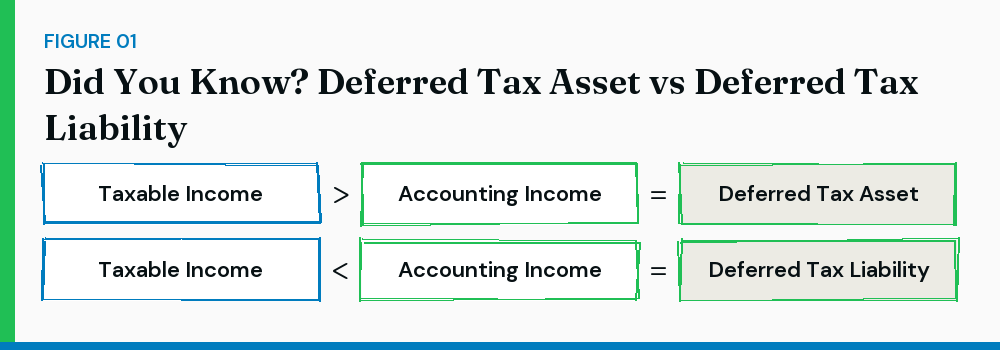
AS 22 needs to be applied when there are differences between taxable income and accounting income. If taxable income is greater than accounting income, then it will result in deferred tax asset. And if accounting income is greater than taxable income, then it will result in deferred tax liability.

When the difference is resulting in deferred tax asset, then it should be recognized only when there is a reasonable certainty of its realization. The recognition of deferred tax asset should be to the extent of the reasonable certainty of the expected realization. The reasonable certainty can be determined by making the realistic estimates of future profits based on the examination of profits and loss statement of earlier periods.

Say, an entity has unabsorbed depreciation or carry forward of losses. In such a case, deferred tax asset should be recognized to the extent there is a virtual certainty supported by convincing evidence. Virtual certainty is a matter of judgment of convincing evidence, which should be available in a concrete form at a particular date.

How to apply AS 22 Accounting for Taxes on Income

The application of AS 22 can be explained with the help of examples: Example of timing difference:

Particulars Year 1 Year 2 Year 3
Profit before tax (A) 100,000 200,000 180,000
Depreciation as per Companies Act (B) 25,000 25,000 25,000
Accounting income (A-B) 75,000 175,000 125,000
Depreciation as per Income tax Act (C) 50,000 0 10,000
Taxable income (A-C) 50,000 200,000 170,000
Timing difference (D) 25,000 -25,000 -15,000
Current tax @ 30% 15,000 60,000 51,000
Deferred tax (D * 30%) 7,500 -7,500 -4,500
Total tax expense 22,500 52,500 46,500
Profit after tax 52,500 122,500 78,500

Deferred tax computation

Particulars Year 1 Year 2 Year 3
Opening balance of timing difference 0 25,000 0
Addition 25,000 0 15,000
Deletion 0 25,000 0
Closing balance of timing difference 25,000 0 15,000
Deferred tax @ 30% 7,500 7,500 4,500
DTA/DTL Creation of DTL Reversal of DTL Creation of DTA
Journal Entry P&L A/c Dr. To DTL DTL Dr. To P&L A/c DTA Dr. To P&L A/c

Comparison between AS 22 and IND AS 12

Basis AS 22 Accounting for Taxes on Income IND AS 12 (Income taxes)
Recognition AS 22 recognized tax effect of differences between taxable income and accounting income. IND AS 12 recognized tax effect of differences between assets and/or liabilities and their tax base.
Approach AS 22 is based on profit or loss statement approach. IND AS 12 is based on balance sheet approach.
Differences The types of differences on which AS 22 is applied are timing differences and permanent differences. The types of differences on which IND AS 12 is applied are taxable temporary differences and deductible temporary differences. Permanent differences are not dealt in by this standard.
Recognition of Deferred tax asset/deductible temporary differences DTA is recognized only when and to the extent there is a reasonable certainty of its realization Deductible temporary differences are recognized to the extent of the probability of taxable profits in future periods.
Disclosure AS 22 deals with the disclosure of DTA/DTL in the balance sheet. IND AS 12 deals with the recognition of current or deferred tax as income or expense in profit and loss statement. It also deals with the disclosure of out of profit and loss transaction in the balance sheet as current or non-current assets/liability.
Revaluation of assets AS 22 does not cover the difference arising between taxable income and accounting income due to the revaluation of assets. IND AS 12 deals with the difference between carrying the amount of revalued asset and its tax base.
Goodwill AS 22 does not cover the difference arising due to goodwill arising a business combination. As per IND AS 12, the difference between carrying the amount of goodwill and its tax base (which will be NIL) is the taxable temporary difference. It does not allow the recognition of such difference because goodwill is measured as a residual and its recognition would increase the carrying amount of goodwill.
The concept of virtual certainty When an entity has unabsorbed depreciation or carry forward of losses then in such a case deferred tax asset should be to the extent there is a virtual certainty supported by convincing evidence. There is no concept of virtual certainty in IND AS 12. Deductible temporary differences are recognized to the extent of the probability of taxable profits in future periods.
Tax holiday AS 22 specifically provides guidance regarding recognition of deferred tax in the situations of Tax Holiday under Sections 80-IA, 80-IB, 10A and 10B of Income-tax Act. IND AS 12 does not specifically deal with the situations of the tax holiday.
Capital Loss AS 22 provides guidance regarding recognition of DTA in case of loss under the head of ‘capital gains’. IND AS 12 does not specifically provide for the same.

IFRIC 23

IFRIC 23 also provides for Uncertainty over Income Tax Treatments. It requires an entity to treat uncertain tax treatments depending on which method will be best suited for its resolution. The major difference between AS 22 and IFRIC 23 is that IFRIC 23 requires an entity, while determining the current and deferred income tax assets and liabilities, to make an assessment whether it is probable that taxation authority will accept an uncertain tax treatment.

If it is not probable, then entity should reflect that uncertainty through either expected value approach or most likely approach. IFRIC 23 will be applicable for annual reporting periods beginning on or after 01.01.2019.

Frequently asked questions

What is AS 22?

AS 22 is the Accounting Standard issued by ICAI that prescribes how taxes on income, including current tax and deferred tax, are accounted for in financial statements.

What is the difference between a timing difference and a permanent difference?

A timing difference arises in one period and reverses in later periods, for example depreciation under different methods. A permanent difference never reverses, for example an expense disallowed by the Income Tax Act.

Does AS 22 create deferred tax on permanent differences?

No. Deferred tax is recognised only for timing differences, not for permanent differences.

How is AS 22 different from Ind AS 12?

AS 22 applies to companies following the Companies (Accounting Standards) Rules and uses the income statement approach based on timing differences, while Ind AS 12 follows a balance sheet approach based on temporary differences.

Official sources

Related reading

Disclaimer

This article is for general informational purposes only and should not be considered professional advice. Please consult a qualified expert for advice tailored to your specific situation. The author and website owner are not liable for any errors or actions based on this content.
Indian Accounting Standard 12: Income Taxes

Last updated: 19 July 2026 · Written and reviewed by CA Meet Dhrangadhariya, CSM & Co LLP

Quick summary

  • Ind AS 12 prescribes how current tax and deferred tax are accounted for, using the balance sheet approach.
  • Deferred tax is recognised on temporary differences between the carrying amount of an asset or liability and its tax base.
  • Deferred tax liabilities are recognised on all taxable temporary differences, with limited exceptions such as initial recognition of goodwill.
  • Deferred tax assets are recognised only to the extent that future taxable profit will probably be available.

How Ind AS 12 deferred tax is worked out

1. Find the carrying amount of the asset or liability in the balance sheet
↓
2. Find its tax base
↓
3. Compute the temporary difference between the two
↓
4. Taxable temporary difference: recognise a deferred tax liability (apart from the exceptions)
↓
5. Deductible temporary difference: recognise a deferred tax asset only if future taxable profit is probable
↓
6. Measure at the tax rate expected when the asset is realised or the liability is settled
↓
7. Present and disclose the components of tax expense

Income taxes as per the Indian Accounting Standard 12 include both domestic and foreign taxes, which are based on taxable profits. It also includes withholding taxes.

Introduction

The objective of this standard is to prescribe the accounting treatment for income taxes. The principal issue in accounting for income taxes is how to account for current and future tax consequences of:

  • Future settlement of carrying amount of assets and liabilities that are recognised in the balance sheet of an organisation. If it is probable that the settlement of the carrying amount will result in a variance of tax amount which should then be recognised as deferred tax.
  • Events and transactions that are recognised in the current period. The treatment for the tax related to the events will be the same as the events.

Ind AS 12 is based on the Balance Sheet approach. It requires recognising tax consequences of the difference between the carrying amounts of assets and liabilities and their tax base.

What is Tax expense or Income?

Tax expense or Tax income is the aggregate amount included in the determination of profit or loss in respect of current tax and deferred tax. Current tax is the amount of income taxes payable/recoverable in respect of the current profit/ loss for a period.

Deferred Tax liability is the amount of income tax payable in future periods with respect to the taxable temporary differences.

Deferred tax asset is the income tax amount recoverable in future periods in respect to the deductible temporary differences, carry forward of unused tax losses, and carry forward of unused tax credits.

Temporary differences are the differences between the carrying amount of an asset or liability in the balance sheet and its tax base.

Tax Base of an asset or liability is the amount attributed to the asset or liability for tax purposes.

Recognition of current tax assets and current tax liabilities

  • Taxes to the extent unpaid for current and prior periods will be recognised as a liability. If the amount already paid for current and prior periods exceeds the actual amount due, then it will be recognised as an asset.
  • A tax loss that can be used to recover current tax of a previous period is recognised as an asset in the period in which tax loss occurred.

Recognition of deferred tax liabilities

Deferred tax liability will be recognised for all taxable temporary differences. However, the following are exceptions to the same:

  • The initial recognition of goodwill.
  • The initial recognition of an asset or liability in a transaction that is not a business combination and affects neither accounting profit nor taxable profit at the time of the transaction. A recent amendment to Ind AS 12 removes this exception where the transaction gives rise to equal taxable and deductible temporary differences (for example leases and decommissioning obligations). Check the current text of the standard for the applicable date.

Recognition of deferred tax assets

A deferred tax asset will be recognised for all the deductible temporary differences, provided it is probable that the taxable profit will be available for utilisation of deductible temporary differences. A deferred tax asset is not recognised if it arises from the initial recognition of an asset or liability in a transaction that is not a business combination and affects neither accounting profit nor taxable profit at the time of the transaction (subject to the amendment mentioned above).

Measurement of current and deferred tax assets/liabilities

Current tax assets or liability will be measured as the amount expected to be recovered or paid to the tax authorities at the tax rate and laws that have been enacted or subsequently enacted by the end of the reporting period. Deferred tax assets or liability will be measured at the expected tax rates in the period in which the asset is realised or liability paid based on the tax laws that have been enacted or subsequently enacted at the end of the reporting period.

Presentation of current and deferred tax assets and liabilities

An entity shall offset current tax assets and liabilities only if it is legally entitled to and it intends to settle on a net basis or to realise assets and settle liabilities simultaneously. It can offset deferred tax assets and liabilities if:

  • It has the legal right to offset current tax assets and liabilities.
  • The deferred tax assets and liabilities relate to the income taxes levied by the same taxation authorities on same entities or on entities that intend to settle current tax assets and liabilities on a net basis or to realise assets and settle liabilities simultaneously.

Disclosure of current and deferred tax assets and liabilities

The major components of tax expense or income will be disclosed separately.

Allocation

As per this standard, an entity must account for tax consequences in the same way as it accounts for the transactions and other events. Therefore, if the transaction and other events are recognised in profit and loss, then the related tax consequences should also be recognised in profit and loss. If the transaction and event is recognised outside profit and loss that is in other comprehensive income or directly in equity, then the tax consequence will also be recognised outside the profit and loss that is in other comprehensive income or directly in equity.

Frequently asked questions

What approach does Ind AS 12 follow?

Ind AS 12 follows the balance sheet approach. It recognises the tax consequences of differences between the carrying amount of assets and liabilities and their tax base.

What is a tax base?

The tax base of an asset or liability is the amount attributed to it for tax purposes.

When is a deferred tax asset recognised under Ind AS 12?

For deductible temporary differences, only when it is probable that taxable profit will be available against which they can be used.

How is Ind AS 12 different from AS 22?

AS 22 uses the income statement approach based on timing differences, while Ind AS 12 uses the balance sheet approach based on temporary differences.

Official sources

Related reading

Disclaimer

This article is for general informational purposes only and should not be considered professional advice. Please consult a qualified expert for advice tailored to your specific situation. The author and website owner are not liable for any errors or actions based on this content.
Decoding the Direct Tax Landscape: Budget 2025 Insights

The Union Budget 2025 brings a fresh wave of reforms to India’s direct tax framework, aiming to balance economic growth with taxpayer relief. With a focus on simplification, compliance, and incentivizing investments, the latest proposals introduce key changes in tax slabs, deductions, corporate taxation, and digital compliance. Whether you’re an individual taxpayer, a business owner, or a financial professional, understanding these shifts is crucial for strategic tax planning. In this blog, we break down the most significant direct tax updates, their implications, and what they mean for you.


1. Rates of Income Tax

  • (a) For Individual, HUF, association of persons, body of individuals, artificial juridical person.
  • •  Section 115BAC (1A) – New scheme – Default Scheme
Sr. No Total income Rate of tax
1. Upto Rs. 4,00,000 Nil
2. From Rs. 4,00,001 to Rs. 8,00,000 5%
3. From Rs. 8,00,001 to Rs. 12,00,000 10%
4. From Rs. 12,00,001 to Rs. 16,00,000 15%
5. From Rs. 16,00,001 to Rs. 20,00,000 20%
6. From Rs. 20,00,001 to Rs. 24,00,000 25%
7. Above Rs. 24,00,000 30%
  • •  No Deduction are available under the New Tax Regime except the following:
    • (i) Standard Deduction of Rs. 75,000/- u/s. 16(ia)
    • (ii) Family Pension of 25,000 or 1/3 of total pension, whichever is less u/s 57(iia)
    • (iii) Contribution to NPS u/s. 80CCD(2) – 14% of salary
    • (iv) Deposit in Agniveer Corpus Fund u/s. 80CCH(2)
    • (v) Deduction for Employment of New Employees u/s. 80JJAA
  • • An individual, HUF, AOP, BOI or artificial judicial person can opt for old scheme on or before due date of filing income tax return as per section 139(1) of the Act. (i.e. 31st July and 31st October)
Sr. No Total income Rate of tax
1. Upto Rs. 2,50,000 Nil
2. From Rs. 2,50,001 to Rs. 5,00,000 5%
3. From Rs. 5,00,001 to Rs. 10,00,000 10%
4. Above Rs. 10,00,000 30%
  • • For resident senior citizen, who is of the age of 60years or more but less than 80 years – Nil rate of Tax upto 3,00,000.
  • • For resident senior citizen, who is of the age of 80years or more – Nil rate of Tax upto 5,00,000
  • • Above tax amount shall be further increased by surcharge at the rate of –
Income level % of Surcharge Remarks
Above 50 lakh to 1 cr 10% Including all special tax rate income i.e. STCG and LTCG

Including all special tax rate income i.e. STCG and LTCG

Above 1 cr – 2 cr 15%
Above 2 cr to 5 cr 25% Excluding Dividend Income, STCG and LTCG – i.e. surcharge is restricted upto 15%

On total income above 2 Cr.

Above 5 cr

(Not applicable to New Scheme)

37%

(For New scheme surcharge is restricted upto 25% on total income above 2 Cr.)

* Marginal relief shall be provided in case of surcharge

  • • Rabate u/s. 87A – Allowed to Resident Individuals only
Particulars Old Scheme New Scheme (Default)
Rebate Amount (Maximum) Rs. 12,500 Rs. 60,000
Threshold limit of Total Income Less than 5,00,000 Less than 12,00,000
Rebate for Special Tax income Allowed against STCG and LTCG (Except 112A) Not Allowed against STCG and LTCG


  • (b) For Partnership Firms/LLP
  • • Tax Rate – 30% + Surcharge & Education Cess of 4% equivalent to 31.2%
  • • Surcharge of 12% if total income exceeds 1 cr.


  • (c) For Companies
Section Conditions Rate of Tax (including Health and Education cess) Surcharge on tax
Income >1 cr < 10 cr Income > 10cr
115BA Turnover for F.Y. 2023-24 does not exceed 400 cr 26% 7% 12%
115BA Turnover for F.Y. 2023-24 exceed 400 cr 31.2% 7% 12%
115BAA No deductions or additional depreciation is allowed except 80JJA or 80M 25.17% – –
115BAB New manufacturing Domestic Companies. No deductions or additional depreciation is allowed except 80JJA or 80M 17.16% – –
Foreign Companies Other than foreign companies chargeable at special rates 35% 2% 5%
MAT Not applicable for companies who opted 115BAA and 115BAB 15.60% 7% 12%


2. Annual value of the self-occupied property simplified

  • • Under section 23 of the Act, owner of the house property can take Annual value of 2 House properties to be Nil due to reason that owner cannot occupy the house property for employment or business carried out at any other place.
  • • Now it is amended so as to provide that the annual value of the property consisting of a house, or any part thereof shall be taken as nil, if the owner occupies it for his own residence or cannot actually occupy it due to any reason. The provision of sub-section (4) of section 23 of the Act which allows this benefit only in respect of two of such houses shall continue to apply as earlier.


3. Bringing clarity in income on redemption of Unit Linked Insurance Policy (ULIP)

  • •  Exemption u/s. 10(10D) on sum received under life policy including bonus on such policy is not applicable if amount of premium or aggregate amount of premium payable during the term of such policy or policies exceeds Rs. 2,50,000/-
  • •  It is now proposed to amend provisions related to ULIP so as to provide that ULIP to which exemption does not apply will be treated as capital asset u/s 2(14). And it will be included in definition of equity oriented fund.


4.Deduction under section 80CCD for contributions made to NPS Vatsalya

  • • Deduction is now available to contribution made to NPS on account of minor. The amount will be charged to tax when withdrawn in case where deposit was made in account of minor. No Tax when withdrawn due to death of the minor.
  • • Clause 12BA of section 10 inserted to provide partial withdrawal upto 25% of the amount contributed shall not be included in the total income of the parent/guardian. NPS Vatsalya Scheme also allows for partial withdrawal from the minor’s account to address certain contingency situations like education, treatment of specified illnesses and disability (of more than 75%) of the minor.


5. Extending the time-limit to file the updated return u/s. 139 (8A)

Sr. No. Period from the end of relevant assessment year Additional tax % of total tax and interest paid
1. Upto 12 months 25%
2. From 12 months upto 24 months 50%
3. From 24 months upto 36 months 60%
4. From 36 months upto 48 months 70%

*No updated return can be filed where any notice u/s. 148A has been issued after 36 months from the end of the relevant assessment year


6.Amendment in TDS Provisions

  • •  All the proposed amendment in the TDS sections are depicted in the below table:
Sr. No. Section Current Threshold Proposed Threshold Rate of TDS
1. 193 – Interest on securities

Nil

Rs. 10,000/-

10%

2. 194A – Interest other than Interest on securities (i) Rs. 50,000/- for senior citizen;

(ii) Rs. 40,000/- in case of others when payer is bank, cooperative society and post office

(iii) Rs. 5,000/- in other cases

(i) Rs. 1,00,000/- for senior citizen;

(ii) Rs. 50,000/- in case of others when payer is bank, cooperative society and post office

(iii) Rs. 10,000/- in other cases

10%

3. 194 – Dividend for an individual shareholder

Rs. 5,000/-

Rs. 10,000/-

10%

4. 194K – Income in respect of units of a mutual fund or specified company or undertaking

Rs. 5,000/-

Rs. 10,000/-

10%

5. 194B – Winnings from lottery, crossword puzzle, etc. Aggregate of amounts exceeding Rs. 10,000/- during the financial year Rs. 10,000/- in respect of a single transaction

30%

6. 194BB – Winnings from horse race
7. 194D – Insurance commission

Rs. 15,000/-

Rs. 20,000/-

2%

8. 194G – Income by way of commission, prize etc. on lottery tickets

Rs. 15,000/-

Rs. 20,000/-

2%

9. 194H – Commission or brokerage

Rs. 15,000/-

Rs. 20,000/-

2%

10. 194-I Rent

Rs. 2,40,000/- during the financial year

Rs. 50,000/- per month or part of a month

(i)2% – Plant & Machinery.

(ii) 10% -Land, Building and Furniture.

11. 194J – Fee for professional or technical services

Rs. 30,000/-

Rs. 50,000/-

(i)10% – Professional Fees

(ii)2% – Technical Fees

(iii) 2% – Royalty in case sale/distribution/exhibition of cinematographic

(iv)10% – All other Royalty

(v) 2% – Payee is in business of call centre

12. 194LA – Income by way of enhanced compensation

Rs. 2,50,000/-

5,00,000/-

10%

13. Section 194LBC -Income in respect of investment in securitization trust

–

–

10%

(Old Rate 25% for Individual, HUF and 30% for others)

13. 206C – TCS

(i)Timber or any other forest produce (not being tendu leaves) obtained under a forest lease

(ii) Timber obtained by any mode other than under a forest lease

–

–

2%

14. 206 (1H) – TCS on sale consideration exceeding 50 lakh

0.1%

Omitted

Section omitted w.e.f. 1st April 2025
15. 206C(1G) – TCS Amount remitted for education and medical Treatment

7,00,000

10,00,000

5%

16. 206C(1G) – TCS Amount remitted for repayment of education loan taken from abroad from specified Financial institute

7,00,000

Omitted

Applicability omitted w.e.f. 1st April 2025


7.Removal of higher TDS/TCS for non-filers of return of income

  • •  Currently, Section 206AB and 206CCA of the Act requires higher deductions or collections of TDS or TCS respectively in case of deductee or collectee are non-filer of Income Tax return.
  • •  To reduce compliance burden for the deductor/collector, it is proposed to omit section 206AB of the Act and section 206CCA of the Act.


8. Obligation to furnish information in respect of crypto-asset

  • • It is proposed to insert new section 285BAA with effect from 01.04.2026, to obligate reporting entity i.e. platform providing trading in cryptocurrency or any digital currency, to furnish information in respect of transactions in such crypto asset in statement, for such period, within such time, in such form and manner as may be prescribed.
  • • This will ensure that information related to cryptocurrency and virtual digital currency will be reported to the AIS statement of the person who have transacted in such cryptocurrency and virtual digital currency.


9. Rationalisation of taxation of capital gains on transfer of capital assets by non-residents

  • • The provisions of Section 115AD of the Act provides that where the total income of a specified fund or Foreign Institutional Investor includes income by way of long term capital gains, if any, tax shall be calculated at 10%. Long Term capital referred in section 112A is taxed at 12.5% irrespective of resident or non-resident.
  • • Therefore, it is proposed to amend the provisions of section 115AD to provide that income-tax on the income by way of long-term capital gains on transfer of securities not referred to in section 112A, if any, included in the total income, shall be calculated at the rate of 12.5%


10.Amendment related to Charitable Trust

  • • It is proposed to amend Explanation to sub-section (4) of section 12AB so as to provide that the situations where the application for registration of trust or institution is not complete, shall not be treated as specified violation for the purpose of the said sub-section. As even minor default in the application may lead to cancellation of registration of trust or institution resulting in tax on accreted income.
  • • Further 12AB is amended to increase the validity of registration of trust from 5 years to 10 years where trust has made an application under sub clause (i) to (v) of the clause (ac) of section 12A(1) and total income of such trust without giving effect of section 11 and 12 does not exceed 5 crores during each of the two previous years preceding the previous year in which application is made.
  • • Section 13 (3) amended to excludes application of income of trust or institution if such income or property of trust or institution is used or applied directly or indirectly to any person – whose contribution to trust or institution exceeds 1 lakh or aggregate contribution exceeds 10 lakhs during the financial year. Amendment also removes relatives or concern in which such person has substantial interest from the said section.


11.Amendment of Definition of ‘Capital Asset’

  • • Section 2(14) of the Act defines capital Asset which is amended to include any security held by investment funds referred to in Section 115UB (Alternative Investment Funds) which has invested in such security in accordance with the regulations made under the Securities and Exchange Board of India Act, 1992 would be treated as capital asset only so that any income arising from transfer of such security would be in the nature of capital gain.


12.Harmonisation of Significant Economic Presence applicability with Business Connection

  • • It is proposed to amend Explanation 2A to Section 9 so that transactions or activities of a non-resident in India which are confined to the purchase of goods in India for the purpose of export shall not constitute significant economic presence of such non-resident in India. This will bring parity to Clause (i) of section 9(1) which states that no income shall be deemed accrue or arise in India to non -resident from operations confined to purchase of goods in India for the purpose of export.


13. Rationalisation of provisions related to carry forward of losses in case of amalgamation

  • • As per section 72A and 72AA of the Act provides carry forward and set off of accumulated loss and unabsorbed depreciation allowance in case of amalgamation or reorganisation for 8 assessments years immediately succeeding the assessment year for which the loss was first computed.
  • • This leads into evergreening of loss of the predecessor entity resulting from successive amalgamation to take benefit of 8 years of carry forward and set off of business loss or depreciation allowance.
  • • It is now proposed to amend section 72A and section 72AA of the Act to provide that any loss forming part of the accumulated loss of the predecessor entity, which is deemed to be the loss of the successor entity, shall be eligible to be carried forward for not more than eight assessment years immediately succeeding the assessment year for which such loss was first computed for original predecessor entity.


14. Exemption to withdrawals by Individuals from National Savings Scheme from taxation

  • • Section 80CCA amended to provide exemption to the withdrawals made by individuals from these deposits for which deduction was allowed, on or after 29th day of August 2024. This exemption is provided to the deposits, with the interest accrued thereon, made before 01.04.1992.


15.Incentives to International Financial Services Centre (IFSC)

  • • Section 9A – It is proposed to rationalize the condition under Clause (c) of subsection (3), determining aggregate participation or investment on 1st April and 1st October of the previous year. If the condition is not met on either date, the fund will have four months to comply. Additionally, the deadline for IFSC based fund managers to commence operations is extended to 31st March 2030, continuing the benefits under Subsection (8A).
  • • To avoid deemed dividend u/s. 2(22)(e) for borrowings by the corporate treasury centre in IFSC from its group entities – It is proposed to amend clause (22) of section 2 to provide that any advance or loan between two group entities, where one of the group entity is a “Finance company” or a “Finance unit” in IFSC set up as a global or regional corporate treasury centre for undertaking treasury activities or treasury services and the ‘parent entity’ or ‘principal entity’ of such ‘group entity’ is listed on stock exchange in a country or territory outside India, other than the country or territory outside India as may be specified by the Board in this behalf, shall not be treated as ‘dividend’. The conditions for a ‘group entity’, ‘principle entity’ and the ‘parent entity’ shall be prescribed
  • • Section 10 – Clause 4(E) – Benefit extended to FPI in addition to banking unit of IFSC. It is proposed to amend clause (4E) of section 10 to provide that the income of a non-resident on account of transfer of non-deliverable forward contracts or offshore derivative instruments or over the-counter derivatives, or distribution of income on offshore derivative instruments, entered into with Foreign Portfolio Investors being an IFSC unit shall also not be included in the total income subject to certain conditions as may be prescribed.
  • • Section 10 – Clause 23FE – Benefits extended to SWP or Pension Funds – Section provides exemption in the nature of dividend, interest and long-term capital gains on investment made in India. It is now proposed to amend that long term gains (irrespective of deemed short term capital gain as per section 50AA) shall not be included in the total income of a SWP or Pension Fund. Further date of investment under the said clause extended from 31st Day of March 2025 to 31st Day of March 2030.
  • • Section 10 – Clause 10D – Exemption on sum received from Life Insurance policy. – It is amended to provide that proceeds received on life insurance policy issued by IFSC insurance intermediary office shall be exempted without the condition related to the maximum premium payable on such policy as mentioned in the clause. (i.e. 2.5 lakh for Unit linked insurance and 5 lakh for other insurance.)
  • • Section 10 – Clause 4H – Extended Capital Gain or Dividend Exemption to Ship leasing units in IFSC – It is proposed to amend clause to provide exemptions to non-residents or units of IFSC engaged in ship leasing on capital tax on transfer of equity shares of domestic companies being units of IFSC and dividends paid by such company being unit of IFSC.
  • • Section 47 (viiad) – provides exemption on transfer of asset being share or unit or interest held in the original fund in consideration for the share or unit of interest in the resultant fund located in IFSC and granted a certificate Category I, II, III AIF. It is now amended to include ETF and retail schemes within the definition of Resultant Fund.
  • • The sunset dates for commencement of operations of IFSC units for several tax concessions, or relocation of funds to IFSC, in clause (d) of sub-section (2) of section 80LA, clause (4D), clause (4F), clause (4H) of section 10 and clause (viiad) of section 47, is proposed to be extended to 31st day of March, 2030.


16.Rationalisation in taxation of Business trusts

  • • As per Section 115UA Real Estate Investment Trust (REIT) and Infrastructure Investment Trust (InVIT) enjoys pass through status in respect of interest, dividend and rental income. Therefore, income of REIT and InVIT shall be charged at maximum marginal rate subject to provisions of section 111A and section 112.
  • • Reference of section 112A was not available in the existing provision. Which is now proposed to be amended to include reference to section 111A, 112A and 112 of the Act.


17. Rationalisation of transfer pricing provisions for carrying out multi-year arm’s length price determination

  • • It is proposed to amend section 92CA of the Act to provide that the ALP determined in relation to an international transaction or a specified domestic transaction for any previous year shall apply to the similar transaction for the two consecutive previous years immediately following such previous year.
  • • For this purpose, assesse shall required to exercise such option within the time as may be prescribed and Transfer pricing officer may order within 1 month from the end of the month in such option is exercised, declare whether such option is valid or not.
  • • The option cannot be exercised if any proceedings is related to search cases.


18. Scheme of presumptive taxation for non-resident providing services for electronics manufacturing facility

  • • It is proposed to insert a new section 44BBD, which deems twenty-five per cent (25%) of the aggregate amount received/ receivable by, or paid/ payable to, the non-resident, on account of providing services or technology to the resident company under a scheme notified by the Central Government, as profits and gains of such non-resident.


19. Extension of benefits of tonnage tax scheme to inland vessels

  • • To promote inland water transportation in the country and to attract investments in the sector, it is proposed to extend the benefits of tonnage tax scheme to Inland Vessels registered under Inland Vessels Act, 2021. Accordingly inland vessels have been included in the section 115VD for being eligible to be a qualified ship. Further, inland vessels have been defined in section 115V of the Act in the same manner as provided in the Inland Vessels Act, 2021. Other corresponding amendments have been made to extend the tonnage tax scheme to inland vessels.


20. Other Administrative Amendments

  • • Extension of timeline for tax benefits to start-ups – The existing provisions of Section 80-IAC of the Act, inter alia, provide for a deduction of an amount equal to hundred percent of the profits and gains derived from an eligible business by an eligible start-up for three consecutive assessment years out of ten years, beginning from the year of incorporation, at the option of the assessee. It is proposed to amend the above section so as to extend the benefit for another period of five years, i.e. the benefit will be available to eligible start-ups incorporated before 01.04.2030.
  • • Amendments proposed in provisions of Block assessment for search and requisition cases under Chapter XIV-B
    • It is proposed to insert the term “virtual digital asset” to the definition of “undisclosed income” in section 158B.
    • Clause (i) of Section 158BB (1) will replace “total income disclosed” with undisclosed income.
    • Clause (iv) will clarify that income for a previous year, if the return due date hasn’t passed before the search, will be taxed under normal provisions.
    • As per section 158BE – the time limit for completing a block assessment is proposed to be made as 12 months ending from the quarter in which last authorisations for search or requisition has been executed.
  • • It is proposed to amend the Section 144BA, section 153, section 153B, section 158BE, section 158BFA, section 263, section 264 and Rule 68B of Schedule-II of the Act,of the Act so as to exclude the period commencing on the date on which stay was granted by an order or injunction of any court and ending on the date on which certified copy of the order vacating the stay was received by the jurisdictional Principal Commissioner or Commissioner.
  • • Certain penalties to be imposed by the Assessing Officer
    • Sections 271C, 271CA, 271D, 271DA, 271DB and 271E of the Act, inter-alia, provide that penalty under these sections shall be imposed by the Joint Commissioner. Though, assessment in such cases were being made by the Assessing Officer, penalty under these sections were being imposed by the Joint Commissioner.
    • In order to rationalize the process, it is proposed to amend sections 271C, 271CA, 271D, 271DA, 271DB and 271E of the Act so that penalties under these sections shall be levied by the Assessing Officer in place of Joint Commissioner, subject to the provisions of sub-section (2) of section 274 of the Act. Thus, Assessing Officer shall take the prior approval of Joint Commissioner for the passing of penalty order, where penalty amount exceeds Rs. 10,000 or 20,000 if AO is ACIT/DCIT as specified in sub-section (2) of section 274 of the Act.
  • • Provisions related to notifying faceless scheme under section 92CA (Transfer Pricing Proceedings), 144C (Dispute Resolution proceedings) 253 and 255 (Appellate Proceedings) are omitted so as to provide that Central Government may issue directions beyond the cut-off date of 31st day of March, 2025, if required.
  • • It is proposed to amend the section 270AA, which inter alia provides the procedure of granting the immunity by the AO from imposition of penalty and prosecution, to process the application within 3 months from the end of month in which application is received instead of current 1 month time.
  • • It proposed to amend section 275 of the Act to provide that any order imposing a penalty under Chapter XXI shall not be passed after the expiry of six months from the end of the quarter in which the connected proceedings are completed, or the order of appeal is received by the jurisdictional Principal Commissioner or Commissioner, or the order of revision is passed, or the notice for imposition of penalty is issued, as the case maybe.
  • • Section 276BB of the Act is amended to provide that the prosecution shall not be instituted against a person covered under the said section, if the payment of the tax collected at source has been made to the credit of the Central Government at any time on or before the time prescribed for filing the quarterly statement respect of such payment.


Conclusion:

To conclude, the direct tax proposals in Budget 2025 introduce a mix of structural changes and rationalization measures aimed at fostering compliance, simplifying tax administration, and promoting economic growth. With revised tax slabs, enhanced deductions under the new tax regime, and targeted incentives for businesses, the government continues to refine the tax landscape to balance revenue mobilization with taxpayer relief. Additionally, amendments in capital gains taxation, IFSC incentives, and rationalization of exemptions reflect a strategic push towards modernization and global competitiveness. As these provisions take effect, individuals and businesses must assess their financial planning strategies to align with the evolving tax framework. Staying informed and proactive will be key to optimizing tax efficiency in the coming fiscal year.


Disclaimer:

This article is for general informational purposes only and should not be considered professional advice. Please consult a qualified expert for advice tailored to your specific situation. The author and website owner are not liable for any errors or actions based on this content.

Understanding Notice under Section 142(1) of the Income Tax Act

Understanding Notice under Section 142(1) of the Income Tax Act

The Income Tax Act, 1961, is a comprehensive legislation that governs the taxation of income in India. One of the key provisions of this Act is Section 142, which deals with the assessment of income tax. Specifically, Section 142(1) empowers the Assessing Officer to issue a notice to the taxpayer, requiring them to file their income tax return.

What is a Notice under Section 142(1)?

A notice under Section 142(1) is a formal communication issued by the Assessing Officer to the taxpayer, requiring them to file their income tax return. This notice is typically issued when the taxpayer has not filed their income tax return or has not furnished the required documents or information.

Why is a Notice under Section 142(1) issued?

A notice under Section 142(1) is issued for several reasons, including:

1. Non-filing of income tax return: If the taxpayer has not filed their income tax return, the Assessing Officer may issue a notice under Section 142(1) to require them to file their return.
2. Non-furnishing of documents or information: If the taxpayer has not furnished the required documents or information, the Assessing Officer may issue a notice under Section 142(1) to require them to furnish the same.
3. Discrepancies in income tax return: If there are discrepancies in the income tax return filed by the taxpayer, the Assessing Officer may issue a notice under Section 142(1) to require them to explain the discrepancies.

What to do if you receive a Notice under Section 142(1)?

If you receive a notice under Section 142(1), it is essential to take immediate action to avoid any penalties or consequences. Here are some steps you can take:

1. Respond to the notice: Respond to the notice within the specified time limit, typically 15 days from the date of receipt of the notice.
2. Furnish the required documents or information: Furnish the required documents or information, such as financial statements, tax audit reports, or other relevant documents.
3. File your income tax return: If you have not filed your income tax return, file it immediately, along with any necessary documents or information.
4. Seek professional help: If you are unsure about how to respond to the notice or need help with filing your income tax return, seek the advice of a tax professional or chartered accountant.

Conclusion

A notice under Section 142(1) is a formal communication issued by the Assessing Officer to the taxpayer, requiring them to file their income tax return or furnish the required documents or information. If you receive such a notice, it is essential to respond promptly and take necessary action to avoid any penalties or consequences. By understanding the purpose and implications of a notice under Section 142(1), you can ensure that you comply with the requirements of the Income Tax Act and avoid any unnecessary complications.

Disclaimer:

This article is for general informational purposes only and should not be considered professional advice. Please consult a qualified expert for advice tailored to your specific situation. The author and website owner are not liable for any errors or actions based on this content.