Audit Trail in Accounting Software: Companies Rule 3(1), Auditor Reporting under Rule 11(g), Retention and Penalty

Last updated: 09 October 2026 · Written and reviewed by CA Meet Dhrangadhariya, CSM & Co LLP

Quick summary

  • Every company that keeps its books in accounting software must use software that records an audit trail of each transaction, keeps an edit log of every change with its date, and cannot have the audit trail switched off.
  • The rule applies from the financial year beginning on or after 01/04/2023 (FY 2023-24), after two deferments.
  • The statutory auditor must report on it in the audit report under Rule 11(g): whether the feature existed, operated all year for all transactions, was not tampered with, and was preserved as the law requires.
  • Books of account are kept for eight financial years under section 128, and the audit trail has to be preserved for the same statutory period.

An audit trail is a time-stamped record that shows who entered or changed a transaction and when. For companies, having it in the accounting software is no longer a best practice but a legal requirement, and the statutory auditor must say in the audit report whether the company complied.

The rule for companies

The proviso to Rule 3(1) of the Companies (Accounts) Rules, 2014 says that, for a financial year beginning on or after 01/04/2023, every company which uses accounting software for maintaining its books of account shall use only such software which:

  1. has a feature of recording an audit trail of each and every transaction,
  2. creates an edit log of each change made in the books of account along with the date when the change was made, and
  3. ensures that the audit trail cannot be disabled.

The date was first 01/04/2021 and was deferred twice, finally to 01/04/2023 by the Companies (Accounts) Second Amendment Rules, 2022. For a company with a March year-end, the first year covered was FY 2023-24.

Who is covered

Every company that uses accounting software, which includes private limited companies, OPCs, Section 8 companies, and Government companies. If the books are kept entirely on paper, the rule has nothing to operate on. Accounting software can be on-premise, on the cloud, a SaaS product, hosted in India or abroad, or run by a service provider for the company. Where a separate system (say a billing or payroll tool) generates entries that become part of the books, that system needs the feature too, because its records form part of the books of account.

What the auditor reports: Rule 11(g)

Rule 11(g) of the Companies (Audit and Auditors) Rules, 2014, read with section 143(3), requires the audit report to state in the section on other legal and regulatory requirements whether the company has used accounting software which:

  • has a feature of recording audit trail (edit log), and that feature has been operated throughout the year for all transactions recorded in the software, and
  • the audit trail has not been tampered with, and
  • the audit trail has been preserved by the company as per the statutory requirements for record retention.

The ICAI Implementation Guide expects the auditor to check whether the feature can be configured or switched off, whether it was enabled for the whole year, whether every transaction is covered, and whether the records have been kept for the statutory period. Where the books are entirely manual, the auditor states that as a fact.

How long to keep it

Section 128(5) requires books of account and the related vouchers to be kept for not less than eight financial years immediately preceding the current year (or all years, if the company is younger than eight years). The audit trail is preserved for that period, which means log storage, backup and the ability to produce the data on request.

Penalty

Section 128(6) provides that the managing director, the whole-time director in charge of finance, the Chief Financial Officer or any other person the Board has charged with complying with section 128, is liable to a fine of at least Rs 50,000 and up to Rs 5 lakh if the section is contravened. The imprisonment limb that earlier appeared in that section was omitted by an amendment effective 21/12/2020.

What a company should do

  • Ask the software vendor in writing whether the audit trail is on by default, whether any user, including an administrator, can disable it, and how long logs are kept.
  • Check the settings once a year and note the date of the check.
  • Do not delete, trim or overwrite log data to save space before the retention period ends.
  • Keep a single list of every system that feeds the books, with its audit trail status.
  • Discuss any gap with the auditor before the year closes, because a gap is reported in the audit report.

Points to check

  • This post is based on the text of the Rules as described in ICAI material, and on section 128 as reported by legal databases. Check the current text on the MCA website and in the latest ICAI guidance before you rely on it for a particular case.
  • The 2024 ICAI guide deals with detailed audit queries, such as database-level logging; follow it for your own audit file.

Frequently asked questions

Who must use accounting software with an audit trail?

Every company, including a private limited company, OPC and Section 8 company, that maintains its books of account in accounting software. Where books are kept entirely manually, the rule has nothing to apply to and the auditor reports that fact.

From when does it apply?

From the financial year beginning on or after 01/04/2023, which is FY 2023-24. The original 2021 date was deferred twice.

What must the software do?

Record an audit trail of each and every transaction, create an edit log of each change made in the books with the date of the change, and ensure that the audit trail cannot be disabled.

What does the auditor report?

Under Rule 11(g), in the report on other legal and regulatory requirements, whether the company used software with an audit trail feature, whether it operated throughout the year for all transactions, whether it was tampered with, and whether the audit trail was preserved as per statutory requirements.

How long should the audit trail be kept?

The books of account and the vouchers must be kept for at least eight financial years under section 128(5), and the audit trail is to be preserved in line with that statutory period.

Does it apply to a partnership firm or LLP?

The rule is made under the Companies Act, 2013 and applies to companies. A firm or LLP is not covered by it.

What is the penalty?

Section 128(6) provides a fine of Rs 50,000 to Rs 5 lakh on the managing director, whole-time director in charge of finance, the CFO or the person the Board has charged with complying with section 128. The words providing imprisonment were omitted in December 2020.

Official sources

Disclaimer

This article is for general informational purposes only and should not be considered professional advice. Please consult a qualified expert for advice tailored to your specific situation. The author and website owner are not liable for any errors or actions based on this content.

AS 22 Accounting for Taxes on Income

Last updated: 10 September 2026 · Written and reviewed by CA Meet Dhrangadhariya, CSM & Co LLP

Quick summary

  • Profits in your accounts rarely match taxable profits, and AS 22 governs how the difference is accounted for.
  • Differences are either timing differences (they reverse in later years) or permanent differences (they never reverse).
  • Timing differences create deferred tax assets or deferred tax liabilities.
  • This guide covers when and how to apply AS 22, the deferred tax computation, and the comparison with Ind AS 12 and IFRIC 23.

How AS 22 is applied at a glance

1. Compare accounting income with taxable income
↓
2. Split the difference into timing differences (reversible) and permanent differences (not reversible)
↓
3. Ignore permanent differences, they create no deferred tax
↓
4. Taxable income higher than accounting income gives a deferred tax asset, recognised only with reasonable certainty (virtual certainty if there are losses or unabsorbed depreciation)
↓
5. Accounting income higher than taxable income gives a deferred tax liability
↓
6. Report tax expense as current tax plus deferred tax in the profit and loss statement

Profits as per your financial statements rarely match with your taxable profits. And it would be incorrect to ignore to account for the difference between these two profits. To govern the accounting for such differences, we cover the following topics  in this article w.r.t. AS 22 Accounting for Taxes on Income:

Introduction - Accounting Standard

Accounting Standard 22 has been prescribed by ICAI to be applied in accounting for taxes on income. This AS is applied to match the differences between accounting income and taxable income. 1. Accounting income is the net profit before tax for a period, as reported in the profit and loss statement. 2. Taxable income is the income on which income tax is payable, computed by applying provisions of the Income Tax Act, 1961 & Rules.

Types of differences and why they appear

The differences can be of two types:

Timing difference

Timing differences are those differences between accounting income and taxable income which can be reversed in one or more subsequent periods. For example, Depreciation allowed as per WDV method for computing taxable income and as per SLM method for computing accounting income.

Permanent difference

Permanent differences are those differences between accounting income and taxable income which cannot be reversed any subsequent period. For example, Donation paid in cash is disallowed in computing taxable income whereas it is allowed as expenditure while computing accounting income. There can be differences between accounting income and taxable income because of the following reasons:

  1. Expenses debited in profit and loss statement, but disallowed as per Income Tax Act 1961, while computing taxable income

  2. Provision for Bad/doubtful debts allowed while computing accounting income, but disallowed while computing taxable income

  3. Charging depreciation using different rates as per Companies Act 2013 and Income Tax Act 1961

  4. Any income recognized on an accrual basis in profit and loss statement but recognized on receipt basis in subsequent period for computing taxable income. In order to account for these kinds of differences, AS 22 needs to be applied.

When to apply AS 22 Accounting for Taxes on Income

Deferred Tax Liability formula

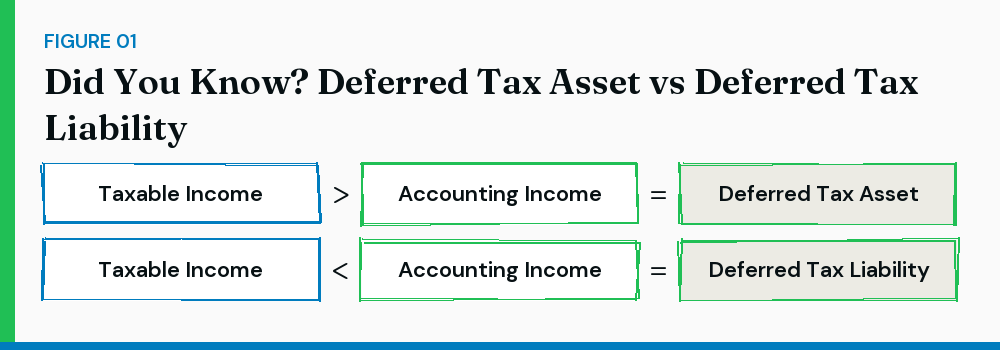
AS 22 needs to be applied when there are differences between taxable income and accounting income. If taxable income is greater than accounting income, then it will result in deferred tax asset. And if accounting income is greater than taxable income, then it will result in deferred tax liability.

When the difference is resulting in deferred tax asset, then it should be recognized only when there is a reasonable certainty of its realization. The recognition of deferred tax asset should be to the extent of the reasonable certainty of the expected realization. The reasonable certainty can be determined by making the realistic estimates of future profits based on the examination of profits and loss statement of earlier periods.

Say, an entity has unabsorbed depreciation or carry forward of losses. In such a case, deferred tax asset should be recognized to the extent there is a virtual certainty supported by convincing evidence. Virtual certainty is a matter of judgment of convincing evidence, which should be available in a concrete form at a particular date.

How to apply AS 22 Accounting for Taxes on Income

The application of AS 22 can be explained with the help of examples: Example of timing difference:

Particulars Year 1 Year 2 Year 3
Profit before tax (A) 100,000 200,000 180,000
Depreciation as per Companies Act (B) 25,000 25,000 25,000
Accounting income (A-B) 75,000 175,000 125,000
Depreciation as per Income tax Act (C) 50,000 0 10,000
Taxable income (A-C) 50,000 200,000 170,000
Timing difference (D) 25,000 -25,000 -15,000
Current tax @ 30% 15,000 60,000 51,000
Deferred tax (D * 30%) 7,500 -7,500 -4,500
Total tax expense 22,500 52,500 46,500
Profit after tax 52,500 122,500 78,500

Deferred tax computation

Particulars Year 1 Year 2 Year 3
Opening balance of timing difference 0 25,000 0
Addition 25,000 0 15,000
Deletion 0 25,000 0
Closing balance of timing difference 25,000 0 15,000
Deferred tax @ 30% 7,500 7,500 4,500
DTA/DTL Creation of DTL Reversal of DTL Creation of DTA
Journal Entry P&L A/c Dr. To DTL DTL Dr. To P&L A/c DTA Dr. To P&L A/c

Comparison between AS 22 and IND AS 12

Basis AS 22 Accounting for Taxes on Income IND AS 12 (Income taxes)
Recognition AS 22 recognized tax effect of differences between taxable income and accounting income. IND AS 12 recognized tax effect of differences between assets and/or liabilities and their tax base.
Approach AS 22 is based on profit or loss statement approach. IND AS 12 is based on balance sheet approach.
Differences The types of differences on which AS 22 is applied are timing differences and permanent differences. The types of differences on which IND AS 12 is applied are taxable temporary differences and deductible temporary differences. Permanent differences are not dealt in by this standard.
Recognition of Deferred tax asset/deductible temporary differences DTA is recognized only when and to the extent there is a reasonable certainty of its realization Deductible temporary differences are recognized to the extent of the probability of taxable profits in future periods.
Disclosure AS 22 deals with the disclosure of DTA/DTL in the balance sheet. IND AS 12 deals with the recognition of current or deferred tax as income or expense in profit and loss statement. It also deals with the disclosure of out of profit and loss transaction in the balance sheet as current or non-current assets/liability.
Revaluation of assets AS 22 does not cover the difference arising between taxable income and accounting income due to the revaluation of assets. IND AS 12 deals with the difference between carrying the amount of revalued asset and its tax base.
Goodwill AS 22 does not cover the difference arising due to goodwill arising a business combination. As per IND AS 12, the difference between carrying the amount of goodwill and its tax base (which will be NIL) is the taxable temporary difference. It does not allow the recognition of such difference because goodwill is measured as a residual and its recognition would increase the carrying amount of goodwill.
The concept of virtual certainty When an entity has unabsorbed depreciation or carry forward of losses then in such a case deferred tax asset should be to the extent there is a virtual certainty supported by convincing evidence. There is no concept of virtual certainty in IND AS 12. Deductible temporary differences are recognized to the extent of the probability of taxable profits in future periods.
Tax holiday AS 22 specifically provides guidance regarding recognition of deferred tax in the situations of Tax Holiday under Sections 80-IA, 80-IB, 10A and 10B of Income-tax Act. IND AS 12 does not specifically deal with the situations of the tax holiday.
Capital Loss AS 22 provides guidance regarding recognition of DTA in case of loss under the head of ‘capital gains’. IND AS 12 does not specifically provide for the same.

IFRIC 23

IFRIC 23 also provides for Uncertainty over Income Tax Treatments. It requires an entity to treat uncertain tax treatments depending on which method will be best suited for its resolution. The major difference between AS 22 and IFRIC 23 is that IFRIC 23 requires an entity, while determining the current and deferred income tax assets and liabilities, to make an assessment whether it is probable that taxation authority will accept an uncertain tax treatment.

If it is not probable, then entity should reflect that uncertainty through either expected value approach or most likely approach. IFRIC 23 will be applicable for annual reporting periods beginning on or after 01.01.2019.

Frequently asked questions

What is AS 22?

AS 22 is the Accounting Standard issued by ICAI that prescribes how taxes on income, including current tax and deferred tax, are accounted for in financial statements.

What is the difference between a timing difference and a permanent difference?

A timing difference arises in one period and reverses in later periods, for example depreciation under different methods. A permanent difference never reverses, for example an expense disallowed by the Income Tax Act.

Does AS 22 create deferred tax on permanent differences?

No. Deferred tax is recognised only for timing differences, not for permanent differences.

How is AS 22 different from Ind AS 12?

AS 22 applies to companies following the Companies (Accounting Standards) Rules and uses the income statement approach based on timing differences, while Ind AS 12 follows a balance sheet approach based on temporary differences.

Official sources

Related reading

Disclaimer

This article is for general informational purposes only and should not be considered professional advice. Please consult a qualified expert for advice tailored to your specific situation. The author and website owner are not liable for any errors or actions based on this content.
Indian Accounting Standard 12: Income Taxes

Last updated: 19 July 2026 · Written and reviewed by CA Meet Dhrangadhariya, CSM & Co LLP

Quick summary

  • Ind AS 12 prescribes how current tax and deferred tax are accounted for, using the balance sheet approach.
  • Deferred tax is recognised on temporary differences between the carrying amount of an asset or liability and its tax base.
  • Deferred tax liabilities are recognised on all taxable temporary differences, with limited exceptions such as initial recognition of goodwill.
  • Deferred tax assets are recognised only to the extent that future taxable profit will probably be available.

How Ind AS 12 deferred tax is worked out

1. Find the carrying amount of the asset or liability in the balance sheet
↓
2. Find its tax base
↓
3. Compute the temporary difference between the two
↓
4. Taxable temporary difference: recognise a deferred tax liability (apart from the exceptions)
↓
5. Deductible temporary difference: recognise a deferred tax asset only if future taxable profit is probable
↓
6. Measure at the tax rate expected when the asset is realised or the liability is settled
↓
7. Present and disclose the components of tax expense

Income taxes as per the Indian Accounting Standard 12 include both domestic and foreign taxes, which are based on taxable profits. It also includes withholding taxes.

Introduction

The objective of this standard is to prescribe the accounting treatment for income taxes. The principal issue in accounting for income taxes is how to account for current and future tax consequences of:

  • Future settlement of carrying amount of assets and liabilities that are recognised in the balance sheet of an organisation. If it is probable that the settlement of the carrying amount will result in a variance of tax amount which should then be recognised as deferred tax.
  • Events and transactions that are recognised in the current period. The treatment for the tax related to the events will be the same as the events.

Ind AS 12 is based on the Balance Sheet approach. It requires recognising tax consequences of the difference between the carrying amounts of assets and liabilities and their tax base.

What is Tax expense or Income?

Tax expense or Tax income is the aggregate amount included in the determination of profit or loss in respect of current tax and deferred tax. Current tax is the amount of income taxes payable/recoverable in respect of the current profit/ loss for a period.

Deferred Tax liability is the amount of income tax payable in future periods with respect to the taxable temporary differences.

Deferred tax asset is the income tax amount recoverable in future periods in respect to the deductible temporary differences, carry forward of unused tax losses, and carry forward of unused tax credits.

Temporary differences are the differences between the carrying amount of an asset or liability in the balance sheet and its tax base.

Tax Base of an asset or liability is the amount attributed to the asset or liability for tax purposes.

Recognition of current tax assets and current tax liabilities

  • Taxes to the extent unpaid for current and prior periods will be recognised as a liability. If the amount already paid for current and prior periods exceeds the actual amount due, then it will be recognised as an asset.
  • A tax loss that can be used to recover current tax of a previous period is recognised as an asset in the period in which tax loss occurred.

Recognition of deferred tax liabilities

Deferred tax liability will be recognised for all taxable temporary differences. However, the following are exceptions to the same:

  • The initial recognition of goodwill.
  • The initial recognition of an asset or liability in a transaction that is not a business combination and affects neither accounting profit nor taxable profit at the time of the transaction. A recent amendment to Ind AS 12 removes this exception where the transaction gives rise to equal taxable and deductible temporary differences (for example leases and decommissioning obligations). Check the current text of the standard for the applicable date.

Recognition of deferred tax assets

A deferred tax asset will be recognised for all the deductible temporary differences, provided it is probable that the taxable profit will be available for utilisation of deductible temporary differences. A deferred tax asset is not recognised if it arises from the initial recognition of an asset or liability in a transaction that is not a business combination and affects neither accounting profit nor taxable profit at the time of the transaction (subject to the amendment mentioned above).

Measurement of current and deferred tax assets/liabilities

Current tax assets or liability will be measured as the amount expected to be recovered or paid to the tax authorities at the tax rate and laws that have been enacted or subsequently enacted by the end of the reporting period. Deferred tax assets or liability will be measured at the expected tax rates in the period in which the asset is realised or liability paid based on the tax laws that have been enacted or subsequently enacted at the end of the reporting period.

Presentation of current and deferred tax assets and liabilities

An entity shall offset current tax assets and liabilities only if it is legally entitled to and it intends to settle on a net basis or to realise assets and settle liabilities simultaneously. It can offset deferred tax assets and liabilities if:

  • It has the legal right to offset current tax assets and liabilities.
  • The deferred tax assets and liabilities relate to the income taxes levied by the same taxation authorities on same entities or on entities that intend to settle current tax assets and liabilities on a net basis or to realise assets and settle liabilities simultaneously.

Disclosure of current and deferred tax assets and liabilities

The major components of tax expense or income will be disclosed separately.

Allocation

As per this standard, an entity must account for tax consequences in the same way as it accounts for the transactions and other events. Therefore, if the transaction and other events are recognised in profit and loss, then the related tax consequences should also be recognised in profit and loss. If the transaction and event is recognised outside profit and loss that is in other comprehensive income or directly in equity, then the tax consequence will also be recognised outside the profit and loss that is in other comprehensive income or directly in equity.

Frequently asked questions

What approach does Ind AS 12 follow?

Ind AS 12 follows the balance sheet approach. It recognises the tax consequences of differences between the carrying amount of assets and liabilities and their tax base.

What is a tax base?

The tax base of an asset or liability is the amount attributed to it for tax purposes.

When is a deferred tax asset recognised under Ind AS 12?

For deductible temporary differences, only when it is probable that taxable profit will be available against which they can be used.

How is Ind AS 12 different from AS 22?

AS 22 uses the income statement approach based on timing differences, while Ind AS 12 uses the balance sheet approach based on temporary differences.

Official sources

Related reading

Disclaimer

This article is for general informational purposes only and should not be considered professional advice. Please consult a qualified expert for advice tailored to your specific situation. The author and website owner are not liable for any errors or actions based on this content.
Embracing the Future of Accounting: Cloud Accounting with Zoho

Embracing the Future of Accounting: Cloud Accounting with Zoho

In today’s fast-paced business environment, staying ahead of the curve is crucial for success. Cloud accounting solutions are reshaping the way businesses manage their finances, offering a wealth of advantages over traditional desktop-based systems. Among the leading solutions available, Zoho stands out as an efficient, user-friendly platform that can transform how businesses handle accounting tasks.

What is Cloud Accounting?

Cloud accounting is an innovative approach to managing financial data, utilizing internet-based software to record, process, and store financial information. Unlike traditional accounting methods, where data is stored locally on desktop systems, cloud accounting solutions allow for real-time access to financial information from anywhere, at any time, and on any device.

This flexibility enhances collaboration, improves efficiency, and ensures that business owners and accountants can make informed decisions quickly, based on the most up-to-date financial data.

Why Choose Zoho for Cloud Accounting?

Zoho offers an integrated suite of business applications designed to meet the needs of small and medium-sized businesses, and their cloud accounting platform is no exception. Here are several compelling reasons why Zoho is a game-changer for businesses seeking robust cloud accounting solutions:

  1. User-Friendly Interface

Zoho’s accounting software is designed with ease of use in mind. The platform offers an intuitive, well-organized interface that simplifies complex accounting tasks, making it accessible for users without an accounting background. Whether you’re invoicing clients, managing expenses, or generating financial reports, Zoho ensures the process is seamless.

  1. Real-Time Financial Data

With Zoho, financial data is updated in real-time, providing you with accurate and current insights into your business’s financial health. This capability is particularly valuable for business owners and accountants who need to make timely decisions based on the latest information.

  1. Automated Processes

Zoho’s cloud accounting software reduces the time and effort spent on manual tasks. The platform allows for automation in areas such as invoicing, expense tracking, and reconciliation. Automating repetitive tasks helps businesses save valuable time, reduce human error, and improve overall accuracy in financial management.

  1. Seamless Integration with Other Zoho Apps

Zoho offers a wide range of business applications, from CRM and project management tools to HR and inventory management systems. Zoho’s cloud accounting platform integrates seamlessly with these apps, allowing you to streamline business operations and ensure that financial data flows smoothly across all departments.

  1. Secure and Scalable

Security is a top priority for Zoho, with the platform using advanced encryption protocols to protect your sensitive financial data. Additionally, Zoho’s cloud accounting solution is highly scalable, meaning it can grow alongside your business. As your business expands, Zoho adapts to your evolving accounting needs, ensuring your financial management remains efficient and effective.

  1. Collaboration and Multi-User Access

Zoho’s cloud-based platform enables easy collaboration between multiple users, including accountants, managers, and other key stakeholders. By granting different levels of access and permissions, businesses can ensure that the right people have access to the right information while maintaining control over sensitive financial data.

  1. Comprehensive Reporting

Zoho offers a variety of reporting features, allowing businesses to generate detailed financial statements, balance sheets, profit and loss reports, and more. These reports can be customized to suit specific business needs, helping you gain valuable insights into your financial performance and make data-driven decisions.

  1. Affordable Pricing Plans

Zoho offers a range of pricing plans designed to accommodate businesses of all sizes. Whether you’re a startup looking for basic functionality or an established company needing advanced features, Zoho’s pricing structure is both transparent and scalable, offering flexibility as your business grows.

The Benefits of Cloud Accounting for Businesses

Adopting cloud accounting brings several key advantages to businesses, especially when combined with the power of a platform like Zoho:

  • Accessibility: With cloud accounting, you no longer need to be tied to a specific location or device to access your financial data. All you need is an internet connection.
  • Cost-Effectiveness: Cloud accounting reduces the need for costly software licenses, IT infrastructure, and maintenance, making it a more affordable option for many businesses.
  • Enhanced Collaboration: Real-time access and multi-user capabilities make it easier for teams to collaborate on financial matters, whether you’re in the office or working remotely.
  • Time Efficiency: Automation of tasks such as invoicing, billing, and reconciliations saves time, enabling your team to focus on higher-value activities that contribute to business growth.
  • Scalability: Zoho’s cloud accounting system can grow with your business, allowing you to easily add new users, features, and functionalities as your needs evolve.

Conclusion: The Future of Accounting is in the Cloud

Incorporating cloud accounting into your business operations is no longer a luxury—it’s a necessity. Zoho provides a comprehensive and flexible solution that streamlines financial management, improves accuracy, and enhances collaboration. By embracing Zoho’s cloud accounting platform, businesses can future-proof their financial management and unlock a host of benefits that drive growth and efficiency.

If you’re ready to take your accounting practices to the next level, Zoho offers the tools and support you need to stay ahead in today’s competitive business landscape. Make the move to cloud accounting with Zoho, and watch your business thrive in an increasingly digital world.

For more information on Zoho’s cloud accounting solution and how it can benefit your business, contact us today to discuss how we can help you integrate this powerful tool into your financial operations.

Disclaimer:

This article is for general informational purposes only and should not be considered professional advice. Please consult a qualified expert for advice tailored to your specific situation. The author and website owner are not liable for any errors or actions based on this content.

WhatsApp