Last updated: 11 October 2026 · Written and reviewed by CA Meet Dhrangadhariya, CSM & Co LLP
Update, 30 October 2026
This post described these changes as proposals awaiting the law amendment. CBIC has since directed field officers to apply them administratively, with immediate effect, even though the CGST Act itself will only be amended from 1 April 2027. See Instruction No. 02/2026-GST: Arrest Powers, E-way Bill Checks and the Rs 10,000 Notice Threshold for the current, binding position.
Quick summary
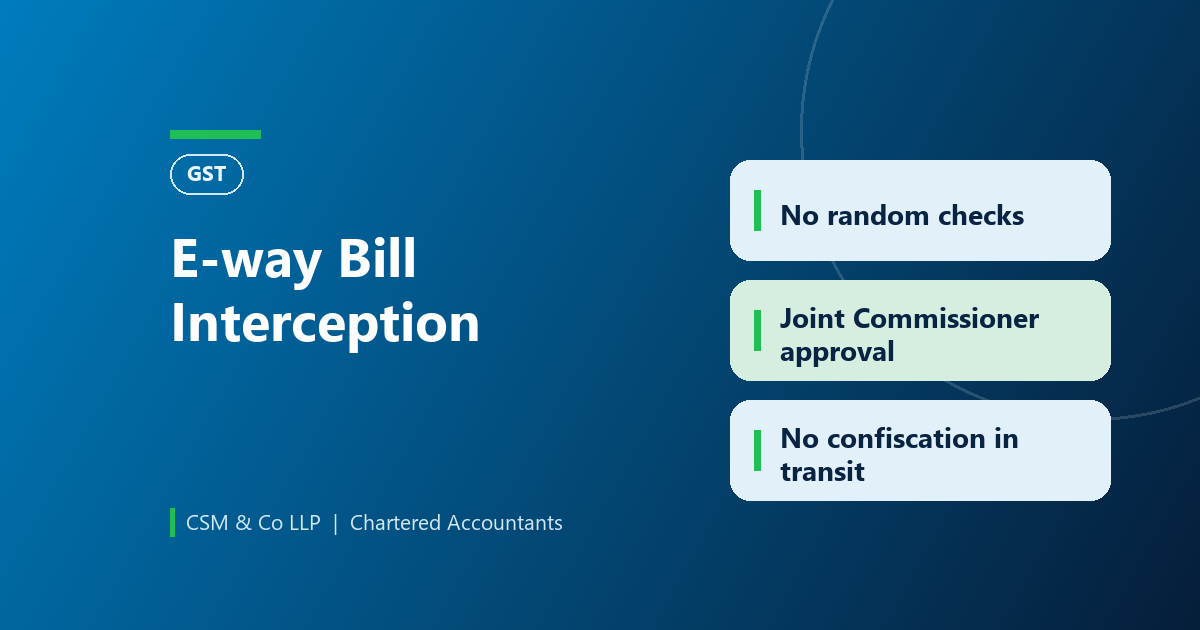
- A conveyance can no longer be stopped at random. Interception needs the authorisation of an officer not below the rank of Joint Commissioner, who must have reasons to believe, recorded in writing, that the goods are being moved in contravention of the law.
- Only officers of the State where the supplier or the recipient is located may inspect, detain or seize goods under section 129. Transit States lose that power entirely.
- An officer in a transit State who notices a contravention must let the vehicle pass unhindered and pass the information to the officer having jurisdiction over the supplier or the recipient.
- The exception is a consignment moving with no e-way bill generated, or without the prescribed documents. Then any authorised officer may act, whatever State the supplier and recipient are in.
- Section 130 confiscation will not apply to goods or conveyances in transit at all. Transit cases are dealt with only under section 129 read with section 68, and on no grounds beyond those in section 68.
Ask any manufacturer or transporter which part of GST causes the most operational pain, and roadside interception will come up before anything about returns. A truck stopped in a State that has nothing to do with the transaction, over a clerical slip in a document, can cost days and a detention demand on goods that were never in dispute.
The 57th GST Council has addressed this with unusual specificity. The FAQ of 09/10/2026 works through it with examples, following the press release of 08/10/2026.
These are proposed amendments to sections 68, 129 and 130. They operate once enacted and notified. A vehicle stopped today is dealt with under the law as it stands.
No more random stops
A conveyance may be intercepted only on the authorisation of a proper officer not below the rank of Joint Commissioner, who has reasons to believe, to be recorded in writing, that the goods being carried are being transported in contravention of the CGST Act or the rules.
Three safeguards are doing work in that sentence, and each is separately useful:
- A rank floor. The authorisation must come from Joint Commissioner level or above, not from the officer at the roadside.
- A standard. Reasons to believe, rather than suspicion or routine.
- A record. Those reasons must be in writing, which means they exist to be tested later.
Random verification, as a practice, ends.
Only the supplier’s State or the recipient’s State
This is the change with the biggest practical effect on long-haul movement. Goods may be inspected, and detained or seized under section 129, only by an officer of the State or Union territory where either the supplier or the recipient is located. Transit States cannot.
The FAQ’s own examples:
| Movement | Who may intercept, inspect, detain or seize |
|---|---|
| M/s X in State A supplies to M/s Y in State B, goods pass through State C | Officers of State A or State B. Officers of State C may not, since neither party is located there |
| Intra-State supply, supplier and recipient both in State A | Officers of State A only |
For a consignment crossing three or four States, that reduces the number of authorities who can stop it to the two with an actual stake in the transaction.
What a transit State officer must do instead
An officer in a State where neither the supplier nor the recipient is located shall not undertake any inspection, detention or seizure. If that officer verifies documents and notices a contravention, the officer:
- shall allow the conveyance and the goods to pass through unhindered; and
- shall transmit the information to the officer having jurisdiction over the supplier or the recipient.
The FAQ’s example is an incorrect HSN noticed in the e-way bill in State C on a movement from State A to State B. State C lets the vehicle proceed and informs the jurisdictional officer in A or B.
Note what this does and does not do. It does not forgive the error. It moves the consequence from the roadside to the assessment, which is where a classification question belongs. Your goods keep moving; the issue follows you home.
The exception, and it is a wide one
Where no e-way bill has been generated, or the person in charge of the conveyance is not carrying the prescribed documents, an authorised officer may inspect the goods and may detain or seize them under section 129 even where neither the supplier nor the recipient is located in that State.
The FAQ’s example: a truck carrying goods worth ₹5 lakh passes through State C without an e-way bill and without any invoice or delivery challan showing the origin and destination. State C may detain or seize.
This is the line the whole reform draws. If your paperwork exists, a transit State cannot touch you and must send any issue to your own jurisdiction. If your paperwork does not exist at all, every State retains full power. The protection is for the compliant consignment with a defect, not for the undocumented one.
No confiscation of goods in transit
Section 130, the confiscation provision, will apply only to cases other than those in transit. Goods and conveyances in transit are to be dealt with only under section 129, read with section 68.
And one more limit that is easy to miss and worth quoting: goods and conveyances in transit shall not be detained or seized for any reason other than those specified under section 68.
Confiscation has been the sharpest instrument available at the roadside, because it reaches the goods and the vehicle themselves. Taking it off the table for transit cases, and closing the list of grounds to section 68, narrows roadside enforcement to a defined set of document and movement failures.
What this means in practice
- The e-way bill itself becomes the thing that matters, more than ever. Generate it, and a transit State is out of the picture. Fail to generate it, and nothing in this reform helps.
- Carry the prescribed documents in the vehicle. The exception is triggered by the absence of documents, not by an error in them.
- A document error is no longer a roadside event on an inter-State movement through other States. It becomes a matter for your own jurisdictional officer.
- Train your drivers and transporters on what must physically travel with the goods. That single point now determines which legal regime applies to a stop.
What to do now
- Audit your e-way bill generation discipline, particularly for movements that start outside normal hours, branch transfers and returns, which are where omissions cluster.
- Fix the document pack that travels with the vehicle: invoice or delivery challan showing origin and destination, and the e-way bill.
- Brief your transporters that a transit State stop should end with the vehicle being allowed to proceed, provided the documents exist.
- Keep a record of any interception, including whether a written authorisation was produced. Once the rank and written reasons requirements are in force, that record is what makes them enforceable.
- Do not rely on any of this yet. The amendments to sections 68, 129 and 130 must be enacted and notified first.
How CSM & Co LLP can help
We can review your e-way bill and transport documentation processes against the proposed regime, advise on a detention or seizure already under way under the present law, prepare the response where goods have been detained under section 129, assess whether a confiscation proceeding under section 130 was properly invoked, and put in place a record keeping practice for interceptions so the new authorisation requirements can actually be relied on once they are in force. Please reach out to our team and we will be happy to assist.
Frequently asked questions
Can my vehicle still be stopped at random to check the e-way bill?
No. After the proposed amendment a conveyance may be intercepted only on the authorisation of a proper officer not below the rank of Joint Commissioner, who has reasons to believe, to be recorded in writing, that the goods are being transported in contravention of the CGST Act or the rules.
Which State’s officers can detain or seize my goods?
Only officers of the State or Union territory where the supplier or the recipient is located. If goods move from State A to State B through State C, officers of A or B may act and officers of C may not. For an intra-State supply within State A, only officers of State A may act.
What happens if a transit State officer spots a mistake in my documents?
The officer must allow the conveyance and the goods to pass through unhindered, and transmit the information to the officer having jurisdiction over the supplier or the recipient. The FAQ gives an incorrect HSN in the e-way bill as the example.
Is there any case where a transit State can still detain my goods?
Yes. Where no e-way bill has been generated, or the person in charge is not carrying the prescribed documents, an authorised officer may inspect and may detain or seize the goods under section 129 even if neither the supplier nor the recipient is in that State.
Can goods in transit be confiscated under section 130?
No. Section 130 is to apply only to cases other than those in transit. Goods and conveyances in transit are to be dealt with only under section 129 read with section 68.
Can goods in transit be detained for some other reason entirely?
No. The FAQ states that goods and conveyances in transit shall not be detained or seized for any reason other than those specified under section 68.
Official sources
- Press Information Bureau: FAQs on reforms related to rationalisation of interception and verification of goods and conveyances in transit (e-way bill), 09/10/2026
- Press Information Bureau: Recommendations of the 57th Meeting of the GST Council, 08/10/2026
Related reading
Disclaimer
This article is for general informational purposes only and should not be considered professional advice. Please consult a qualified expert for advice tailored to your specific situation. The author and website owner are not liable for any errors or actions based on this content.
Related GST reading
- GST Arrest and Prosecution (2026): Section 69 Removed, ₹5 Crore Threshold and Court Discretion
- GST Litigation Management (2026): ₹10,000 Notice Threshold, Penalty as a Charge and Reduced Penalties
- How to Cancel GST Registration (2026): Form GST REG-16, Auto Acceptance and Revocation