Section 80-IAC: Tax Exemption for Startups, Eligibility and Conditions

Last updated: 28 August 2026 · Written and reviewed by CA Meet Dhrangadhariya, CSM & Co LLP

Quick summary

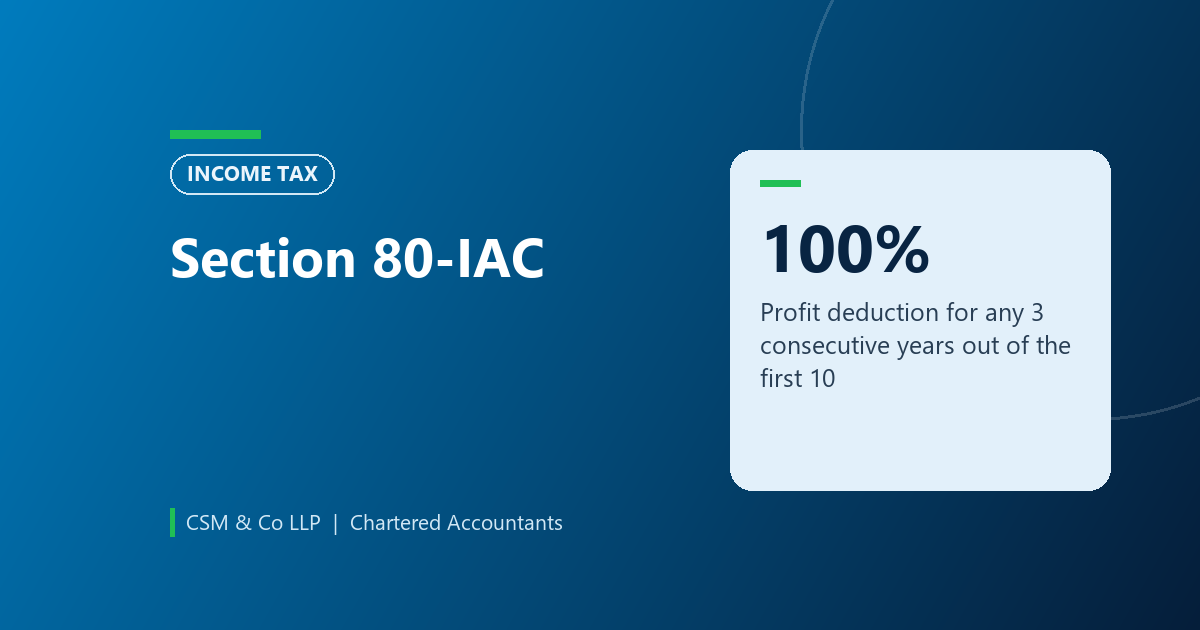
  • Section 80-IAC gives an eligible startup a deduction of 100% of its business profits for any 3 consecutive years out of its first 10.
  • The startup must be a company or LLP incorporated on or after 01/04/2016 and before 01/04/2030, with an Inter-Ministerial Board certificate.
  • The turnover cap is ₹100 crore for FY 2025-26 and ₹300 crore from Tax Year 2026-27.
  • From Tax Year 2026-27 it is section 140 of the Income-tax Act, 2025, and the audit report is Form 32. It is not available if a company pays tax at 22% or 15%.

Section 80-IAC lets a certified startup pay no income tax on the profits of its eligible business for three years. It is one of the most useful tax benefits for young companies and LLPs. From Tax Year 2026-27 the provision is section 140 of the Income-tax Act, 2025. For FY 2025-26 (assessment year 2026-27) it is still section 80-IAC of the 1961 Act.

How much and for how long?

The deduction is 100% of the profits and gains derived from the eligible business. The startup can claim it for any three consecutive tax years, chosen by the startup, out of the ten years beginning with the year of incorporation. Choose the three years in which you expect profits.

Who is an eligible startup?

A company or limited liability partnership that:

  • is engaged in an eligible business, meaning innovation, development or improvement of products, processes or services, or a scalable business model with a high potential for employment generation or wealth creation;
  • is incorporated on or after 1 April 2016 and before 1 April 2030;
  • has total business turnover within the limit in the year of the claim: ₹100 crore for FY 2025-26 under the 1961 Act, and ₹300 crore from Tax Year 2026-27 under section 140 (the Finance Act, 2026 raised it); and
  • holds a certificate of eligible business from the Inter-Ministerial Board of Certification (IMBC).

A partnership firm or proprietorship cannot claim it. A private limited company and an LLP can.

Other conditions

  • The startup must not be formed by splitting up or reconstructing a business already in existence.
  • It must not be formed by transferring to the new business machinery or plant previously used for any purpose. Used plant and machinery up to 20% of the total value of machinery in the business does not break this rule, and imported machinery that was never used in India and never claimed depreciation is also not treated as previously used.
  • The eligible business is treated as the only source of income of the startup when working out the profits for the deduction.
  • If goods or services move between the eligible business and another business of the assessee at a price different from market value, the profits are worked out at market value.
  • A business discontinued because of flood, cyclone, earthquake, riot, accidental fire, explosion or enemy action and revived within three years of the end of that year is not treated as a reconstruction.
  • The accounts of the eligible business must be audited and the audit report furnished before the specified date. The report is Form 10CCB up to FY 2025-26 and Form 32 (Rule 66) under the Income-tax Rules, 2026.

Two steps to qualify

  1. DPIIT recognition. Register on the Startup India portal and get recognised as a startup by the Department for Promotion of Industry and Internal Trade (DPIIT, formerly DIPP).
  2. IMBC certificate for tax benefits. Apply separately on the portal for the Inter-Ministerial Board of Certification, choosing the tax exemption option. Keep ready the constitution documents, financial statements, and a pitch deck or video. Recognition alone is not enough for section 80-IAC.

Tax regime

A company can claim section 80-IAC only if it pays tax under the normal provisions. The 22% and 15% regimes (sections 200 and 201 of the 2025 Act) allow only section 146 and section 148 from the deduction chapter, so a startup that takes the 22% rate loses this deduction. An LLP, taxed at the flat rate for LLPs, is not affected by that choice.

Do not forget MAT

Zero tax on profits does not always mean zero tax. A company taxed under the normal provisions can still face minimum alternate tax on its book profit, and the section 80-IAC deduction does not reduce book profit. Check the book profit position before assuming the startup will pay nothing.

Example

A private limited company was incorporated in April 2023 and holds the DPIIT and IMBC certificates. It makes a loss in its first two years and a profit of ₹40,00,000 from its eligible business in the third year. It can choose that year, and the next two, as its three years. In the profit year the deduction is ₹40,00,000, so its taxable business income is nil, subject to MAT.

Frequently asked questions

Who is an eligible startup under section 80-IAC?

A company or LLP engaged in an eligible business, incorporated on or after 01/04/2016 and before 01/04/2030, with turnover within the limit and a certificate of eligible business from the Inter-Ministerial Board of Certification.

How long is the deduction?

100% of profits from the eligible business for any 3 consecutive tax years, chosen by the startup out of the 10 years beginning with the year of incorporation.

What is the turnover limit?

₹100 crore under the 1961 Act (up to FY 2025-26) and ₹300 crore under section 140 of the 2025 Act from Tax Year 2026-27.

Is DPIIT recognition enough?

No. The Act asks for a certificate of eligible business from the Inter-Ministerial Board of Certification, which is a separate step from DPIIT recognition.

Can a company that pays tax at 22% claim it?

No. The 22% and 15% company regimes allow only additional employee cost (section 146) and inter-corporate dividends (section 148) from the deduction chapter.

Official sources

Related reading

Disclaimer

This article is for general informational purposes only and should not be considered professional advice. Please consult a qualified expert for advice tailored to your specific situation. The author and website owner are not liable for any errors or actions based on this content.

Appointment of Auditor under Section 139 of the Companies Act, 2013: Term, Rotation, First Auditor, Casual Vacancy and Removal

Last updated: 09 October 2026 · Written and reviewed by CA Meet Dhrangadhariya, CSM & Co LLP

Quick summary

  • A company appoints an auditor at its first AGM, to hold office till the sixth AGM, and then for each further block of five years (until the conclusion of every sixth AGM).
  • The first auditor is appointed by the Board within 30 days of registration, or by members at an EGM within 90 days if the Board fails. For a Government company, the CAG appoints within 60 days.
  • Listed companies and prescribed classes must rotate: an individual for one term of five years, a firm for two terms, then a five year cooling off.
  • Removal before the term ends needs a special resolution and the previous approval of the Central Government. A resigning auditor files a statement within 30 days.

Every company must have a statutory auditor. Section 139 of the Companies Act, 2013 says how the auditor is appointed, how long the appointment lasts, who steps in when the post falls vacant, and when a change is compulsory. Sections 140 and 141 deal with removal, resignation, and who may be an auditor.

Who can be an auditor (section 141)

  • A chartered accountant, or a firm in which the majority of partners practising in India are chartered accountants (an LLP counts as a firm). Only the partners who are chartered accountants may sign.
  • Not eligible: a body corporate other than an LLP; an officer or employee of the company; a person whose relative is a director or key managerial personnel; a person (or relative or partner) holding securities of the company above the permitted limit, or indebted to it above the prescribed amount; a person with a prescribed business relationship; a person holding more than 20 company audits; a person convicted of fraud in the last ten years; and a person who provides the prohibited non-audit services under section 144.
  • If an auditor becomes disqualified after appointment, the office is vacated and treated as a casual vacancy.

First auditor

Type of company Who appoints By when Holds office till
Company other than a Government company Board of Directors Within 30 days of registration Conclusion of the first AGM
Same, if the Board fails Members at an extraordinary general meeting Within 90 days (the Board informs the members) Conclusion of the first AGM
Government company Comptroller and Auditor-General of India Within 60 days of registration; if CAG does not, the Board within next 30 days; if the Board fails, members within 60 days at an EGM Conclusion of the first AGM

At the first AGM and after

At the first annual general meeting, the company appoints an individual or a firm as auditor to hold office from the conclusion of that meeting till the conclusion of its sixth annual general meeting, and thereafter till the conclusion of every sixth meeting. Before the appointment, the company must obtain the auditor’s written consent and a certificate that the appointment is within the prescribed conditions, including that the auditor meets section 141. The company must inform the auditor of the appointment and file a notice with the Registrar within 15 days of the meeting (this is done in Form ADT-1).

“Appointment” includes re-appointment. A retiring auditor can be re-appointed if not disqualified, has not given written notice of unwillingness, and no special resolution has been passed to appoint someone else or to say that he shall not be re-appointed. If no auditor is appointed at an AGM, the existing auditor continues.

If the company must have an Audit Committee, appointments and the filling of a casual vacancy are made after taking its recommendations into account.

Rotation (section 139(2))

No listed company, and no company in a class prescribed by rules, may appoint or re-appoint:

  • an individual auditor for more than one term of five consecutive years, or
  • an audit firm for more than two terms of five consecutive years.

After completing its term, the individual (or the firm) is not eligible for re-appointment in the same company for five years. A firm that has a common partner with an outgoing firm, whose tenure has just expired, cannot be appointed for five years. Members may also resolve that the auditing partner and team be rotated, or that the audit be done by more than one auditor (section 139(3)). The companies in the prescribed classes are set out in the Companies (Audit and Auditors) Rules, 2014: please check the paid-up capital and borrowing thresholds in the current rules before concluding that your company is outside rotation.

Government companies

The Comptroller and Auditor-General appoints the auditor within 180 days of the start of each financial year, and the auditor holds office till the AGM.

Casual vacancy (section 139(8))

  • Company not audited by a CAG-appointed auditor: the Board fills the vacancy within 30 days. If the vacancy arose from the auditor’s resignation, the company must approve the appointment at a general meeting convened within three months of the Board’s recommendation. The new auditor holds office till the next AGM.
  • Company audited by a CAG-appointed auditor: the CAG fills the vacancy within 30 days; if it does not, the Board fills it within the next 30 days.

Special notice and removal (section 140)

  • Special notice is required for a resolution at an AGM appointing a person other than the retiring auditor, or saying that the retiring auditor shall not be re-appointed. It is not needed where the retiring auditor has completed the maximum term of five or ten years under section 139(2). The company sends a copy of the notice to the retiring auditor, and if the auditor makes a reasonable written representation, the company states this in the notice to members and sends the representation to members. If it is received too late, the auditor can ask that it be read out at the meeting. The Tribunal can stop this if the right is being abused.
  • Removal before the term ends: only by a special resolution of the company, after getting the previous approval of the Central Government in the prescribed manner, and after the auditor has been given a reasonable chance to be heard.
  • Resignation: the auditor files a statement in the prescribed form with the company and the Registrar within 30 days of the resignation, giving reasons. For a failure to do so the auditor is liable to a penalty of Rs 50,000 or the amount of the remuneration, whichever is less, and Rs 500 for each day of continuing failure, up to Rs 2 lakh.
  • Fraud: the Tribunal can direct a company to change its auditor if the auditor has acted fraudulently or colluded in fraud. An auditor against whom a final order is passed is not eligible for appointment in any company for five years.

Remuneration (section 142)

Fixed by the members in general meeting or in the manner they decide. The Board can fix the first auditor’s remuneration. Expenses incurred for the audit are included, but not remuneration for other services requested by the company.

Points to check

  • Auditor rotation applies only to listed companies and the prescribed classes, so a small private company can keep the same auditor for any number of terms.
  • Forms (ADT-1 and the resignation forms), thresholds and fees come from the Rules and can change; use the current Companies (Audit and Auditors) Rules, 2014 and the MCA portal.
  • The text above follows the Companies Act as published on India Code, including its amendments up to the footnotes in that edition.

Frequently asked questions

When is the first auditor appointed?

By the Board of Directors within 30 days of the date of registration of the company. If the Board fails, it informs the members, who appoint within 90 days at an extraordinary general meeting. The first auditor holds office till the conclusion of the first AGM.

What is the term of an auditor?

At the first AGM the company appoints an auditor to hold office till the conclusion of its sixth AGM, and thereafter till the conclusion of every sixth meeting. This is the usual five year term.

Is auditor rotation compulsory for every company?

No. Section 139(2) applies to listed companies and the classes of companies prescribed by rules. An individual can serve one term of five consecutive years and an audit firm two terms, with a five year cooling off after that.

How is a casual vacancy filled?

The Board fills it within 30 days. If the vacancy is due to the auditor’s resignation, the company must also approve the appointment at a general meeting held within three months of the Board’s recommendation, and the appointee holds office till the next AGM.

Who appoints the auditor of a Government company?

The Comptroller and Auditor-General of India, within 180 days from the start of the financial year. The first auditor is appointed by the CAG within 60 days of registration.

Can an auditor be removed in the middle of the term?

Only by a special resolution of the company, after obtaining the previous approval of the Central Government, and after giving the auditor a reasonable opportunity of being heard.

What if no auditor is appointed at an AGM?

The existing auditor continues to be the auditor.

Official sources

Related reading

Disclaimer

This article is for general informational purposes only and should not be considered professional advice. Please consult a qualified expert for advice tailored to your specific situation. The author and website owner are not liable for any errors or actions based on this content.

WhatsApp