Last updated: 04 August 2026 · Written and reviewed by CA Meet Dhrangadhariya, CSM & Co LLP
Quick summary
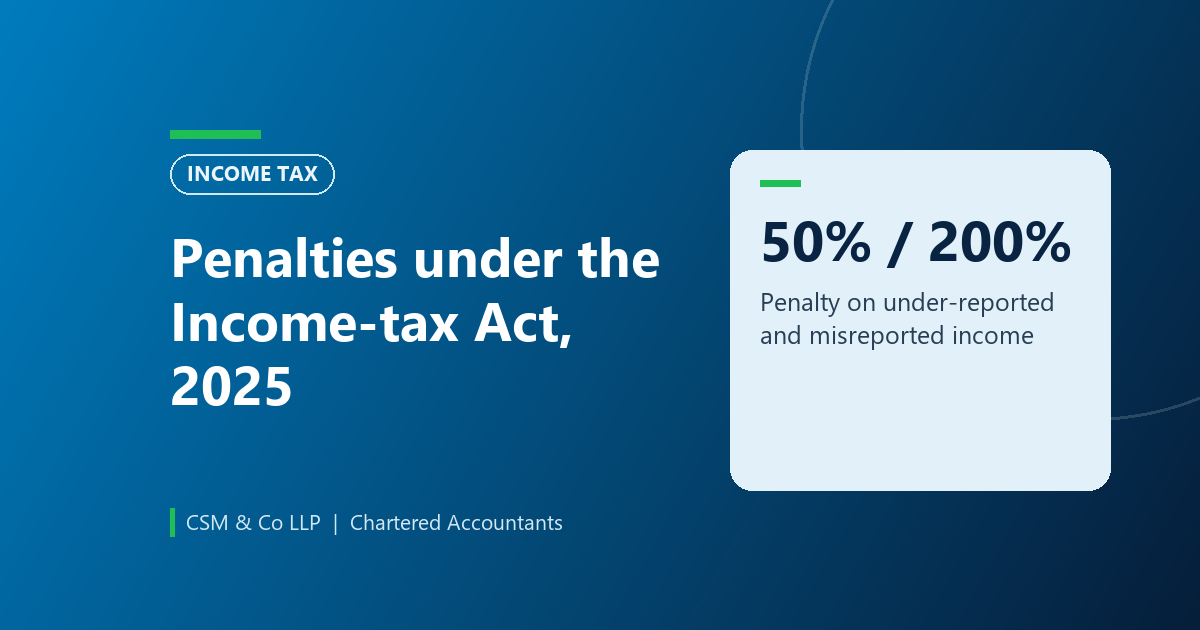
- Section 439 of the Income-tax Act, 2025 (old section 270A) imposes a penalty of 50% of the tax on under-reported income and 200% of the tax on misreported income; misreporting means misrepresentation or suppression of facts, unrecorded investments, unsubstantiated expenditure, false entries, unrecorded receipts, unreported transfer pricing transactions and income referred to in section 195(1)(b).
- Finance Act 2026 replaced the immunity scheme in section 440 with a waiver: the assessee pays the tax and interest, plus additional income-tax of 100% (120% in the section 195(1)(b) case) of the tax on under-reported income in place of the penalty, files no appeal, and applies within one month from the end of the month of the order.
- Other penalties are fixed in the Act: ₹25,000 for not keeping books (section 441), 2% of transaction value for transfer pricing documentation failures (section 442), the amount of tax not deducted or collected (sections 448 and 449) and the amount involved in breaches of the cash rules (sections 450 to 453).
- No penalty is levied for a listed default if there was reasonable cause (section 470); a show-cause notice and prior approval apply (section 471).
Penalties are in Chapter XXI (sections 439 to 472) of the Income-tax Act, 2025, in force from 01/04/2026. This post covers the main ones: under-reporting and misreporting of income (the old section 270A), the changed waiver scheme, and the fixed penalties for other defaults.
Section 439: under-reporting and misreporting (old 270A)
When income is under-reported (section 439(2))
- Income assessed is more than the income determined in the return processed under section 270(1)(a).
- Where no return was filed, or the first return was filed under section 280, income assessed is more than the maximum amount not chargeable to tax.
- Income reassessed is more than the income assessed or reassessed before.
- Deemed total income under section 206 (minimum alternate tax and alternative minimum tax) is more than in the processed return, or is more than the exemption limit where there was no return.
- The assessment reduces a loss or converts it into income.
Amount of under-reported income and tax (section 439(3) to (5) and (12))
| Case | Under-reported income |
|---|---|
| Return filed and income assessed for the first time | Income assessed less income in the processed return |
| No return, or first return on a section 280 notice: company, firm or local authority | The whole income assessed |
| No return, or first return on a section 280 notice: others | Income assessed less the maximum amount not chargeable to tax |
| Reassessment or recomputation | Income reassessed less income in the preceding order |
| Loss reduced or converted into income | The difference between the loss claimed and the income or loss assessed |
The tax on the under-reported income is worked out as the extra tax caused by that income (section 439(12)). No addition that has already been a basis for penalty can be penalised again (section 439(13)), and income on which additional income-tax was paid on an updated return under section 267(5)(ii) is outside the penalty (section 439(13A)).
Rates
| Case | Penalty |
|---|---|
| Under-reporting | 50% of the tax payable on the under-reported income (section 439(9)) |
| Misreporting | 200% of the tax payable on the under-reported income (section 439(10)) |
Misreporting (section 439(11)): misrepresentation or suppression of facts; failure to record investments in the books; a claim of expenditure not substantiated by evidence; recording a false entry; failure to record a receipt that has a bearing on total income; failure to report an international transaction, deemed international transaction or specified domestic transaction under Chapter X; and, added by Finance Act 2026, income referred to in section 195(1)(b).
Not treated as under-reported income (section 439(8))
- Income for which the assessee offers a bona fide explanation and has disclosed all material facts to the satisfaction of the Competent Authority.
- An addition on an estimate, where the accounts are correct and complete but the method is such that income cannot be properly deduced.
- An addition on an estimate, where the assessee had on his own estimated a lower amount of addition or disallowance on the same issue, included it in his income and disclosed all material facts.
- An addition in line with the arm’s length price determined by the Transfer Pricing Officer, where the assessee had maintained the prescribed documents, declared the international transaction and disclosed the facts.
The Competent Authority is the Assessing Officer, Joint Commissioner (Appeals), Commissioner (Appeals), Commissioner or Principal Commissioner, and the penalty is imposed by a written order (section 439(14) and (15)).
Example. An assessment adds ₹10,00,000 to the income in the return (a deduction claim that is not allowed), with tax on that addition at 30%, so ₹3,00,000. The penalty for under-reporting is 50% of ₹3,00,000, which is ₹1,50,000. If the same addition is a misreporting case (for example, an expense not backed by any evidence), the penalty is 200%, which is ₹6,00,000.
Section 440: waiver of penalty and immunity (new from 01/04/2026)
Finance Act 2026 substituted section 440. Earlier, an assessee could get immunity from the penalty by paying the tax and interest and not appealing, except in misreporting cases. Now an assessee can apply for waiver of the penalty and immunity from prosecution under sections 478 and 479, even in misreporting cases, on these conditions (section 440(1)):
- The tax and interest under the assessment (section 270(10)) or reassessment (section 279) order are paid within the period in the notice of demand.
- Where the penalty is for misreporting under section 439(11)(a) to (f), additional income-tax of 100% of the tax payable on the under-reported income is paid within that period, in place of the penalty.
- Where the penalty is for misreporting of income under section 195(1)(b) (section 439(11)(g)), the additional income-tax is 120%.
- No appeal is filed against the assessment or reassessment order or the penalty.
The application is made within one month from the end of the month in which the order is received, in the prescribed form (section 440(2)). The Assessing Officer grants the waiver and immunity after the period for appeal under section 358(3)(a) has expired (section 440(3)), but not where a proceeding has been initiated under Chapter XXII (section 440(4)). He decides within three months from the end of the month of receipt, and after hearing the assessee if rejecting (section 440(5) and (6)). The order is final, and if the application is accepted no appeal or revision against the assessment order is admissible (section 440(7) and (8)).
Other penalties
| Default | Penalty | Section |
|---|---|---|
| Not keeping and maintaining books under section 62, or not retaining them for the prescribed period | ₹25,000 | 441 |
| Transfer pricing documents not kept, transaction not reported or incorrect information | 2% of the value of each transaction | 442(1) |
| Failure to furnish group information to the prescribed authority | ₹5,00,000 | 442(2) |
| False or omitted entry in the books to evade tax | Amount of the false or omitted entry | 444 |
| Failure to deduct tax at source (or to pay it) | Equal to the tax | 448 |
| Failure to collect tax at source | Equal to the tax | 449 |
| Loan, deposit or specified sum taken in breach of section 185 | Equal to the amount | 450 |
| Cash receipt in breach of section 186 | Equal to the amount | 451 |
| No digital payment facility where required (section 187) | ₹5,000 for every day | 452 |
| Repayment in breach of section 188 | Equal to the amount | 453 |
| Benefits to related persons by a registered non-profit organisation | Equal to the income so applied (first time), 200% (repeat) | 445 |
Late return and audit-related defaults carry a fee under section 428 (late return, audit report, transfer pricing report) rather than a penalty.
Safeguards (sections 470 to 472)
- Reasonable cause: no penalty is imposed for failures under sections 441, 442, 446, 448 to 453 and the other sections listed in section 470 if the person proves reasonable cause (section 470). The under-reporting penalty has its own exclusions in section 439(8).
- Procedure: the assessee must be heard and, after Finance Act 2026, given a show-cause notice (section 471(1)); prior approval of the Joint Commissioner is needed where the penalty exceeds ₹10,000 (order by the Income-tax Officer) or ₹20,000 (order by an Assistant or Deputy Commissioner) (section 471(2)).
- Limitation: the order must be passed within six months from the end of the quarter in which the proceedings are completed, the appeal order is received or the penalty notice is issued, as applicable (section 472(1)).
How CSM & Co LLP can help
We reply to penalty show-cause notices, argue reasonable cause and bona fide explanation, and advise on the new waiver scheme in section 440. Please reach out to our team and we will be happy to assist.
Frequently asked questions
Which section replaces 270A?
Section 439 of the Income-tax Act, 2025, which imposes penalty for under-reporting and misreporting of income. Section 440 deals with waiver of penalty and immunity from prosecution, and section 441 with failure to keep and maintain books.
When is income “under-reported”?
When the income assessed is greater than the income in the processed return (or greater than the maximum amount not chargeable to tax, where no return was filed or the first return was filed on a notice under section 280); when income reassessed is greater than the income assessed; when the deemed total income under the minimum alternate tax provisions is greater than that in the return; or when the assessment reduces a loss or converts it into income (section 439(2)).
What is the penalty?
50% of the tax payable on the under-reported income (section 439(9)), and 200% of the tax payable on the under-reported income if it results from misreporting (section 439(10)).
What is misreporting?
Misrepresentation or suppression of facts, failure to record investments in the books, a claim of expenditure not substantiated by evidence, recording of a false entry, failure to record a receipt that has a bearing on total income, failure to report an international transaction or a specified domestic transaction under Chapter X, and, from 01/04/2026, income referred to in section 195(1)(b) (section 439(11)).
When is under-reported income excused?
Where the assessee offers an explanation that the authority is satisfied is bona fide and discloses all material facts; where the income is determined on an estimate and the accounts are correct and complete; where the assessee had himself estimated a lower addition or disallowance and disclosed the facts; and where the addition follows the arm’s length price determined by the Transfer Pricing Officer and the assessee had maintained the documents, declared the transaction and disclosed the facts (section 439(8)).
How does the waiver of penalty work?
Under section 440, as substituted by Finance Act 2026, an assessee can apply to the Assessing Officer for waiver of the penalty and immunity from prosecution under sections 478 or 479 if the tax and interest are paid within the time in the demand notice, additional income-tax of 100% of the tax on the under-reported income (120% where the case is under section 439(11)(g)) is paid within that time in place of the penalty, and no appeal is filed. The application is made within one month from the end of the month in which the order is received, and the Assessing Officer decides within three months from the end of the month of its receipt, after a hearing if rejecting.
Official sources
Related reading
- DTAA and Foreign Tax Credit under the Income-tax Act, 2025: Sections 159 and 160, Forms 41 to 44 and Rule 76 (Tax Year 2026-27)
- Cash Transaction Limits under the Income-tax Act, 2025: Sections 185 to 188 and Section 36(4) (Tax Year 2026-27)
- Decoding the Direct Tax Landscape: Budget 2025 Insights
Disclaimer
This article is for general informational purposes only and should not be considered professional advice. Please consult a qualified expert for advice tailored to your specific situation. The author and website owner are not liable for any errors or actions based on this content.