Last updated: 17 September 2026 · Written and reviewed by CA Meet Dhrangadhariya, CSM & Co LLP
Quick summary
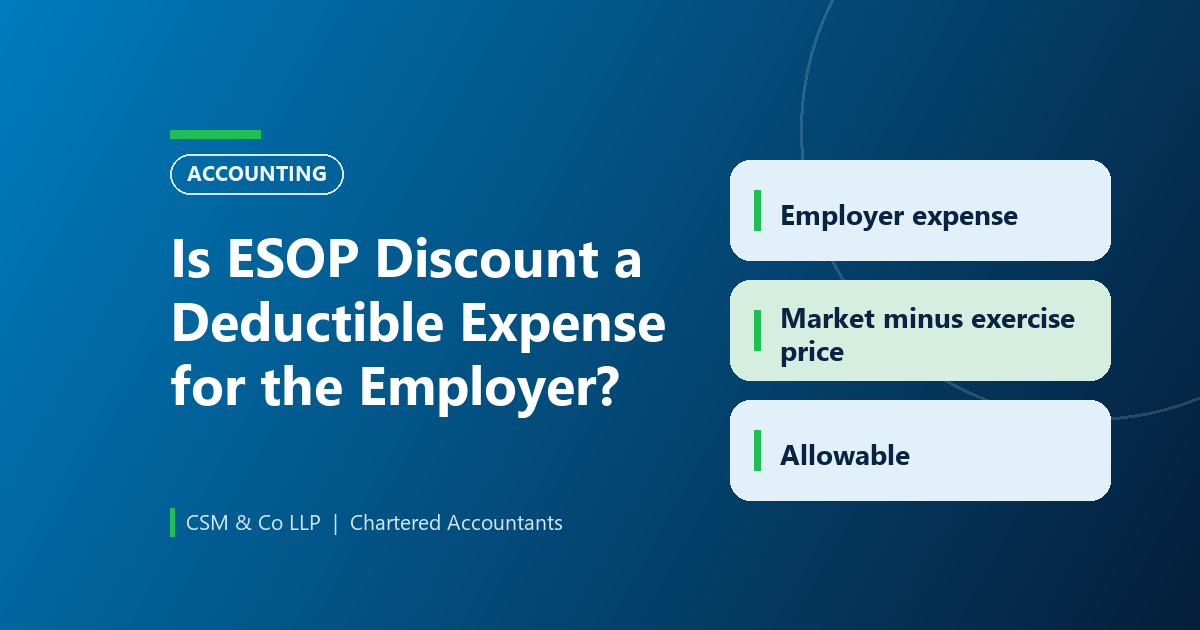
- The discount an employer gives on shares issued under an ESOP (market price less exercise price) has been held to be an allowable business expense, as employee compensation.
- The leading rulings are the ITAT Special Bench and the Karnataka High Court in Biocon, followed by the Delhi High Court.
- The Income-tax Act, 2025 has no separate provision for it, so the claim rests on the general deduction in section 34 (earlier section 37(1)).
- The claim is spread over the vesting period, and the employee is separately taxed on the perquisite at exercise.
When a company issues shares to employees under an ESOP at less than the market price, it gives up value. Can the company claim that difference, the “discount”, as an expense in computing its business profits? For years the department said no. The courts have said yes.
The position in the Income-tax Act, 2025
The Act taxes the employee on the benefit: the fair market value on the exercise date less the exercise price is a perquisite (section 17(1)(d) and (4)(h)). It does not carry a matching rule for the employer’s deduction.
The employer’s claim therefore rests on the general deduction in section 34: expenditure, not capital or personal, laid out or expended wholly and exclusively for the purposes of the business or profession, which is not covered by the specific deduction sections. Section 34 corresponds to section 37(1) of the 1961 Act, on which the case law is based. We found nothing in the 2025 Act that changes the reasoning.
Why the department objected
The usual grounds were that no cash leaves the company on a share issue, that the discount is a notional loss of capital receipt rather than an expense, and that the liability is contingent until the employee exercises the option.
What the courts have held
- Biocon Ltd v DCIT (ITAT Special Bench, Bangalore, 16/07/2013): the discount on ESOP shares is employee remuneration expenditure and allowable under section 37(1).
- Karnataka High Court in Biocon (reported December 2020): the department’s appeal was dismissed. Where options vest over a period, for example 25% each year over four years, the employee gets a definite right to that portion at each vesting date and the company is bound to allow it. The discount is therefore an ascertained liability, not a contingent one. Section 37(1) does not require a cash pay out.
- Delhi High Court: the department’s appeals were dismissed in line with Biocon, in the Lemon Tree Hotels matter, and the court has since followed Biocon in the matter reported as PVR Ltd v CIT.
The employer’s deduction is a business expenditure and the employee’s perquisite is a salary item, so one does not depend on the other.
How to claim it
- The reported rulings measure the discount as the market price on the grant date less the exercise price, and treat it as accruing as each tranche vests. Claim each tranche in the year it vests, use one method consistently, and take advice on the method before you adopt it.
- Keep the plan document, the board and shareholder approvals, the vesting schedule and the valuation with the return.
- Deduct and deposit TDS on the employee’s perquisite at exercise, and report it in Form 123 and the salary TDS certificate.
- Where the company is an eligible start-up under section 140, the employee’s tax is payable later (within 14 days of the earliest of 60 months, sale or leaving the job), but the employer’s deduction question remains the same.
Before you rely on this
- The rulings turn on the facts and terms of the plans before the courts. A plan run through a trust, or one where the employer reimburses a trust, can raise separate questions, so look at your own plan terms.
- The case summaries above are taken from the reports linked below. Read the full order before you quote it to a client.
Frequently asked questions
Is the ESOP discount deductible for the company?
Courts have held that it is employee compensation cost and an allowable business expenditure. The leading ruling is Biocon Ltd, where the ITAT Special Bench (2013) allowed it and the Karnataka High Court upheld that view.
Which section gives the deduction?
The Income-tax Act, 2025 has no section on ESOP discount specifically. The claim is under the general deduction for business expenditure in section 34, which replaced section 37(1) of the 1961 Act.
In which year is the deduction claimed?
The courts have followed the vesting. Where options vest over several years, each vesting gives the employee a definite right, so the discount for that portion is an ascertained liability of that year.
What is the discount?
The difference between the market price of the share and the price at which the option is exercised. The Karnataka High Court treated it as the cost of securing the employees’ services.
Does the employee also pay tax?
Yes. The employee is taxed on the same difference (FMV on exercise less exercise price) as a perquisite under section 17(1)(d). The employer’s deduction and the employee’s perquisite are separate computations.
Official sources
- Biocon Ltd v DCIT, ITAT Bangalore Special Bench, 16/07/2013
- Cyril Amarchand Mangaldas: Karnataka HC affirms discount on issue of ESOPs is a deductible business expenditure
- TaxGuru: Delhi High Court on ESOP discount under section 37(1)
- Income Tax Department: Income-tax Act, 2025 (sections 17 and 34)
Disclaimer
This article is for general informational purposes only and should not be considered professional advice. Please consult a qualified expert for advice tailored to your specific situation. The author and website owner are not liable for any errors or actions based on this content.