How to Deduct TDS from Employees’ Salary (FY 2026-27): A Complete Guide for Employers
 CA Meet Dhrangadhariya
  July 2, 2026
 CA Meet Dhrangadhariya July 2, 2026
Table of Contents
 5 min read
Table of Contents
Every employer paying salary in India is legally required to deduct tax at source before crediting the payment. Getting this wrong, whether by under-deducting, over-deducting, or missing the deposit deadline, creates real compliance risk: interest, penalties, and even disallowance of expenses. This guide walks through exactly how salary TDS works for FY 2026-27, under both the old Income Tax Act, 1961 and the new Income Tax Act, 2025.
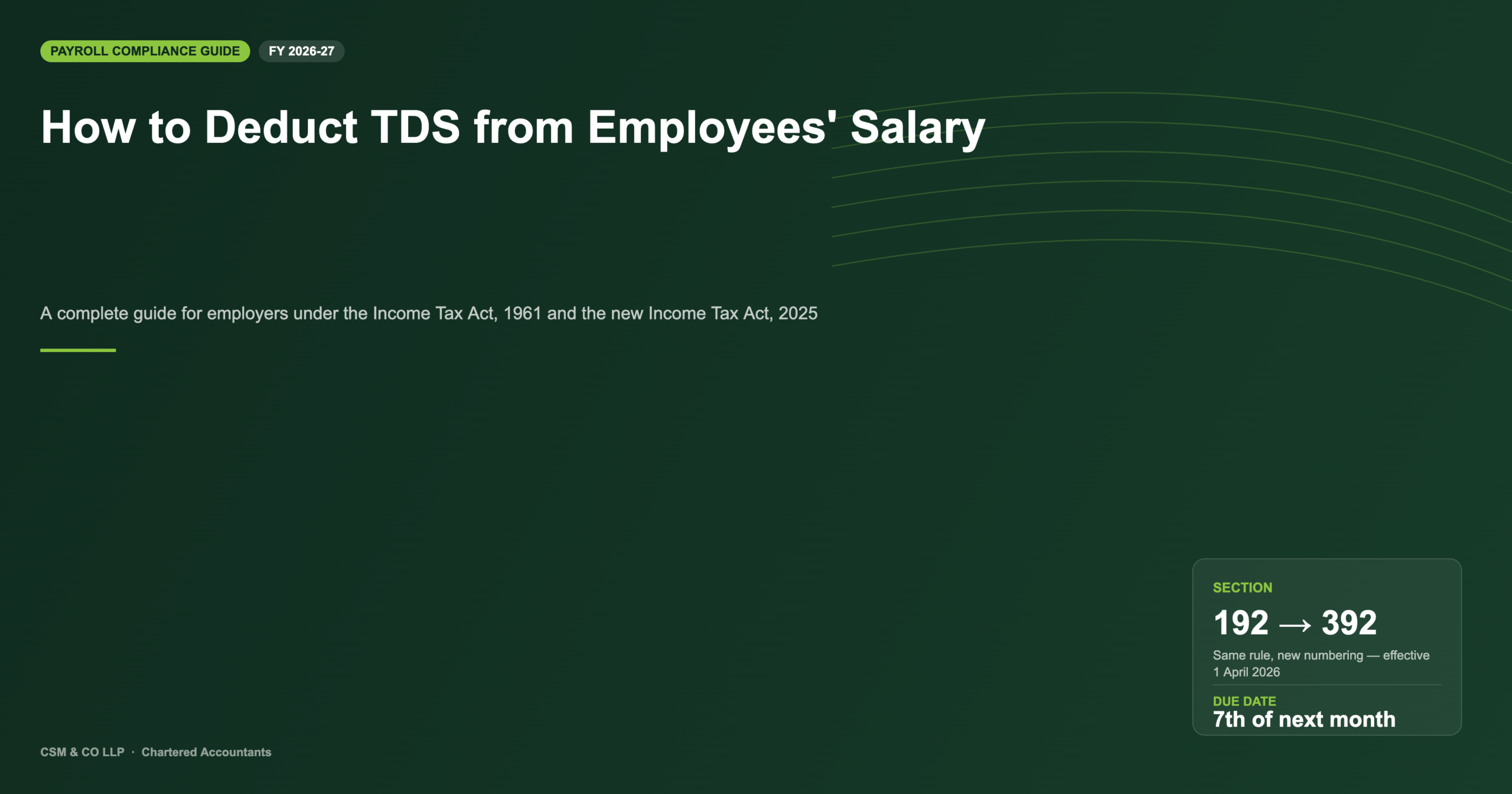
Salary TDS has traditionally been governed by Section 192 of the Income Tax Act, 1961. With the Income Tax Act, 2025 coming into force from 1 April 2026, the same provision now sits under Section 392 of the Income Tax Act, 2025. There is no change in policy, only in section numbering and presentation.
Which Act applies depends on the date of actual payment, not accrual:
So, salary for March 2026 paid on 31 March 2026 falls under the old Act, while the same salary paid even a day later, on 1 April 2026, falls under the new Act.
Any person responsible for paying salary, be it a company, LLP, proprietorship, HUF, or individual employer, must deduct TDS if the employee’s estimated total income for the year exceeds the basic exemption limit applicable under the tax regime the employee has opted for:
If an employee’s estimated income stays within these limits, no TDS is required. If not, the employer must deduct tax every month at the time of actual payment of salary, whether paid on time, in advance, or with delay.
Unlike TDS on contractor or professional payments, which apply a flat percentage, salary TDS has no fixed rate. It is computed using the employee’s average rate of income tax, worked out from their estimated annual income. The process:
Important clarification: This monthly instalment method is not the same as the 15% / 45% / 75% / 100% advance-tax payment schedule under Section 234C. That quarterly schedule applies to a taxpayer’s own advance tax payments on non-salary income. Salary TDS under Section 192 / 392 simply spreads the estimated annual tax liability equally across the remaining pay months of the year, and is recalculated whenever income, regime choice, or investment declarations change.
The Union Budget 2026 did not revise slab rates. The following continue to apply for FY 2026-27 (AY 2027-28):
New Tax Regime (default)
| Income Slab | Rate |
|---|---|
| Up to ₹4,00,000 | Nil |
| ₹4,00,000 – ₹8,00,000 | 5% |
| ₹8,00,000 – ₹12,00,000 | 10% |
| ₹12,00,000 – ₹16,00,000 | 15% |
| ₹16,00,000 – ₹20,00,000 | 20% |
| ₹20,00,000 – ₹24,00,000 | 25% |
| Above ₹24,00,000 | 30% |
A rebate of up to ₹60,000 continues to apply for taxable income up to ₹12,00,000 (making salary up to about ₹12,75,000 effectively tax-free after the ₹75,000 standard deduction, subject to conditions and provided the rebate isn’t lost due to marginal cliff effects just above the threshold).
Old Tax Regime (opt-in)
| Income Slab | Rate |
|---|---|
| Up to ₹2,50,000 | Nil |
| ₹2,50,000 – ₹5,00,000 | 5% |
| ₹5,00,000 – ₹10,00,000 | 20% |
| Above ₹10,00,000 | 30% |
Employees must indicate their choice of regime at the start of the year, and the employer must deduct TDS accordingly. Key differences that affect payroll:
If an employee doesn’t declare a preference, the new regime applies by default.
If an employee joins mid-year, the new employer should obtain details of salary already paid and TDS already deducted by the previous employer, using Form 12B. This ensures the new employer computes TDS on the employee’s full-year income rather than under-deducting.
Once deducted, TDS must be deposited with the government:
This applies whether the deduction falls under Section 192 (up to 31 March 2026) or the corresponding Section 392 (from 1 April 2026).
Failure to deduct or deposit TDS correctly can result in:
This article is for general guidance only and does not constitute tax advice. For specific queries relating to your organisation’s payroll and TDS compliance, please get in touch with our team.
 CA Meet Dhrangadhariya July 2, 2026
 Hatim Bharmal April 30, 2025
 CA Meet Dhrangadhariya February 12, 2025
 CA Meet Dhrangadhariya July 22, 2025