Learn to Save Taxes on Your Trading Profits

How Traders Can Save Tax Through Eligible Business Expenses in ITR

In the fast-paced world of share trading, where profits and losses can swing dramatically, smart tax planning can significantly boost your net returns. If you’re a stock market trader dealing in Intraday or Futures & Options (F&O), understanding what expenses you can claim in your Income Tax Return (ITR) can help reduce your taxable income and legally save taxes.

Let’s explore how you can make the most of this benefit.

Who Can Claim Trading Expenses?

If you’re engaged in:
• Intraday Trading
• Futures & Options Trading (F&O)

…then you can claim eligible business-related expenses while computing your taxable income. This applies whether you follow the Old Tax Regime or the New Tax Regime.

Key Benefits for Traders

  1. Reduce Your Taxable Income: Legitimate trading expenses reduce your net business income, directly impacting your tax liability.
  2. Carry Forward of Losses:
    • F&O Losses: Can be carried forward for 8 years.
    • Intraday Losses: Can be carried forward for 4 years.

This makes it crucial to report your business income and expenses accurately.

Tax-saving tips for stock market traders: claim expenses on intraday and F&O trading, carry forward business losses, and maximize deductions under both tax regimes.

Common Expenses You Can Claim

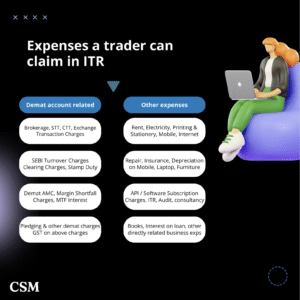
Here’s a sample list of expenses a trader can typically claim in the ITR:

Expense Category Examples
Internet & Phone Bills Broadband used for trading activities
Brokerage Charges Fees paid to brokers for executing trades
Software & Tools Charting tools, trading platforms, analytics tools
Advisory/Consulting Charges Subscriptions to trading advisories or analysts
Electricity If a home office is used for trading
Office Rent Applicable if a separate office is used
Depreciation On laptops, phones, and office equipment
Education & Seminars Trading courses or workshops attended
Books & Journals Financial newspapers, magazines, or books
Bank Charges Charges linked to your trading account

List of expenses a trader can claim in ITR - categorized into demat account-related and other business expenses

Note: Keep proper invoices, payment proofs, and usage justification for all claimed expenses. This is crucial in case of an audit.

What Expenses Cannot Be Claimed?

While many expenses are allowed, some are not claimable, such as:
• Personal expenses (e.g., personal phone bills, family subscriptions)
• Capital expenditures (unless depreciation is claimed)
• Any unrelated professional or personal expenses
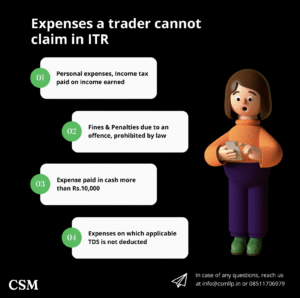
Infographic showing a list of expenses that traders in India cannot claim as deductions in their income tax returns, including personal expenses, fines and penalties, cash payments above Rs.10,000, and expenses where TDS is not deducted.

Final Thoughts

Every saved rupee is an earned rupee. File smart, trade smarter!

Trading is not just about profits—it’s also about smart financial management. By claiming legitimate business expenses in your ITR, you’re not only reducing your tax outgo but also managing your business like a professional.

Disclaimer:

This article is for general informational purposes only and should not be considered professional advice. Please consult a qualified expert for advice tailored to your specific situation. The author and website owner are not liable for any errors or actions based on this content.

 

Relief for TDS/TCS Defaults Due to Inoperative PAN: CBDT Circular No. 9/2025

PAN Inoperative? CBDT Gives Grace Period for TDS/TCS Relief

The Central Board of Direct Taxes (CBDT) has issued Circular No. 9/2025 dated 21st July 2025, providing partial modifications to its earlier circulars to offer relief to deductors and collectors facing demands due to TDS/TCS defaults caused by inoperative PANs. This move aims to address numerous grievances raised by taxpayers regarding demands for short-deductions or collections, even in cases where the PAN was later made operative.

This blog outlines the implications, relief measures, and compliance expectations stemming from the new circular.


Background

  • Circular No. 3/2023 (dated 28th March 2023) had specified that if PAN becomes inoperative (under Rule 114AAA of the Income-tax Rules, 1962), higher TDS/TCS rates under Section 206AA/206CC would apply from July 01, 2023 onwards, until the PAN is made operative.

  • Circular No. 6/2024 (dated 23rd April 2024) provided temporary relief for transactions done up to March 31, 2024, if the PAN was linked with Aadhaar by May 31, 2024.

However, many deductors/collectors have received notices for short deduction or collection, despite the PAN becoming operative later, leading to avoidable tax demands.

The Issue with Inoperative PAN:

As per Circular No. 3 of 2023, if a PAN is not linked with Aadhaar, it becomes inoperative from July 1, 2023.

Consequences include:

• No tax refunds while PAN is inoperative.
• No interest on refunds for the inoperative period.
• TDS/TCS must be deducted/collected at higher rates under sections 206AA/206CC of the Income-tax Act.


New Relief under Circular No. 9/2025

To mitigate hardships, CBDT has introduced two key relaxations for cases where PANs became operative due to Aadhaar linkage after the transaction dates:

No higher TDS/TCS liability will arise in the following two situations:

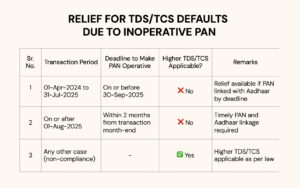
  1. Payments/Credits between April 1, 2024 and July 31, 2025

    ➤ Condition: PAN must be made operative on or before September 30, 2025.

  2. Payments/Credits on or after August 1, 2025

    ➤ Condition: PAN must be made operative within 2 months from the end of the month in which the amount was paid/credited.

In such cases, higher TDS/TCS under Section 206AA/206CC will not apply, and no default will be treated for the deductor/collector.

Summary Table:


Action Points:

• For deductors/collectors:

Review TDS/TCS statements, communicate with clients/vendors whose PAN was previously inoperative, and encourage prompt PAN–Aadhaar linkage.

• For taxpayers:

Check your PAN–Aadhaar linkage status immediately if there is any doubt.

Notes:

  • These reliefs are subject to PAN becoming operative through Aadhaar linkage, within the stipulated deadlines.
  • Other TDS/TCS provisions (under Chapter XVII-B or XVII-BB) must still be complied with.
  • This circular is a welcome move, ensuring that genuine cases are not penalized due to temporary PAN inoperativeness.

Final Thoughts

This circular reinforces the government’s intent to balance compliance with taxpayer convenience. While PAN-Aadhaar linkage remains mandatory, the latest relief provides much-needed protection for deductors/collectors from unjust demands, provided they meet the revised deadlines.

Download official circular from government by clicking here.

For assistance with PAN-Aadhaar linking or resolving TDS/TCS defaults, feel free to ask in comment section.

Disclaimer:

This article is for general informational purposes only and should not be considered professional advice. Please consult a qualified expert for advice tailored to your specific situation. The author and website owner are not liable for any errors or actions based on this content.
Required Documents for ITR compliances – FY 2024-25

Introduction

As financial year gets ended in the month of March, preparation for Income Tax Return (ITR) filing gets started where department and taxpayers both have to work upon various aspects. Department generally releases ITR forms during May or June and taxpayers compile the documents and rush towards their CAs for ITR compliances. Indian income tax law is considered to be one the most complex tax laws in the world and it is obvious that many complications will be faced by taxpayers for such ITR filing compliances.

To avoid unnecessary hustle, we have simplified the document compilation process for the taxpayers which can be very useful during ITR compliances. Documentary requirements for various ITR forms are different. It is best to discuss the summary of transactions carried out during the financial year with your CAs or advisors and they will suggest a proper ITR form to be filed based on the transactions carried out during the previous year.

Important Documents for ITR 1

Person required to file ITR 1 (Gross income upto ₹50 lac)

  1. Income from Salaries
  2. Income from House Property
  3. Income Other Sources
  4. Income from Long term capital gains (listed securities as per section 112A upto ₹1.25 lacs)

Required Documents for ITR 1

  1. PAN and Aadhaar number
  2. Form 16 from Employer
  3. AIS (Annual Information Statement) and TIS (Tax Information Statement)
  4. Interest Certificates for saving bank accounts
  5. Interest certificates and Account Statements for housing loan
  6. Profit and Loss statement for Demat Account (if any)

Note: Form 16 should be accompanied with Form 12BA for arriving the values of various perquisites which are included in the salary. Moreover, if there are more than 2 employers during a financial year or more than a single house property income then ITR 2 shall be applicable. Further, if any investments in foreign assest will be carried out during a financial year then also, ITR 2 will be applicable.


Important Documents for ITR 2

Person required to file ITR 2 (Gross income above ₹50 lac)

  1. Income from Salaries (more than 2 employers)
  2. Income from House Property (more than 1 house property)
  3. Income Other Sources
  4. Income from Capital gains (including crypto asset)

Required Documents for ITR 2

  1. PAN and Aadhaar number
  2. Form 16 from Employer
  3. AIS (Annual Information Statement) and TIS (Tax Information Statement)
  4. Interest Certificates for saving bank accounts
  5. Interest certificates and Account Statements for housing loan
  6. Profit and Loss statement for Demat Account (if any)
  7. Foreign Investment and Income statement
  8. Holding statement of Foreign Assets as on 31st December
  9. Profit and Loss statement of Crypto Assets
  10. Details of Capital Assests which are sold during previous year


Important Documents for ITR 3

Person required to file ITR 3

  1. All Income types as per ITR 2
  2. Income from Business and Profession

Required Documents for ITR 3

  1. PAN and Aadhaar number
  2. Form 16 from Employer
  3. AIS (Annual Information Statement) and TIS (Tax Information Statement)
  4. Interest Certificates for saving bank accounts
  5. Interest certificates and Account Statements for housing loan
  6. Profit and Loss statement for Demat Account (if any)
  7. Foreign Investment and Income statement
  8. Holding statement of Foreign Assets as on 31st December
  9. Profit and Loss statement of Crypto Assets
  10. Details of Capital Assests which are sold during previous year
  11. Financial Statements of the Business or Profession carried out during the previous year
  12. Capital account statement from the Firms in which partnership interest was available during previous year


Important Documents for ITR 4

Person required to file ITR 4

  1. All Income types as per ITR 1
  2. Income from Business and Profession – Presumptive Scheme benefit

Required Documents for ITR 4

  1. PAN and Aadhaar number
  2. Form 16 from Employer
  3. AIS (Annual Information Statement) and TIS (Tax Information Statement)
  4. Interest Certificates for saving bank accounts
  5. Interest certificates and Account Statements for housing loan
  6. Profit and Loss statement for Demat Account (if any)
  7. Financial Statements of the Business or Profession carried out during the previous year
  8. Capital account statement from the Firms in which partnership interest was available during previous year


Important Documents for Deductions

Taxpayers who are willing to opt old scheme of taxation shall be required to have following document while complying with ITR filing requirements.

Required Documents for claiming deductions under old scheme of taxation

  1. Invoice or Receipts to claim deductions under section 80C (such as LIC, PPF, NPS, Educational Fees etc)
  2. Health insurance invoice for claiming deduction under section 80D
  3. Interest certificates for claiming deductions under section 80E
  4. Donation receipts for claiming deductions under section 80G and 80GGC
  5. Invoice or Receipts for claiming any other deductions as per chapter VI of Income Tax Act, 1962


Conclusion

It is very important to figure out the proper ITR form to be required to file based on the transaction and nature of the activities carried out during the previous year. CAs or Advisors are the best person who will guide to determine the proper ITR form which should be filed based on the information made available to them. It is important to note that wrong selection of ITR will cause significant challenges where wrongly filed ITR would be considered as Defective ITR under section 139(9) of the Income Tax Act, 1962 and notice of the same would be issued to the taxpayers. Moreover, ITR should be filed within due dates mentioned under section 139(1) of the Income Tax Act, 1962 to carry forward the losses from business or capital gains for future years.


Disclaimer:

This article is for general informational purposes only and should not be considered professional advice. Please consult a qualified expert for advice tailored to your specific situation. The author and website owner are not liable for any errors or actions based on this content.

Crackdown on Fraudulent ITR Claims: What Every Taxpayer Should Know

IT Department Launches Nationwide Crackdown on Bogus Tax Deductions

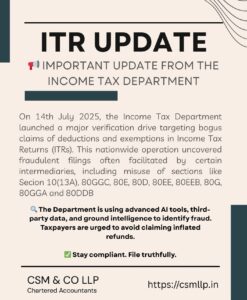
The Income Tax Department of India has launched an aggressive crackdown on fraudulent deduction claims in Income Tax Returns (ITRs). Powered by AI and advanced data analytics, this crackdown is now targeting suspicious claims under specific deduction sections—some of which have been commonly misused by both individuals and intermediaries.

Here’s what you need to know to stay safe and compliant.

What’s Triggering the Crackdown?

A sharp rise in false or exaggerated claims made under various sections of the Income Tax Act has prompted the government to act. Fraudulent practices—often facilitated by unverified intermediaries—are now being flagged by the Income Tax Department’s advanced detection tools.

The crackdown focuses on deductions claimed under the following sections:

Sections Under Scrutiny:

• Section 10(13A) – House Rent Allowance (HRA)
• Section 80GGC – Donations to political parties
• Section 80E – Interest on education loans
• Section 80D – Health insurance premiums
• Section 80EE – Interest on home loans for first-time buyers
• Section 80EEB – Interest on loans for electric vehicles
• Section 80G – Donations to registered charities and relief funds
• Section 80GGA – Donations for scientific research and rural development
• Section 80DDB – Medical treatment for specified critical illnesses

Many of these claims were found to be either inflated or entirely bogus—submitted with fake documents or no proof at all.

AI-Powered Monitoring & Real-Time Cross-Verification

The Income Tax Department is now leveraging AI and data analytics to automatically flag suspicious deduction patterns across thousands of returns. Real-time cross-verification has also been implemented to compare taxpayer claims with actual data from:

• Banks and financial institutions (for loan interest and repayments)
• Insurance companies (for policy premium verification)
• Employers (for rent and HRA)
• Recognized donation platforms and political party disclosures

If a claim doesn’t match backend data, the taxpayer may receive a notice or demand.

Examples of Fraudulent Practices Being Flagged

1. Fake HRA Claims (Section 10(13A)): Claiming rent deductions using fictitious landlords or PANs.
2. Bogus Political Donations (Section 80GGC): False declarations to inflate refund amounts.
3. Fake or Inflated Education Loan Interest (Section 80E): Claiming deductions for non-existent loans.
4. Unsubstantiated Medical Claims (Section 80DDB): Claims without medical certificates or treatment proof.
5. Misuse of Health Insurance (Section 80D): Deducting for lapsed or ineligible policies.
6. Invalid Home Loan or EV Loan Interest (Sections 80EE & 80EEB): Claiming interest deductions without ownership or valid financing.
7. Questionable NGO Donations (Section 80G, 80GGA): Submitting receipts from unapproved or blacklisted institutions.

Legal & Financial Consequences

The Department has already taken action in major cities like Mumbai, Delhi, Jaipur, and Ahmedabad. Hundreds of notices have been served, and several searches and surveys have been conducted under Sections 132 and 133A of the Income Tax Act.

Penalties for false deduction claims may include:

• Demand for repayment of refunds with interest and penalties
• Prosecution under Sections 276C (evasion) and 277 (false statements)
• Imprisonment, in extreme cases

What Taxpayers Should Do Immediately?

  • Recheck Your ITR: Ensure that all deductions claimed are accurate and fully supported by documentation.
  • Avoid Dubious Tax Advisors: Stay away from intermediaries who guarantee high refunds by misusing deduction sections.
  • File an Updated Return (ITR-U): If you realize an error, you can correct it voluntarily through the ITR-U mechanism to minimize penalties.
  • Preserve Proof: Maintain receipts, loan sanction letters, insurance policies, and donation certificates for at least 6 years.

Deadline to Act

You can file an Updated Return (ITR-U) for Financial Year 2023–24 up to March 31, 2026. This gives taxpayers a chance to rectify mistakes without attracting harsher consequences—but the longer the delay, the higher the interest and penalties.

Final Takeaway

The Income Tax Department’s message is clear: fraudulent deductions won’t go unnoticed. With technology closing the loopholes, it’s time for every taxpayer to clean up their returns and ensure compliance.

Transparency is not just good practice—it’s now a legal necessity.

Read the source of this post by clicking here.

Disclaimer:

This article is for general informational purposes only and should not be considered professional advice. Please consult a qualified expert for advice tailored to your specific situation. The author and website owner are not liable for any errors or actions based on this content.
Income Tax Assessee under the Income Tax Act

Last updated: 04 August 2026 · Written and reviewed by CA Meet Dhrangadhariya, CSM & Co LLP

Quick summary

  • An assessee is a person liable to pay tax, interest, penalty or any other sum under the Income Tax Act, or whose income or refund is being assessed.
  • A person includes an individual, HUF, company, firm, AOP or BOI, local authority and artificial juridical person.
  • Types of assessee: normal, representative, deemed, and assessee in default.
  • An assessee must file returns, pay tax, deduct and deposit TDS where required and reply to notices on time.

An assessee is a person who is liable to pay tax, interest, penalty or any other sum under the Income Tax Act. The word is wider than “taxpayer”: a person is also an assessee if proceedings are going on to assess their income or loss, or if they are entitled to a refund. The definition is in section 2(7) of the Income-tax Act, 1961. The Income-tax Act, 2025 (from 1 April 2026) keeps the same idea under new section numbers.

Who is an Assessee?

An assessee is a person who has to pay tax or any other sum to the government under the Act. A person can be an assessee even without paying tax, for example:

  • when proceedings are under way to determine the person’s income or loss,
  • when the person is liable to pay tax on someone else’s income,
  • when the person has a loss and files a return to carry it forward, or
  • when the person is entitled to a refund.

A person who is made responsible for another under the Act, such as the legal representative of a deceased person, is also an assessee. A person who fails to deduct or deposit tax as required, such as an employer who does not deposit TDS, is an assessee in default.

Who is a “Person” under the Act?

Section 2(31) of the Income-tax Act, 1961 says a person includes:

  • an individual,
  • a Hindu Undivided Family (HUF),
  • a company,
  • a firm (including an LLP),
  • an Association of Persons (AOP) or a Body of Individuals (BOI), whether incorporated or not,
  • a local authority, and
  • every other artificial juridical person not covered above.

Types of Assessee

Normal assessee

A person who is liable to pay tax on their own income, or who is entitled to a refund, is a normal assessee. For example, a salaried individual who files a return every year is a normal assessee. Anyone with a loss who wants to carry it forward must also file a return on time.

Representative assessee

A person may be liable to pay tax on the income of another person who cannot act for themselves, such as a non-resident, a minor or a person of unsound mind. The person who represents them, such as an agent, guardian or manager, is called a representative assessee. The tax is recovered from the representative, to the extent of the income they hold or control for the person represented.

Example: Mr. X lives abroad and owns two rented houses in India. His relative Mr. Y collects the rent and looks after the property. Mr. Y can be treated as Mr. X’s representative assessee, and the Assessing Officer can ask him for documents.

Deemed assessee

Some persons are treated by law as an assessee for another person’s tax. Examples:

  • the legal representative (heir or executor) of a person who has died,
  • the guardian of a minor or of a person of unsound mind, and
  • the agent of a non-resident who receives income in India.

Example: Mr. P owns a commercial building that earns rent. His will names his niece as the executor. After his death she is his legal representative and is responsible for filing the return and paying tax on the rent up to the date of death, out of the estate she holds.

Assessee in default

A person who fails to meet a statutory duty under the Act, most commonly by not deducting or not depositing tax deducted at source (TDS) or tax collected at source (TCS), is an assessee in default. For example, an employer who deducts TDS from salaries but does not deposit it by the due date is an assessee in default. Interest, penalty and prosecution can follow.

Duties of an Assessee

  • Register for PAN and quote it correctly.
  • File the return of income on time when required.
  • Pay advance tax, self-assessment tax and any other tax due.
  • Deduct and deposit TDS where required, and file the TDS returns.
  • Keep books of account and documents for the period required.
  • Respond to notices and communications from the department within the time given.
  • Report all income, including exempt income, in the return.

If you receive a notice, read it carefully, check the section and the time limit, and reply with the required details on time. Take professional help for notices on assessment or reassessment, since the procedure and time limits are strict.

Frequently asked questions

Who is an assessee?

An assessee is a person who is liable to pay tax or any other sum under the Income Tax Act, or whose income, loss or refund is being assessed.

Can a person be an assessee without paying tax?

Yes. A person with a loss who files a return, or someone entitled to a refund, is still an assessee.

What is an assessee in default?

A person who fails to meet a duty under the Act, most commonly an employer or payer who does not deduct or deposit TDS or TCS.

What is a representative assessee?

A person, such as an agent or guardian, who is liable to pay tax on behalf of a non-resident, minor or person of unsound mind.

Official sources

Related reading

Disclaimer

This article is for general informational purposes only and should not be considered professional advice. Please consult a qualified expert for advice tailored to your specific situation. The author and website owner are not liable for any errors or actions based on this content.

Car Provided by the Employer: Perquisite Value Under Rule 15 (Tax Year 2026-27)

Last updated: 06 September 2026 · Written and reviewed by CA Meet Dhrangadhariya, CSM & Co LLP

Quick summary

  • A car used wholly for official duties has no taxable value if the employer keeps journey records and a certificate.
  • A car also used privately is valued per month at ₹5,000 (plus ₹3,000 for a chauffeur) up to 1.6 litres or for an electric vehicle, and ₹7,000 (plus ₹3,000) above 1.6 litres, where the employer pays the running costs.
  • If you meet the running costs, the figures are ₹2,000 and ₹3,000, each plus ₹3,000 for a chauffeur.
  • These are the Rule 15(3) figures of the Income-tax Rules, 2026, up from ₹1,800, ₹2,400, ₹600 and ₹900 under the old Rule 3.

A car given to you by your employer can be a tax-free business tool or a taxable perquisite, depending on how you use it. From Tax Year 2026-27 the values are in Rule 15(3), Table II of the Income-tax Rules, 2026. For FY 2025-26 the old Rule 3 figures apply (₹1,800 and ₹2,400 where the employer meets the costs, ₹600 and ₹900 where you do, and ₹900 for a driver).

Value per calendar month (Table II)

Situation Car up to 1.6 litres, or electric vehicle Car above 1.6 litres
Car owned or hired by the employer, used wholly and exclusively for official duties No value, if the records below are kept No value, if the records below are kept
Car owned or hired by the employer, used only for private use, running costs met by the employer Actual expenditure on running and maintenance in the tax year, including the chauffeur’s pay, plus wear and tear, less what you pay Same
Used partly for duty and partly for private use, running costs met or reimbursed by the employer ₹5,000 (plus ₹3,000 if a chauffeur is provided) ₹7,000 (plus ₹3,000 if a chauffeur is provided)
Used partly for duty and partly for private use, private running costs met by you ₹2,000 (plus ₹3,000 if a chauffeur is provided) ₹3,000 (plus ₹3,000 if a chauffeur is provided)

Normal wear and tear is 10% a year of the cost of the car.

Employee owned car

If you own the car and the employer meets or reimburses the running and maintenance costs (including a chauffeur):

  • Wholly official use: no value, with the same records.
  • Partly official, partly private use: the actual expenditure of the employer, less the amount in the mixed-use row above (₹5,000 or ₹7,000 including the chauffeur add-on where applicable), if the conditions are met.
  • Another automotive conveyance (such as a motorcycle) that you own: for partly official use, the actual expenditure less ₹3,000 a month.

Records that remove the value

For wholly official use, or to claim a higher official amount, two conditions apply:

  1. The employer keeps full details of journeys for official purposes: date, destination, mileage and the expenditure.
  2. The employer gives a certificate that the expenditure was incurred wholly and exclusively for official duties.

If you can show that the official use costs more than the standard deduction in the table, the value is the actual amount the employer pays, less the higher official amount, on the same two conditions.

More than one car

If the employer provides more than one car for your use or your household’s use, one car is valued at the mixed use rate and every other car at the private use rule, which is the actual expenditure plus wear and tear.

Home to office

The cost of a vehicle used for your journey between home and the office is not a perquisite at all (section 17(2)(e) of the Act).

Example

An employee gets a petrol car of 1.4 litres from the employer for office and personal use. The employer pays the fuel and a chauffeur’s pay.

Item Amount in ₹
Value per month (₹5,000 plus ₹3,000 for the chauffeur) 8,000
Value for 12 months 96,000

The ₹96,000 is added to salary. The employee’s tax on it is at the slab rate. If the same car were 1.8 litres, the monthly value would be ₹10,000. For an electric car the 1.6 litre column applies whatever the size.

A caution on lease and salary restructuring schemes

Some employers offer a car lease deducted from your pay. The lease payment is not exempt just because it sits on the payslip. The car’s perquisite value is added to your salary under the table above, and what the employee gains depends on the tax slab, not on the label. Work out both sides before agreeing.

Frequently asked questions

Is a company car taxable?

Only if it is used for private purposes. Used wholly and exclusively for official duties it has no value, if the employer keeps details of journeys and gives a certificate.

How is a car for mixed use valued?

Per month, ₹5,000 (plus ₹3,000 if a chauffeur is provided) for a car up to 1.6 litres or an electric vehicle, and ₹7,000 (plus ₹3,000) for a bigger car, where the employer pays the running costs. If you pay them yourself, ₹2,000 or ₹3,000 (plus ₹3,000 for a chauffeur).

How is a car used only for private purposes valued?

At the actual expenditure on running and maintenance in the year, including the chauffeur’s pay, plus 10% a year of the cost of the car for wear and tear, less any amount you pay.

What if the employer provides two cars?

One car is valued at the mixed use rate and each other car at the private use rule.

Are electric vehicles treated differently?

Yes. An electric vehicle is valued at the lower figure (the up to 1.6 litre column) whatever its power.

Official sources

Related reading

Disclaimer

This article is for general informational purposes only and should not be considered professional advice. Please consult a qualified expert for advice tailored to your specific situation. The author and website owner are not liable for any errors or actions based on this content.

Section 80M: Deduction for Inter-Corporate Dividends, Conditions and Example

Last updated: 15 September 2026 · Written and reviewed by CA Meet Dhrangadhariya, CSM & Co LLP

Quick summary

  • Section 80M removes the cascading tax on dividends passed from company to company.
  • A domestic company gets a deduction for dividends it receives, up to the dividend it distributes at least one month before the return due date.
  • Dividends from domestic companies, foreign companies and business trusts all qualify.
  • From Tax Year 2026-27 it is section 148 of the Income-tax Act, 2025, and it stays available to companies taxed at 22% or 15%.

When one company pays dividend to another and the second company then passes it on to its own shareholders, the same profit could be taxed at every step. Section 80M removes that cascading effect. From Tax Year 2026-27 the provision is section 148 of the Income-tax Act, 2025. For FY 2025-26 (assessment year 2026-27) it is still section 80M of the 1961 Act.

Background

Until 31 March 2020 the company declaring a dividend paid dividend distribution tax (DDT) and the dividend was exempt in the shareholder’s hands. DDT was abolished from 1 April 2020, so dividends are now taxed in the hands of the recipient at its normal rates. Section 80M was brought in alongside, so that a company that merely passes dividends through is not taxed on them twice.

What does section 80M allow?

A domestic company whose gross total income includes dividends from any of the following gets a deduction:

  • another domestic company,
  • a foreign company, or
  • a business trust.

The deduction is the amount of that dividend income, limited to the amount of dividend the company itself distributes at least one month before the due date for filing its return of income. In short, it is the lower of the two figures.

Conditions

  • Only a domestic company can claim it.
  • The distribution must be made at least one month before the due date for filing the return (section 139(1) of the 1961 Act, section 263(1) of the 2025 Act).
  • A distribution that has been used to claim the deduction in one year cannot be used again in any other year.

Example

A domestic company receives ₹10,00,000 as dividend from another domestic company and ₹2,00,000 from a foreign company, so ₹12,00,000 in all. In the same year it distributes ₹9,00,000 as dividend to its own shareholders, more than a month before the return due date.

Item Amount in ₹
Dividends received 12,00,000
Dividend distributed in time 9,00,000
Deduction (the lower) 9,00,000
Dividend income left in taxable income 3,00,000

If it had distributed ₹15,00,000, the deduction would be capped at the ₹12,00,000 received.

Concessional tax regimes

A company that has opted for the 22% rate (section 115BAA of the 1961 Act, section 200 of the 2025 Act) or the 15% rate for new manufacturing companies (section 115BAB, now section 201) cannot claim most deductions in Chapter VIII. The 2025 Act expressly keeps two for them: section 146 (additional employee cost) and section 148 (inter-corporate dividends). Under the 1961 Act the same exceptions applied to 80JJAA and 80M.

Dividends from foreign companies

Earlier guidance described a special 15% rate for dividends from foreign companies in which a company held 26% or more. The 2025 Act has no such rate. Dividends from foreign companies are part of total income at normal rates, and section 148 gives relief to the extent they are passed on to shareholders in time.

Frequently asked questions

Who can claim the section 80M deduction?

A domestic company whose gross total income includes dividends from another domestic company, a foreign company or a business trust.

How much is the deduction?

The lower of the dividend received and the dividend the company itself distributes at least one month before the due date for filing its return.

Can the same distribution be used twice?

No. If a distribution has been used to claim the deduction in one year, it cannot be used again in another year.

Is it available if the company pays tax at 22% or 15%?

Yes. The concessional regimes in sections 200 and 201 of the 2025 Act block most Chapter VIII deductions but expressly keep section 148 (and section 146).

What is the section number from Tax Year 2026-27?

Section 148 of the Income-tax Act, 2025.

Official sources

Related reading

Disclaimer

This article is for general informational purposes only and should not be considered professional advice. Please consult a qualified expert for advice tailored to your specific situation. The author and website owner are not liable for any errors or actions based on this content.
Section 80QQB: Deduction for Royalty Income of Authors

Last updated: 24 September 2026 · Written and reviewed by CA Meet Dhrangadhariya, CSM & Co LLP

Quick summary

  • Section 80QQB gives a resident author a deduction of the lower of the royalty income and ₹3,00,000 on royalty or copyright fees from a literary, artistic or scientific book.
  • Royalty from abroad counts only if it is brought into India in convertible foreign exchange within 6 months of the end of the year.
  • The payer’s certificate (Form 10CCD, now Form 36) must be filed with the return, and the deduction is available only in the old tax regime.
  • From Tax Year 2026-27 it is section 151 of the Income-tax Act, 2025.

An author who earns royalty from books gets a deduction under section 80QQB, up to ₹3,00,000 a year. From Tax Year 2026-27 the provision is section 151 of the Income-tax Act, 2025. For FY 2025-26 (assessment year 2026-27) it is still section 80QQB of the 1961 Act.

What is royalty here?

When an author gives a book to a publisher, the publisher pays a share of sales or profit as royalty. The section covers income derived by an author in the exercise of the profession of writing:

  • a lump sum for assigning or granting any of the author’s interests in the copyright of a book of literary, artistic or scientific nature, and
  • royalty or copyright fees on the book, whether received as a lump sum or otherwise.

A lump sum includes an advance on royalty or copyright fees that is not returnable. A joint author is treated as an author.

Who can claim?

An individual who is an author resident in India. HUFs, companies and non-residents cannot claim it.

How much is the deduction?

The lower of:

  • the royalty income included in gross total income, or
  • ₹3,00,000.

If the income is royalty rather than a lump sum for all rights in the book, then the part of income (before expenses) that exceeds 15% of the value of the books sold in the year is ignored for this deduction.

Which books are excluded?

The word “books” does not include brochures, commentaries, diaries, guides, journals, magazines, newspapers, pamphlets, text-books for schools, tracts and other publications of a similar nature.

Royalty from abroad

Income from a source outside India qualifies only to the extent it is brought into India in convertible foreign exchange within six months from the end of the tax year in which it is earned, or within any further period the Reserve Bank of India or other competent authority allows. The author also has to furnish a certificate from the RBI or other authorised authority with the return.

Certificates and forms

  • Up to FY 2025-26: the payer’s certificate in Form 10CCD, and for foreign income Form 10H.
  • Under the Income-tax Rules, 2026 (from 01/04/2026): the certificate verified by the person who pays the royalty is Form 36 (Rule 70), and the certificate for income from outside India is Form 38 (Rule 72). Both are furnished along with the return of income.

No double deduction

If a deduction has been allowed for a year on this income, the same income cannot be deducted under any other provision of the Act in any year.

Old regime only

The deduction is not allowed in the new tax regime. Section 202 of the 2025 Act (the new regime) disallows Chapter VIII deductions other than sections 124(1), 124(2), 125(2) and 146.

Examples

An author with some business income. Komal is a resident author. She earns ₹5,50,000 in royalty (not a lump sum for all rights, and below 15% of the value of books sold) and has other business profits of ₹2,00,000.

Item Amount in ₹
Royalty income 5,50,000
Other business profit 2,00,000
Gross total income 7,50,000
Deduction under section 80QQB (lower of 5,50,000 and 3,00,000) 3,00,000
Total income 4,50,000

Foreign royalty and the six month rule. Ravi is a resident author. In FY 2024-25 he earns ₹6,00,000 as royalty from a UK publisher and receives it in India in convertible foreign exchange on 31 October 2024. The six months run from the end of the tax year, that is 31 March 2025, so the deadline is 30 September 2025 and he received it in time. The ₹6,00,000 counts, and he can claim ₹3,00,000, provided he files the RBI or authorised authority certificate with the return. If the money had come in after 30 September 2025, with no further extension, none of it would have qualified.

Frequently asked questions

Who can claim section 80QQB?

An individual author resident in India whose income includes lump sum consideration for assigning copyright in a book, or royalty or copyright fees, earned in the exercise of the profession of an author. A joint author can claim.

How much is the deduction?

The lower of the royalty income and ₹3,00,000 in a year.

Which books are excluded?

Brochures, commentaries, diaries, guides, journals, magazines, newspapers, pamphlets, text-books for schools, tracts and similar publications.

What if the royalty comes from abroad?

It counts only to the extent it is brought into India in convertible foreign exchange within 6 months from the end of the year in which it is earned, or a further period allowed by the RBI or competent authority, and a certificate in Form 38 must be filed.

Is it available in the new tax regime?

No. It is available only in the old tax regime.

Official sources

Disclaimer

This article is for general informational purposes only and should not be considered professional advice. Please consult a qualified expert for advice tailored to your specific situation. The author and website owner are not liable for any errors or actions based on this content.
Perquisites in Income Tax: Types, Valuation and Taxability for Tax Year 2026-27

Last updated: 12 September 2026 · Written and reviewed by CA Meet Dhrangadhariya, CSM & Co LLP

Quick summary

  • A perquisite is a benefit your employer gives you because of your job, and it is taxed as salary at the value fixed by Rule 15 of the Income-tax Rules, 2026.
  • The 2026 Rules raised several limits: free meals ₹200 per meal, gifts ₹15,000 a year, interest-free loans ₹2,00,000, school fees ₹3,000 per child a month, and the salary test for non-director employees ₹4,00,000.
  • Rent-free accommodation is valued at 10%, 7.5% or 5% of salary by city size, and hotel accommodation at 24% of salary.
  • Employer contributions above ₹7,50,000 a year to PF, NPS and superannuation are also a perquisite.

Salary is more than the money in your bank account. A house, a car, a cheap loan, free meals or shares given by your employer because of your job are perquisites, and they are taxed as part of salary. From Tax Year 2026-27 the definition is in section 17 of the Income-tax Act, 2025 and the valuation is in Rule 15 of the Income-tax Rules, 2026. For FY 2025-26 the 1961 Act and Rule 3 apply, with lower limits.

What counts as a perquisite? (section 17(1))

  • the value of rent-free accommodation, and of accommodation at a concessional rent above the rent you pay,
  • a benefit or amenity given free or at a concessional rate by a company to a director or a person with a substantial interest in it, or by any employer to an employee whose salary income in cash is more than ₹4,00,000 (Rule 17; it was ₹50,000),
  • the value of shares or specified securities, including sweat equity, allotted free or at a concession,
  • any other benefit or amenity prescribed,
  • an obligation of yours that the employer pays, such as your personal bills,
  • life insurance or annuity premium paid by the employer, other than for a recognised provident fund, approved superannuation fund or deposit-linked insurance fund, and
  • the employer’s contribution above ₹7,50,000 in a tax year, taken together for the recognised provident fund, the NPS and an approved superannuation fund, and the yearly accretion on that excess.

What is not a perquisite? (section 17(2))

  • Medical treatment of the employee or family in a hospital maintained by the employer.
  • Medical expenses paid by the employer in Government, local authority or approved hospitals, and for prescribed diseases in hospitals approved by the Chief Commissioner (Rule 18).
  • The employer’s share of health insurance premium under an approved scheme, and the premium you pay that the employer reimburses.
  • The cost of a vehicle used for the journey between home and the office.
  • Medical treatment abroad and travel and stay abroad for the patient and one attendant, to the extent permitted by the RBI (and for travel, only if gross total income is within the prescribed limit).

Rent-free and concessional accommodation (Rule 15(2))

Case Value
Government employee in Government accommodation Licence fee set by the Government, less rent paid
Employer owns it: city with population above 40 lakh (2011 census) 10% of salary for the period occupied, less rent paid
Employer owns it: city between 15 and 40 lakh 7.5% of salary, less rent paid
Employer owns it: other areas 5% of salary, less rent paid
Employer rents or leases it Lower of the rent paid by the employer and 10% of salary, less rent paid by the employee
Hotel accommodation Lower of the hotel charges and 24% of salary, less rent paid. Nil for up to 15 days in all on a transfer

Further points: if the accommodation is furnished, add 10% a year of the cost of the furniture and appliances (or the actual hire charges). If the same accommodation continues for more than one tax year, the value cannot rise above the first year’s value adjusted by the Cost Inflation Index. On a transfer, if you keep the old accommodation, only the lower-valued one counts for up to 90 days. Temporary accommodation at a mining, oil, project, dam or power site (up to 1,000 sq ft, at least eight kilometres from municipal limits, or in a remote area) is excluded.

Motor car

A car provided for personal use has a value for each month in Table II of Rule 15(3): ₹5,000 (plus ₹3,000 for a chauffeur) for a car up to 1.6 litres or an electric vehicle, and ₹7,000 (plus ₹3,000) above 1.6 litres, where the employer meets the running costs; ₹2,000 and ₹3,000 (each plus ₹3,000 for a chauffeur) where you meet the running costs. A car used wholly for official duties has no value if journey records and the employer’s certificate are kept. The full table is in our separate post on cars provided by employers.

Services, utilities and education (Table III)

Benefit Value
Sweeper, gardener, watchman or personal attendant Salary paid for those services, less what you pay
Gas, electricity or water bought from an outside agency The amount the employer pays, less what you pay
Gas, electricity or water from the employer’s own resources Manufacturing cost per unit, less what you pay
Free or concessional education, in general Employer’s expenditure, less what you pay
Education in the employer’s own school, or free education in another institution Cost of similar education nearby, less what you pay, only where the value is more than ₹3,000 per child per month (it was ₹1,000)
Free travel by a transport employer (not an airline or the railways) The value offered to the public, less what you pay

Other benefits (Table IV)

Benefit Value and exemption
Interest-free or concessional loan Interest at the State Bank of India rate on the first day of the year for the same type of loan, on the maximum monthly balance, less interest you pay. No value if the loans total ₹2,00,000 or less (it was ₹20,000), or if they are for medical treatment of the diseases in Rule 18 (to the extent not reimbursed by insurance)
Holiday travel, stay and other expenses paid by the employer The employer’s expense. For an official tour extended into a vacation, only the vacation part. LTA under Rule 277 is outside this
Free food and non-alcoholic drinks The employer’s expense, less what you pay. No value for up to ₹200 per meal (it was ₹50) at the office or through vouchers usable only at eating places, for tea or snacks in working hours, or for free food in a remote area or offshore installation
Gift, voucher or token The amount of the gift. Nil if the total in the tax year is below ₹15,000 (it was ₹5,000)
Credit card expenses, including fees, paid or reimbursed by the employer The amount, less what you pay. No value for expenses wholly for official purposes with records and the employer’s certificate
Club expenses and fees The employer’s expense, less what you pay. Initial fee for corporate membership is excluded. No value if wholly for business and facilities are open to all employees
Use of a movable asset (not a laptop, computer, tablet or mobile phone) 10% a year of its cost, or the rent paid by the employer, less what you pay
Transfer of a movable asset to the employee Cost less wear and tear (50% a year for computers and electronics, 20% for motor cars, 10% for other assets, each on the reducing balance method), less what you pay
Any other benefit Cost to the employer at arm’s length, less what you pay. Telephone and mobile phone expenses are excluded

Shares and stock options

The value of specified securities or sweat equity shares allotted free or at a concession is taxed as a perquisite on the date the option is exercised. For a listed share, the fair market value is the average of the opening and closing price on the exchange with the highest volume on that date, and where there was no trading, the closing price on the nearest earlier date. Unlisted shares are valued under the method in the rule. See our posts on ESOP taxation.

Tax paid by the employer

Where the employer pays the tax on a non-monetary perquisite at its option, that tax is itself not added to your income (Schedule III, Sl. No. 10).

Example

Priya’s salary for the rule is ₹10,00,000. Her employer, in a city with 20 lakh population (2011 census), provides unfurnished accommodation it owns, and she pays no rent. She also gets a ₹4,00,000 interest-free loan that is outstanding for the year and a ₹12,000 gift voucher at Diwali.

Item Taxable value
Accommodation: 7.5% of ₹10,00,000 ₹75,000
Loan: interest at the SBI rate on ₹4,00,000 (the loan is above ₹2,00,000), less nil interest paid Interest at the SBI rate for that type of loan
Gift voucher: ₹12,000 is below ₹15,000 Nil

Keep records

The employer shows perquisites in the salary statement and in the Form 16 of the employee. Employees should check each figure against the valuation rule, because wrong valuation, such as using the old ₹50 per meal limit, over-states income.

Frequently asked questions

What is a perquisite?

A benefit or amenity given by the employer because of the employment, for example rent-free housing, a car for personal use, a loan at a low rate, or shares. It is taxed as part of salary.

How is rent-free accommodation valued?

If the employer owns it: 10% of salary in cities with population above 40 lakh (2011 census), 7.5% in cities between 15 and 40 lakh, and 5% elsewhere, less rent paid. If the employer rents it: the lower of the rent paid and 10% of salary, less rent paid by you.

When is an employer loan taxable?

When the interest-free or low-interest loans total more than ₹2,00,000. The value is interest at the State Bank of India rate on the maximum monthly balance, less interest you pay. Loans for specified diseases are not taxed.

Are free meals taxable?

Not if the value is within ₹200 per meal at the office or through vouchers usable only at eating places, or if it is tea or snacks in working hours.

Are gifts from the employer taxable?

Gifts, vouchers or tokens are taxable only if their total in the tax year is ₹15,000 or more. Cash gifts are always salary.

Official sources

Related reading

Disclaimer

This article is for general informational purposes only and should not be considered professional advice. Please consult a qualified expert for advice tailored to your specific situation. The author and website owner are not liable for any errors or actions based on this content.
Section 10AA: Deduction for Units in Special Economic Zones (Status for Tax Year 2026-27)

Last updated: 13 August 2026 · Written and reviewed by CA Meet Dhrangadhariya, CSM & Co LLP

Quick summary

  • Section 10AA gave SEZ units 100% of export profits for 5 years, 50% for the next 5 years, and 50% of ploughed back profit for a further 5 years.
  • It applies only to units that began manufacture or services on or after 01/04/2006 and before 01/04/2021, so no new unit can qualify.
  • Existing units continue to claim under section 144 of the Income-tax Act, 2025, calculated as under section 10AA and only for the years it would have allowed.
  • It is not available in the new tax regime or at the 22% and 15% company rates.

Section 10AA of the 1961 Act gave tax holidays to units set up in Special Economic Zones (SEZs) under the Special Economic Zones Act, 2005. The start date is long past, so it now matters only for units that began earlier and are still inside their 15 year window. From Tax Year 2026-27 the saving provision is section 144 of the Income-tax Act, 2025. For FY 2025-26 (assessment year 2026-27) the claim is still under section 10AA.

Who qualified?

An entrepreneur (as defined in section 2(j) of the SEZ Act, 2005) running a Unit in an SEZ that:

  • began to manufacture or produce articles or things, or to provide services, on or after 1 April 2006 and before 1 April 2021,
  • was not formed by splitting up or reconstructing a business already in existence, and
  • was not formed by transferring to the new business machinery or plant previously used for any purpose. Used machinery up to 20% of the total value of machinery in the business is ignored, and imported machinery never used in India and never depreciated also counts as new.

A unit that had already enjoyed the section 10A deduction for ten years before the SEZ Act cannot claim section 10AA.

The 5, 5 and 5 year deduction

Years Deduction
First 5 consecutive years from the year the unit begins 100% of profits from export of articles, things or services
Next 5 years 50% of those export profits
Next 5 years Up to 50% of the profit that is debited to the profit and loss account and credited to the “Special Economic Zone Re-investment Reserve Account”

Because the latest start year is FY 2020-21 (assessment year 2021-22), the last year anyone can claim is FY 2034-35.

Export profit formula

Profit from export = profit of the unit’s business x export turnover of the unit / total turnover of the business carried on by the unit.

Export turnover is the consideration for export of articles, things or services received in, or brought into, India. It does not include freight, telecommunication charges or insurance attributable to delivery outside India, or expenses incurred in foreign exchange in rendering services outside India. On-site development of software outside India counts as export of software.

Re-investment reserve conditions

For the third block of five years, the deduction is allowed only if the amount credited to the reserve is:

  • used to acquire machinery or plant that is first put to use within three years after the year in which the reserve is created, and
  • until then, used for the purposes of the business, and not for dividends or profits, remittance outside India as profits, or creating an asset outside India.

An amount not used for these purposes, or not used within three years, is treated as profit and taxed, in the year of misuse or the year after the three years.

Other points

  • The deduction is worked out on the total income before giving effect to section 10AA, and cannot exceed that total income.
  • Brought forward losses of the unit can be carried forward and set off.
  • If the unit is transferred in an amalgamation or demerger, the amalgamating or demerged unit gets no deduction for that year, and the section applies to the successor as if it had not happened.
  • A deduction under section 10AA bars a deduction for the same specified business under section 35AD.
  • Section 10AA(8) applies sub-sections (5) and (6) of section 10A. Sub-section (5) requires the report of an accountant, in the prescribed form, certifying that the deduction has been correctly claimed, to be furnished with the return of income. Sub-section (6) works the depreciation and similar allowances of the deduction years as if they had been given full effect in those years, so they are not carried into later years. A unit should confirm the current form for the report under the Income-tax Rules, 2026.

Which tax regime?

Section 144 of the 2025 Act sits in Chapter VIII. The new regime for individuals, HUFs and similar persons (section 202) and the 22% and 15% regimes for companies (sections 200 and 201) bar Chapter VIII deductions other than the few they list, and section 144 is not among them. A unit has to be taxed under the normal provisions to claim it. The Finance Act, 2026 also removed the separate reference to section 144 from section 202, which was a duplicate of the Chapter VIII bar.

Frequently asked questions

Can a new SEZ unit claim section 10AA?

No. The unit must have begun to manufacture, produce or provide services on or after 01/04/2006 and before 01/04/2021.

How long is the benefit?

Up to 15 years: 100% of export profits for the first 5 years, 50% for the next 5 years, and for the next 5 years up to 50% of profit transferred to the SEZ Re-investment Reserve Account.

How are export profits worked out?

Profit of the unit multiplied by export turnover divided by total turnover of the business carried on by the unit.

What happens from Tax Year 2026-27?

Section 144 of the Income-tax Act, 2025 allows the deduction for units still within their period, calculated as under section 10AA.

Is it available in the new tax regime?

No. The new regime and the 22% and 15% company regimes bar Chapter VIII deductions other than sections 146 and 148 (and a few others for individuals).

Official sources

Related reading

Disclaimer

This article is for general informational purposes only and should not be considered professional advice. Please consult a qualified expert for advice tailored to your specific situation. The author and website owner are not liable for any errors or actions based on this content.