Valuation of Supply under GST (2026): Section 15, Transaction Value and Discounts

Last updated: 22 August 2026 · Written and reviewed by CA Meet Dhrangadhariya, CSM & Co LLP

Quick summary

  • GST is charged on “transaction value” - the price actually paid or payable for a supply, but only where the supplier and buyer are unrelated and price is the sole consideration.
  • Section 15(2) of the CGST Act adds specific items into the taxable value: other taxes and duties (except GST itself), costs the supplier should have borne but the buyer paid, incidental charges like packing and commission, interest or late fee for delayed payment, and subsidies linked to the price (government subsidies excluded).
  • A discount given before or at the time of supply, and recorded in the invoice, is never part of the taxable value - no conditions attached.
  • A post-supply discount is excluded only if the supplier issues a credit note and the buyer reverses the matching input tax credit, as section 34 requires; a Finance Act, 2026 amendment to this rule is enacted but not yet notified into force.
  • When price alone cannot fix the value - for example, between related persons - the value is worked out instead under the CGST Rules’ valuation methods, not simply assumed.

How much GST is charged on a supply depends on getting one number right first: the value of that supply. Get the valuation wrong - by leaving out something that should be added, or including a discount that does not qualify - and every GST figure that follows is wrong too.

New to terms such as “transaction value” or “related persons”? See the technical terms explained in simple words further down.

The starting point: transaction value

Under section 15(1) of the CGST Act, 2017 (Value of Taxable Supply), the value of a supply is its transaction value - the price actually paid or payable for it - but only where two conditions both hold:

  1. The supplier and the recipient are not related persons, and
  2. Price is the sole consideration for the supply - nothing else of value is changing hands alongside the money.

If either condition fails - say, a sale between group companies, or a deal bundled with some other non-cash benefit - the stated price cannot simply be taken at face value, and the valuation moves to the rules discussed further down.

What must be added to the transaction value

Section 15(2) lists specific items that are always added to the taxable value, even if they are not part of the headline price:

  1. Any other tax, duty, cess, fee or charge levied under any law other than the GST Acts themselves, if charged separately by the supplier (GST itself is never added on top of GST).
  2. Costs the supplier was liable to pay, but which the recipient actually paid instead, and which were not already built into the price.
  3. Incidental expenses, including commission and packing, and any amount charged for anything the supplier does in connection with the supply, at or before delivery.
  4. Interest, late fee or penalty charged for delayed payment of consideration.
  5. Subsidies directly linked to the price - except subsidies given by the Central Government or a State Government, which are specifically excluded.

Example: A manufacturer sells machinery for Rs 5,00,000, separately charges Rs 15,000 for packing and transport, and offers 2% interest if payment is delayed beyond 30 days. The packing and transport charge is added under clause (c); any interest actually charged for a delay is added under clause (d). Both become part of the value on which GST is calculated - they are not separate, GST-free charges.

How discounts are treated

A discount given before or at the time of supply is excluded from the taxable value automatically, with only one condition: it must be recorded in the invoice for that supply. No further paperwork is needed.

A discount given after the supply has already happened is a stricter case. It is excluded only if:

  • The supplier issues a credit note for the discount, and
  • The recipient reverses the input tax credit attributable to that discount, as required under section 34.

If the recipient does not reverse the matching credit, the post-supply discount cannot be excluded from the supplier’s taxable value - which is why post-supply discount schemes (year-end rebates, volume-linked discounts, and similar) need careful documentation on both sides of the transaction, not just a credit note from the seller.

A pending change to watch: the Finance Act, 2026 (enacted 30 March 2026) has amended this exact discount provision in section 15(3)(b), but the amendment is not yet notified into force as of this post. Until it is notified, the current rule above - credit note plus matching credit reversal by the recipient - still applies in practice. Check for the notification date before relying on any changed treatment.

Who counts as a “related person”

Section 15’s Explanation defines related persons broadly - the test is not limited to family. Two persons are related if:

  • They are officers or directors of one another’s businesses;
  • They are legally recognised partners in business;
  • One is the employer and the other the employee;
  • One directly or indirectly owns, controls or holds 25% or more of the other’s voting stock or shares;
  • One directly or indirectly controls the other;
  • Both are directly or indirectly controlled by a third person;
  • Together they directly or indirectly control a third person;
  • They are members of the same family; or
  • One is the sole agent, sole distributor or sole concessionaire of the other, however that relationship is described.

A sale between related persons is not automatically disallowed or penalised - it simply cannot be valued at a stated price alone. The valuation has to be worked out under the CGST Rules’ specific methods instead.

When the stated price cannot be used

Under section 15(4), where the value cannot be determined under section 15(1) - most commonly because the parties are related, or the consideration is not wholly in money - the value is determined in the manner prescribed by the CGST Rules, not simply assumed from the invoice. Broadly, these rules look (in order of preference, depending on the exact rule) at the open market value of an identical or similar supply, or fall back to cost-based or residual methods where no comparable value exists. Section 15(5) also lets the Government, on the GST Council’s recommendation, prescribe a special valuation method for specific categories of supply it notifies.

How CSM & Co LLP can help

Valuation questions come up constantly in practice - whether a discount qualifies for exclusion, whether a related-party transaction needs a different valuation method, or whether a reimbursed cost should have been added to the taxable value in the first place. Please reach out to our team and we will be happy to assist with transaction structuring, discount documentation, and related-party valuation under GST.

Technical terms explained in simple words

Term What it means
Transaction value The price actually paid or payable for a supply, used as its GST value when the parties are unrelated and price is the only thing changing hands.
Related persons Parties connected by specific relationships the GST law defines - officers/directors of each other, business partners, employer-employee, common control, family, and similar - whose transactions need a different valuation approach.
Credit note A document a supplier issues to reduce the value of an earlier invoice, for example for a post-supply discount or a return of goods.
Input tax credit reversal Giving back, in the buyer’s GST return, a part of the input tax credit originally claimed, because the underlying purchase value has since reduced (for example, because of a discount).
Consideration Anything of value - money or otherwise - given or promised in return for a supply.
Open market value The full value a supply would fetch between unrelated parties dealing at arm’s length, used as a benchmark when the stated price cannot be relied on for valuation.

Frequently asked questions

What is the value on which GST is charged?

The “transaction value” - the price actually paid or payable for the supply - but only where the supplier and the recipient are not related persons and the price is the sole consideration for the supply.

What gets added to the transaction value under GST?

Under section 15(2): any other tax, duty, cess or fee charged separately (apart from GST itself), any cost the supplier should have borne but which the buyer actually paid, incidental charges such as packing and commission, interest, late fee or penalty for delayed payment, and subsidies directly linked to the price - except subsidies given by the Central or State Government.

Are discounts excluded from the value of supply?

A discount given before or at the time of supply is excluded automatically, as long as it is recorded in the invoice for that supply. A discount given after the supply is excluded only if the supplier issues a credit note for it and the buyer reverses the matching input tax credit, as required under section 34.

Who counts as a “related person” for GST valuation?

Officers or directors of each other’s businesses, legally recognised business partners, an employer and employee, anyone who owns or controls 25 percent or more of both businesses’ voting stock, one business controlling the other (directly or indirectly), both controlled by the same third party, both jointly controlling a third party, members of the same family, and a sole agent, sole distributor or sole concessionaire of the other party.

What happens if the price alone cannot fix the value of a supply, such as between related persons?

Section 15(4) sends the valuation to the methods prescribed in the CGST Rules instead of relying on the stated price - these rules look at comparable open-market value, the value of similar supplies, or cost-based methods, depending on the situation.

Has section 15 changed recently?

Yes - the Finance Act, 2026 (enacted 30 March 2026) amended the discount provision in section 15(3)(b), but as of this post that amendment is not yet notified into force, so the earlier wording (credit note plus matching input tax credit reversal) still applies in practice.

Official sources

Related reading

Disclaimer

This article is for general informational purposes only and should not be considered professional advice. Please consult a qualified expert for advice tailored to your specific situation. The author and website owner are not liable for any errors or actions based on this content.

Scope of Supply under GST (2026): Section 7 and Schedules I, II and III Explained

Last updated: 09 October 2026 · Written and reviewed by CA Meet Dhrangadhariya, CSM & Co LLP

Quick summary

  • GST is charged on “supply” - a single taxable event that replaced excise duty (on manufacture), service tax (on provision of service) and VAT (on sale) under three separate pre-GST laws.
  • Under section 7(1) of the CGST Act, a transaction is a supply only if it is made for a consideration, in the course or furtherance of business - with narrow, specific exceptions listed in Schedule I.
  • Schedule I lists four situations treated as supply even without consideration: permanent transfer of business assets on which credit was claimed, supply between related or distinct persons, principal-agent transactions, and import of services from a related party abroad.
  • Schedule II classifies borderline cases as either a supply of goods or a supply of services - for example, leasing land or a building is always a service, never a sale of goods.
  • Schedule III is the negative list - things that are neither a supply of goods nor of services at all, such as an employee’s services to their employer, the sale of land, and, since a 2019 amendment with retrospective effect, three specific insurance and warehousing transactions.

Before GST, a single transaction could be taxed at different points under different laws - excise duty at the factory gate, service tax when a service was rendered, VAT when goods were sold. GST replaced all of that with one taxable event: supply. Whether a transaction attracts GST at all, and when, almost always comes back to whether it counts as a “supply” under section 7 of the CGST Act.

New to terms such as “consideration” or “furtherance of business”? See the technical terms explained in simple words further down.

What counts as a supply: section 7(1)

Under section 7(1) of the CGST Act, 2017 (Scope of supply), “supply” includes:

  • All forms of supply of goods or services - sale, transfer, barter, exchange, licence, rental, lease or disposal - made or agreed to be made for a consideration, in the course or furtherance of business;
  • Transactions between an unincorporated association or body and its own members or constituents, for cash, deferred payment or other valuable consideration - the two are legally treated as separate persons for this purpose, even though older case law under the “mutuality principle” said otherwise;
  • Import of services for a consideration, whether or not it is in the course or furtherance of business; and
  • The specific activities listed in Schedule I, made or agreed to be made even without any consideration.

The two conditions that matter most

For an ordinary transaction (not one of the Schedule I exceptions), two elements must both be present:

  1. Consideration - something of value is paid or payable in return.
  2. In the course or furtherance of business - it happens as part of carrying on a business, not a private, personal transaction.

If either element is missing, it is not a supply, and GST does not apply:

  • A person selling their own used personal table to a dealer is not making a supply - there is consideration, but it is not in the course of business.
  • A person giving free tuition to neighbourhood children as a hobby is not making a supply - there is no consideration at all.

Schedule I: supply even without consideration

Four specific situations are treated as supply even though no consideration changes hands:

  1. Permanent transfer or disposal of business assets on which input tax credit was claimed.
  2. Supply between related persons, or between “distinct persons” (as defined in section 25) in the course or furtherance of business - except that gifts up to Rs 50,000 in value in a financial year, from an employer to an employee, are specifically excluded and are not treated as a supply.
  3. Principal-agent transactions in goods - a principal supplying goods to its agent for onward supply, or an agent receiving goods on the principal’s behalf.
  4. Import of services by a taxable person from a related person, or from any of their own establishments outside India, in the course or furtherance of business - here the “no consideration needed” rule applies, unlike the general import-of-services rule under section 7(1)(b), which does require consideration.

Schedule II: is it a supply of goods, or of services?

Some transactions sit at the boundary between “goods” and “services.” Schedule II settles the classification, which matters because goods and services can carry different GST rates and different place-of-supply rules. Key examples:

Transaction Classified as
Transfer of title in goods Supply of goods
Transfer of a right in goods, or an undivided share, without transferring title Supply of services
Transfer of title under an agreement where it passes only on full payment at a future date (hire-purchase style) Supply of goods
Lease, tenancy, easement, or licence to occupy land Supply of services
Lease or letting out of a building, commercial, industrial or residential, wholly or partly Supply of services
Any treatment or process applied to another person’s goods (job work) Supply of services
An owner allowing business assets to be used for personal purposes Supply of services

Schedule III: neither goods nor services at all

Schedule III is the negative list - transactions GST does not touch, because they are treated as neither a supply of goods nor a supply of services:

  • Services by an employee to their employer, in the course of employment
  • Services of any court or Tribunal
  • Functions performed by a Member of Parliament, State Legislature, Panchayat, Municipality or other local authority, in that capacity
  • Duties performed by a Chairperson, Member or Director of a body set up by a Central or State Government or local authority, where they are not an employee
  • Services of funeral, burial, cremation or mortuary, including transporting the deceased
  • Sale of land, and, subject to a specific exception for part-payment before completion, sale of a building
  • Actionable claims, other than specified actionable claims (such as lottery, betting and gambling)

A 2019 amendment, with retrospective effect from 1 July 2017, added three more entries that are now settled, enacted law, not a pending proposal:

  • Supply of goods from a place outside India’s taxable territory to another place outside it, without entering India
  • Supply of warehoused goods to any person before clearance for home consumption, including goods warehoused in a Special Economic Zone or a Free Trade Warehousing Zone before export or supply to the domestic area
  • Supply of goods by the consignee to another person, by endorsing the title documents, after dispatch from a port outside India but before clearance for home consumption

A further amendment added two insurance-specific entries, also now in force:

  • Apportionment of co-insurance premium between the lead insurer and a co-insurer for jointly supplied insurance services, provided the lead insurer pays the full GST on the entire premium
  • Ceding commission deducted by a reinsurer from the reinsurance premium paid by the insurer, provided GST is paid on the gross reinsurance premium inclusive of that commission

Composite supply and mixed supply

Section 7(1A) sends any activity that is a supply (under sub-section 1) on to Schedule II for classification, but a separate question - how several items bundled into one supply are taxed - is answered under section 8 of the Act:

  • Composite supply: two or more items naturally bundled together in the ordinary course of business, with one principal item. The whole supply is taxed at the principal item’s rate. Example: a gift box of dry fruits, with the box and wrapper supplied only along with the dry fruits - taxed at the dry fruits’ rate.
  • Mixed supply: two or more independent items sold together for a single price, where each could just as easily be sold separately and is not a composite supply. The whole supply is taxed at whichever item’s rate is highest. Example: a festive hamper of cakes, chocolates and aerated drinks, each available separately - taxed at the highest rate among them.

How CSM & Co LLP can help

Whether a transaction is a supply at all, and if so which rate and classification applies, is often the first and most consequential question in a GST dispute - getting it wrong at the invoicing stage is far cheaper to fix than after an assessment. Please reach out to our team and we will be happy to assist with transaction classification, composite and mixed supply determinations, and GST structuring.

Technical terms explained in simple words

Term What it means
Consideration Anything of value - money or otherwise - given or promised in return for a supply.
Furtherance of business Done as part of carrying on a business, rather than a private or personal act unconnected to it.
Related persons People or entities connected by specific relationships defined in the GST law (officers/directors of each other’s businesses, certain family members, entities under common control, and similar), whose transactions get special GST treatment.
Distinct persons The same legal entity’s separate GST registrations (for example, two different State registrations of the same company), treated as separate “persons” for GST purposes.
Job work Any treatment or process carried out by one person on goods belonging to another registered person.
Actionable claim A legal claim to a debt or to movable property not in the claimant’s possession - mostly outside GST’s scope except lottery, betting and gambling.

Frequently asked questions

What does “supply” mean under GST?

Any transfer, sale, barter, exchange, licence, rental, lease or disposal of goods or services made for a consideration, in the course or furtherance of business - plus a short list of specific exceptions in Schedule I that count as supply even without any consideration.

What two conditions must a transaction meet to count as a supply?

It must be made for a consideration, and it must be in the course or furtherance of business. A transaction missing either element - a private sale with no business connection, or something given away free as a hobby - does not count as supply, unless Schedule I specifically treats it as one anyway.

What does Schedule I cover?

Four situations treated as supply even with no consideration at all: a permanent transfer of business assets on which input tax credit was claimed, a supply between related or distinct persons in the course of business (gifts up to Rs 50,000 a year from an employer to an employee are excluded), a principal-agent transaction involving goods, and import of services, without payment, from a related person or establishment outside India.

What does Schedule II do?

It settles borderline cases by classifying specific activities as either a supply of goods or a supply of services - for example, any lease or letting out of land or a building is always treated as a supply of services, never as a sale of goods, no matter how the parties describe it.

What does Schedule III cover, and has it changed recently?

Schedule III lists transactions treated as neither a supply of goods nor of services at all - an employee’s services to their employer, court and tribunal services, the sale of land, and most sales of a building. A 2019 amendment (with retrospective effect from 1 July 2017) added warehoused-goods and high-seas-type transactions, and a later amendment added two specific insurance transactions: apportionment of co-insurance premium between a lead insurer and co-insurer, and ceding commission deducted from reinsurance premium.

What is the difference between composite supply and mixed supply?

In a composite supply, two or more items are naturally bundled and supplied together in the ordinary course of business, with one principal item - the whole supply is taxed at that principal item’s rate. In a mixed supply, two or more independent items are sold together for a single price but could just as easily be sold separately - the whole supply is taxed at the rate of whichever item in it has the highest rate.

Official sources

Related reading

Disclaimer

This article is for general informational purposes only and should not be considered professional advice. Please consult a qualified expert for advice tailored to your specific situation. The author and website owner are not liable for any errors or actions based on this content.
GST vs Income Tax (2026): Direct Tax vs Indirect Tax, Registration Thresholds and Return Filing Compared

Last updated: 10 September 2026 · Written and reviewed by CA Meet Dhrangadhariya, CSM & Co LLP

Quick summary

  • GST is an indirect tax on the supply of goods and services, governed by the CGST Act, 2017; income tax is a direct tax on a person’s income, governed by the Income-tax Act, 2025 (Tax Year 2026-27 onward).
  • GST registration is compulsory once aggregate turnover crosses Rs 20 lakh (Rs 40 lakh for an exclusive goods supplier in States that have notified the higher limit), or Rs 10 lakh in a special category State - this is a one-time registration, not an annual filing.
  • Income tax applies to every person who earns income above the basic exemption limit - Rs 4 lakh a year under the new, default tax regime for 2026-27 - and the return is filed once a year for the whole year’s income.
  • GST can be collected at multiple points of a supply chain, with credit flowing between them; income tax is a personal, non-transferable liability that cannot be passed on to anyone else.
  • A single business routinely deals with both: GST on what it sells and buys, income tax on what it earns as profit - they are not alternatives to each other.

GST and income tax are both taxes a business or individual deals with in India, but they tax completely different things, under completely different laws, and neither one substitutes for the other. Confusing the two - thinking GST registration covers income tax, or that filing an income tax return means GST is taken care of - is a common and costly mistake.

New to terms such as “aggregate turnover” or “basic exemption limit”? See the technical terms explained in simple words further down.

The core difference: direct tax vs indirect tax

GST Income Tax
Type of tax Indirect Direct
What it taxes Supply of goods and services A person’s income
Who ultimately bears it The final consumer The person who earned the income
Can the burden be shifted? Yes - it is built into the price charged to the buyer No - it cannot be transferred to anyone else
Governing law CGST Act, 2017 (plus SGST, UTGST and IGST Acts) Income-tax Act, 2025
Collected by Central and State/UT Governments jointly Central Government only

An indirect tax is collected by a registered supplier from the buyer, and deposited with the Government - the supplier is only a collection agent in substance, since the cost sits in the price the buyer pays. A direct tax is paid straight by the person who earns the income, with no one else in between.

When GST registration becomes compulsory

Under section 22 of the CGST Act, 2017 (Persons liable for registration):

Category Threshold (aggregate turnover in a financial year)
Most suppliers (not in a special category State) Rs 20 lakh
Supplier dealing exclusively in goods, in a State that has notified the higher limit Up to Rs 40 lakh
Special category States Rs 10 lakh (may be raised up to Rs 20 lakh if that State requests it)

Crossing this threshold means registering once, not filing anything annually by itself - GST compliance (returns, payments) follows from being registered, the same way income tax compliance follows from earning taxable income.

When income tax becomes payable

Income tax applies to anyone - individuals, HUFs, firms, companies and more - whose income exceeds the applicable exemption limit for the Tax Year. The current figures, under the new (default) tax regime for Tax Year 2026-27, are:

New regime (default) Old regime (optional)
Basic exemption (nil-tax slab) Up to Rs 4 lakh Up to Rs 2.5 lakh
Effective tax-free income (after rebate) Up to Rs 12 lakh, for most individuals No equivalent rebate at that level

See our full guide to Income Tax for Tax Year 2026-27 for the complete slab table and special rates.

How return filing differs

GST Income Tax
Who files A GST-registered person or business Anyone whose income exceeds the exemption limit, or who otherwise must file
How often Monthly, quarterly or annually, depending on the return and the taxpayer’s scheme Once a year, for the whole financial year
What is reported Outward and inward supplies, tax collected and paid, input tax credit Total income from all heads, deductions, tax computed
Where filed GST Portal Income Tax e-filing portal

GST’s filing cadence is much tighter because it tracks transactions as they happen through the year, while an income tax return is a once-a-year summary of total income.

Why a business usually deals with both

A GST-registered business is almost always also an income tax assessee, because the two taxes apply to different things happening in the same business:

  • GST applies to every taxable sale the business makes, and it can claim credit for the GST it paid on its own purchases.
  • Income tax applies separately to the profit the business actually makes after all its expenses - GST paid or collected does not itself form part of taxable income or a deductible expense (it passes through the electronic credit ledger, not the profit and loss account).

A shopkeeper below the GST threshold may still owe income tax on their profit. A business well above the GST threshold may, in a loss-making year, owe no income tax at all. The two run on entirely separate rules.

How CSM & Co LLP can help

Many small businesses either register for GST too late, because they did not track aggregate turnover against the section 22 threshold, or assume GST compliance covers their income tax obligation, which it never does. Please reach out to our team and we will be happy to assist with GST registration, GST return filing, and income tax return filing, so neither obligation is missed.

Technical terms explained in simple words

Term What it means
Aggregate turnover The total value of all taxable, exempt and export supplies made by a person under one PAN, across all their GST registrations, added together - the figure checked against the section 22 threshold.
Basic exemption limit The slice of total income on which income tax is charged at a nil rate, before the first taxable slab begins.
Special category State A State listed under Article 279A(4)(g) of the Constitution (mostly the North-Eastern States, plus Himachal Pradesh, Sikkim and Uttarakhand), given a lower GST registration threshold.
Input tax credit The GST already paid on a business’s own purchases, which it can subtract from the GST it owes on its own sales.
Rebate under section 87A A deduction straight from the income tax payable (not from income) that can bring the tax to nil for a total income up to a set limit.
Assessee The legal term under the Income-tax Act for any person liable to pay income tax, or in respect of whom any proceeding under the Act has been taken.

Frequently asked questions

Is GST a direct tax or an indirect tax?

Indirect. GST is levied on the supply of goods and services, and the person who actually bears the cost (the final consumer) is not the one who deposits it with the Government - the registered supplier collects and deposits it on the consumer’s behalf.

Is income tax a direct tax or an indirect tax?

Direct. Income tax is levied straight on the income of the person who earns it, and that person pays it themselves - the liability cannot be shifted to anyone else.

At what turnover does a business have to register for GST?

Under section 22 of the CGST Act, registration becomes compulsory once aggregate turnover in a financial year exceeds Rs 20 lakh for most suppliers, or Rs 10 lakh in a special category State. States can notify a higher Rs 40 lakh limit specifically for a supplier dealing exclusively in goods.

At what income does a person have to pay income tax?

Under the new tax regime (the default from Tax Year 2026-27), income up to Rs 4 lakh is taxed at nil, and a rebate under section 87A brings the effective tax-free limit to Rs 12 lakh of total income for most individuals. The old regime, if chosen, has a basic exemption of Rs 2.5 lakh.

How often is GST paid and filed, compared to income tax?

GST liability is typically paid and reported monthly or quarterly through GST returns (GSTR-1, GSTR-3B and others), depending on the taxpayer’s turnover and scheme. Income tax is computed and reported once a year, for the full financial year, in an income tax return.

Can the same business be liable for both GST and income tax?

Yes, and almost every GST-registered business is. GST applies to what the business supplies (its sales), and income tax applies separately to what the business earns as profit after expenses - they tax two different things and neither replaces the other.

Official sources

Disclaimer

This article is for general informational purposes only and should not be considered professional advice. Please consult a qualified expert for advice tailored to your specific situation. The author and website owner are not liable for any errors or actions based on this content.

What is GST (2026): Meaning, Objectives, Constitutional Basis and the GST Council

Last updated: 26 September 2026 · Written and reviewed by CA Meet Dhrangadhariya, CSM & Co LLP

Quick summary

  • GST is a single, destination-based indirect tax on the supply of goods and services, replacing a web of Central and State taxes (excise, service tax, VAT, CST, entry tax and more) that existed before 1 July 2017.
  • It exists in the Constitution because of Article 246A, inserted by the Constitution (101st Amendment) Act, 2016 - both Parliament and every State Legislature can make GST law, with Parliament alone having power over inter-State GST.
  • Rates, exemptions, thresholds and the taxes subsumed into GST are not decided by one government alone - Article 279A set up the GST Council, where the Centre’s vote counts one-third and all States together count two-thirds, and a decision needs three-fourths of the weighted votes.
  • “One Nation, One Tax” is the slogan; in practice it means one chain of input tax credit running across CGST, SGST/UTGST and IGST, replacing taxes that used to cascade on top of each other.
  • GST is destination-based - the tax revenue belongs to the State or Union Territory where goods or services are finally consumed, not where they are made or sold from.

GST - the Goods and Services Tax - is a single indirect tax charged on the supply of goods and services, in force across India since 1 July 2017. It replaced a long list of separate Central and State taxes with one tax, collected through one chain of input tax credit, administered through one common portal.

New to GST terms such as “input tax credit” or “cascading tax”? See the technical terms explained in simple words further down.

What GST actually is

GST is levied on the supply of goods or services (not on manufacture, sale, or provision of service separately, as the old system taxed them), at the point the supply happens, and collected in stages all the way from the first supplier to the final consumer - with each stage able to claim credit for the GST already paid at the stage before it. Only the value added at each stage is effectively taxed by the time the chain reaches the end customer.

GST itself is split into CGST, SGST/UTGST and IGST depending on whether a supply is within one State or between States - see our separate guide, CGST, SGST, IGST and UTGST Explained, for how that split and credit chain works.

The constitutional basis: Article 246A

GST could not exist as a single tax under India’s original Constitution, because the power to tax goods and the power to tax services sat with different levels of government. The Constitution (One Hundred and First Amendment) Act, 2016 fixed this by inserting Article 246A:

“Notwithstanding anything contained in articles 246 and 254, Parliament, and, subject to clause (2), the Legislature of every State, have power to make laws with respect to goods and services tax imposed by the Union or by such State.”

In plain terms: both Parliament and every State’s own Legislature can make GST law for supplies within that State. For GST on supplies that cross State lines (inter-State trade), Parliament alone has that power - which is exactly why IGST exists as a separate Central levy rather than something each State legislates on its own.

The GST Council: who actually decides rates and rules

No single government sets GST rates, exemptions or the registration threshold on its own. Article 279A, also inserted by the 101st Amendment, created the GST Council for exactly that purpose, within 60 days of the amendment coming into force.

Composition:

  • The Union Finance Minister - Chairperson
  • The Union Minister of State in charge of Revenue or Finance - Member
  • One Minister nominated by every State Government (usually the Finance Minister) - Member

What the Council recommends (Article 279A(4)):

  • Which Central, State and local taxes get merged into GST
  • Which goods and services are taxed, or exempted
  • Model GST laws, levy principles, and place-of-supply rules
  • The turnover threshold below which a business is exempt from GST
  • GST rates, including floor rates and rate bands
  • Special rates to raise money during a natural calamity or disaster
  • Special treatment for Arunachal Pradesh, Assam, Jammu and Kashmir, Manipur, Meghalaya, Mizoram, Nagaland, Sikkim, Tripura, Himachal Pradesh and Uttarakhand
  • The date from which GST applies to petroleum crude, diesel, petrol, natural gas and aviation turbine fuel (still pending as of this post)

How a decision gets made (Article 279A(7)-(9)):

  • A quorum of half the total members is needed for a meeting.
  • A decision needs at least three-fourths of the weighted votes of members present and voting.
  • The Centre’s vote carries one-third weight, and all the States’ votes together carry two-thirds weight - so neither the Centre alone nor a handful of States can force a decision through on their own.

This voting structure is why GST Council meetings are reported on so closely: a rate change, an exemption, or a new compliance rule only takes effect once it clears that three-fourths threshold.

What GST replaced

Side Taxes subsumed into GST
Central Central Excise Duty, Service Tax, Additional Customs Duty (CVD), Special Additional Duty of Customs, Central cesses and surcharges related to supply of goods and services
State State VAT, Central Sales Tax, Entry Tax, Luxury Tax, Entertainment Tax (other than what is levied by local bodies), Purchase Tax, State cesses and surcharges related to supply of goods and services

Under the old system, a product could pick up excise duty at the factory gate, VAT when sold within the State, and CST when sold across a State border - with no credit available between these different taxes, so each one added to the cost on top of the last (a “cascading” or “tax on tax” effect). GST’s single chain of credit removes that cascade.

Core features and objectives

  • One nation, one tax - a uniform tax structure across States, replacing a patchwork of different State VAT rates and rules.
  • Destination-based - GST revenue belongs to the State or Union Territory where goods or services are finally consumed, not where they were produced or billed from. This is why an inter-State sale is taxed as IGST and later apportioned to the consuming State.
  • Dual GST structure - both the Centre and the States tax the same supply simultaneously (as CGST plus SGST, or IGST for inter-State supplies), reflecting India’s federal structure under Article 246A.
  • Seamless input tax credit - credit flows from the first supplier to the last, so only the value added at each stage carries real tax.
  • Technology-driven compliance - registration, returns, payments and refunds are all handled through the common GST Portal (GSTN), rather than separate State-wise systems.
  • A uniform threshold for registration - a small business below the turnover limit is exempt from registering at all, and a business just above it can opt for the simplified Composition Scheme (see our Composition Scheme guide).

How CSM & Co LLP can help

Whether you are registering for GST for the first time, structuring a business across more than one State, or trying to understand why a notice or a credit mismatch has come up, understanding which level of government is actually responsible for a rule - the Centre, a State, or the GST Council jointly - is often the first step to resolving it. Please reach out to our team and we will be happy to assist.

Technical terms explained in simple words

Term What it means
Supply The GST law’s word for a sale, transfer, exchange or other provision of goods or services for a consideration - the event that actually triggers GST.
Cascading tax / tax on tax Where one tax is charged on a price that already includes another tax, inflating the final cost with no credit given for the earlier tax paid.
Input tax credit The GST already paid on a business’s own purchases, which it can subtract from the GST it owes on its own sales.
Destination-based tax A tax whose revenue belongs to where goods or services are finally consumed, not where they were made or sold from.
GST Council The joint body of the Union Finance Minister and every State’s Finance (or equivalent) Minister that recommends GST rates, exemptions and rules, under Article 279A of the Constitution.
Floor rate / rate band A minimum GST rate, or a range of rates, that the GST Council can set for a category of goods or services, within which the actual notified rate is fixed.

Frequently asked questions

What is GST in simple terms?

GST (Goods and Services Tax) is one indirect tax charged on the supply of goods and services across India, replacing most of the separate Central and State taxes that applied before 1 July 2017, such as excise duty, service tax, VAT and entry tax.

Which article of the Constitution allows GST to be levied?

Article 246A, inserted by the Constitution (101st Amendment) Act, 2016. It gives Parliament and every State Legislature the power to make GST law, with Parliament alone having exclusive power over GST on inter-State supplies.

What is the GST Council and who decides GST rates?

The GST Council, set up under Article 279A, chaired by the Union Finance Minister with a Minister from every State as a member. It recommends rates, exemptions, the threshold for registration, and which taxes are merged into GST. No single government decides rates alone - a decision needs three-fourths of the weighted votes, with the Centre’s vote worth one-third and all States together worth two-thirds.

Why is GST called a destination-based tax?

Because the tax revenue goes to the State or Union Territory where the goods or services are actually consumed, not the State where they were manufactured or sold from. This is why IGST on an inter-State sale is first collected by the Centre and then apportioned to the consuming State.

What taxes did GST replace?

On the Central side: central excise duty, service tax, additional customs duty (CVD), special additional duty of customs. On the State side: State VAT, Central Sales Tax, entry tax, luxury tax, entertainment tax (except what local bodies levy), purchase tax and some State cesses and surcharges.

What are the main objectives of GST?

A single national market in place of fragmented State-wise taxation, removing the cascading “tax on tax” effect that the earlier system had, a continuous chain of input tax credit from the manufacturer to the final consumer, and simpler, more uniform compliance across States through one common portal.

Official sources

Related reading

Disclaimer

This article is for general informational purposes only and should not be considered professional advice. Please consult a qualified expert for advice tailored to your specific situation. The author and website owner are not liable for any errors or actions based on this content.
CGST, SGST, IGST and UTGST Explained (2026): How GST Splits Between Centre and State

Last updated: 15 August 2026 · Written and reviewed by CA Meet Dhrangadhariya, CSM & Co LLP

Quick summary

  • GST has four components - CGST, SGST, UTGST and IGST - and which ones apply depends only on whether a supply is intra-State or inter-State, never on the product or the buyer.
  • A supply within the same State charges CGST plus SGST (or UTGST in a Union Territory without its own legislature); a supply between two States or Union Territories charges IGST alone.
  • CGST is capped at 20 percent and IGST at 40 percent by the Acts themselves - the GST Council’s notified rates are always far lower, and CGST plus SGST together equal the single IGST rate for the same goods or services.
  • Credit of IGST must be used up first, for IGST, before any of it can be used for CGST or SGST; CGST credit can never be used to pay SGST, and SGST credit can never be used to pay CGST.
  • GST is a destination-based tax: the State that finally consumes the goods or services gets the SGST/UTGST revenue, not the State where they were made or sold from.

GST is one tax on paper, but every rupee of it is actually split between the Centre and a State (or Union Territory) before it reaches the exchequer. Which split applies, and how much of it a business can set off against which liability, depends on a single question: is this supply happening inside one State, or across two?

New to GST terms such as “input tax credit” or “place of supply”? See the technical terms explained in simple words further down.

The four components of GST

  • CGST - Central Goods and Services Tax, collected by the Central Government
  • SGST - State Goods and Services Tax, collected by the State Government
  • UTGST - Union Territory Goods and Services Tax, collected in a Union Territory that has no legislature of its own
  • IGST - Integrated Goods and Services Tax, collected by the Centre on inter-State supplies and apportioned afterwards

Before GST, these same collections sat under separate laws - central excise, service tax, State VAT, entry tax, luxury tax, and more. GST folded all of them into one structure, with CGST and SGST/UTGST replacing the Centre’s and the State’s share respectively, and IGST replacing what used to be CST (Central Sales Tax) on inter-State trade.

Which one applies: the only question that matters

Under section 8 of the IGST Act, 2017 (Intra-State supply), a supply is intra-State when the location of the supplier and the place of supply are in the same State or the same Union territory. CGST and SGST (or UTGST) then apply together, in equal halves of the total rate.

Under section 7 of the IGST Act, 2017 (Inter-State supply), a supply is inter-State when the supplier’s location and the place of supply are in two different States, two different Union territories, or a State and a Union territory - and the same treatment applies to imports into India, exports, and any supply to or by a Special Economic Zone developer or unit. IGST alone applies.

Intra-State supply Inter-State supply
Tax charged CGST + SGST (or UTGST) IGST
Who collects it Central Government + State/UT Government Central Government, later apportioned to the consuming State
Covers Supplies within one State/UT Supplies between States/UTs, imports, exports, SEZ supplies

The product being sold has no bearing on which of these applies - a trader in Gujarat selling to a buyer in Gujarat always charges CGST and SGST, and the same trader selling the identical item to a buyer in Maharashtra always charges IGST instead. Only the location of the supplier against the place of supply decides it.

CGST: the Centre’s share

Section 9 of the CGST Act, 2017 (Levy and collection) levies CGST on all intra-State supplies of goods or services, except alcoholic liquor for human consumption, at a rate the Government notifies on the GST Council’s recommendation - capped by the Act itself at 20 percent. The notified rates actually used (2.5, 6, 9, 14 percent and so on, paired with an equal SGST rate to make up the familiar 5, 12, 18, 28 percent slabs) sit well under that ceiling.

CGST credit can be used to pay CGST or IGST liability. It can never be used to pay SGST or UTGST.

SGST and UTGST: the State’s (or Territory’s) share

An equal SGST rate is levied by each State’s own SGST Act on the same intra-State supply, collected for that State. SGST replaced the pre-GST State VAT, entry tax, luxury tax and entertainment tax.

Where the place of supply is in a Union Territory that has no legislature of its own - Andaman and Nicobar Islands, Lakshadweep, Dadra and Nagar Haveli and Daman and Diu, Chandigarh, and Ladakh - the Union Territory Goods and Services Tax Act, 2017 levies UTGST instead of SGST, at the same rate. Delhi, Jammu and Kashmir, and Puducherry have their own legislatures, so SGST applies there like any other State.

SGST/UTGST credit can be used to pay SGST/UTGST or IGST liability. It can never be used to pay CGST.

IGST: the inter-State and import/export tax

Section 5 of the IGST Act, 2017 (Levy and collection) levies IGST on inter-State supplies of goods or services (with the same alcoholic-liquor exclusion as CGST), at a rate capped by the Act at 40 percent - in practice, the same combined rate as CGST plus SGST would be for the same supply within a State. Imports of goods are taxed as IGST at the point customs duty is levied, under the Customs Tariff Act, 1975; exports are zero-rated.

IGST is collected by the Centre and then apportioned between the Centre and the State where the goods or services are finally consumed, since GST is a destination-based tax - the revenue goes to where the supply ends up being used, not where it was made or billed from.

A worked example: CGST and SGST

M/s Rajesh Traders in Chhattisgarh sells goods worth Rs 10,000 to a buyer also in Chhattisgarh. The GST rate is 18 percent, split 9 percent CGST and 9 percent SGST.

Step Amount
Value of supply Rs 10,000
CGST @ 9% Rs 900
SGST @ 9% Rs 900
Total GST collected from buyer Rs 1,800

Rs 900 is deposited to the Central Government and Rs 900 to the Chhattisgarh Government.

A worked example: IGST

The same trader sells an identical Rs 10,000 consignment to a buyer in Maharashtra instead. Because the supplier and the place of supply are now in different States, the entire 18 percent is charged as IGST.

Step Amount
Value of supply Rs 10,000
IGST @ 18% Rs 1,800
Total GST collected from buyer Rs 1,800

The buyer pays the same total tax either way - only how it is labelled, and which governments it is first credited to, changes. The Rs 1,800 IGST goes to the Centre first, and is later apportioned between the Centre and Maharashtra (the consuming State) once the goods are actually consumed there.

How input tax credit moves between CGST, SGST and IGST

Under rule 88A of the CGST Rules, 2017 (Order of utilisation of input tax credit):

  1. IGST credit must be used up fully for IGST liability first.
  2. Only the balance left after that, if any, can be used for CGST or SGST/UTGST liability, in whichever order the taxpayer prefers.
  3. CGST credit can be used for CGST, then for IGST - but CGST credit cannot be used for IGST until any available IGST credit has itself been fully used.
  4. SGST/UTGST credit can be used for SGST/UTGST, then for IGST, on the same condition.
  5. CGST credit and SGST credit can never be set off against each other directly, in either direction.

This is why a single inter-State sale in a supply chain can shift which State actually ends up with the revenue. A manufacturer in Maharashtra selling to a dealer also in Maharashtra charges CGST and SGST; if that dealer resells to a trader in Rajasthan, the dealer charges IGST instead, and uses the SGST credit sitting in the ledger (after IGST credit is exhausted) to help pay it. Maharashtra’s SGST department then transfers that amount to the Centre, which in turn settles Rajasthan’s share once the goods are consumed there - keeping the tax destination-based even though it physically moved through Maharashtra’s books first.

Why four taxes instead of one

India is a federal country, and the Constitution gives both the Centre and the States the power to levy tax on the supply of goods and services. Splitting GST into CGST/IGST (Central) and SGST/UTGST (State/Territory) lets both governments raise their own revenue from the same transaction without taxpayers having to deal with two completely separate tax systems - the “One Nation, One Tax” structure, with a single chain of credit running across CGST, SGST/UTGST and IGST instead of the fragmented central and state taxes that existed before GST.

How CSM & Co LLP can help

Getting the CGST/SGST versus IGST call wrong on an invoice, or misapplying the credit set-off order in rule 88A, is one of the most common and most expensive errors in day-to-day GST compliance - it shows up as a credit mismatch or a demand notice much later. Please reach out to our team and we will be happy to assist with invoice classification, credit utilisation, and GST return reconciliation.

Technical terms explained in simple words

Term What it means
Intra-State supply A sale where the seller and the place of supply (usually the buyer’s location) are in the same State or Union Territory.
Inter-State supply A sale where the seller and the place of supply are in different States or Union Territories, or the transaction is an import, export, or SEZ supply.
Place of supply The location the law treats as where a sale “happens” for GST purposes - not always the same as where the goods physically move from or to.
Input tax credit The GST a business already paid on its own purchases, which it can subtract from the GST it owes on its sales.
Destination-based tax A tax whose revenue belongs to the place where goods or services are finally consumed, not where they were produced or sold from.
Electronic credit ledger The online account on the GST Portal that holds a taxpayer’s available input tax credit, split by CGST, SGST/UTGST and IGST.

Frequently asked questions

What are the four types of GST in India?

Central GST (CGST), State GST (SGST), Union Territory GST (UTGST) and Integrated GST (IGST). CGST and SGST/UTGST apply together to a supply within one State or Union Territory; IGST applies alone to a supply between two States or Union Territories, including imports and exports.

How do I know whether a transaction attracts CGST plus SGST, or IGST?

Check the location of the supplier against the place of supply. If both are in the same State or Union territory, it is an intra-State supply and CGST plus SGST/UTGST applies. If they are in different States or Union territories, or the transaction is an import, export, or involves an SEZ, it is an inter-State supply and IGST applies.

What is the maximum rate the law allows for CGST and IGST?

Section 9 of the CGST Act caps CGST at 20 percent of the value of the supply, and section 5 of the IGST Act caps IGST at 40 percent. These are legal ceilings, not the rates actually charged - the GST Council notifies the real slabs (5, 12, 18, 28 percent and others), split equally between CGST and SGST for an intra-State supply.

Can CGST credit be used to pay SGST, or SGST credit be used to pay CGST?

No. CGST credit can only be used to pay CGST or IGST, never SGST. SGST credit can only be used to pay SGST or IGST, never CGST. The two streams never cross directly.

In what order must input tax credit be used under GST?

Under rule 88A of the CGST Rules, credit of IGST must be used up fully for IGST liability first. Only the balance left after that, if any, can be used for CGST or SGST/UTGST, in whichever order the taxpayer chooses. CGST or SGST credit can be used for IGST, but only after the IGST credit itself has been fully exhausted.

Which Union Territories charge UTGST instead of SGST?

Union Territories without their own State legislature: Andaman and Nicobar Islands, Lakshadweep, Dadra and Nagar Haveli and Daman and Diu, Chandigarh, and Ladakh. Delhi, Jammu and Kashmir, and Puducherry have their own legislatures, so SGST applies there, not UTGST.

Official sources

Related reading

Disclaimer

This article is for general informational purposes only and should not be considered professional advice. Please consult a qualified expert for advice tailored to your specific situation. The author and website owner are not liable for any errors or actions based on this content.

GST Gets Simpler: Key Rate Changes from Sept 2025

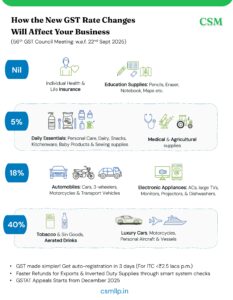
How the New GST Rate Changes Will Impact Businesses (w.e.f. 22nd Sept 2025)

56th GST Council Meeting, held in September 2025, has introduced significant changes to GST rates across various goods and services. These revisions aim to simplify compliance, reduce burden on essential items, and ensure higher taxation on luxury and sin goods. Let’s break down the impact for businesses and consumers.


Key GST Rate Changes

Nil Rate (0%)
  • Individual Health & Life Insurance

  • Educational Supplies: Pencils, notebooks, erasers, maps etc.

➡ Relief for households and students, encouraging affordability in health and education.


5% GST
  • Daily Essentials: Dairy, snacks, personal care, kitchenware, baby products, sewing supplies

  • Medical & Agricultural Supplies

➡ This keeps household and farming necessities affordable while maintaining tax revenues.


18% GST
  • Automobiles: Cars, motorcycles, three-wheelers, transport vehicles

  • Electronic Appliances: Air conditioners, large TVs, monitors, projectors, dishwashers

➡ Common in mid-range consumption, this rate continues to balance revenue and accessibility.


40% GST
  • Tobacco & Sin Goods, Aerated Drinks

  • Luxury Cars, High-end Motorcycles, Personal Aircraft & Vessels

➡ Heavier taxation on luxury and harmful products to discourage over-consumption and generate revenue.


Compliance & Business Ease Measures

Apart from rate changes, the Council announced key reforms:

  • Auto-registration within 3 days for taxpayers with ITC claims below ₹2.5 lakhs/month

  • Faster refunds for exports & inverted duty supplies through smart system checks

  • GSTAT Appeals to commence from December 2025 for quicker dispute resolution


What This Means for Businesses

  • Manufacturers & Traders in FMCG, agriculture, and medical supplies benefit from lower rates.

  • Automobile & Electronics Sectors remain at 18%, ensuring stability.

  • Luxury & Tobacco Industries face a steeper 40% rate, requiring pricing adjustments.

  • Exporters & MSMEs gain from faster refunds and easier registration.


Conclusion

The latest GST changes mark a step toward a more equitable and simplified tax structure. Essentials have been made more affordable, while luxury and sin goods will contribute more revenue. Businesses must realign their pricing, compliance, and invoicing systems before 22nd September 2025 to stay fully compliant.

Read the source of this post by clicking here (Recommendations of the 56th Meeting of the GST Council held at New Delhi)

Disclaimer:

This article is for general informational purposes only and should not be considered professional advice. Please consult a qualified expert for advice tailored to your specific situation. The author and website owner are not liable for any errors or actions based on this content.
Related GST reading

GST Registration Field Visit Guide for Drop-Shipping & E-commerce Sellers

GST Field Visit Guide for E-Commerce Sellers Without Inventory at Home

If you’re an e-commerce seller operating on platforms like Amazon, Flipkart, Meesho, or others—and you don’t store any products at your home address—getting a visit from a GST officer can feel confusing or intimidating.

But don’t worry: field visits are a normal part of the GST registration process, especially when your home is listed as your principal place of business. Here’s exactly what to expect and how to respond confidently and correctly during the verification process.


Why a GST Field Visit Happens

The field visit is meant to verify the existence and legitimacy of your business at the declared address. The officer is not there to harass you, but simply to check:

  • Whether the address is valid

  • If business activities are happening from the location

  • That your documents are genuine


Common Questions Asked — With Sample Answers

  1. What is the nature of your business?

    Answer: “I sell clothing (or your product) online through platforms like Amazon, Flipkart, and Meesho.”

  2. Why is your home listed as your business address?

    Answer: “I operate the business digitally from home for documentation and compliance purposes. No physical inventory is stored here.”

  3. Where is your stock stored?

    Answer: “I don’t stock goods at home. I use a drop-shipping model—suppliers ship products directly to customers.”

  4. Can you show any business setup (e.g., devices or tools used)?

    Answer: “Yes, I can show my laptop, mobile, email confirmations, platform dashboards, and order management system.”

  5. Do you have documents related to your suppliers or products?

    Answer: “Yes. I maintain supplier contracts, e-commerce platform registrations, and digital copies of invoices and orders.


Documents to Keep Ready

Make sure you have the following documents available (digitally or physically):

  • PAN & Aadhaar Card

  • Recent utility bill for address proof

  • GST application acknowledgment

  • E-commerce platform registration confirmation (email/screenshot)

  • Sample order or invoice from your portal

  • Supplier details or agreement (if applicable)


Important Compliance Tips

  • Ensure your documents match the GST application exactly—especially address and name.

  • Clarify that your home is only for communication, not for stocking goods.

  • Remain calm, honest, and cooperative with the officer.

  • Keep a clean, professional digital trail of orders, invoices, and platform communications.

You are operating a 100% legitimate e-commerce business under the drop-shipping model. GST law fully supports this approach as long as you:

  • File your GST returns on time

  • Maintain proper digital records

  • Provide truthful responses during verification


Display a Business Name Board at Your Address

Before the GST officer visits, it’s highly recommended to fix a nameplate or board with your business name at a visible location—such as the entrance, main door, or gate of your home. This small step significantly increases the chances of successful verification, as it visibly establishes that your home address is being used for official business correspondence. The board should ideally mention:

  • Your GST-registered business name
  • Your GSTIN or “Registered Office” label

This shows the officer that your business is active and traceable at the registered address—even if no stock is stored there.


Final Thoughts

GST field visits can sound intimidating, but with a little preparation and honesty, they’re usually quick and straightforward. As a modern online seller, your business setup is different—but completely valid.

Be transparent, stay compliant, and your GST registration will go through smoothly.

Disclaimer:

This article is for general informational purposes only and should not be considered professional advice. Please consult a qualified expert for advice tailored to your specific situation. The author and website owner are not liable for any errors or actions based on this content.
Related GST reading

Advisory on HSN Validations in Table 12 of GSTR-1

Advisory on HSN Validations in Table 12 of GSTR-1

The Goods and Services Tax (GST) authorities have issued an advisory detailing the implementation of Phase-3 for reporting Harmonized System of Nomenclature (HSN) codes in Table 12 of GSTR-1 and GSTR-1A, effective from the February 2025 return period. This phase introduces significant changes to enhance the accuracy and consistency of HSN code reporting for taxpayers.

Key Changes in Phase-3:

1. Mandatory Selection from Dropdown:

• Taxpayers with Aggregate Annual Turnover (AATO) up to ₹5 crore: Required to report 4-digit HSN codes for goods and services.

• Taxpayers with AATO exceeding ₹5 crore: Required to report 6-digit HSN codes for goods and services.

Turnover HSN Digits
Upto 5 crores Mandatory 4-digit HSN codes
More than 5 crores Mandatory 6-digit HSN codes

Manual entry of HSN codes is now restricted. Taxpayers must select the appropriate HSN code from a predefined dropdown list. Upon selection, a customized description from the HSN master will auto-populate in a new field labeled “Description as per HSN Code.”

2. Validation of Supply Values:

• The system will validate the values of Business-to-Business (B2B) and Business-to-Consumer (B2C) supplies reported in various tables against the values in Table 12.

• Initially, these validations will operate in a warning mode, allowing taxpayers to file GSTR-1 even if discrepancies are detected. However, if B2B supplies are reported in other tables, the B2B tab in Table 12 cannot be left empty.

In Table-12 validation with regards to value of the supplies have also been introduced.

1) These validations will validate the value of B2B supplies shown in different Tables viz: 4A, 4B, 6B, 6C, 8 (recipient registered), 9A, 9B (registered), 9C (registered), 15 (recipient registered), 15A (recipient registered) with the value of B2B supplies shown in table-12.

2) Similarly, validations will validate the value of B2C supplies shown in different tables viz: 5A, 6A, 7A, 7B, 8 (recipient unregistered), 9A (export), 9A (B2CL), 9B (unregistered), 9C (unregistered), 10, 15 (recipient unregistered), 15A (recipient unregistered) with the value of B2C supplies shown in Table-12.

3) In case of amendments, only the differential value will be taken for the purpose of validation.

3. Enhancements in Table 12:

• Segregation of Supplies: Table 12 is now divided into two tabs: “B2B Supplies” and “B2C Supplies.” Taxpayers must enter HSN summary details separately under each tab.

• Downloadable HSN Code List: A new “Download HSN Codes List” button allows taxpayers to download an Excel file containing the updated list of HSN and SAC codes along with their descriptions.

• Searchable “Product Name as in My Master”: This feature enables taxpayers to search and select descriptions from their HSN master. Upon selection, the corresponding HSN code, description, Unit Quantity Code (UQC), and quantity will auto-populate. This functionality is optional.

Conclusion:

These changes aim to streamline the HSN reporting process, reduce errors, and ensure compliance with GST regulations. Taxpayers are advised to familiarize themselves with these updates and adjust their reporting processes accordingly to ensure a smooth transition.

For a detailed understanding, refer to the official advisory issued by the GST authorities by clicking here.

Related GST reading

A Comprehensive Guide to GST Registration and Required Documents

A Comprehensive Guide to GST Registration and Required Documents

In today’s business landscape, Goods and Services Tax (GST) registration is essential for businesses to operate legally and efficiently. GST is a unified indirect tax that has streamlined taxation across India, eliminating multiple state and central levies. If your business meets the eligibility criteria, obtaining GST registration is mandatory. In this blog, we will discuss the significance of GST registration, the eligibility criteria, and the documents required for a smooth registration process.

What is GST Registration?

GST registration is the process of obtaining a unique GST Identification Number (GSTIN) from the tax authorities. It enables businesses to collect GST from customers and claim input tax credits on purchases. A GST-registered entity must comply with tax regulations, including timely returns filing and tax payments.

Who Needs to Register for GST?

Businesses and individuals are required to register for GST under the following conditions:

  1. Turnover Criteria: Businesses with an annual turnover exceeding Rs. 40 lakh (for goods) and Rs. 20 lakh (for services) must register for GST. In special category states, the threshold is Rs. 10 lakh.
  2. Interstate Business: Any business involved in interstate supply of goods or services must register for GST, regardless of turnover.
  3. E-commerce Operators: Businesses selling through e-commerce platforms like Amazon, Flipkart, or their own online store must register for GST.
  4. Casual Taxable Persons: Businesses operating on a temporary basis, such as seasonal businesses or event-based sellers, must obtain GST registration.
  5. Voluntary Registration: Any business can opt for voluntary GST registration to avail input tax credit and enhance market credibility.

Documents Required for GST Registration

The required documents for GST registration vary based on the type of business entity. Here’s a detailed list:

1. Sole Proprietorship

  • PAN card of the proprietor
  • Aadhaar card of the proprietor
  • Passport-sized photograph
  • Bank account details (cancelled cheque or bank statement)
  • Business address proof (electricity bill, rent agreement, NOC from owner, etc.)

2. Partnership Firm

  • PAN card of the firm
  • Partnership deed
  • PAN and Aadhaar of all partners
  • Passport-sized photographs of partners
  • Bank account details
  • Business address proof

3. Private Limited Company / LLP / Public Limited Company

  • PAN card of the company
  • Certificate of incorporation issued by MCA
  • Memorandum of Association (MoA) and Articles of Association (AoA)
  • PAN and Aadhaar of directors
  • Digital Signature Certificate (DSC) of an authorized signatory
  • Board resolution authorizing GST registration
  • Business address proof
  • Bank account details

4. Hindu Undivided Family (HUF)

  • PAN card of HUF
  • Aadhaar of Karta
  • Passport-sized photograph of Karta
  • Bank account details
  • Business address proof

How to Apply for GST Registration?

The GST registration process is straightforward and can be completed online through the GST portal. Follow these steps:

  1. Visit the official GST portal (https://www.gst.gov.in/).
  2. Click on “New Registration” and fill in the required details.
  3. Upload the necessary documents as per your business structure.
  4. Verify with an OTP sent to your registered mobile number and email.
  5. Receive the Application Reference Number (ARN) for tracking.
  6. After verification by tax authorities, the GSTIN is issued.

Conclusion

GST registration is a crucial step for businesses to ensure compliance with tax laws and take advantage of input tax credits. Having the right documents ready can help streamline the process. If you need assistance, consulting a tax expert can help you navigate the registration process efficiently.

For more business-related tax updates, stay tuned to our blog!

Disclaimer:

This article is for general informational purposes only and should not be considered professional advice. Please consult a qualified expert for advice tailored to your specific situation. The author and website owner are not liable for any errors or actions based on this content.

Related GST reading

Features of Indirect Tax Explained

Last updated: 10 August 2026 · Written and reviewed by CA Meet Dhrangadhariya, CSM & Co LLP

Quick summary

  • Indirect taxes are charged on goods and services and the burden is passed on to the final consumer.
  • Today the main indirect taxes are GST, customs duty, a limited central excise and state VAT on petroleum and alcohol.
  • Key features: shifting of burden, tax on consumption, broad base, easy collection, possible inflationary effect and regressive nature.
  • GST removed the cascading effect of the old regime through input tax credit.

Indirect taxes are taxes on spending rather than on earning. They are built into the price of goods and services, collected by businesses and paid to the government, while the final burden falls on the consumer. Direct taxes, such as income tax, are charged on income. This note explains what indirect tax is, which taxes fall under it in India today, and its main features.

What is Indirect Tax?

An indirect tax is charged on the supply of goods and services and not on the profit of the person who pays it to the government. It is collected by intermediaries in the supply chain, such as manufacturers, wholesalers and retailers, and the consumer who finally uses the product bears the burden.

Which indirect taxes exist in India today?

  • Goods and Services Tax (GST): the main indirect tax on the supply of goods and services. It has replaced most earlier indirect taxes since 1 July 2017.
  • Customs duty: charged on goods imported into India (and on a few exports).
  • Central excise duty: now limited to a small set of goods, mainly petroleum products, as most goods moved into GST.
  • State VAT: still charged by states on petrol, diesel and some other petroleum products, and on alcohol for human consumption, which are outside GST.

Service tax, the earlier central VAT, state VAT on most goods, central sales tax and octroi have been subsumed in GST.

Key features of indirect taxes

1. The burden can be shifted

The person who pays the tax to the government can recover it from the next person in the chain, until it reaches the final consumer.

2. A tax on consumption

The tax depends on what is bought and not on the buyer’s income, so it affects the price of goods and services.

3. A broad tax base

Because almost everyone buys goods and services, indirect taxes reach a very wide base and give the government a steady flow of revenue.

4. Possible inflationary effect

A higher tax rate raises the selling price, which can add to inflation.

5. Easy to collect

The tax is collected in small amounts at the point of sale by registered businesses, so the government collects it from far fewer people than the number who finally bear it.

6. Cascading effect, removed in GST

Under the old regime, tax was often charged on a price that already contained tax, and the effect repeated at every stage. GST avoids this through input tax credit, so tax paid on purchases can be set off against tax on sales.

7. Regressive nature

Everyone pays the same rate on the same item, so the tax takes a larger share of the income of low-income households than of high-income ones. GST softens this with lower rates on essentials.

Impact of indirect taxes

Indirect taxes change prices and spending patterns, and so affect the cost of living and the purchasing power of consumers. For businesses, they influence pricing, competition and cash flow, especially through the timing of input tax credit. For the government, they are a major source of revenue that funds public services and infrastructure.

Conclusion

Indirect taxes are paid by everyone who buys goods and services. Knowing how they are charged helps consumers read the tax on their bills and helps businesses price correctly and claim the credit they are entitled to.

Frequently asked questions

What is an indirect tax?

An indirect tax is a tax on the supply of goods and services. It is collected by sellers and paid to the government, while the final burden falls on the consumer.

Which are the main indirect taxes in India now?

GST, customs duty, a limited central excise duty mainly on petroleum products, and state VAT on petrol, diesel and alcohol for human consumption.

Why is indirect tax called regressive?

Everyone pays the same rate on the same item, so the tax takes a larger share of income from low-income households than from high-income households.

What is the cascading effect of tax?

It is tax charged on a price that already includes tax, repeated at every stage of the supply chain. GST avoids it through input tax credit.

Official sources

Disclaimer

This article is for general informational purposes only and should not be considered professional advice. Please consult a qualified expert for advice tailored to your specific situation. The author and website owner are not liable for any errors or actions based on this content.

Related GST reading

WhatsApp