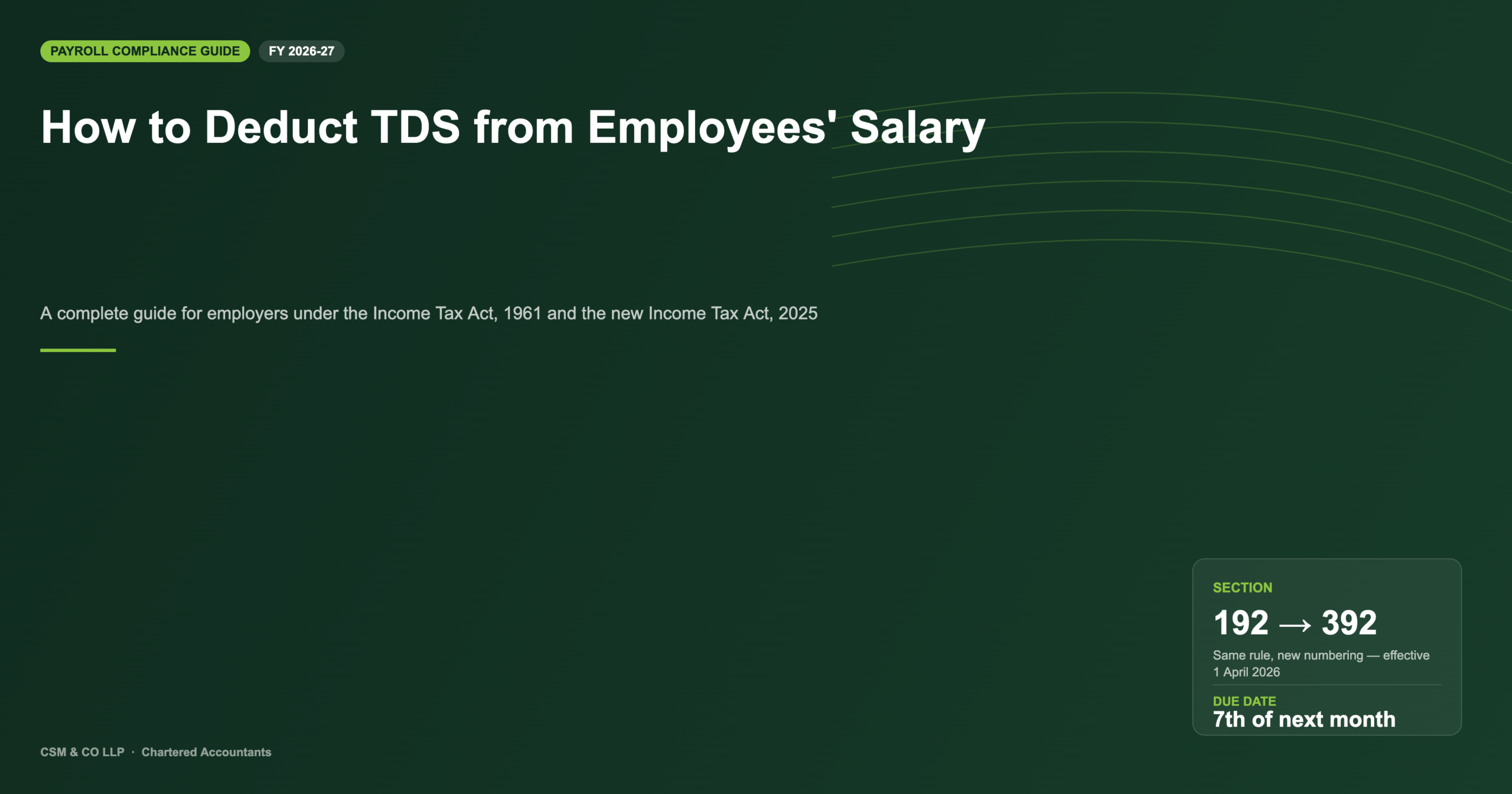
How to Deduct TDS from Employees’ Salary (FY 2026-27): A Complete Guide for Employers

Salary TDS Deduction for Employees in FY 2026-27: Step-by-Step Guide

Every employer paying salary in India is legally required to deduct tax at source before crediting the payment. Getting this wrong, whether by under-deducting, over-deducting, or missing the deposit deadline, creates real compliance risk: interest, penalties, and even disallowance of expenses. This guide walks through exactly how salary TDS works for FY 2026-27, under both the old Income Tax Act, 1961 and the new Income Tax Act, 2025.

1. The Legal Basis: Section 192 (Old Act) and Section 392 (New Act)

Salary TDS has traditionally been governed by Section 192 of the Income Tax Act, 1961. With the Income Tax Act, 2025 coming into force from 1 April 2026, the same provision now sits under Section 392 of the Income Tax Act, 2025. There is no change in policy, only in section numbering and presentation.

Which Act applies depends on the date of actual payment, not accrual:

  • Salary paid up to 31 March 2026 → governed by Section 192, Income Tax Act, 1961
  • Salary paid on or after 1 April 2026 → governed by Section 392, Income Tax Act, 2025

So, salary for March 2026 paid on 31 March 2026 falls under the old Act, while the same salary paid even a day later, on 1 April 2026, falls under the new Act.


2. Who Needs to Deduct TDS, and When

Any person responsible for paying salary, be it a company, LLP, proprietorship, HUF, or individual employer, must deduct TDS if the employee’s estimated total income for the year exceeds the basic exemption limit applicable under the tax regime the employee has opted for:

  • New Regime (default): basic exemption of ₹4,00,000
  • Old Regime (opt-in): basic exemption of ₹2,50,000

If an employee’s estimated income stays within these limits, no TDS is required. If not, the employer must deduct tax every month at the time of actual payment of salary, whether paid on time, in advance, or with delay.

3. How the TDS Amount Is Actually Calculated

Unlike TDS on contractor or professional payments, which apply a flat percentage, salary TDS has no fixed rate. It is computed using the employee’s average rate of income tax, worked out from their estimated annual income. The process:

  1. Estimate annual gross salary: basic, allowances (HRA, LTA, special allowance), perquisites, and any known bonus for the year.
  2. Apply the standard deduction: ₹75,000 under the new regime, or ₹50,000 under the old regime.
  3. Deduct eligible exemptions/deductions (old regime only): HRA exemption, 80C investments, 80D premiums, home loan interest, etc., based on proofs and declarations submitted by the employee.
  4. Add other declared income: house property income/loss, income from a previous employer (via Form 12B), or other sources disclosed by the employee.
  5. Compute tax on the resulting taxable income using the applicable slab rates for the chosen regime, then add 4% health and education cess (and surcharge, where applicable).
  6. Divide the annual tax liability by the number of salary months remaining in the financial year to arrive at the monthly TDS instalment.

Important clarification: This monthly instalment method is not the same as the 15% / 45% / 75% / 100% advance-tax payment schedule under Section 234C. That quarterly schedule applies to a taxpayer’s own advance tax payments on non-salary income. Salary TDS under Section 192 / 392 simply spreads the estimated annual tax liability equally across the remaining pay months of the year, and is recalculated whenever income, regime choice, or investment declarations change.

4. FY 2026-27 Slab Rates (No Change from FY 2025-26)

The Union Budget 2026 did not revise slab rates. The following continue to apply for FY 2026-27 (AY 2027-28):

New Tax Regime (default)

Income Slab Rate
Up to ₹4,00,000 Nil
₹4,00,000 – ₹8,00,000 5%
₹8,00,000 – ₹12,00,000 10%
₹12,00,000 – ₹16,00,000 15%
₹16,00,000 – ₹20,00,000 20%
₹20,00,000 – ₹24,00,000 25%
Above ₹24,00,000 30%

A rebate of up to ₹60,000 continues to apply for taxable income up to ₹12,00,000 (making salary up to about ₹12,75,000 effectively tax-free after the ₹75,000 standard deduction, subject to conditions and provided the rebate isn’t lost due to marginal cliff effects just above the threshold).

Old Tax Regime (opt-in)

Income Slab Rate
Up to ₹2,50,000 Nil
₹2,50,000 – ₹5,00,000 5%
₹5,00,000 – ₹10,00,000 20%
Above ₹10,00,000 30%

5. Old Regime vs New Regime: What Employers Must Collect

Employees must indicate their choice of regime at the start of the year, and the employer must deduct TDS accordingly. Key differences that affect payroll:

  • New regime: only the standard deduction is available; investment proofs are not required.
  • Old regime: employer must collect investment/deduction proofs, such as 80C, 80D, HRA rent receipts, and home loan interest certificates, before finalising TDS, typically before the last quarter of the year.

If an employee doesn’t declare a preference, the new regime applies by default.

6. Multiple Employers in the Same Year

If an employee joins mid-year, the new employer should obtain details of salary already paid and TDS already deducted by the previous employer, using Form 12B. This ensures the new employer computes TDS on the employee’s full-year income rather than under-deducting.

7. Depositing TDS: Due Dates

Once deducted, TDS must be deposited with the government:

  • By the 7th of the following month, for TDS deducted in April–February
  • By 30th April, for TDS deducted in March

This applies whether the deduction falls under Section 192 (up to 31 March 2026) or the corresponding Section 392 (from 1 April 2026).

8. Returns and Certificates

  • Form 24Q: the quarterly TDS return for salary payments, filed by all employers each quarter.
  • Form 16 / Form 130: the annual TDS certificate issued to employees. Form 16 continues to apply for FY 2025-26 salary; Form 130 is the equivalent certificate for Tax Year 2026-27 salary under the new Act.

9. Consequences of Getting It Wrong

Failure to deduct or deposit TDS correctly can result in:

  • Interest for late deduction or late deposit
  • The employer being treated as an “assessee-in-default,” with recovery of the TDS amount plus interest
  • Penalty and, in cases of deduction without deposit, potential prosecution
  • Disallowance of 30% of the relevant expense while computing business income, where tax was deductible but not deducted or deposited on time

10. Quick Checklist for HR and Payroll Teams

  • Collect tax regime declaration from every employee at the start of the year
  • Confirm PAN is valid and updated in payroll records
  • Collect Form 12B for employees who joined mid-year
  • Collect investment/deduction proofs from employees on the old regime
  • Recompute monthly TDS whenever salary, bonus, or declarations change
  • Deposit TDS by the 7th of the following month (30th April for March)
  • File Form 24Q every quarter and issue Form 16 / Form 130 after year-end

This article is for general guidance only and does not constitute tax advice. For specific queries relating to your organisation’s payroll and TDS compliance, please get in touch with our team.

Slump Sale: Capital Gains Under Section 77 (Earlier 50B), Net Worth and Form 28 (Tax Year 2026-27)

Last updated: 23 August 2026 · Written and reviewed by CA Meet Dhrangadhariya, CSM & Co LLP

Quick summary

  • A slump sale is the transfer of one or more undertakings for a lump sum without values for the individual assets and liabilities (section 2(103)). The profit is a long-term capital gain if the undertaking was held for more than 36 months, and a short-term gain otherwise (section 77).
  • The cost of acquisition and of improvement is the net worth of the undertaking, which is its total assets less liabilities as in the books, ignoring revaluation; the sale price is the fair market value of the capital assets worked out under Rule 53.
  • An accountant’s report in Form 28 must be furnished before the specified date in section 63 (section 77(4) and Rule 54).
  • The long-term gain is taxed at 12.5% without indexation.

When a business is sold as a whole, the tax follows special rules. Instead of valuing every asset, the law taxes the profit on the sale of the undertaking as a slump sale. The rules are in section 77 of the Income-tax Act, 2025 (earlier section 50B), with the details of valuation in Rule 53 and the accountant’s report in Rule 54.

What is a slump sale

Section 2(103): the transfer of one or more undertakings, by any means, for a lump sum consideration without values being assigned to the individual assets and liabilities. Fixing a value of an asset or liability only for stamp duty, registration fees or similar taxes is not assigning values.

An undertaking includes any part of an undertaking, or a unit or division, or a business activity taken as a whole, but not individual assets or liabilities or any combination of them that is not a business activity (section 2(35)).

Two points follow:

  • A sale of individual assets, even many of them, is not a slump sale.
  • A sale of a business with a price allocated to each asset is also not a slump sale. That is an itemised sale, taxed asset by asset.

Long-term or short-term (section 77(1) and (2))

  • The profit or gain is chargeable as long-term capital gain in the year of the transfer.
  • If the undertaking or division was owned and held for 36 months or less before the transfer, the gain is short-term.

Computing the gain (section 77(3) and (5))

  • Full value of consideration: the fair market value of the capital assets on the date of transfer, calculated as prescribed (Rule 53).
  • Cost of acquisition and cost of improvement: the net worth of the undertaking or division.

Net worth = the aggregate value of total assets of the undertaking, less the value of its liabilities as appearing in the books, with any revaluation of assets ignored. In the aggregate value of total assets:

  • depreciable assets are taken at the written down value of the block of assets (as in section 41(1)(c));
  • goodwill not acquired by purchase from a previous owner is nil;
  • assets whose entire expenditure has been or can be deducted under section 46 are nil; and
  • other assets are at their book value.

There is no indexation. Because the cost is the net worth, which is based on the books, the gain is largely the amount by which the price exceeds the book value of the net assets.

Rule 53: fair market value

Rule 53 gives the fair market value as the higher of two figures:

  • FMV1, the asset-based value: A + B + C + D - L, where A is the book value of assets other than jewellery, artistic work, shares, securities and immovable property (less income-tax paid net of refunds and unamortised deferred expenditure), B the open market price of jewellery and artistic work on a registered valuer’s report, C the fair market value of shares and securities as determined under Rule 57, D the stamp duty value of immovable property, and L the book value of liabilities excluding paid-up capital, proposed dividends, reserves and surplus, provisions for tax beyond tax paid and other provisions and contingent liabilities (as listed in the Rule); or
  • FMV2, the consideration-based value: the monetary consideration received plus the fair market value of non-monetary consideration, determined in the manner in the Rule.

Report of an accountant (section 77(4); Rule 54)

Every assessee must furnish, before the specified date referred to in section 63, a report of an accountant in Form 28. It must include the computation of the net worth of the undertaking or division and certify that the net worth has been correctly arrived at. The specified date in section 63 is the date by which the tax audit report must be filed, so the report is due before that.

Tax rate

A long-term slump sale gain is taxed at 12.5% without indexation (section 197), because the undertaking is not listed equity. A short-term gain is taxed at the rates for the assessee. The surcharge on the long-term gain is capped at 15% (Finance Act, 2026).

Example

A company sells its manufacturing division, held for five years, for a lump sum of ₹5 crore. The aggregate value of total assets of the division, taking depreciable assets at the written down value and other assets at book value, is ₹3 crore, and its liabilities are ₹1 crore.

  • Net worth = 3,00,00,000 - 1,00,00,000 = ₹2,00,00,000
  • Full value of consideration = the higher of FMV1 and FMV2 under Rule 53; suppose it is ₹5,00,00,000 (the consideration)
  • Long-term capital gain = 5,00,00,000 - 2,00,00,000 = ₹3,00,00,000
  • Tax at 12.5% = ₹37,50,000, plus surcharge (capped at 15% on this gain) and cess.

Practical points

  • Do not allocate the price to the assets. If the agreement fixes values for individual assets, the transaction can fail the slump sale test, and each asset is taxed separately, including depreciable assets, under section 74.
  • A demerger or amalgamation that satisfies the Act’s conditions is not a transfer at all (section 70), and has no capital gain.
  • Keep the valuation reports, the net worth working and the Form 28 on file for the return.

Frequently asked questions

What is a slump sale?

The transfer of one or more undertakings, by any means, for a lump sum consideration without values being assigned to the individual assets and liabilities (section 2(103)). Fixing values for stamp duty or registration purposes does not count as assigning values.

Is the gain long-term or short-term?

Long-term if the undertaking or division was owned and held for more than 36 months immediately before the transfer; otherwise short-term (section 77(1) and (2)).

How is the gain computed?

Full value of consideration is the fair market value of the capital assets on the transfer date, worked out under Rule 53; the cost of acquisition and improvement is the net worth of the undertaking (section 77(3)).

What is net worth?

The aggregate value of total assets of the undertaking, less its liabilities as shown in the books, ignoring any revaluation. Depreciable assets are taken at the written down value of the block, self-generated goodwill at nil, and assets whose cost was fully deductible at nil (section 77(5)).

Which report is needed?

An accountant’s report in Form 28 computing and certifying the net worth, furnished before the specified date in section 63, that is the date by which the tax audit report is due (Rule 54).

What is the tax rate on a long-term slump sale gain?

12.5% without indexation (section 197), plus surcharge (at most 15% on this gain) and 4% cess.

Official sources

Disclaimer

This article is for general informational purposes only and should not be considered professional advice. Please consult a qualified expert for advice tailored to your specific situation. The author and website owner are not liable for any errors or actions based on this content.

Crossed Cheque under the Negotiable Instruments Act: General Crossing, Special Crossing, Not Negotiable and Account Payee

Last updated: 09 October 2026 · Written and reviewed by CA Meet Dhrangadhariya, CSM & Co LLP

Quick summary

  • A cheque with two parallel transverse lines across its face (with or without “and company” or “not negotiable”) is crossed generally, and a bank on which it is drawn can pay it only to another banker, not over the counter.
  • A cheque with the name of a banker across its face is crossed specially, and can be paid only to that banker or its agent for collection.
  • “Not negotiable” does not stop transfer, but the person taking the cheque gets no better title than the person from whom he took it.
  • “Account payee” is a banking practice and is not defined in the Act. It tells the collecting bank to credit only the payee’s account.

Crossing a cheque is the oldest anti-fraud device in banking. The Negotiable Instruments Act, 1881 deals with it in sections 123 to 131A (Chapter XIII, “Of crossed cheques”). The idea is simple: a crossed cheque cannot be paid in cash across the counter, so the money has to pass through a bank account where it can be traced.

General crossing (section 123)

A cheque that bears across its face either:

  • the words “and company” (or an abbreviation) between two parallel transverse lines, or
  • two parallel transverse lines simply,

with or without the words “not negotiable”, is crossed generally.

Special crossing (section 124)

A cheque that bears across its face the name of a banker, with or without the words “not negotiable”, is crossed specially, and crossed to that banker.

Who can cross, and when (section 125)

  • The holder of an uncrossed cheque may cross it generally or specially.
  • The holder of a cheque crossed generally may cross it specially, or add the words “not negotiable”.
  • A banker to whom a cheque is crossed specially may cross it again specially to another banker, his agent, for collection.

How the paying bank must act

Crossing The drawee bank may pay
General Only to a banker (section 126)
Special Only to the banker to whom it is crossed, or his agent for collection (section 126)
Special to more than one banker (other than an agent for collection) The bank must refuse payment (section 127)

Consequences for the banks and the parties

  • Payment in due course (section 128): if the drawee bank has paid a crossed cheque in due course, both the bank, and the drawer (where the cheque has reached the payee), are placed in the same position as if the amount had been paid to and received by the true owner.
  • Payment out of due course (section 129): a bank that pays a generally crossed cheque otherwise than to a banker, or a specially crossed cheque otherwise than to the banker named or its collecting agent, is liable to the true owner for any loss he sustains.
  • Collecting bank (section 131): a banker who in good faith and without negligence receives payment for a customer of a crossed cheque, crossed to itself, is not liable to the true owner merely because the customer’s title turns out to be defective. A banker is treated as receiving payment even if it credits the customer’s account before receiving payment. Where the payment is based on an electronic image of a truncated cheque, the collecting banker must verify the prima facie genuineness of the cheque and any fraud, forgery or tampering apparent on its face, with due diligence and ordinary care.
  • Drafts (section 131A): the same chapter applies to a draft as if it were a cheque.

“Not negotiable” (section 130)

The words do not make the cheque non-transferable. What they do is take away the usual protection of a person who takes a negotiable instrument in good faith for value: someone who takes a crossed cheque marked “not negotiable” does not have, and cannot give, a better title than the person from whom he took it. If the cheque was stolen, no later holder gets good title, however innocent.

“Account payee”

The words “account payee” or “A/c payee only” written between the lines are not in the Act. They are a banking practice, understood as an instruction to the collecting bank to credit only the account of the named payee. How a bank treats them is a matter of its own rules and RBI instructions, so ask your bank before relying on them for a large payment.

Practical points

  • To protect a cheque you send by post or courier, cross it, and add the payee’s name and “account payee only”.
  • To pay a person who has no bank account, do not cross the cheque, or use a bearer cheque with caution, since an uncrossed cheque can be paid in cash to whoever presents it.
  • Where a crossed cheque has been paid to the wrong person, tell the bank in writing at once and keep a copy of the cheque and the statement.
  • A crossed cheque that is returned unpaid for insufficiency of funds still falls under section 138 if all other conditions are met (see our post on cheque bounce).

Points to check

  • This post follows the Act as published on India Code. The truncated-cheque explanation to section 131 was added by amendment and applies where payment is based on an electronic image.
  • Practice for “account payee” and bank procedures varies; check the bank’s own rules and RBI instructions for the cheque truncation system.

Frequently asked questions

What is a crossed cheque?

A cheque with an addition across its face that restricts how the drawee bank may pay it. Under section 123, two parallel transverse lines (with or without the words and company or not negotiable) make it crossed generally. Under section 124, the name of a banker across its face makes it crossed specially.

Can a crossed cheque be encashed over the counter?

No. A cheque crossed generally can be paid only to a banker, and a cheque crossed specially only to the banker named or to his agent for collection (section 126). It has to go through a bank account.

Can the holder cross an uncrossed cheque?

Yes. The holder may cross it generally or specially. The holder of a generally crossed cheque may cross it specially or add not negotiable (section 125).

What does not negotiable mean on a cheque?

The cheque can still be transferred, but a person who takes it gets no better title than the person from whom he took it, and cannot give a better title (section 130). A thief or finder cannot pass on good title.

What happens if a bank pays a crossed cheque wrongly?

A banker who pays a generally crossed cheque otherwise than to a banker, or a specially crossed cheque otherwise than to the named banker or its agent, is liable to the true owner for any loss (section 129).

Is account payee in the Act?

No. The Act deals with general and special crossing and not negotiable. Account payee is a banking practice of writing the words across the cheque so that the proceeds are credited only to the payee’s account.

Official sources

Related reading

Disclaimer

This article is for general informational purposes only and should not be considered professional advice. Please consult a qualified expert for advice tailored to your specific situation. The author and website owner are not liable for any errors or actions based on this content.