Section 80DDB: Deduction for Medical Treatment of Specified Diseases

Last updated: 06 September 2026 · Written and reviewed by CA Meet Dhrangadhariya, CSM & Co LLP

Quick summary

  • Section 80DDB allows a deduction for the amount actually paid on treatment of specified serious diseases, up to ₹40,000, or up to ₹1,00,000 if the patient is a senior citizen.
  • The deduction is reduced by any amount received from insurance or reimbursed by an employer, so only your net out-of-pocket cost counts.
  • It covers you and your dependants (spouse, children, parents, brothers and sisters), and needs a prescription from the specialist named in the rules.
  • From Tax Year 2026-27 it is section 128 of the Income-tax Act, 2025, and it is available only in the old tax regime.

How to claim the section 80DDB deduction

1. Check that the illness is on the specified list
↓
2. Get a prescription from the specialist named for that disease
↓
3. Pay the treatment cost and keep the bills
↓
4. Reduce the claim by insurance or employer reimbursement
↓
5. Claim the balance, up to ₹40,000 or ₹1,00,000, in the old regime

Treating a serious illness is expensive. Section 80DDB lets a resident individual or HUF deduct what they actually pay on the treatment of certain specified diseases, up to a limit. It reduces taxable income, and is available only under the old tax regime.

From Tax Year 2026-27 the provision is section 128 of the Income-tax Act, 2025. For FY 2025-26 (assessment year 2026-27) it is section 80DDB of the 1961 Act.

Who can claim?

  • A resident individual, for treatment of self or a dependant.
  • A HUF, for treatment of any of its members.
  • A dependant means the spouse, children, parents, brothers and sisters of the individual. Companies and other entities cannot claim.

Deduction limit

Patient Maximum deduction
Under 60 years ₹40,000
Senior citizen (60 or more at any time during the year) ₹1,00,000

The deduction is the amount actually paid or the limit, whichever is less. It is then reduced by any amount received under an insurance policy or reimbursed by an employer for that treatment.

Examples

  1. You pay ₹80,000 for treatment and get ₹30,000 from the insurer. For a patient under 60, the limit is ₹40,000 (less than the ₹80,000 paid), so the deduction is ₹40,000 less ₹30,000, which is ₹10,000. For a senior citizen the amount paid (₹80,000) is less than the limit of ₹1,00,000, so the deduction is ₹80,000 less ₹30,000, which is ₹50,000.
  2. You pay ₹80,000 and the insurer pays ₹60,000. For a patient under 60 it is ₹40,000 less ₹60,000, so there is no deduction. For a senior citizen it is ₹80,000 less ₹60,000, which is ₹20,000.

In short, take the lower of the amount paid and the limit, then subtract what the insurer or employer paid.

Diseases covered and who must prescribe

Disease Specialist who must prescribe
Specified neurological diseases where disability is 40% or more: dementia, dystonia musculorum deformans, motor neuron disease, ataxia, chorea, hemiballismus, aphasia and Parkinson’s disease Neurologist with D.M. in Neurology
Malignant cancers Oncologist with D.M. in Oncology
Full blown AIDS Any specialist with a post-graduate degree in General or Internal Medicine
Chronic renal failure Nephrologist with D.M. in Nephrology, or urologist with M.Ch. in Urology
Haemophilia and thalassaemia Specialist with D.M. in Haematology

An equivalent degree recognised by the Medical Council of India is also accepted. If the patient is treated in a government hospital, a full-time specialist of that hospital with a post-graduate degree in General or Internal Medicine (or equivalent) can give the prescription.

What should the prescription show?

  • The patient’s name and age.
  • The disease or ailment.
  • The name, address, registration number and qualification of the specialist.
  • For a government hospital, the hospital’s name and address.

How to claim

  1. Keep the specialist’s prescription and the bills.
  2. Subtract any insurance claim or employer reimbursement.
  3. Report the net amount, within the limit, in the deductions section of your return.
  4. Choose the old regime. The deduction is not available in the new regime.

Frequently asked questions

What is the limit under section 80DDB?

₹40,000, or ₹1,00,000 if the patient is a senior citizen (60 or more at any time during the year). The claim is the amount paid or the limit, whichever is less, reduced by any insurance or reimbursement.

Which diseases are covered?

Specified neurological diseases (with 40% or more disability), malignant cancers, full blown AIDS, chronic renal failure, and haemophilia and thalassaemia.

Is a prescription needed?

Yes, from the specialist named in the rules for that disease. If treated in a government hospital, a full-time specialist of that hospital can give it.

Who counts as a dependant?

The spouse, children, parents, brothers and sisters of an individual, or a member of a HUF.

Is section 80DDB available in the new tax regime?

No. It is available only in the old tax regime.

Official sources

Related reading

Disclaimer

This article is for general informational purposes only and should not be considered professional advice. Please consult a qualified expert for advice tailored to your specific situation. The author and website owner are not liable for any errors or actions based on this content.

Section 80DD: Deduction for Dependant with Disability, Limit and Who Can Claim

Last updated: 11 July 2026 · Written and reviewed by CA Meet Dhrangadhariya, CSM & Co LLP

Quick summary

  • Section 80DD gives a resident individual or HUF a flat deduction of ₹75,000 for a dependant with disability (40% or more), or ₹1,25,000 for severe disability (80% or more).
  • It does not depend on the actual amount spent, but you must have spent on the dependant’s medical treatment, nursing, training or rehabilitation, or paid into an approved insurer scheme for their maintenance.
  • The dependant is the spouse, children, parents, brothers or sisters, and cannot be someone who claims section 80U for themselves.
  • From Tax Year 2026-27 the provision is section 127 of the Income-tax Act, 2025. It is available only in the old tax regime.

Section 80DD helps families who look after a dependant with a disability. A resident individual or Hindu undivided family (HUF) gets a fixed deduction from income, whatever the actual expense, provided they spent on the dependant’s care or paid into an approved scheme for the dependant’s future. It is available only under the old tax regime.

From Tax Year 2026-27 the provision is section 127 of the Income-tax Act, 2025. For FY 2025-26 (assessment year 2026-27) it is still section 80DD of the 1961 Act.

Amount of deduction

Disability of the dependant Deduction
40% or more, but less than 80% ₹75,000
Severe disability: 80% or more, including autism, cerebral palsy and multiple disabilities certified as severe ₹1,25,000

The amount is fixed. You do not need bills for the amount you claim, but you must actually have incurred the spending, or paid the scheme premium, in that year.

Conditions

  • The claimant must be a resident individual or HUF.
  • The dependant is, for an individual, the spouse, children, parents, brothers and sisters. For a HUF, it is a member of the HUF. The dependant must be dependent wholly or mainly on the claimant.
  • The claim is for a dependant, not for yourself. If you have a disability yourself, see section 80U.
  • The dependant must not claim a deduction under section 80U (section 154 in the new Act) for themselves. If they do, 80DD cannot be claimed for them.
  • You must either (a) spend on medical treatment (including nursing), training and rehabilitation of the dependant, or (b) pay or deposit an amount under an approved scheme of the Life Insurance Corporation or another insurer for the dependant’s maintenance.
  • For the insurance route, the scheme must pay an annuity or lump sum to the dependant on your death, or when you reach 60, and you must name the dependant (or a trust or other person for the dependant) to receive it.

Disabilities covered

The disability must be certified by the medical authority. The list includes blindness, low vision, leprosy-cured, hearing impairment, locomotor disability, mental retardation, mental illness, autism, cerebral palsy and multiple disabilities.

Certificate and documents

  • The disability must be certified by the prescribed medical authority, such as a civil surgeon or chief medical officer of a government hospital, or a specialist neurologist where the rules provide.
  • A copy of the certificate must be furnished with your return of income. Up to FY 2025-26 the form for autism, cerebral palsy and multiple disability was Form 10-IA. Under the Income-tax Rules, 2026 the certificate form is Form 30.
  • If the certificate says the disability needs reassessment after a period, the deduction stops after the year the certificate expires, until you furnish a new certificate.
  • If you claim the insurance route, keep the premium receipts and the policy terms.

Section 80DD vs section 80U

Basis Section 80DD Section 80U
Who claims A resident individual or HUF who supports a dependant with disability A resident individual with disability, for themselves
Amount ₹75,000, or ₹1,25,000 for severe disability ₹75,000, or ₹1,25,000 for severe disability
Both for the same person? Not allowed Not allowed
Regime Old regime only Old regime only

If the dependant dies first

If the dependant dies before you, the amount paid or deposited under the insurance scheme is treated as your income of the year in which you receive it, and is taxed.

Remember

The deduction is in addition to other deductions such as section 80C or 80D. Check your tax under both regimes, because 80DD, like most deductions, is lost in the new regime.

Frequently asked questions

How much is the deduction under section 80DD?

₹75,000 if the dependant has a disability of 40% or more, and ₹1,25,000 if the disability is severe (80% or more). It is a fixed amount, not the actual expense.

Who is a dependant for section 80DD?

For an individual, the spouse, children, parents, brothers and sisters. For a HUF, a member of the HUF.

Can I claim 80DD if the dependant claims section 80U?

No. If the dependant claims 80U for themselves, you cannot claim 80DD for the same person.

Is a medical certificate needed?

Yes. A certificate from the prescribed medical authority has to be furnished with the return.

Is section 80DD available in the new tax regime?

No. It is available only in the old tax regime.

Official sources

Related reading

Disclaimer

This article is for general informational purposes only and should not be considered professional advice. Please consult a qualified expert for advice tailored to your specific situation. The author and website owner are not liable for any errors or actions based on this content.
Section 80TTA vs 80TTB: Key Differences, Benefits and How to Claim

Last updated: 27 September 2026 · Written and reviewed by CA Meet Dhrangadhariya, CSM & Co LLP

Quick summary

  • Section 80TTA gives individuals and HUFs a deduction of up to ₹10,000 on savings account interest.
  • Section 80TTB gives resident senior citizens (age 60 or more) up to ₹50,000 on interest from savings accounts, fixed deposits and recurring deposits. A senior citizen cannot claim 80TTA.
  • Both are available only in the old tax regime, and both appear as section 153 of the Income-tax Act, 2025 from Tax Year 2026-27.
  • The deduction is not automatic: enter it in your return.

Section 80TTA and section 80TTB give a deduction on interest earned from bank and post office deposits. They are alternatives. 80TTA is for everyone else and is smaller, while 80TTB is only for senior citizens and is wider and larger. Both are available only in the old tax regime.

What is section 80TTA?

Section 80TTA allows an individual or HUF a deduction of up to ₹10,000 (or the actual interest, if less) on interest from a savings account with a bank, a co-operative bank or a post office. It does not cover interest on fixed deposits or recurring deposits. A senior citizen who claims section 80TTB cannot claim 80TTA.

What is section 80TTB?

Section 80TTB allows a resident senior citizen a deduction of up to ₹50,000 (or the actual interest, if less) on interest from savings accounts and time deposits, including fixed deposits and recurring deposits, with a bank, a co-operative bank or a post office.

A senior citizen here means a resident individual who is 60 or more at any time during the year.

Key differences

Basis Section 80TTA Section 80TTB
Who can claim Individuals and HUFs (not senior citizens claiming 80TTB) Resident senior citizens, age 60 or more
Maximum deduction ₹10,000 or actual interest, whichever is less ₹50,000 or actual interest, whichever is less
Interest covered Savings account Savings account, fixed deposit, recurring deposit
Institutions Bank, co-operative bank, post office Bank, co-operative bank, post office
Regime Old regime only Old regime only

Example

Mr B is 59 years old on 01/04/2025 and turns 60 on 15/01/2026. In FY 2025-26 he earns ₹7,000 as savings account interest and ₹20,000 as FD interest.

  • Because he is 60 at some point during FY 2025-26, he is a senior citizen for that year. He can claim 80TTB on the full ₹27,000 (below the ₹50,000 limit).
  • If he were still under 60 throughout the year, he could claim only 80TTA on the ₹7,000 savings interest, and nothing on the FD interest.

New regime

Neither section is available if you choose the new tax regime. Interest income is then simply taxed at slab rates.

Income-tax Act, 2025

From Tax Year 2026-27 both deductions are found in section 153 of the Income-tax Act, 2025, with the same limits. Budget 2025 raised the TDS threshold on interest (₹50,000 for others and ₹1,00,000 for senior citizens), but that only affects when TDS is deducted. It does not change the 80TTA and 80TTB limits.

How to claim

The deduction is not given automatically. Check your interest in the bank statements and the Annual Information Statement (AIS), then enter the amount in the deductions schedule of your return. Keep the interest certificates from the bank or post office.

Frequently asked questions

Who can claim section 80TTA?

Individuals and HUFs who are not claiming section 80TTB, up to ₹10,000 on interest from savings accounts with a bank, co-operative bank or post office.

Who can claim section 80TTB?

Only resident individuals aged 60 or more at any time during the year, up to ₹50,000 on interest from savings and time deposits.

Can a senior citizen claim both?

No. A senior citizen claims 80TTB and cannot claim 80TTA.

Is FD interest covered by section 80TTA?

No. Only savings account interest is covered. FD and RD interest qualifies only for senior citizens under 80TTB.

Are these deductions available in the new regime?

No. Both are available only in the old tax regime.

Official sources

Related reading

Disclaimer

This article is for general informational purposes only and should not be considered professional advice. Please consult a qualified expert for advice tailored to your specific situation. The author and website owner are not liable for any errors or actions based on this content.
Section 80E of Income Tax Act: Deduction for Interest on Education Loan

Last updated: 15 September 2026 · Written and reviewed by CA Meet Dhrangadhariya, CSM & Co LLP

Quick summary

  • Section 80E allows a deduction for the full interest paid on a higher education loan, with no upper limit.
  • It is available only to individuals, for 8 years from the year interest payment starts (or until the loan is repaid, if sooner), and only in the old tax regime.
  • The loan must be from a bank, notified financial institution or approved charitable institution, for yourself, your spouse, children or a student you are legal guardian of.
  • Only interest counts, not the principal. From Tax Year 2026-27 the provision is section 129 of the Income-tax Act, 2025.

Section 80E allows an individual to deduct the interest paid on an education loan taken for higher studies, whether for self or for close family. There is no maximum amount, but the deduction runs for a limited period and is available only under the old tax regime.

What is section 80E?

Section 80E is a deduction from total income for the interest part of the EMIs you pay on a loan taken for higher education. The principal repaid is not deductible under this section.

From Tax Year 2026-27 the same deduction is found in section 129 of the Income-tax Act, 2025. For FY 2025-26 (assessment year 2026-27) it is still section 80E of the 1961 Act.

Eligibility for the 80E deduction

  • Only individuals can claim it. HUFs, firms and companies cannot.
  • The loan must be taken for higher education of yourself, your spouse, your children, or a student for whom you are the legal guardian.
  • The loan must be taken from a bank or other financial institution, or from an approved charitable institution. A loan from friends or relatives does not qualify.
  • You must be the borrower, and the interest must actually have been paid out of your income.
  • It is available only under the old tax regime.

Which courses count as higher education?

Any course after passing the senior secondary examination (Class 12) or its equivalent, regular or vocational, in India or abroad.

How much can you claim?

The whole interest paid in the year. For example, if your income after other deductions is ₹6,70,000 and you paid ₹2,00,000 as interest on the education loan, your taxable income becomes ₹4,70,000.

For how many years?

The deduction starts in the year you begin paying interest and continues for 8 years in total, or until the interest is fully repaid, whichever is earlier. If you repay the loan in five years, you can claim for those five years only. If repayment runs beyond eight years, there is no deduction for the later years.

Documents needed

Get an interest certificate from the lender each year. It should show the interest and principal parts of the EMIs paid in that financial year separately. Keep it for your records, and give it to your employer if you want TDS adjusted.

Should you repay early?

Interest saved by repaying early is usually larger than the tax saved by claiming 80E. A deduction reduces your tax only by your slab rate (for example 30% plus cess), while the interest costs you 100%. So the tax benefit alone is not a reason to delay repayment. Consider the loan interest rate, your other investments and your cash needs, and prepay if the interest rate is higher than what you can safely earn elsewhere.

Old regime or new regime?

The new tax regime does not allow section 80E. If education loan interest is large, compare your tax under both regimes before you choose.

Frequently asked questions

Is there a limit on the section 80E deduction?

No. The whole interest paid in the year is deductible. Only the interest counts, not the principal.

For how many years can I claim section 80E?

For up to 8 years starting from the year in which you begin paying the interest, or until the interest is fully paid, whichever is earlier.

Who can claim section 80E?

Only individuals, for a loan taken for higher education of self, spouse, children or a student for whom they are the legal guardian. HUFs and companies cannot.

Does a loan from a relative or friend qualify?

No. The loan must be from a bank, a notified financial institution or an approved charitable institution.

Is section 80E available in the new tax regime?

No. It is allowed only in the old tax regime.

Official sources

Related reading

Disclaimer

This article is for general informational purposes only and should not be considered professional advice. Please consult a qualified expert for advice tailored to your specific situation. The author and website owner are not liable for any errors or actions based on this content.
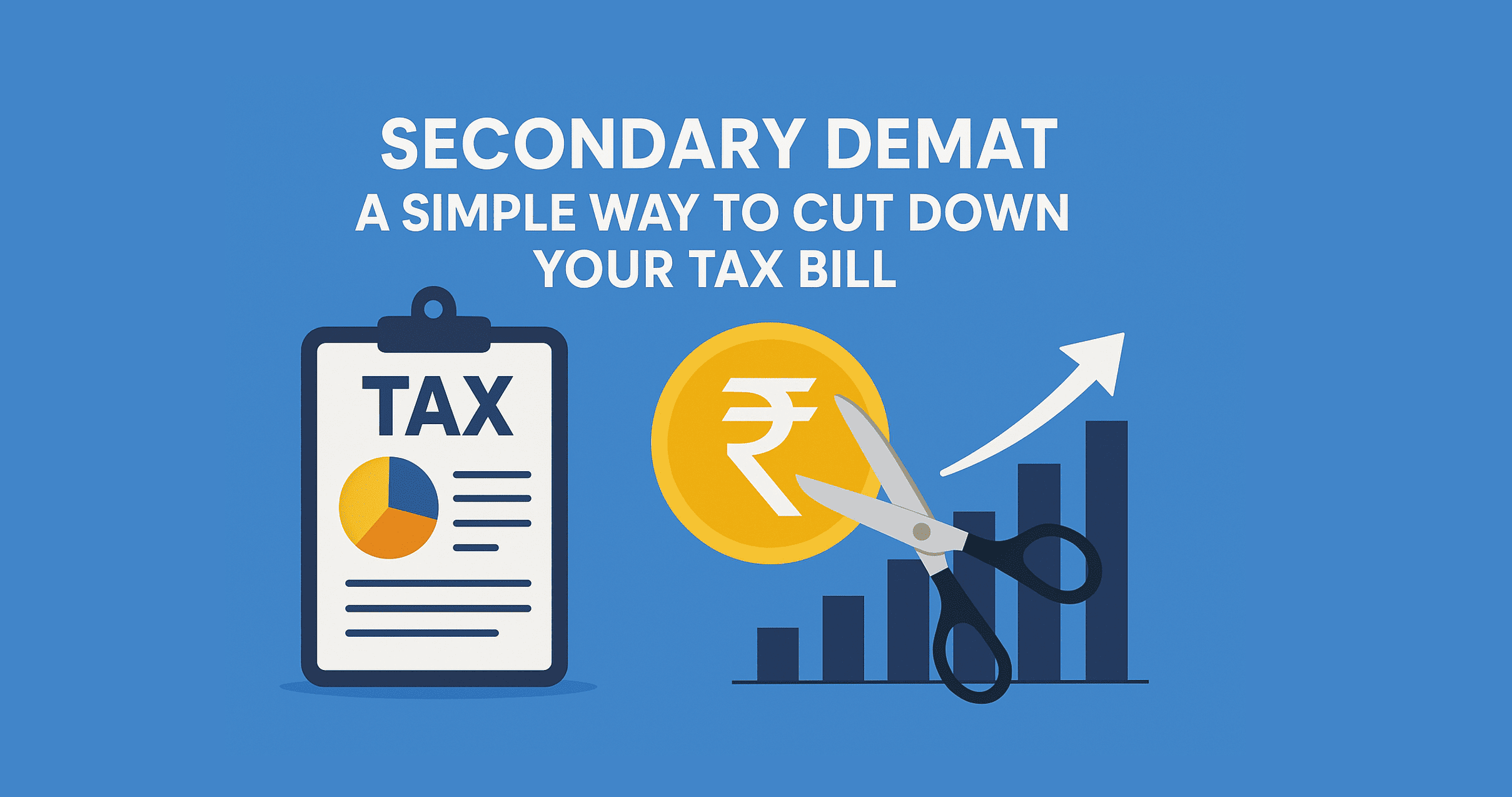
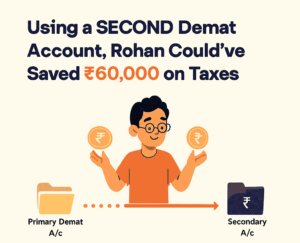
Secondary Demat: A Simple Way to Cut Down Your Tax Bill

How Secondary Demat Account Can Save You Lakhs in Taxes

Zerodha has introduced a Secondary Demat Account feature – a huge win for investors who juggle both long-term holdings and short-term trades.

And if you don’t use Zerodha, no worries. You can still achieve the same benefit by simply opening two separate demat accounts with your broker instead of using just one. The idea is the same: keep investments and trades apart so your long-term gains don’t get taxed as short-term under FIFO rules.

We analysed a case where investor Rohan (imaginary investor) ended up paying lakhs of extra tax only because all his shares sat in one account. With a secondary demat, that problem disappears.


The Problem with FIFO in a Single Demat

When you hold all your shares in a single demat, FIFO (First-In-First-Out) rules apply. This means whenever you sell, the system assumes you are selling the oldest lot first.

For active investors, this is a problem. Your long-term, low-cost investments often get sold “on paper” before your newer trades, pushing up your short-term capital gains (STCG) bill unnecessarily.


How Rohan Paid Extra Tax

Let’s say Rohan made these trades:

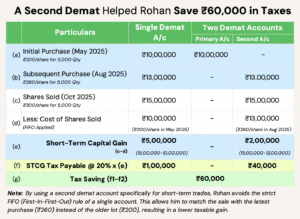
  • May 2025: Bought 5,000 shares at ₹200 each → ₹10,00,000

  • August 2025: Bought another 5,000 shares at ₹260 each → ₹13,00,000

  • October 2025: Sold 5,000 shares at ₹300 each → ₹15,00,000

If all shares are in a single demat:

  • FIFO applies → May 2025 lot (₹200/share) is sold
  • Cost = ₹10,00,000

  • Sale = ₹15,00,000

  • Total Short-Term Capital Gain = ₹5,00,000

  • STCG Tax @ 20% = ₹1,00,000

If shares are split across two demats:

  • May 2025 lot sits in the primary account (kept as long-term investment)

  • August 2025 lot sits in the secondary account (used for short-term investment)

  • Sale in October is from the secondary account → FIFO applies here, so cost = ₹13,00,000

  • Sale = ₹15,00,000

  • Total Short-Term Capital Gain = ₹2,00,000

  • STCG Tax @ 20% = ₹40,000

Just by using a secondary demat, Rohan saves ₹60,000 in tax in a single transaction. 


Preserving Long-Term Gains

Now imagine if Rohan sells his May 2025 lot later in June 2026 at ₹350 per share:

  • Cost = ₹10,00,000

  • Sale = ₹17,50,000

  • Total Long-Term Capital Gain = ₹7,50,000

  • Taxed as LTCG @ 12.5% (after ₹1.25 lakh exemption) ≈ ₹75,000

Since he held the shares for more than 12 months, this qualifies as Long-Term Capital Gain (LTCG). Now, imagine if the same lot had been compulsorily sold earlier under FIFO rules. In that case, it would have been treated as Short-Term Capital Gain (STCG) and taxed at 20% – meaning a much higher tax outgo.


Why This Works

  • FIFO runs separately in each demat → your long-term and short-term positions stay ring-fenced.

  • Off-market transfers between your own demats are not taxable.

  • You still see both demats under one Zerodha Console login.


Costs and Caveats

  • AMC: Approx. ₹300 + GST per demat

  • Transfer Fee: Approx.₹25 + GST per off-market transfer
  • BSDA Loss: Holding more than one demat means you can’t claim BSDA (Basic Services Demat Account) benefits, which are meant for small investors with holdings under ₹2 lakh.


The Takeaway

With just one smart step – opening a secondary demat – Rohan:

  • Saved ₹60,000 immediately in October 2025
  • Preserved his long-term capital gains benefit instead of paying 20% STCG in June 2026

For active investors, this isn’t a one-time trick. Over time, keeping trades and investments in separate demats can help save lakhs in taxes year after year.


Disclaimer:

This article is for general informational purposes only and should not be considered professional advice. Please consult a qualified expert for advice tailored to your specific situation. The author and website owner are not liable for any errors or actions based on this content.