Vibe Coding: How CAs Can Build Tools Without Being Tech Experts

Vibe Coding for Chartered Accountants: Building Smarter Tools Without Coding

For years, if a CA wanted custom software, there were only two options: hire an expensive developer or learn to code yourself. Neither was practical when you have audits to wrap up and deadlines to meet.

But that gap is closing.

A new approach called vibe coding is changing how software gets built. It allows you to describe what you need in plain English, while AI handles the actual coding.

What is Vibe Coding?

Vibe coding isn’t about cutting corners. It is about shifting your effort from writing syntax to thinking clearly.

Instead of worrying about programming languages, you simply explain the logic. The AI generates the software, you test it, and then refine it. Since CAs are already trained in logic, process flow, and edge cases, this approach fits our skillset perfectly.

You focus on what the system should do, not how the computer speaks.

Why This Matters for Indian Firms

Most firms rely on expensive, rigid software that isn’t always tailored to our specific practice needs. With vibe coding, a CA can quickly build:

  • A simple tracker for GST, TDS, or Advance Tax due dates.

  • An internal audit checklist customized to your firm’s specific methodology.

  • A basic document tracker for client data.

  • Client-facing dashboards without waiting on an IT team.

You do not need to know Python or Java. You just need to know exactly what you want the result to look like

Tools CAs Can Use to Build These Solutions

You do not need a full tech stack or an IT team. Most vibe coded tools are built using simple, low friction platforms combined with AI.

1. ChatGPT or Similar AI Assistants

This is the core engine of vibe coding. You describe the logic, workflows, validations, and edge cases in plain English. The AI generates the code, formulas, or automation steps. You then review and refine it like you would review work from an article assistant.

2. Google Sheets or Excel (with AI help)

For many CA use cases, spreadsheets are more than enough. Using AI, you can build

• GST, TDS, and advance tax trackers

• Due date calendars with alerts

• Audit sampling sheets

• Client wise compliance dashboards

AI can write formulas, conditional formatting, and scripts without you knowing Excel coding.

3. Notion or Airtable

These are excellent for internal firm systems. With AI assistance, CAs can create

• Document trackers

• Internal audit checklists

• Client onboarding workflows

• Status dashboards

They are visual, easy to maintain, and ideal for firms moving away from scattered Excel files.

4. No Code Builders (Bubble, Glide, Softr)

If you want something client facing, these tools work well with AI guidance. You can build

• Simple client portals

• Upload dashboards

• Filing status trackers

AI helps generate logic, workflows, and validation rules while you focus on compliance accuracy.

5. Automation Tools (Zapier, Make)

These tools connect everything together. For example

• Auto reminder emails before due dates

• Moving clients from one status to another

• Creating tasks when documents are uploaded

AI helps you design the automation logic step by step.

6. PDF and Document Tools

Using AI with document tools, CAs can generate

• Automated checklists

• Standardised audit working papers

• Client wise summary reports

This saves hours spent on repetitive documentation.

Practical Tip for CAs

Start small.

Do not aim to replace your main software. Begin with one internal pain point like due date tracking or audit checklists. Build, test, refine, then expand.

Vibe coding works best when compliance logic comes from you and execution is delegated to AI. That balance keeps risk low and efficiency high.

How it Actually Works

Think of it like delegating work to a junior article who types very fast but needs clear instructions.

  1. Explain: You tell the AI, “I want a tool that tracks client due dates and highlights overdue items in red.”

  2. Verify: The AI explains its plan back to you to ensure it understood.

  3. Build & Test: It writes the code. You test it. If a button doesn’t work or a calculation is wrong, you simply say, “Fix the calculation for leap years,” and it corrects it.

Benefits for Clients and Auditees

Clients rarely care how a system is built; they care about clarity. Vibe-coded tools can help you offer:

  • Simpler portals for uploading documents.

  • Automated reminders for filings (so you don’t have to chase them manually).

  • Better transparency on audit status.

A Word of Caution

While this is powerful, do not trust it blindly.

AI makes mistakes. In our profession, a wrong calculation or a missed compliance date has legal consequences. Every tool you build this way must be tested thoroughly. Treat the AI’s output the same way you would treat a draft from a new intern. Review it carefully before relying on it.

The Bottom Line

Vibe coding isn’t about turning CAs into software engineers. It is about solving small firm headaches without heavy IT dependency. Even a small internal tool that saves five hours a month is a win for efficiency.

Ideally, this lets you spend less time wrestling with rigid software and more time on what matters: your expertise and your clients.

Disclaimer:

This article is for general informational purposes only and should not be considered professional advice. Please consult a qualified expert for advice tailored to your specific situation. The author and website owner are not liable for any errors or actions based on this content.


Understanding Tax on ₹12 Lakh Income in India (Tax Year 2025-26)

Understanding Tax on ₹12 Lakh Income in India (Tax Year 2025-26)

Income tax can be confusing, especially when new rules come into play. Budget 2025 brought one of the biggest changes in personal income tax in recent years. If you earn ₹12 lakh a year, here’s what you need to know about your tax liability under the Income Tax Act 2025.

What’s Changed in 2025

The government revised the income tax structure effective for financial year 2025-26 (assessment year 2026-27). A key feature is the higher rebate and adjusted slab rates to boost disposable income for individuals. 

How Tax Works on ₹12 Lakh

Under the new tax regime:

  • Income upto ₹12 lakh is eligible for a full tax rebate under Section 87A, which essentially reduces your tax liability to zero. 

  • This means a person earning ₹12 lakh in a year does not pay any income tax if they choose the new tax regime. 

Here’s the idea:

  • The slabs start at zero tax for the first part of income.

  • Even though regular slabs would tax portions of income above ₹4 lakh, the rebate cancels the tax completely up to ₹12 lakh. 

This change is a major relief for middle-income earners and increases take-home salary. 

What Salary Earners Should Know

If you’re a salaried employee:

  • You receive a standard deduction (around ₹75,000) before calculating taxable income. 

  • After standard deduction, your taxable income might effectively fall below ₹12 lakh even if your gross salary is slightly above that.

  • In practice, many salaried individuals earning up to ~₹12.75 lakh also pay zero tax because of this deduction plus the rebate. 

Choosing Between Old and New Regime

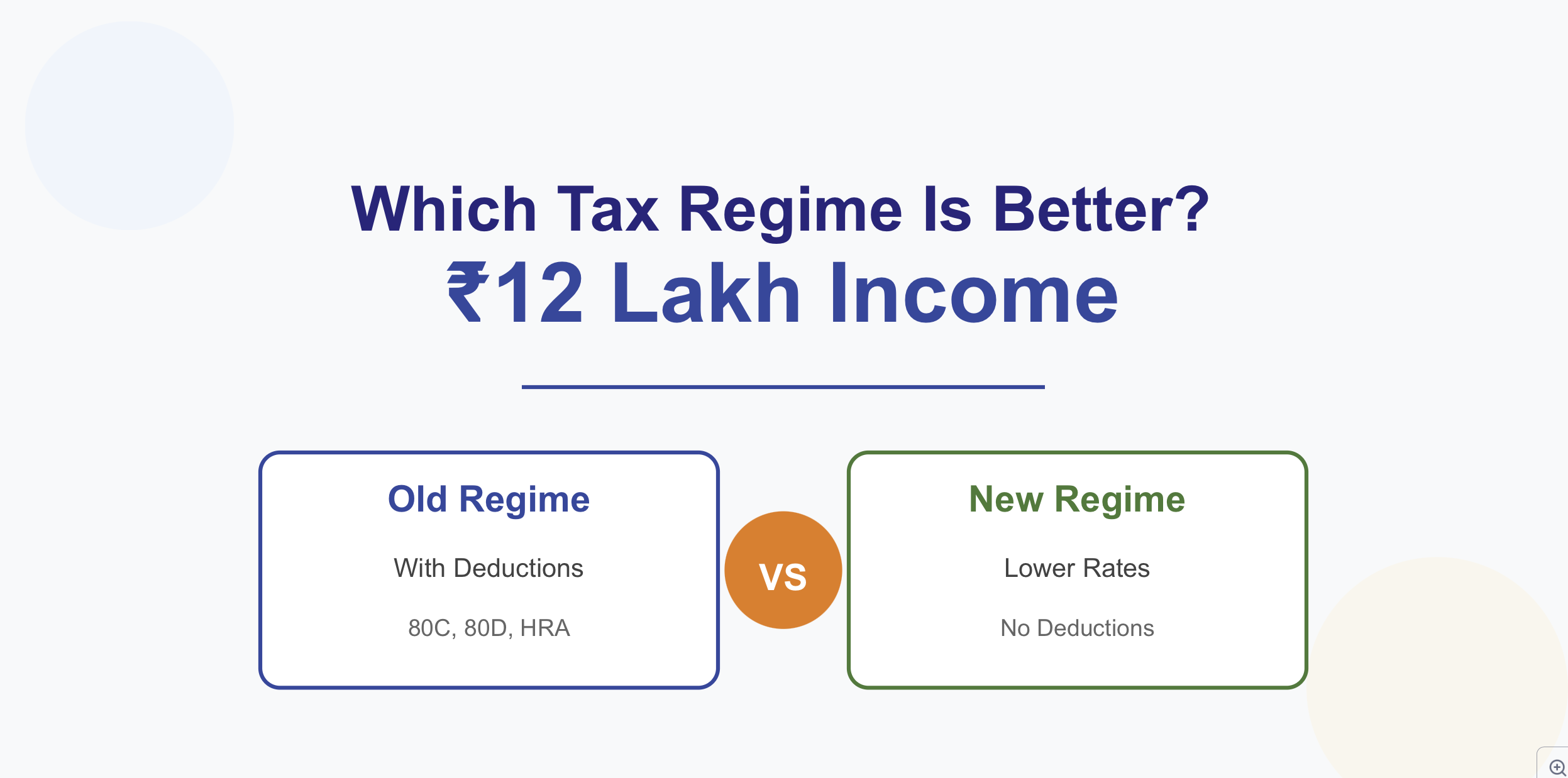
You can choose between the old tax regime (with exemptions and deductions like 80C, HRA, 80D) and the new simplified regime. For someone at ₹12 lakh:

  • Under the old regime, you will have tax liability after standard slabs and only enjoy exemptions you claim.

  • Under the new regime, the tax rebate wipes out tax up to ₹12 lakh, making it generally more beneficial for many people without heavy deductions. 

Example in Simple Terms

Imagine your gross salary is ₹12 lakh:

  1. You get standard deduction (₹75,000 for a salaried person).

  2. Your taxable income becomes ₹11,25,000.

  3. Section 87A rebate cancels your tax liability on that amount under the new regime.

  4. Final tax payable is zero.

This drastically increases your monthly take-home pay compared to previous years.

Comparison Chart: Old vs New Tax Regime on ₹12 Lakh Income

Particulars

Old Tax Regime

New Tax Regime (2025)

Gross Annual Income

₹12,00,000

₹12,00,000

Standard Deduction

₹50,000

₹75,000

Income After Standard Deduction

₹11,50,000

₹11,25,000

Other Deductions (80C, 80D, HRA etc.)

Assumed ₹1,50,000

Not Applicable

Taxable Income

₹10,00,000

₹11,25,000

Tax Before Rebate

₹1,12,500 approx

₹56,250 approx

Section 87A Rebate

Not Available

Available up to ₹12 lakh

Final Tax Payable

₹1,12,500 + cess

₹0

Best Suited For

People with high deductions

Most salaried individuals


Tax Calculator Example: New Tax Regime (₹12 Lakh)

Step 1: Gross Income

₹12,00,000

Step 2: Standard Deduction (Salaried)

₹75,000

Step 3: Taxable Income

₹12,00,000 − ₹75,000 = ₹11,25,000

Step 4: Tax as per slabs

Tax calculated as per new slab rates

Step 5: Section 87A Rebate

Since taxable income is below ₹12,00,000, entire tax is rebated

Final Tax Payable

₹0


Tax Calculator Example: Old Tax Regime (₹12 Lakh)

Assumptions

  • Standard deduction: ₹50,000

  • 80C deduction: ₹1,50,000

Taxable Income

₹12,00,000 − ₹50,000 − ₹1,50,000 = ₹10,00,000

Tax Calculation

  • Up to ₹2.5 lakh: Nil

  • ₹2.5 lakh to ₹5 lakh: 5% = ₹12,500

  • ₹5 lakh to ₹10 lakh: 20% = ₹1,00,000

Total Tax

₹1,12,500

Plus 4% cess = ₹4,500

Final Tax Payable

₹1,17,000 approx


Key Takeaways

  • Under the new tax regime, income up to ₹12 lakh is completely tax free due to Section 87A rebate.

  • Salaried employees can effectively earn up to ₹12.75 lakh with zero tax because of the higher standard deduction.

  • The old regime only benefits those with large deductions like home loan interest or major investments.

  • For most individuals earning ₹12 lakh, the new tax regime is clearly more beneficial.


Final Thoughts

The 2025 tax changes are designed to benefit middle-class taxpayers by reducing or eliminating tax on incomes up to ₹12 lakh. For many people with this income level, the best option is the new tax regime with the rebate, especially if you don’t have large deductions to claim. 

Always consider using a tax calculator or consulting a tax professional to determine what’s best for your individual financial situation.

GST Gets Simpler: Key Rate Changes from Sept 2025

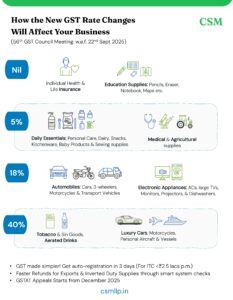
How the New GST Rate Changes Will Impact Businesses (w.e.f. 22nd Sept 2025)

56th GST Council Meeting, held in September 2025, has introduced significant changes to GST rates across various goods and services. These revisions aim to simplify compliance, reduce burden on essential items, and ensure higher taxation on luxury and sin goods. Let’s break down the impact for businesses and consumers.


Key GST Rate Changes

Nil Rate (0%)
  • Individual Health & Life Insurance

  • Educational Supplies: Pencils, notebooks, erasers, maps etc.

➡ Relief for households and students, encouraging affordability in health and education.


5% GST
  • Daily Essentials: Dairy, snacks, personal care, kitchenware, baby products, sewing supplies

  • Medical & Agricultural Supplies

➡ This keeps household and farming necessities affordable while maintaining tax revenues.


18% GST
  • Automobiles: Cars, motorcycles, three-wheelers, transport vehicles

  • Electronic Appliances: Air conditioners, large TVs, monitors, projectors, dishwashers

➡ Common in mid-range consumption, this rate continues to balance revenue and accessibility.


40% GST
  • Tobacco & Sin Goods, Aerated Drinks

  • Luxury Cars, High-end Motorcycles, Personal Aircraft & Vessels

➡ Heavier taxation on luxury and harmful products to discourage over-consumption and generate revenue.


Compliance & Business Ease Measures

Apart from rate changes, the Council announced key reforms:

  • Auto-registration within 3 days for taxpayers with ITC claims below ₹2.5 lakhs/month

  • Faster refunds for exports & inverted duty supplies through smart system checks

  • GSTAT Appeals to commence from December 2025 for quicker dispute resolution


What This Means for Businesses

  • Manufacturers & Traders in FMCG, agriculture, and medical supplies benefit from lower rates.

  • Automobile & Electronics Sectors remain at 18%, ensuring stability.

  • Luxury & Tobacco Industries face a steeper 40% rate, requiring pricing adjustments.

  • Exporters & MSMEs gain from faster refunds and easier registration.


Conclusion

The latest GST changes mark a step toward a more equitable and simplified tax structure. Essentials have been made more affordable, while luxury and sin goods will contribute more revenue. Businesses must realign their pricing, compliance, and invoicing systems before 22nd September 2025 to stay fully compliant.

Read the source of this post by clicking here (Recommendations of the 56th Meeting of the GST Council held at New Delhi)

Disclaimer:

This article is for general informational purposes only and should not be considered professional advice. Please consult a qualified expert for advice tailored to your specific situation. The author and website owner are not liable for any errors or actions based on this content.
Secondary Demat: A Simple Way to Cut Down Your Tax Bill

How Secondary Demat Account Can Save You Lakhs in Taxes

Zerodha has introduced a Secondary Demat Account feature – a huge win for investors who juggle both long-term holdings and short-term trades.

And if you don’t use Zerodha, no worries. You can still achieve the same benefit by simply opening two separate demat accounts with your broker instead of using just one. The idea is the same: keep investments and trades apart so your long-term gains don’t get taxed as short-term under FIFO rules.

We analysed a case where investor Rohan (imaginary investor) ended up paying lakhs of extra tax only because all his shares sat in one account. With a secondary demat, that problem disappears.


The Problem with FIFO in a Single Demat

When you hold all your shares in a single demat, FIFO (First-In-First-Out) rules apply. This means whenever you sell, the system assumes you are selling the oldest lot first.

For active investors, this is a problem. Your long-term, low-cost investments often get sold “on paper” before your newer trades, pushing up your short-term capital gains (STCG) bill unnecessarily.


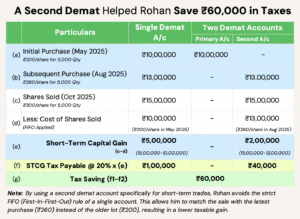
How Rohan Paid Extra Tax

Let’s say Rohan made these trades:

  • May 2025: Bought 5,000 shares at ₹200 each → ₹10,00,000

  • August 2025: Bought another 5,000 shares at ₹260 each → ₹13,00,000

  • October 2025: Sold 5,000 shares at ₹300 each → ₹15,00,000

If all shares are in a single demat:

  • FIFO applies → May 2025 lot (₹200/share) is sold
  • Cost = ₹10,00,000

  • Sale = ₹15,00,000

  • Total Short-Term Capital Gain = ₹5,00,000

  • STCG Tax @ 20% = ₹1,00,000

If shares are split across two demats:

  • May 2025 lot sits in the primary account (kept as long-term investment)

  • August 2025 lot sits in the secondary account (used for short-term investment)

  • Sale in October is from the secondary account → FIFO applies here, so cost = ₹13,00,000

  • Sale = ₹15,00,000

  • Total Short-Term Capital Gain = ₹2,00,000

  • STCG Tax @ 20% = ₹40,000

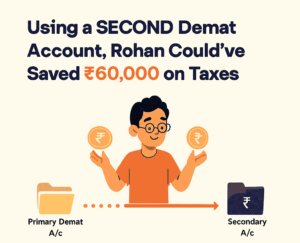
Just by using a secondary demat, Rohan saves ₹60,000 in tax in a single transaction. 


Preserving Long-Term Gains

Now imagine if Rohan sells his May 2025 lot later in June 2026 at ₹350 per share:

  • Cost = ₹10,00,000

  • Sale = ₹17,50,000

  • Total Long-Term Capital Gain = ₹7,50,000

  • Taxed as LTCG @ 12.5% (after ₹1.25 lakh exemption) ≈ ₹75,000

Since he held the shares for more than 12 months, this qualifies as Long-Term Capital Gain (LTCG). Now, imagine if the same lot had been compulsorily sold earlier under FIFO rules. In that case, it would have been treated as Short-Term Capital Gain (STCG) and taxed at 20% – meaning a much higher tax outgo.


Why This Works

  • FIFO runs separately in each demat → your long-term and short-term positions stay ring-fenced.

  • Off-market transfers between your own demats are not taxable.

  • You still see both demats under one Zerodha Console login.


Costs and Caveats

  • AMC: Approx. ₹300 + GST per demat

  • Transfer Fee: Approx.₹25 + GST per off-market transfer
  • BSDA Loss: Holding more than one demat means you can’t claim BSDA (Basic Services Demat Account) benefits, which are meant for small investors with holdings under ₹2 lakh.


The Takeaway

With just one smart step – opening a secondary demat – Rohan:

  • Saved ₹60,000 immediately in October 2025
  • Preserved his long-term capital gains benefit instead of paying 20% STCG in June 2026

For active investors, this isn’t a one-time trick. Over time, keeping trades and investments in separate demats can help save lakhs in taxes year after year.


Disclaimer:

This article is for general informational purposes only and should not be considered professional advice. Please consult a qualified expert for advice tailored to your specific situation. The author and website owner are not liable for any errors or actions based on this content.

How the New Perquisite Rules Affect Your Salary Package (Notification 133/2025)

CBDT Notification No. 133/2025: Key Amendments under Section 17(2) of the Income-tax Act:

Comparison: Old Rule vs Amended Rule (2025)

Provision Amended Limit
(w.e.f. 18 Aug 2025)
Earlier Limit
Section 17(2)(iii)(c)

Taxability of perquisites for high-salaried employees

₹4,00,000

(salary income threshold)

₹50,000

(salary income threshold)

Proviso (vi) to Section 17(2)

Exemption for medical treatment abroad (travel condition)

₹8,00,000

(gross total income limit)

₹2,00,000

(gross total income limit)

Understanding Section 17(2)(iii)(c) & Proviso (vi) of the Income-tax Act, 1961

The Income-tax Act, 1961 lays down clear definitions of “salary,” “perquisites,” and “profits in lieu of salary.” Among these, Section 17(2) specifically defines perquisites. Over the years, perquisites have become a focal point in taxation, as they include various benefits provided by employers to employees apart from regular salary.

In this blog, we’ll break down Section 17(2)(iii)(c) and the Proviso (vi) to Section 17(2), examine their implications, and look at the latest amendments introduced in August 2025.


Section 17(2)(iii)(c): Value of Benefits or Amenities

According to Section 17(2)(iii), the value of any benefit or amenity granted free of cost or at a concessional rate is considered a perquisite. It applies in three scenarios:

  1. To a director of a company (clause a)

  2. To an employee holding substantial interest in the company (clause b)

  3. To any other employee whose income under the head “Salaries” (excluding non-monetary benefits) exceeds the prescribed threshold (clause c)

  • Earlier, this threshold was ₹50,000. However, as per the Income-tax (Twenty Second Amendment) Rules, 2025 notified via Notification No. 133/2025 dated 18th August 2025, the new threshold has been revised to ₹4,00,000 .
  • This means that only employees whose salary income (excluding perquisites) exceeds ₹4 lakh will have the value of employer-provided amenities taxed as perquisites.

Key Points:

  • Benefits like free housing, concessional loans, or luxury facilities will not be taxed as perquisites unless the employee’s salary income crosses ₹4 lakh.

  • Commuting facilities (like a company car used for home-to-office travel) remain outside the perquisite scope under this clause.


Proviso (vi) to Section 17(2): Medical Treatment Abroad

The provisos to Section 17(2) carve out certain exemptions where benefits provided by employers are not treated as taxable perquisites.

Under Proviso (vi), the following expenses are exempt from perquisite taxation if incurred by the employer:

  1. Medical treatment of the employee or family abroad

  2. Travel and stay abroad of the employee or family for such medical treatment

  3. Travel and stay abroad of one attendant accompanying the patient

Conditions for exemption:

  • The expenditure on medical treatment and stay abroad is exempt only to the extent permitted by the RBI.

  • The expenditure on travel abroad is exempt only if the employee’s gross total income (before including this expenditure) does not exceed the prescribed limit.

Previously, this limit was ₹2,00,000. But as per the as per the Income-tax (Twenty Second Amendment) Rules, 2025 notified via Notification No. 133/2025 dated 18th August 2025, for the purposes of Proviso (vi) to Section 17(2), the prescribed gross total income shall now be ₹8,00,000 .

This revision significantly broadens the scope of employees who can claim exemption for medical expenditure abroad.


Practical Implications of 2025 Amendment

For employees:

  • The perquisite taxation threshold under Section 17(2)(iii)(c) has increased from ₹50,000 to ₹4 lakh, reducing the tax burden on middle-income employees receiving non-monetary benefits.
  • For medical treatment abroad, the exemption limit has expanded fourfold from ₹2 lakh to ₹8 lakh, allowing more employees to claim relief.

For employers:

  • Salary structuring becomes more flexible — many perquisites will now escape taxation for employees with salaries below ₹4 lakh.
  • Medical support abroad provided by employers can now benefit a larger pool of employees without additional tax liability.

Conclusion

Section 17(2)(iii)(c) ensures that high-income employees pay tax on perks and benefits beyond their core salary, but the 2025 amendment has made the threshold more realistic by raising it to ₹4 lakh. Similarly, Proviso (vi) reflects the humane side of tax law, and the recent upward revision of the exemption limit to ₹8 lakh provides welcome relief for employees facing genuine medical needs abroad.

These changes balance the government’s aim of preventing tax-free luxury perks with providing much-needed support in health-related scenarios.

Read the source of this post by clicking here (Section 17 & Notification No. 133/2025)

Disclaimer:

This article is for general informational purposes only and should not be considered professional advice. Please consult a qualified expert for advice tailored to your specific situation. The author and website owner are not liable for any errors or actions based on this content.


Learn to Save Taxes on Your Trading Profits

How Traders Can Save Tax Through Eligible Business Expenses in ITR

In the fast-paced world of share trading, where profits and losses can swing dramatically, smart tax planning can significantly boost your net returns. If you’re a stock market trader dealing in Intraday or Futures & Options (F&O), understanding what expenses you can claim in your Income Tax Return (ITR) can help reduce your taxable income and legally save taxes.

Let’s explore how you can make the most of this benefit.

Who Can Claim Trading Expenses?

If you’re engaged in:
• Intraday Trading
• Futures & Options Trading (F&O)

…then you can claim eligible business-related expenses while computing your taxable income. This applies whether you follow the Old Tax Regime or the New Tax Regime.

Key Benefits for Traders

  1. Reduce Your Taxable Income: Legitimate trading expenses reduce your net business income, directly impacting your tax liability.
  2. Carry Forward of Losses:
    • F&O Losses: Can be carried forward for 8 years.
    • Intraday Losses: Can be carried forward for 4 years.

This makes it crucial to report your business income and expenses accurately.

Tax-saving tips for stock market traders: claim expenses on intraday and F&O trading, carry forward business losses, and maximize deductions under both tax regimes.

Common Expenses You Can Claim

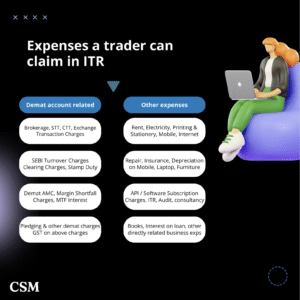
Here’s a sample list of expenses a trader can typically claim in the ITR:

Expense Category Examples
Internet & Phone Bills Broadband used for trading activities
Brokerage Charges Fees paid to brokers for executing trades
Software & Tools Charting tools, trading platforms, analytics tools
Advisory/Consulting Charges Subscriptions to trading advisories or analysts
Electricity If a home office is used for trading
Office Rent Applicable if a separate office is used
Depreciation On laptops, phones, and office equipment
Education & Seminars Trading courses or workshops attended
Books & Journals Financial newspapers, magazines, or books
Bank Charges Charges linked to your trading account

List of expenses a trader can claim in ITR - categorized into demat account-related and other business expenses

Note: Keep proper invoices, payment proofs, and usage justification for all claimed expenses. This is crucial in case of an audit.

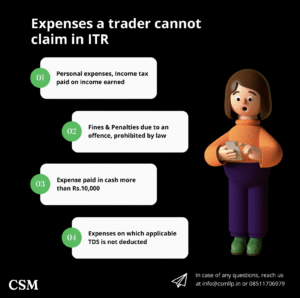
What Expenses Cannot Be Claimed?

While many expenses are allowed, some are not claimable, such as:
• Personal expenses (e.g., personal phone bills, family subscriptions)
• Capital expenditures (unless depreciation is claimed)
• Any unrelated professional or personal expenses

Infographic showing a list of expenses that traders in India cannot claim as deductions in their income tax returns, including personal expenses, fines and penalties, cash payments above Rs.10,000, and expenses where TDS is not deducted.

Final Thoughts

Every saved rupee is an earned rupee. File smart, trade smarter!

Trading is not just about profits—it’s also about smart financial management. By claiming legitimate business expenses in your ITR, you’re not only reducing your tax outgo but also managing your business like a professional.

Disclaimer:

This article is for general informational purposes only and should not be considered professional advice. Please consult a qualified expert for advice tailored to your specific situation. The author and website owner are not liable for any errors or actions based on this content.
 

Relief for TDS/TCS Defaults Due to Inoperative PAN: CBDT Circular No. 9/2025

PAN Inoperative? CBDT Gives Grace Period for TDS/TCS Relief

The Central Board of Direct Taxes (CBDT) has issued Circular No. 9/2025 dated 21st July 2025, providing partial modifications to its earlier circulars to offer relief to deductors and collectors facing demands due to TDS/TCS defaults caused by inoperative PANs. This move aims to address numerous grievances raised by taxpayers regarding demands for short-deductions or collections, even in cases where the PAN was later made operative.

This blog outlines the implications, relief measures, and compliance expectations stemming from the new circular.


Background

  • Circular No. 3/2023 (dated 28th March 2023) had specified that if PAN becomes inoperative (under Rule 114AAA of the Income-tax Rules, 1962), higher TDS/TCS rates under Section 206AA/206CC would apply from July 01, 2023 onwards, until the PAN is made operative.

  • Circular No. 6/2024 (dated 23rd April 2024) provided temporary relief for transactions done up to March 31, 2024, if the PAN was linked with Aadhaar by May 31, 2024.

However, many deductors/collectors have received notices for short deduction or collection, despite the PAN becoming operative later, leading to avoidable tax demands.

The Issue with Inoperative PAN:

As per Circular No. 3 of 2023, if a PAN is not linked with Aadhaar, it becomes inoperative from July 1, 2023.

Consequences include:

• No tax refunds while PAN is inoperative.
• No interest on refunds for the inoperative period.
• TDS/TCS must be deducted/collected at higher rates under sections 206AA/206CC of the Income-tax Act.


New Relief under Circular No. 9/2025

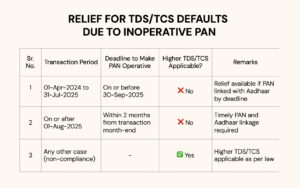
To mitigate hardships, CBDT has introduced two key relaxations for cases where PANs became operative due to Aadhaar linkage after the transaction dates:

No higher TDS/TCS liability will arise in the following two situations:

  1. Payments/Credits between April 1, 2024 and July 31, 2025

    Condition: PAN must be made operative on or before September 30, 2025.

  2. Payments/Credits on or after August 1, 2025

    Condition: PAN must be made operative within 2 months from the end of the month in which the amount was paid/credited.

In such cases, higher TDS/TCS under Section 206AA/206CC will not apply, and no default will be treated for the deductor/collector.

Summary Table:


Action Points:

• For deductors/collectors:

Review TDS/TCS statements, communicate with clients/vendors whose PAN was previously inoperative, and encourage prompt PAN–Aadhaar linkage.

• For taxpayers:

Check your PAN–Aadhaar linkage status immediately if there is any doubt.

Notes:

  • These reliefs are subject to PAN becoming operative through Aadhaar linkage, within the stipulated deadlines.
  • Other TDS/TCS provisions (under Chapter XVII-B or XVII-BB) must still be complied with.
  • This circular is a welcome move, ensuring that genuine cases are not penalized due to temporary PAN inoperativeness.

Final Thoughts

This circular reinforces the government’s intent to balance compliance with taxpayer convenience. While PAN-Aadhaar linkage remains mandatory, the latest relief provides much-needed protection for deductors/collectors from unjust demands, provided they meet the revised deadlines.

Download official circular from government by clicking here.

For assistance with PAN-Aadhaar linking or resolving TDS/TCS defaults, feel free to ask in comment section.

Disclaimer:

This article is for general informational purposes only and should not be considered professional advice. Please consult a qualified expert for advice tailored to your specific situation. The author and website owner are not liable for any errors or actions based on this content.
GST Registration Field Visit Guide for Drop-Shipping & E-commerce Sellers

GST Field Visit Guide for E-Commerce Sellers Without Inventory at Home

If you’re an e-commerce seller operating on platforms like Amazon, Flipkart, Meesho, or others—and you don’t store any products at your home address—getting a visit from a GST officer can feel confusing or intimidating.

But don’t worry: field visits are a normal part of the GST registration process, especially when your home is listed as your principal place of business. Here’s exactly what to expect and how to respond confidently and correctly during the verification process.


Why a GST Field Visit Happens

The field visit is meant to verify the existence and legitimacy of your business at the declared address. The officer is not there to harass you, but simply to check:

  • Whether the address is valid

  • If business activities are happening from the location

  • That your documents are genuine


Common Questions Asked — With Sample Answers

  1. What is the nature of your business?

    Answer: “I sell clothing (or your product) online through platforms like Amazon, Flipkart, and Meesho.”

  2. Why is your home listed as your business address?

    Answer: “I operate the business digitally from home for documentation and compliance purposes. No physical inventory is stored here.”

  3. Where is your stock stored?

    Answer: “I don’t stock goods at home. I use a drop-shipping model—suppliers ship products directly to customers.”

  4. Can you show any business setup (e.g., devices or tools used)?

    Answer: “Yes, I can show my laptop, mobile, email confirmations, platform dashboards, and order management system.”

  5. Do you have documents related to your suppliers or products?

    Answer: “Yes. I maintain supplier contracts, e-commerce platform registrations, and digital copies of invoices and orders.


Documents to Keep Ready

Make sure you have the following documents available (digitally or physically):

  • PAN & Aadhaar Card

  • Recent utility bill for address proof

  • GST application acknowledgment

  • E-commerce platform registration confirmation (email/screenshot)

  • Sample order or invoice from your portal

  • Supplier details or agreement (if applicable)


Important Compliance Tips

  • Ensure your documents match the GST application exactly—especially address and name.

  • Clarify that your home is only for communication, not for stocking goods.

  • Remain calm, honest, and cooperative with the officer.

  • Keep a clean, professional digital trail of orders, invoices, and platform communications.

You are operating a 100% legitimate e-commerce business under the drop-shipping model. GST law fully supports this approach as long as you:

  • File your GST returns on time

  • Maintain proper digital records

  • Provide truthful responses during verification


Display a Business Name Board at Your Address

Before the GST officer visits, it’s highly recommended to fix a nameplate or board with your business name at a visible location—such as the entrance, main door, or gate of your home. This small step significantly increases the chances of successful verification, as it visibly establishes that your home address is being used for official business correspondence. The board should ideally mention:

  • Your GST-registered business name
  • Your GSTIN or “Registered Office” label

This shows the officer that your business is active and traceable at the registered address—even if no stock is stored there.


Final Thoughts

GST field visits can sound intimidating, but with a little preparation and honesty, they’re usually quick and straightforward. As a modern online seller, your business setup is different—but completely valid.

Be transparent, stay compliant, and your GST registration will go through smoothly.

Disclaimer:

This article is for general informational purposes only and should not be considered professional advice. Please consult a qualified expert for advice tailored to your specific situation. The author and website owner are not liable for any errors or actions based on this content.
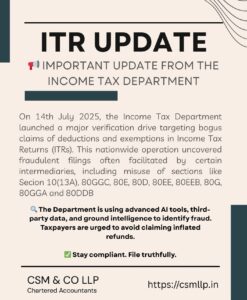
Crackdown on Fraudulent ITR Claims: What Every Taxpayer Should Know

IT Department Launches Nationwide Crackdown on Bogus Tax Deductions

The Income Tax Department of India has launched an aggressive crackdown on fraudulent deduction claims in Income Tax Returns (ITRs). Powered by AI and advanced data analytics, this crackdown is now targeting suspicious claims under specific deduction sections—some of which have been commonly misused by both individuals and intermediaries.

Here’s what you need to know to stay safe and compliant.

What’s Triggering the Crackdown?

A sharp rise in false or exaggerated claims made under various sections of the Income Tax Act has prompted the government to act. Fraudulent practices—often facilitated by unverified intermediaries—are now being flagged by the Income Tax Department’s advanced detection tools.

The crackdown focuses on deductions claimed under the following sections:

Sections Under Scrutiny:

• Section 10(13A) – House Rent Allowance (HRA)
• Section 80GGC – Donations to political parties
• Section 80E – Interest on education loans
• Section 80D – Health insurance premiums
• Section 80EE – Interest on home loans for first-time buyers
• Section 80EEB – Interest on loans for electric vehicles
• Section 80G – Donations to registered charities and relief funds
• Section 80GGA – Donations for scientific research and rural development
• Section 80DDB – Medical treatment for specified critical illnesses

Many of these claims were found to be either inflated or entirely bogus—submitted with fake documents or no proof at all.

AI-Powered Monitoring & Real-Time Cross-Verification

The Income Tax Department is now leveraging AI and data analytics to automatically flag suspicious deduction patterns across thousands of returns. Real-time cross-verification has also been implemented to compare taxpayer claims with actual data from:

• Banks and financial institutions (for loan interest and repayments)
• Insurance companies (for policy premium verification)
• Employers (for rent and HRA)
• Recognized donation platforms and political party disclosures

If a claim doesn’t match backend data, the taxpayer may receive a notice or demand.

Examples of Fraudulent Practices Being Flagged

1. Fake HRA Claims (Section 10(13A)): Claiming rent deductions using fictitious landlords or PANs.
2. Bogus Political Donations (Section 80GGC): False declarations to inflate refund amounts.
3. Fake or Inflated Education Loan Interest (Section 80E): Claiming deductions for non-existent loans.
4. Unsubstantiated Medical Claims (Section 80DDB): Claims without medical certificates or treatment proof.
5. Misuse of Health Insurance (Section 80D): Deducting for lapsed or ineligible policies.
6. Invalid Home Loan or EV Loan Interest (Sections 80EE & 80EEB): Claiming interest deductions without ownership or valid financing.
7. Questionable NGO Donations (Section 80G, 80GGA): Submitting receipts from unapproved or blacklisted institutions.

Legal & Financial Consequences

The Department has already taken action in major cities like Mumbai, Delhi, Jaipur, and Ahmedabad. Hundreds of notices have been served, and several searches and surveys have been conducted under Sections 132 and 133A of the Income Tax Act.

Penalties for false deduction claims may include:

• Demand for repayment of refunds with interest and penalties
• Prosecution under Sections 276C (evasion) and 277 (false statements)
• Imprisonment, in extreme cases

What Taxpayers Should Do Immediately?

  • Recheck Your ITR: Ensure that all deductions claimed are accurate and fully supported by documentation.
  • Avoid Dubious Tax Advisors: Stay away from intermediaries who guarantee high refunds by misusing deduction sections.
  • File an Updated Return (ITR-U): If you realize an error, you can correct it voluntarily through the ITR-U mechanism to minimize penalties.
  • Preserve Proof: Maintain receipts, loan sanction letters, insurance policies, and donation certificates for at least 6 years.

Deadline to Act

You can file an Updated Return (ITR-U) for Financial Year 2023–24 up to March 31, 2026. This gives taxpayers a chance to rectify mistakes without attracting harsher consequences—but the longer the delay, the higher the interest and penalties.

Final Takeaway

The Income Tax Department’s message is clear: fraudulent deductions won’t go unnoticed. With technology closing the loopholes, it’s time for every taxpayer to clean up their returns and ensure compliance.

Transparency is not just good practice—it’s now a legal necessity.

Read the source of this post by clicking here.

Disclaimer:

This article is for general informational purposes only and should not be considered professional advice. Please consult a qualified expert for advice tailored to your specific situation. The author and website owner are not liable for any errors or actions based on this content.

TDS on House Rent Payments: Know the Rates, Rules & Applicability

TDS on House Rent Payments: Know the Rates, Rules & Applicability w.e.f April 1, 2025:

Tax Deducted at Source (TDS) is a mechanism in India where tax is deducted at the source of income, ensuring that the government collects tax on income as it is earned. When it comes to house rent, specific TDS rules apply under the Income Tax Act, particularly for individuals, Hindu Undivided Family (HUF), companies, and firms. In this blog, we’ll break down the TDS rates and criteria for house rent for Financial Year 2025-26, as outlined in the table below, helping you understand your obligations as a tenant or landlord.

TDS on House Rent: The Basics

The table outlines two key scenarios for TDS deduction on house rent, including the criteria, applicable rates, sections of the Income Tax Act, and who it applies to. Let’s dive into the details:
A. TDS on Rent Paid to a Resident Indians:
No. House Rent Criteria TDS Rate Section Tenant Applicability
1 Rent is more than ₹2.40 lacs per annum 10% 194-I – Company

– Firm

– Individual/HUF with business turnover more than ₹1 crore

– Individual/HUF with professional gross receipts more than ₹50 lacs

2 Rent is more than ₹50,000 per month 2% 194-IB – Individual/HUF with business turnover less than ₹1 crore

– Individual/HUF with professional gross receipts less than ₹50 lacs

Scenario 1: Rent Exceeding ₹2.40 Lacs Per Annum
• Criteria: If the annual rent paid exceeds ₹2,40,000, TDS must be deducted.
• TDS Rate: The applicable TDS rate is 10%.
• Section: This falls under Section 194-I of the Income Tax Act, which deals with TDS on rent payments.

• Applicability: This rule applies to:
a) Companies and firms, regardless of their income.
b) Individuals or HUFs who have a business turnover exceeding ₹1 crore in a financial year.
c) Individuals or HUFs with professional gross receipts exceeding ₹50 lacs in a financial year.

• Example: Suppose a company rents office space and pays ₹3,00,000 annually. Since the rent exceeds ₹2.40 lacs, the company must deduct 10% TDS, which amounts to ₹30,000, and pay the remaining ₹2,70,000 to the landlord. The deducted TDS must be deposited to the government, and the landlord can claim credit for this amount while filing their income tax return.

Scenario 2: Rent Exceeding ₹50,000 Per Month
• Criteria: If the monthly rent exceeds ₹50,000, TDS is applicable.
• TDS Rate: The TDS rate in this case is 2%.
• Section: This is covered under Section 194-IB of the Income Tax Act.

• Applicability: This rule applies to:
a) Individuals or HUFs with business turnover less than ₹1 crore.
b) Individuals or HUFs with professional gross receipts less than ₹50 lacs.

• Example: An individual pays ₹60,000 per month as rent for their apartment, totaling ₹7,20,000 annually. Since the monthly rent exceeds ₹50,000, they must deduct 2% TDS, which is ₹1,200 per month (₹14,400 annually). The remaining ₹58,800 is paid to the landlord each month. The tenant must deposit the TDS to the government and issue a TDS certificate (Form 16C) to the landlord.

Key Points to Understand

1) Threshold Limits: The ₹2.40 lacs per annum threshold (Section 194-I) is an annual limit, while the ₹50,000 per month threshold (Section 194-IB) is a monthly limit. Ensure you calculate the rent correctly to determine which section applies.

2) Who Deducts TDS? Under Section 194-I, companies, firms, and high-income individuals/HUFs are responsible for deducting TDS. Under Section 194-IB, individuals/HUFs with lower incomes (below the specified thresholds) are responsible, making it easier for the government to track rent payments by smaller taxpayers.

3) TDS Deposit and Compliance: The deducted TDS must be deposited to the government by the 7th of the following month (or by April 30th for TDS deducted in March). Additionally, tenants must issue TDS certificates to landlords—Form 16A for Section 194-I and Form 16C for Section 194-IB.

4) No TAN Requirement for Section 194-IB: Unlike Section 194-I, where a Tax Deduction Account Number (TAN) is required to deduct and deposit TDS, individuals under Section 194-IB can use their PAN to deduct and deposit TDS, simplifying the process for smaller taxpayers.

B. TDS on Rent Paid to Non-Resident Indians (NRIs)

When remitting rental payments to a Non-Resident Indian (NRI), Tax Deducted at Source (TDS) must be withheld at a rate of 30%, in addition to the applicable surcharge and a 4% cess. This TDS deduction is mandatory regardless of the rental amount, as there is no prescribed threshold for rent payments to NRIs. However, an NRI may apply for a certificate of nil or reduced TDS deduction if their taxable income in India falls below the basic exemption limit, subject to the provisions of the Income Tax Act.

What Happens If You Miss TDS?

TDS on house rent ensures that rental income is taxed at the source, reducing tax evasion. For tenants, deducting TDS is a legal obligation, and non-compliance can lead to penalties. For landlords, the TDS deducted can be claimed as a credit when filing their income tax returns, ensuring they aren’t taxed twice on the same income.

• Penalties: Non-deduction or late deduction may attract interest (1% per month) and fines equal to the TDS amount.
• Disallowance of Expenses: The rent paid may not be deductible as a business expense for the tenant.

Practical Tips for Tenants and Landlords

  • Tenants: Always check the rent amount and your income status to determine if TDS applies. Use online tools or consult a tax professional to calculate and deposit TDS correctly. Keep records of rent payments and TDS certificates issued.

  • Landlords: Ensure your tenants are aware of their TDS obligations. Provide your PAN to the tenant for TDS deduction and verify that the TDS amount is credited to your account when filing your returns.

Conclusion

Understanding TDS on house rent is crucial for both tenants and landlords in India. Whether you’re a company paying high rent or an individual renting a modest apartment, knowing the applicable TDS rates and sections can help you stay compliant with tax laws. The table above provides a clear snapshot of the rules, but if you’re unsure about your specific situation, it’s always a good idea to consult a tax expert.

By staying informed and proactive, you can ensure smooth rent transactions while fulfilling your tax responsibilities. Have questions about TDS on rent? Drop them in the comments below, and let’s discuss!

Check out TDS Section 194-I & 194I-B of the Income Tax Act, 1961.

Disclaimer:

This article is for general informational purposes only and should not be considered professional advice. Please consult a qualified expert for advice tailored to your specific situation. The author and website owner are not liable for any errors or actions based on this content.