Goods Return under GST (2026): Credit Notes, Time Limits and ITC Reversal

Last updated: 10 October 2026 · Written and reviewed by CA Meet Dhrangadhariya, CSM & Co LLP

Quick summary

  • A sales return after GST has already been charged is handled through a credit note under section 34 of the CGST Act, not by cancelling or reversing the original invoice.
  • A credit note for a return must be declared in GSTR-1 (now reported through GSTR-1A/IMS flows) by the earlier of 30 November following the end of that financial year, or the date of filing the annual return for that year - the old “30 September” deadline was extended by the Finance Act, 2022.
  • Once the seller issues and declares the credit note, the buyer’s input tax credit is reduced to match, so the tax reduction on one side is mirrored by a credit reversal on the other - no net revenue loss to the government.
  • Returns from a registered buyer are reported invoice-wise; returns from an unregistered buyer are reported as a consolidated figure, net of intra-State and inter-State splits.
  • If a credit note is not declared within the time limit, the seller cannot reduce their output tax liability for that return, even though the goods have genuinely come back.

When a buyer sends goods back to the seller after a GST invoice has already been raised, the original invoice is never cancelled or reversed. Instead, the correction flows through a credit note, and the time limit for declaring that credit note decides whether the seller can actually recover the tax already paid on the returned goods.

The credit note is the mechanism, not the invoice

Section 34 of the CGST Act lets a registered seller issue a credit note where goods supplied are returned, found deficient, or where the value or tax charged in the original invoice turns out to be higher than what is actually due. The credit note must reference the original invoice and reduce the seller’s output tax liability for the period in which it is declared, not the period of the original sale.

Goods returned by a registered buyer

The seller issues a credit note and declares it, invoice-wise, in GSTR-1 for the month it is issued. Because the buyer is registered, the credit note flows through to the buyer’s credit ledger (via the return and statement ecosystem built around GSTR-2B), reducing the input tax credit the buyer can claim or retain by the same amount.

Goods returned by an unregistered buyer

There is no buyer GSTIN to match a credit note against, so the seller reports these as a consolidated figure in GSTR-1 rather than invoice-wise, with intra-State and inter-State returns shown separately (and e-commerce-sourced returns kept distinct from others, where applicable).

The time limit: a hard cut-off, not a guideline

A credit note for a return must be declared by the earlier of:

  • 30 November following the end of the financial year in which the original supply was made, or
  • the date of filing the annual return for that financial year.

This deadline moved from 30 September to 30 November with effect from the Finance Act, 2022 - a change frequently missed in older write-ups still quoting the earlier cut-off. Missing this date has a real consequence: the seller cannot reduce output tax liability for that return through the credit note mechanism at all, even though the goods have genuinely been returned and the money refunded. There is no separate relief route once this window closes.

Adjustment of tax liability, and why it is linked both ways

The seller’s tax liability reduces only to the extent the buyer’s credit is correspondingly reversed - GST does not allow one side of a transaction to keep a tax benefit the other side gives up. If the incidence of tax has effectively been passed on to someone else and cannot practically be reversed, the seller’s liability is not reduced either. Similarly, where goods are returned but the money is, for some reason, not actually refunded to the buyer, the reduction in tax liability does not apply - the underlying principle is that nobody should profit at another’s expense through a return that is return in form only.

How CSM & Co LLP can help

Getting credit notes declared correctly, within the time limit, and reconciled against the buyer’s credit reversal is a recurring year-end compliance item - please reach out to our team and we will be happy to assist with return reconciliation and GSTR-1/GSTR-3B accuracy.

Technical terms explained in simple words

Term What it means
Credit note A document a seller issues to reduce the value or tax of an earlier invoice, used for returns, discounts given after sale, or a tax amount charged in excess.
Output tax liability The GST a registered person owes on its own outward supplies for a tax period, before any input tax credit is set off against it.
Input tax credit (ITC) The GST already paid on purchases/inputs that a registered buyer can set off against its own output tax liability.
Invoice-wise reporting Reporting a transaction against the specific original invoice it relates to, so it matches to a specific buyer’s records.
Consolidated reporting Reporting a total figure for a category of transactions (here, returns from unregistered buyers) rather than against individual invoices, since there is no buyer GSTIN to match against.

Frequently asked questions

How does GST treat goods that are returned after sale?

Through a credit note issued by the seller under section 34 of the CGST Act, rather than by cancelling the original invoice. The credit note reduces the seller’s output tax liability and correspondingly reduces the buyer’s input tax credit.

By when must a credit note for a sales return be declared?

By the earlier of 30 November following the end of the financial year in which the original supply was made, or the date of filing the annual return for that year. This deadline was extended from 30 September by the Finance Act, 2022.

What happens if the credit note is declared after the deadline?

The seller loses the ability to reduce output tax liability for that return through GST, even though the goods have physically come back - the time limit is strict.

Is a return from an unregistered buyer reported differently from one by a registered buyer?

Yes. Returns from registered buyers are reported invoice-wise so the credit note flows to the specific buyer’s credit ledger. Returns from unregistered buyers are reported as a consolidated figure, split between intra-State and inter-State, since there is no buyer GSTIN to match the credit note against.

Does the buyer need to do anything when a credit note is issued?

The buyer’s input tax credit reduces automatically to match the declared credit note; if the buyer had already claimed credit on the original invoice, that excess credit is reversed to that extent.

Can a seller refuse to pass on a credit note and keep the tax collected?

No. GST works on the principle that tax collected without a corresponding supply should not be retained - if the incidence of tax was passed on to the buyer and the amount is not actually refunded to them, the seller’s output liability is not reduced either, since that would mean profiting from the return.

Official sources

Related reading

Disclaimer

This article is for general informational purposes only and should not be considered professional advice. Please consult a qualified expert for advice tailored to your specific situation. The author and website owner are not liable for any errors or actions based on this content.

How to Save Tax Other Than 80C: Deductions and Exemptions for 2026-27

Last updated: 25 July 2026 · Written and reviewed by CA Meet Dhrangadhariya, CSM & Co LLP

Quick summary

  • Besides section 80C, you can save tax through NPS (₹50,000 extra), health insurance (up to ₹1 lakh), home loan interest, education loan interest, donations, rent, disability and treatment deductions, and exempt life insurance maturity.
  • Most of these work only in the old tax regime. In the new regime the standard deduction (₹75,000) and the employer’s NPS contribution are the main benefits.
  • Each deduction now has a new section number in the Income-tax Act, 2025 from Tax Year 2026-27: for example 80D is section 126 and 80E is section 129.
  • Compare your tax under both regimes before you choose.

Section 80C is the best known deduction, but it is only one of many. If you are in the old tax regime, these other sections can reduce your tax further. From 01/04/2026 the Income-tax Act, 2025 applies, and each deduction has a new section number, shown below.

Deductions other than 80C

Deduction Limit Section in 1961 Act Section in 2025 Act
Own contribution to NPS ₹50,000, over and above 80C 80CCD(1B) 124(3)
Health insurance, preventive check-up, medical for senior citizens ₹25,000 self and family (₹50,000 if senior), ₹25,000 for parents (₹50,000 if senior); preventive check-up ₹5,000 within these 80D 126
Dependant with disability ₹75,000 or ₹1,25,000 80DD 127
Treatment of specified diseases ₹40,000 or ₹1,00,000 (senior citizen) 80DDB 128
Education loan interest Whole interest, 8 years 80E 129
First-time buyer home loan interest (loans of FY 2016-17) ₹50,000 80EE 130
Donations 100% or 50%, with a 10% limit for some 80G 133
Rent without HRA Up to ₹60,000 80GG 134
Contributions to political parties Whole amount, other than cash 80GGC 137
Savings account interest ₹10,000 80TTA 153
Deposit interest, senior citizens ₹50,000 80TTB 153
Person with disability ₹75,000 or ₹1,25,000 80U 154

Chapter VIII of the 2025 Act contains these deductions. The loan interest deduction for electric vehicles (80EEB) ended for loans sanctioned after 31/03/2023, and the additional affordable housing interest (80EEA) was for loans sanctioned up to 31/03/2022.

Other ways to save tax

  • Home loan interest: up to ₹2 lakh a year on a self-occupied house (section 24(b) of the 1961 Act, section 22 of the 2025 Act). On a let-out house the whole interest is deducted against the rent, with the loss set-off limited to ₹2 lakh a year.
  • Exempt allowances and HRA: HRA, LTA, children education allowance and others reduce taxable salary in the old regime.
  • Exempt insurance proceeds: the maturity amount of a life insurance policy is exempt if the premium conditions are met: for policies issued from 01/04/2012, premium up to 10% of sum assured (15% for special policies), and for policies issued on or after 01/04/2023 the total premium must be below ₹5 lakh a year, or below ₹2.5 lakh for unit linked policies.
  • Agniveer Corpus Fund: the whole contribution is deductible.

Employer contribution to NPS

If your employer contributes to your NPS account, the contribution is deductible up to 10% of salary (14% for Government employers) in the old regime. In the new regime the limit is 14% for all employers. This is the one major deduction that works in both regimes.

What works in the new tax regime?

  • Standard deduction: ₹75,000 for salary and pension (₹25,000 for family pension).
  • Employer’s NPS contribution, up to 14% of salary.
  • Interest on a let-out house against its rent.
  • Contribution to the Agniveer Corpus Fund.
  • Travel, daily charges and conveyance allowances, and the disabled employee’s transport allowance.

Old or new regime?

Add up all deductions and exemptions you can claim. If they are large enough (for example HRA, 80C, 80D and home loan interest together), the old regime can still cost less. If they are small, the new regime usually wins. Do this calculation every year, since you choose with your return, and a person without business income must choose the old regime along with the return furnished by the due date.

Frequently asked questions

What can I claim over and above section 80C?

NPS (₹50,000 under 80CCD(1B)), health insurance (80D), education loan interest (80E), donations (80G), rent without HRA (80GG), home loan interest, savings interest (80TTA or 80TTB) and disability related deductions.

What is the limit under section 80D?

₹25,000 for self, spouse and children (₹50,000 if a senior citizen) and the same again for parents, so up to ₹1,00,000 in total when both are senior citizens.

Which of these work in the new tax regime?

Mainly the standard deduction of ₹75,000, the employer’s contribution to NPS, and interest on a let-out house against its rent. Most other deductions need the old regime.

What are the new section numbers?

80D is section 126, 80E is 129, 80G is 133, 80GG is 134, 80TTA and 80TTB are 153, and 80CCD(1B) is 124(3) in the Income-tax Act, 2025.

Official sources

Related reading

Disclaimer

This article is for general informational purposes only and should not be considered professional advice. Please consult a qualified expert for advice tailored to your specific situation. The author and website owner are not liable for any errors or actions based on this content.
Powers and Duties of a Statutory Auditor (Sections 143 to 147): Audit Report, Fraud Reporting, Prohibited Services and Penalties

Last updated: 09 October 2026 · Written and reviewed by CA Meet Dhrangadhariya, CSM & Co LLP

Quick summary

  • An auditor has a right of access at all times to the books and vouchers and may ask officers for any information needed. The audit report must say whether the accounts give a true and fair view and whether the company has adequate internal financial controls with reference to financial statements.
  • The auditor must report suspected fraud by officers or employees: to the Central Government above the prescribed amount, otherwise to the audit committee or the Board.
  • An auditor cannot provide services such as bookkeeping, internal audit, financial information system design, actuarial, investment advisory, investment banking, outsourced financial services or management services.
  • For contravening sections 139, 143, 144 or 145 the fine is Rs 25,000 to Rs 5 lakh or four times the remuneration, whichever is less. Wilful deception can mean up to one year in prison and a fine of up to Rs 25 lakh.

The statutory auditor is appointed by the members to protect them, so the Companies Act, 2013 gives the auditor wide powers, a long list of things that the audit report must say, and strong penalties when those duties are not performed.

Powers (section 143(1))

  • A right of access at all times to the books of account and vouchers of the company, wherever they are kept.
  • The right to require from officers of the company any information and explanation needed for the audit.
  • A duty to inquire, among other matters, whether: loans and advances made against security are properly secured and not prejudicial to the company or its members; transactions represented only by book entries are prejudicial; shares, debentures or other securities (other than by an investment or banking company) were sold below their purchase price; loans and advances are shown as deposits; personal expenses are charged to revenue account; and, where shares are said to have been allotted for cash, cash was actually received.
  • The auditor of a holding company has access to the records of its subsidiaries and associate companies as far as consolidation requires.
  • The accounts of a branch office are audited either by the company’s auditor or by another qualified person appointed under section 139 (or, for a branch outside India, by a local qualified person).

What the audit report must contain (section 143(2) to (4))

The auditor reports to the members on the accounts and every financial statement laid before the company in general meeting, taking account of the Act, accounting and auditing standards and the matters required by rules or by an order under section 143(11) (such as CARO). The report states whether, to the best of the auditor’s information and knowledge, the accounts give a true and fair view of the state of affairs, profit or loss and cash flow for the year.

It must also state:

  1. whether all information and explanations needed were obtained, and if not, the details and effect;
  2. whether proper books of account have been kept, and proper returns received from branches not visited;
  3. how a separate branch auditor’s report was dealt with;
  4. whether the balance sheet and profit and loss account agree with the books and returns;
  5. whether the financial statements comply with the accounting standards;
  6. observations on financial transactions or matters with an adverse effect on the company’s functioning;
  7. whether any director is disqualified under section 164(2);
  8. any qualification, reservation or adverse remark on the maintenance of accounts;
  9. whether the company has adequate internal financial controls with reference to financial statements and the operating effectiveness of those controls; and
  10. such other matters as are prescribed.

Where any item is answered in the negative or with a qualification, the report must give the reasons.

Every auditor must comply with the auditing standards (section 143(9)); until the Central Government notifies standards on the recommendation of ICAI, the standards specified by ICAI are deemed to be the standards.

Reporting fraud (section 143(12) and (15))

If, in the course of duties, the auditor has reason to believe that an offence of fraud involving the prescribed amount is being or has been committed in the company by its officers or employees, the auditor reports it to the Central Government within the prescribed time and manner. For a fraud below the prescribed amount, the report goes to the audit committee (or to the Board, where there is no audit committee). The company must disclose such frauds, reported to the committee or Board but not to the Government, in the Board’s report. A report made in good faith is not a breach of any other duty (section 143(13)). The same section applies to cost accountants doing cost audit and company secretaries doing secretarial audit.

Penalty for failing to report: Rs 5 lakh in a listed company, and Rs 1 lakh in any other company. The prescribed amount, time and form are in the Companies (Audit and Auditors) Rules, 2014, so check the current figures there.

Services an auditor cannot render (section 144)

An auditor may provide other services only if the Board or audit committee approves them, and never these, directly or indirectly, to the company, its holding company or its subsidiary: accounting and bookkeeping; internal audit; design and implementation of any financial information system; actuarial services; investment advisory services; investment banking services; outsourced financial services; management services; and any other prescribed service. “Directly or indirectly” includes services through relatives, partners, a parent, subsidiary or associate entity, or any entity in which the auditor or a partner has significant influence or control, or whose name or brand is used. An auditor who renders any such service is also disqualified under section 141(3)(i).

Signing the report (section 145)

The auditor signs the report, and signs or certifies any other document of the company, in accordance with section 141(2) (only partners who are chartered accountants sign for a firm). Qualifications, observations or adverse comments on financial transactions in the report are read before the company in general meeting and open to inspection by any member.

Penalties (section 147)

Who and what Consequence
Company contravening sections 139 to 146 Fine of Rs 25,000 to Rs 5 lakh; every officer in default, Rs 10,000 to Rs 1 lakh
Auditor contravening section 139, 143, 144 or 145 Fine of Rs 25,000 to Rs 5 lakh, or four times the remuneration, whichever is less
Auditor acting knowingly or wilfully to deceive the company, shareholders, creditors or tax authorities Imprisonment up to one year and fine of Rs 50,000 to Rs 25 lakh, or eight times the remuneration, whichever is less
Auditor convicted under section 147(2) Refund of remuneration and damages for loss caused by incorrect or misleading statements in the audit report (to the company, statutory bodies, members or creditors)
Audit firm, where partners acted fraudulently The partners and the firm are jointly and severally liable; for criminal liability other than fine, only the partners concerned

The Tribunal can also direct a change of auditor where the auditor has acted fraudulently or colluded in fraud, and the auditor is barred from appointment for five years under section 140(5).

Points to check

  • The amount above which fraud goes to the Central Government, and the time and form of reporting, are set by the Rules and can change.
  • Listed companies and other classes face further reporting duties from the Companies (Auditor’s Report) Order and SEBI rules, which this post does not cover.
  • The text above follows the Companies Act as published on India Code, including its amendments up to the footnotes in that edition.

Frequently asked questions

What are the main powers of a company auditor?

A right of access at all times to the books of account and vouchers, wherever kept, the right to require information and explanations from officers, and, for a holding company’s auditor, access to the records of subsidiaries and associates for consolidation.

What must the audit report state?

Whether the accounts give a true and fair view, whether all information was obtained, whether proper books were kept, whether the balance sheet and profit and loss account agree with the books, whether the financial statements comply with accounting standards, adverse observations, director disqualification, qualifications on accounts and adequacy and operating effectiveness of internal financial controls.

Does the auditor have to report fraud?

Yes. If the auditor has reason to believe that an offence of fraud involving the prescribed amount is being or has been committed by officers or employees, it is reported to the Central Government. Smaller frauds are reported to the audit committee or the Board, and the company must disclose them in the Board’s report.

Which services is an auditor barred from providing?

Accounting and bookkeeping, internal audit, design and implementation of financial information systems, actuarial services, investment advisory, investment banking, outsourced financial services, management services and any other service prescribed, whether direct or indirect, to the company, its holding or its subsidiary.

What is the penalty if an auditor fails to report fraud?

A penalty of Rs 5 lakh for a listed company and Rs 1 lakh for any other company.

Can an auditor be held liable to refund fees?

Yes. On conviction under section 147(2) the auditor must refund the remuneration received and pay damages for loss caused by incorrect or misleading statements in the audit report.

Official sources

Related reading

Disclaimer

This article is for general informational purposes only and should not be considered professional advice. Please consult a qualified expert for advice tailored to your specific situation. The author and website owner are not liable for any errors or actions based on this content.
Types Of Taxes In India: Direct Tax And Indirect Tax

Last updated: 28 September 2026 · Written and reviewed by CA Meet Dhrangadhariya, CSM & Co LLP

Quick summary

  • Taxes in India are direct (income tax, Securities Transaction Tax) or indirect (GST, customs duty, limited central excise, state VAT on petroleum and alcohol).
  • Direct taxes are borne by the person on whom they are levied; indirect taxes are passed on to the final consumer.
  • Wealth tax, gift tax and fringe benefit tax no longer exist, and GST replaced service tax, sales tax, state VAT on most goods and octroi.
  • The note compares both kinds with advantages, disadvantages and a difference table.

Taxes in India are broadly classified into direct taxes, such as income tax, and indirect taxes, such as GST and customs duty. Direct taxes are paid by the person on whom they are levied. Indirect taxes are included in the price of goods and services, and the burden passes to the final consumer. Knowing the types of taxes helps taxpayers comply with the law and plan their finances.

Types Of Taxes In India

Direct taxes are administered by the Central Board of Direct Taxes (CBDT). Indirect taxes (GST, customs and central excise) are administered by the Central Board of Indirect Taxes and Customs (CBIC).

Direct Taxes

A direct tax is levied on the income or profits of a person, who has to bear it and cannot pass it on to someone else. The main direct taxes in force are:

  • Income tax: charged on the income of individuals, HUFs, firms, companies and other persons. Capital gains tax is part of income tax. Surcharge and the 4% health and education cess are added on top of income tax.
  • Securities Transaction Tax (STT): charged on specified transactions in listed securities. It is a direct tax collected at the time of the transaction.

Several direct taxes that older books still list no longer exist: wealth tax (abolished from AY 2016-17), gift tax (abolished in 1998; gifts above the prescribed limit are now taxed as income) and fringe benefit tax (abolished from AY 2010-11).

Indirect Taxes

An indirect tax is charged on goods and services. It is collected by the seller and the burden is passed on to the end consumer. The main indirect taxes in force are:

  • Goods and Services Tax (GST): a single tax on the supply of goods and services, in force since 1 July 2017. It replaced service tax, central excise on most goods, state VAT on most goods, central sales tax, octroi and entry tax, and removed the cascading effect.
  • Customs duty: charged on goods imported into India.
  • Central excise duty: now limited to a small set of goods, mainly petroleum products.
  • State VAT: still levied by states on petrol, diesel and alcohol for human consumption.

Other levies

Some levies are neither central direct nor indirect taxes: property tax (local municipal), stamp duty and registration fees (state), and professional tax (state, capped at Rs 2,500 a year under the Constitution). A toll is a fee for using a road, not a tax.

Direct taxes Indirect taxes Other levies
Income tax (including capital gains) GST Property tax
Securities Transaction Tax Customs duty Stamp duty and registration fees
Central excise (limited goods) Professional tax
State VAT (petroleum, alcohol) Toll (a fee)

Advantages And Disadvantages Of Direct Tax

Advantages Disadvantages
Progressive in nature: people with lower incomes pay less tax than people with higher incomes. Some taxpayers evade or avoid tax.
Helps reduce income inequality. Compliance and documentation can be complex and time-consuming.
Certainty: the government and the taxpayer both know what is to be paid and when. The burden cannot be transferred to anyone else.

Advantages And Disadvantages Of Indirect Tax

Advantages Disadvantages
Everyone who spends contributes to nation-building. Raises the overall price of goods and services.
Easy to collect from the end consumer. Consumers often do not know how much tax they pay.
Lower rates can be applied to essential goods and higher rates to luxury goods. Regressive in nature, as it takes a larger share of low incomes.
The burden can be passed to the end consumer. Revenue is hard to predict because it depends on what people buy.

Difference Between Direct Tax And Indirect Tax

Basis Direct Tax Indirect Tax
Definition Tax levied directly on the income or profits of a person. Tax levied on the supply of goods and services.
Burden of Tax Cannot be shifted; borne by the person on whom it is imposed. Can be shifted; ultimately borne by the end consumer.
Governing Body Central Board of Direct Taxes (CBDT). Central Board of Indirect Taxes and Customs (CBIC).
Examples Income tax, Securities Transaction Tax. GST, customs duty, central excise.
Impact on Prices Does not directly affect the price of goods and services. Forms part of the price of goods and services.
Payment Paid directly to the government by the taxpayer. Collected by the seller or service provider and paid to the government.

Now that you know the main types of taxes in India, it is easier to see which ones apply to you.

Frequently asked questions

What are the two main types of taxes in India?

Direct taxes, such as income tax, which are paid by the person on whom they are levied, and indirect taxes, such as GST and customs duty, which are passed on to the final consumer.

Is wealth tax still charged in India?

No. Wealth tax was abolished with effect from AY 2016-17. Gift tax was abolished in 1998 and gifts above the prescribed limit are now taxed as income.

Which taxes did GST replace?

GST replaced service tax, central excise on most goods, state VAT on most goods, central sales tax, octroi and entry tax.

Who administers direct and indirect taxes?

Direct taxes are administered by the Central Board of Direct Taxes (CBDT) and indirect taxes such as GST, customs and central excise by the Central Board of Indirect Taxes and Customs (CBIC).

Official sources

Related reading

Disclaimer

This article is for general informational purposes only and should not be considered professional advice. Please consult a qualified expert for advice tailored to your specific situation. The author and website owner are not liable for any errors or actions based on this content.
Related GST reading

Slump Sale under GST (2026): Transfer of Business as a Going Concern

Last updated: 08 October 2026 · Written and reviewed by CA Meet Dhrangadhariya, CSM & Co LLP

Quick summary

  • A slump sale (selling a whole business, or a complete independent unit, for one lump sum) is treated as a “supply of service” under Schedule II, clause 4(c) of the CGST Act.
  • That supply is exempt from GST under Notification No. 12/2017-Central Tax (Rate), entry 2, if the business or unit transferred is a going concern - fully functional, with all assets and liabilities moving together.
  • Selling only selected assets, or a unit that cannot function on its own, is a taxable transfer of business assets, not an exempt going-concern transfer.
  • Input tax credit on the stock and inputs that move with the business transfers to the buyer through Form GST ITC-02, not as ordinary supply.
  • The Karnataka Authority for Advance Ruling (Rajshri Foods) confirmed that a fully functional unit sold with all its assets and liabilities qualifies for the exemption.

A slump sale means selling a whole business, or one complete and independent unit of it, for a single lump sum price, without separately valuing each asset or liability. GST law does not use or define the term “slump sale” at all - it only cares whether what moved was a “going concern.”

Is a slump sale a supply under GST?

Supply under GST is defined widely, covering sale, transfer, lease, barter or disposal made for consideration in the course or furtherance of business, so a slump sale is a supply unless a specific provision takes it out.

Schedule II: the key distinction

Schedule II of the CGST Act, 2017, clause 4, deals with transfer of business assets:

  • Clause 4 generally treats a transfer of business assets as a supply of goods.
  • Clause 4(c) carves out an exception: where a business is transferred as a whole, as a going concern, that transfer is treated as a supply of service, not of goods.

The exemption: Notification No. 12/2017-Central Tax (Rate)

Entry 2 of this notification exempts “services by way of transfer of a going concern, as a whole or an independent part thereof,” from GST. Read with Schedule II clause 4(c), this means a slump sale structured as a genuine going-concern transfer is a supply of service that carries a nil rate of tax.

What “going concern” requires

GST law does not define “going concern,” but rulings and departmental practice look for the transferred unit to be:

  • A complete, self-contained business, not a selection of individual assets.
  • Fully functional and capable of continuing to operate under the new owner without interruption.
  • Transferred along with its liabilities, not just its assets, and typically its employees and contracts.

What is taxable, and what is exempt

Transaction GST treatment
Transfer of selected business assets only (not the whole unit) Supply of goods, taxable under Schedule II, clause 4
Transfer of a business, or an independent unit, as a going concern Supply of service, exempt under Notification 12/2017-CT(R)
Sale of a non-functional unit, or one stripped of key assets/liabilities before transfer Risks being treated as a taxable asset sale, not an exempt going-concern transfer

Input tax credit: Form GST ITC-02

Because the seller’s business, including its unutilised input tax credit, moves to the buyer, that credit is not reversed or forfeited. The seller transfers the balance in its electronic credit ledger to the buyer by filing Form GST ITC-02, and the buyer must accept the transfer on the portal for the credit to pass through.

Registration

The seller generally applies to cancel or suitably amend its GST registration once the business (or unit) stands transferred, and the buyer must hold or obtain its own registration to receive the credit and continue operating the transferred business.

The Rajshri Foods ruling

The Karnataka Authority for Advance Ruling considered a company with three manufacturing units that intended to sell one of them, complete with its land, building, plant and machinery, current assets and liabilities, for a lump sum. The Authority held that because the entire functional unit, assets and liabilities together, was transferred, the transaction was a supply of service covered by the Notification 12/2017 exemption, not a supply of goods.

How CSM & Co LLP can help

Structuring a slump sale to genuinely meet the going-concern test, and handling the ITC transfer and registration formalities correctly, decides whether the deal is exempt or exposed to GST - please reach out to our team and we will be happy to assist.

Technical terms explained in simple words

Term What it means
Slump sale Selling a whole business, or one complete unit of it, for one lump sum price, without pricing each asset separately. Not a GST term; borrowed from income-tax usage.
Going concern A business, or part of one, that is complete and functional and can keep operating without interruption once transferred to a new owner.
Schedule II A schedule to the CGST Act that lists activities deemed to be a supply of goods or of services.
Form GST ITC-02 The form used to transfer unutilised input tax credit from a transferor’s electronic credit ledger to a transferee’s, on a business transfer, sale, merger, demerger, amalgamation or lease.
Advance ruling A binding decision by a tax authority, given to a specific applicant on a specific set of facts, clarifying how the law applies to their transaction.

Frequently asked questions

Is a slump sale taxable under GST?

No, not when the business or unit transferred is a going concern. Schedule II, clause 4(c) of the CGST Act treats the transfer of a business as a whole, as a going concern, as a supply of service, and Notification No. 12/2017-Central Tax (Rate) exempts that service from GST.

What does “going concern” mean for this exemption?

The unit being sold must be a complete, functional business on its own - all its assets, liabilities, employees and contracts transfer together, and it can continue operating under the new owner without a break. Selling only selected assets out of a business does not qualify.

What happens if only some assets are sold, not the whole business?

That is a transfer of business assets, taxed as a supply of goods under Schedule II, clause 4, not the exempt going-concern transfer of clause 4(c).

How is input tax credit handled in a slump sale?

The unutilised input tax credit in the seller’s electronic credit ledger is transferred to the buyer by filing Form GST ITC-02, rather than being reversed or lost.

Does a slump sale still need GST registration formalities?

Yes. The seller typically applies to cancel or amend its registration once the business transfers, and the buyer must already hold, or obtain, GST registration to receive the transferred credit and continue the business.

What did the Rajshri Foods ruling decide?

The Karnataka Authority for Advance Ruling held that selling one of three manufacturing units, complete with its assets and liabilities and fully functional, as a going concern, is a supply of service covered by the Notification 12/2017 exemption.

Official sources

Disclaimer

This article is for general informational purposes only and should not be considered professional advice. Please consult a qualified expert for advice tailored to your specific situation. The author and website owner are not liable for any errors or actions based on this content.
Dividend under the Companies Act, 2013: Sources, Interim Dividend, Payment, Unpaid Dividend Account and IEPF (Sections 123, 124, 127)

Last updated: 09 October 2026 · Written and reviewed by CA Meet Dhrangadhariya, CSM & Co LLP

Quick summary

  • A company can pay dividend only out of profits of the year (after depreciation under Schedule II), undistributed profits of earlier years, both, or money provided by a Government under a guarantee. Unrealised and notional gains are excluded, and past losses and unprovided depreciation must be set off first.
  • The Board can declare an interim dividend. The dividend amount must be deposited in a separate scheduled bank account within five days of declaration, and paid within 30 days.
  • Dividend unpaid or unclaimed for 30 days goes to the Unpaid Dividend Account within seven days; after seven years it goes to the Investor Education and Protection Fund, along with shares on which no dividend was claimed for seven consecutive years.
  • Failure to pay within 30 days attracts 18% simple interest on the company and imprisonment up to two years for a director who knowingly is party to the default.

A dividend is a share of the profits paid to members, so the Companies Act, 2013 allows it only from specific sources, requires the money to be put aside promptly, and protects shareholders who have not collected it.

Where dividend can come from (section 123(1))

A company can declare or pay dividend for a financial year only:

  • (a) out of the profits of that year after providing for depreciation under Schedule II, or out of undistributed profits of previous years after providing for depreciation, or out of both; or
  • (b) out of money provided by the Central or a State Government for the payment of dividend under a guarantee given by that Government.

In computing profits, any amount representing unrealised gains, notional gains or revaluation of assets, and any change in the carrying amount of an asset or liability on fair value measurement, is excluded.

Other conditions

  • Before declaring dividend for a year, the company may transfer such percentage of the year’s profits to its reserves as it considers appropriate.
  • Where profits are inadequate or absent and the company proposes to pay from accumulated profits earlier transferred to free reserves, it must follow the prescribed rules.
  • No dividend may be declared or paid from reserves other than free reserves.
  • No dividend can be declared unless previous losses carried over and depreciation not provided in earlier years are set off against the current year’s profit.
  • A company that fails to comply with sections 73 and 74 (deposits) cannot declare dividend on its equity shares while the failure continues.

Interim dividend (section 123(3))

The Board can declare an interim dividend during any financial year, or at any time from the closing of the year until the AGM, out of the surplus in the profit and loss account, or out of the profits of the year for which it is declared, or out of profits generated up to the quarter before the date of declaration. If the company has incurred a loss in the current year up to that quarter, the interim dividend cannot be at a rate higher than the average dividends declared in the preceding three financial years.

Payment (section 123(4) and (5))

  • The amount of the dividend, including interim dividend, must be deposited in a separate account in a scheduled bank within five days from the date of declaration.
  • Dividend is paid only to the registered shareholder, or to his order or his banker, and not otherwise than in cash. It may be paid by cheque, warrant or in any electronic mode. Issuing fully paid bonus shares by capitalising profits or reserves is not prohibited.

Unpaid or unclaimed dividend (section 124)

  1. A dividend that is not paid or claimed within 30 days of declaration is transferred, within seven days after those 30 days, to a special account called the Unpaid Dividend Account in a scheduled bank.
  2. Within 90 days of the transfer, the company prepares and places on its website (and a website approved by the Central Government) a statement of names, last known addresses and amounts.
  3. If the company defaults in the transfer, it pays interest at 12% a year on the amount not transferred, for the benefit of the members in proportion.
  4. A person entitled can apply to the company for payment of the money.
  5. Money that remains unpaid or unclaimed for seven years from the date of transfer goes, with accrued interest, to the Investor Education and Protection Fund (section 125).
  6. Shares on which dividend has not been paid or claimed for seven consecutive years or more are transferred to the IEPF. A claimant can claim them back from the IEPF by the prescribed procedure. If a dividend is paid or claimed in any year within the seven years, the shares are not transferred.
  7. Penalty (section 124(7)): the company is liable to a penalty of Rs 1 lakh and a further Rs 500 a day (maximum Rs 10 lakh), and every officer in default to Rs 25,000 and a further Rs 100 a day (maximum Rs 2 lakh).

Failure to pay a declared dividend (section 127)

If a declared dividend is not paid, or the warrant is not posted, within 30 days of declaration to a shareholder entitled to it:

  • every director who is knowingly a party to the default is punishable with imprisonment up to two years and a fine of not less than Rs 1,000 for every day the default continues; and
  • the company is liable to pay simple interest at 18% a year during the default.

No offence is committed where the dividend could not be paid by reason of the operation of any law; where a shareholder’s directions cannot be complied with and this has been communicated to him; where there is a dispute about the right to receive it; where it has been lawfully adjusted against a sum the shareholder owes the company; or where for any other reason the failure was not due to the company’s default.

A short dividend checklist

  1. Compute distributable profits: current year profit after Schedule II depreciation, less past losses and unprovided depreciation, excluding unrealised and notional gains.
  2. Board recommends (or declares an interim) dividend; members approve the final dividend at the AGM.
  3. Deposit the amount in a separate scheduled bank account within five days of declaration.
  4. Pay within 30 days, electronically where possible, to registered holders.
  5. Move unclaimed amounts to the Unpaid Dividend Account on time, publish the statement within 90 days, and track the seven year clock for IEPF transfer of money and shares.

Points to check

  • This post follows the Companies Act as published on India Code, including its amendments up to the footnotes in that edition. The Rules on dividend out of accumulated profits (the conditions for paying when profits are inadequate), the form of the unpaid dividend statement, and the IEPF Rules for transfer and claim were not reviewed.
  • Tax on dividend in the hands of the shareholder and TDS on dividend are governed by the Income-tax law and are not covered here.
  • Listed companies also follow SEBI’s listing regulations on dividend policy and record dates.

Frequently asked questions

Out of what can a company pay dividend?

Out of the profits of the current year after providing for depreciation as per Schedule II, out of undistributed profits of previous years after depreciation, out of both, or out of money provided by the Central or a State Government under a guarantee. Unrealised gains, notional gains and revaluation gains are excluded when computing profits.

Can dividend be paid out of reserves?

Not from reserves other than free reserves. Where profits are inadequate or absent and the company proposes to pay from accumulated profits transferred to free reserves, it must follow the prescribed rules. No dividend can be declared unless carried over previous losses and unprovided depreciation have been set off against the current year’s profit.

What is an interim dividend?

A dividend the Board declares during the financial year, or between the year end and the AGM, out of the surplus in the profit and loss account, the profits of that year, or profits up to the quarter before the declaration. If the company has a loss up to the previous quarter, the interim dividend rate cannot exceed the average of the dividends in the preceding three financial years.

When must the dividend be paid?

The amount must be deposited in a separate account in a scheduled bank within five days of declaration, and paid, or the warrant posted, within 30 days from the date of declaration. It is paid only to the registered shareholder or to his order or banker, in cash, by cheque or warrant, or electronically.

What happens to dividend not claimed?

Within seven days after the 30 day period, the unpaid or unclaimed amount is transferred to the Unpaid Dividend Account. Within 90 days a statement of names, addresses and amounts is placed on the company’s website. After seven years the amount goes to the Investor Education and Protection Fund, and shares on which dividend has not been paid or claimed for seven consecutive years are transferred to the IEPF as well.

What if the company cannot pay dividend because of a deposit default?

A company that fails to comply with sections 73 and 74 on deposits cannot declare any dividend on its equity shares while the failure continues.

What is the penalty for not paying a declared dividend?

Under section 127, every director who is knowingly a party to the default is punishable with imprisonment up to two years and a fine of not less than Rs 1,000 for each day of default, and the company pays simple interest at 18% a year during the default. Exceptions apply, for example where payment is prevented by law, there is a dispute about the right to the dividend or the shareholder’s directions cannot be complied with.

Official sources

Disclaimer

This article is for general informational purposes only and should not be considered professional advice. Please consult a qualified expert for advice tailored to your specific situation. The author and website owner are not liable for any errors or actions based on this content.
Stock Transfer under GST (2026): When It Is Taxable, and When It Is Not

Last updated: 05 October 2026 · Written and reviewed by CA Meet Dhrangadhariya, CSM & Co LLP

Quick summary

  • Stock transfer means moving goods between locations of the same business - a factory to its own branch, warehouse or depot - usually without any sale price changing hands.
  • Whether GST applies turns entirely on registration, not on the State border: a transfer is taxable only between two separate GSTINs that the law treats as “distinct persons,” never between locations covered by the same single registration.
  • Two separate registrations of the same PAN count as distinct persons under section 25(4) and (5) of the CGST Act, whether those registrations sit in different States or in the same State (a business can opt for a separate registration per place of business within one State).
  • Since a stock transfer usually has no price, its GST value is not the invoice amount - it falls back to the open market value, or the value of similar goods, under the CGST Valuation Rules.
  • Free samples and promotional stock sent between distinct persons are taxed the same way as any other stock transfer between them - “no consideration” does not mean “no GST” once Schedule I applies.

A business moving its own stock from a factory to a branch, a warehouse, or a depot is not “selling” anything in the ordinary sense - usually no invoice, no price, no third-party buyer. Whether this still attracts GST is one of the most commonly misunderstood questions in day-to-day compliance, and the answer has nothing to do with distance or State borders - it turns entirely on registration.

New to terms such as “distinct persons” or “open market value”? See the technical terms explained in simple words further down.

What a stock transfer is

Moving goods from one location of a registered business to another location of the same business - typically without any consideration (price) changing hands. A factory moving inventory to its own branch or warehouse is the standard example.

The only question that decides taxability: is it between “distinct persons”?

Under section 25(4) of the CGST Act, 2017, a person who holds, or is required to hold, more than one GST registration - whether in one State/Union Territory or across several - is treated as a distinct person in respect of each registration. Section 25(5) extends the same treatment where a registered establishment has another establishment in a different State or Union Territory.

Combined with Schedule I, which treats a supply between distinct persons in the course of business as a supply even without consideration, this gives the real rule:

Scenario Taxable?
Goods move between two locations covered by the same single GST registration No - this is purely an internal movement, not a supply at all, regardless of distance within the State
Goods move between two separate registrations in different States Yes - the two registrations are distinct persons
Goods move between two separate registrations within the same State (a business can opt for a separate registration per place of business in one State, under section 25(2)) Yes - still distinct persons, even though there is no State border crossed

This is why “intra-State transfers are never taxed” is not a safe rule of thumb. A business that has voluntarily taken separate registrations for different units within one State will find stock transfers between those units are taxable, exactly as if they were in different States.

Valuing a stock transfer when there is no price

Section 15’s ordinary transaction value rule cannot apply to most stock transfers, because there is usually no price paid or payable at all. The CGST Valuation Rules instead fall back, broadly in this order, to:

  1. The open market value of an identical or similar supply made around the same time.
  2. The value of goods of like kind and quality, where open market value cannot be determined.
  3. A computed value - cost of production or acquisition, plus general expenses and an appropriate profit margin - where neither of the above is available.

Input tax credit on a stock transfer

Where the receiving location uses the transferred goods to make further taxable supplies, the GST paid on the stock transfer is available as input tax credit in the ordinary way - it is treated like any other inward supply for credit purposes.

e-Way bill requirement

Both inter-State and intra-State stock transfers need an e-way bill once the consignment value crosses the prescribed threshold - including intra-State transfers between distinct persons, since those are taxable supplies in exactly the same way as a transfer across a State border.

Free samples and promotional stock

Since Schedule I already treats a supply between distinct persons as taxable even without consideration, sending free samples or promotional material between two separately-registered branches of the same business is taxed the same way as any other stock transfer between them - “it was free” does not take it outside GST once the distinct-persons test is met. Businesses with a large promotional footprint across multiple registrations (FMCG, pharma, and similar) should budget for this when planning sample distribution.

How CSM & Co LLP can help

The distinct-persons test is easy to get wrong in practice, especially for businesses with multiple registrations in one State or complex branch structures - please reach out to our team and we will be happy to assist with stock transfer structuring, valuation, and input tax credit planning.

Technical terms explained in simple words

Term What it means
Distinct persons Two separate GST registrations of the same legal entity, treated as if they were two different “persons” for GST purposes - whether the registrations are in different States or within the same State.
Consideration Anything of value - money or otherwise - given or promised in return for a supply.
Open market value The full value a supply would fetch between unrelated parties dealing at arm’s length - used as a valuation benchmark when no real price exists.
Computed value A fallback valuation method based on the cost of making or acquiring the goods, plus general expenses and a reasonable profit margin.
Business vertical A distinguishable, separately-managed component of a business, which a company could (before a 2018 amendment) register separately within one State - replaced since then by a simpler “any place of business” option.

Frequently asked questions

Is every stock transfer taxable under GST?

No. It is taxable only between two separate GST registrations that the law treats as “distinct persons” - never when goods simply move between locations covered by one single registration, which is an internal movement, not a supply at all.

Who counts as “distinct persons” for a stock transfer?

Under section 25(4) and (5) of the CGST Act, any person who holds, or is required to hold, more than one GST registration - whether those registrations are in different States or more than one registration within the same State - is treated as a distinct person in respect of each registration.

Does an intra-State stock transfer ever attract GST?

Yes, if the sending and receiving locations hold separate GSTINs within the same State (a business can opt for a separate registration per place of business in one State under section 25(2)). If both locations share the same single registration, there is no GST either way, regardless of distance.

How is a stock transfer valued for GST, since there is usually no sale price?

Transaction value under section 15 cannot apply because there is no price paid or payable. The value instead falls back, in order, to the open market value of the goods, the value of goods of like kind and quality, or a computed value (cost plus profit) under the CGST Valuation Rules.

Does GST apply to free samples sent between a company’s own branches?

Yes, if the branches are distinct persons. Under Schedule I of the CGST Act, a supply between distinct persons in the course of business is treated as a supply even without any consideration, so sending free promotional stock between two separately-registered branches is still taxable.

Is input tax credit available on goods sent as a stock transfer?

Yes, where the receiving location uses the goods for making further taxable supplies - the GST paid on the stock transfer is available as input tax credit in the ordinary way, the same as any other inward supply.

Official sources

Related reading

Disclaimer

This article is for general informational purposes only and should not be considered professional advice. Please consult a qualified expert for advice tailored to your specific situation. The author and website owner are not liable for any errors or actions based on this content.
Continuous Supply of Goods and Services under GST (2026): Invoice Timing under Section 31

Last updated: 06 October 2026 · Written and reviewed by CA Meet Dhrangadhariya, CSM & Co LLP

Quick summary

  • Continuous supply is a supply made on a recurring basis under a contract, with periodic invoicing and payment - brick supply billed with each delivery, or a telecom connection billed every month, are typical examples.
  • For continuous supply of goods, the invoice must be issued before or at the time each statement of account is issued, or each payment is received, under section 31(4) of the CGST Act.
  • For continuous supply of services, the exact invoicing trigger depends on whether the contract fixes a due date for payment, with a separate rule for when the supply stops partway through, under section 31(5) and (6).
  • The general invoice deadline for services is 30 days from the date of supply, but insurers, banks and NBFCs get 45 days - set by Rule 47 of the CGST Rules, not the CGST Act itself.
  • Getting continuous-supply invoicing timing wrong does not just delay billing - it misstates the time of supply itself, which decides which tax period the transaction and the GST liability fall into.

Most supplies are a single event - a sale, a job done, an invoice raised. A continuous supply is different: goods or services flow on a recurring basis under one contract, with invoicing and payment happening periodically rather than once. Getting the invoice timing right for a continuous supply matters because it directly feeds into time of supply - the date GST liability actually arises.

New to terms such as “statement of account” or “tax period”? See the technical terms explained in simple words further down.

Continuous supply of goods

A supply of goods provided, or to be provided, continuously or on a recurrent basis under a contract - often through a wire, cable, pipeline or similar conduit - where the supplier invoices the recipient periodically. A classic example is a brick supplier delivering batches to a builder over a long construction project, invoicing with each batch.

Invoice timing for continuous supply of goods

Under section 31(4) of the CGST Act, where successive statements of account or successive payments are involved, the invoice must be issued before or at the time each such statement is issued, or each such payment is received.

Continuous supply of services

A supply of services provided, or to be provided, continuously or on a recurrent basis under a contract, with periodic payment obligations. Telecom and internet services, billed monthly under a standing contract, are the standard example.

Invoice timing for continuous supply of services

Under section 31(5), the rule depends on how the contract fixes payment:

  • Where the due date for payment can be identified from the contract: the invoice must be issued on or before that due date - regardless of whether payment has actually been received by then. Example: a telecom provider’s contract fixes monthly billing, so the invoice goes out on schedule whether or not the customer has paid yet.
  • Where the due date cannot be identified from the contract: the invoice must be issued before or at the time the supplier actually receives payment.
  • Where payment is linked to completing a specific event (a milestone, for instance): the invoice must be issued on or before the date that event is completed.

When a continuous service contract stops early

Under section 31(6), if a continuous service supply ceases under the contract before completion, the invoice must be issued at the time the supply stops, covering only the service actually delivered up to that point.

Example: A works contract begins on 1 August and is due to finish in March the following year, but the contractor stops work on 11 November because the contract is terminated. The contractor must issue an invoice on 11 November, for the value of work completed up to that date only - not the full contract value.

The general invoice deadline, and who gets longer

Separately from the continuous-supply-specific rules above, Rule 47 of the CGST Rules, 2017 fixes the general deadline for issuing a tax invoice for services:

  • 30 days from the date of supply of service, for most suppliers.
  • 45 days from the date of supply, where the supplier is an insurer, a bank, or a non-banking financial company (NBFC).
  • A further relaxation lets an insurer, bank, NBFC, telecom operator, or any other Government-notified class of supplier making supplies between its own distinct persons (branches under the same PAN) issue the invoice either when it is recorded in their books, or before the end of the quarter in which the supply was made - whichever comes first.

Why the timing matters beyond paperwork

Continuous supply invoicing is not just an administrative deadline - the invoice date (or the date it should have been issued) is itself one of the inputs that fixes time of supply, which decides which tax period a transaction is reported in and taxed under. Getting the trigger wrong - issuing late, or on the wrong basis for the type of contract - can shift GST liability into the wrong period entirely.

How CSM & Co LLP can help

Continuous-supply contracts - SaaS subscriptions, rental agreements, long-term service contracts, construction and works contracts - are exactly where invoice timing most often gets mishandled, because the trigger depends on contract terms rather than a single, obvious event. Please reach out to our team and we will be happy to assist with invoicing compliance for continuous and recurring supplies.

Technical terms explained in simple words

Term What it means
Statement of account A periodic billing statement issued under a continuous-supply contract, summarising charges for that period.
Tax period The period (usually a month or quarter) for which GST liability is reported in a return - time of supply decides which tax period a transaction falls into.
Distinct persons The same legal entity’s separate GST registrations (for example, branches in different States), treated as separate “persons” for GST purposes.
Non-banking financial company (NBFC) A financial institution that provides banking-like services (loans, credit) without holding a full banking licence.

Frequently asked questions

What makes a supply a “continuous supply”?

A supply of goods or services provided on a continuous or recurrent basis under a contract, with periodic invoicing and (for services) periodic payment obligations - such as bricks delivered to a builder in batches, or a telecom connection billed every month.

When must an invoice be issued for continuous supply of goods?

Before or at the time each statement of account is issued, or each payment is received - whichever applies under the contract - under section 31(4) of the CGST Act.

When must an invoice be issued for continuous supply of services?

It depends on the contract: if a due date for payment can be identified, on or before that due date; if it cannot, before or at the time payment is actually received; if payment is linked to completing an event, on or before that event’s completion date - all under section 31(5).

What happens if a continuous service contract stops before the work is finished?

The invoice must be issued at the point the supply stops, covering only the service actually provided up to that point - under section 31(6).

What is the deadline for issuing a tax invoice for an ordinary (non-continuous) service?

30 days from the date of supply, under Rule 47 of the CGST Rules - extended to 45 days where the supplier is an insurer, a bank, or a non-banking financial company (NBFC).

Why does getting continuous-supply invoice timing right matter?

Because the invoice date, or the date it should have been issued, is itself part of how “time of supply” is calculated - getting the invoicing timing wrong can shift a transaction into the wrong tax period and misstate GST liability for that period.

Official sources

Related reading

Disclaimer

This article is for general informational purposes only and should not be considered professional advice. Please consult a qualified expert for advice tailored to your specific situation. The author and website owner are not liable for any errors or actions based on this content.
Landlord’s PAN for HRA Exemption: When It Is Mandatory

Last updated: 06 September 2026 · Written and reviewed by CA Meet Dhrangadhariya, CSM & Co LLP

Quick summary

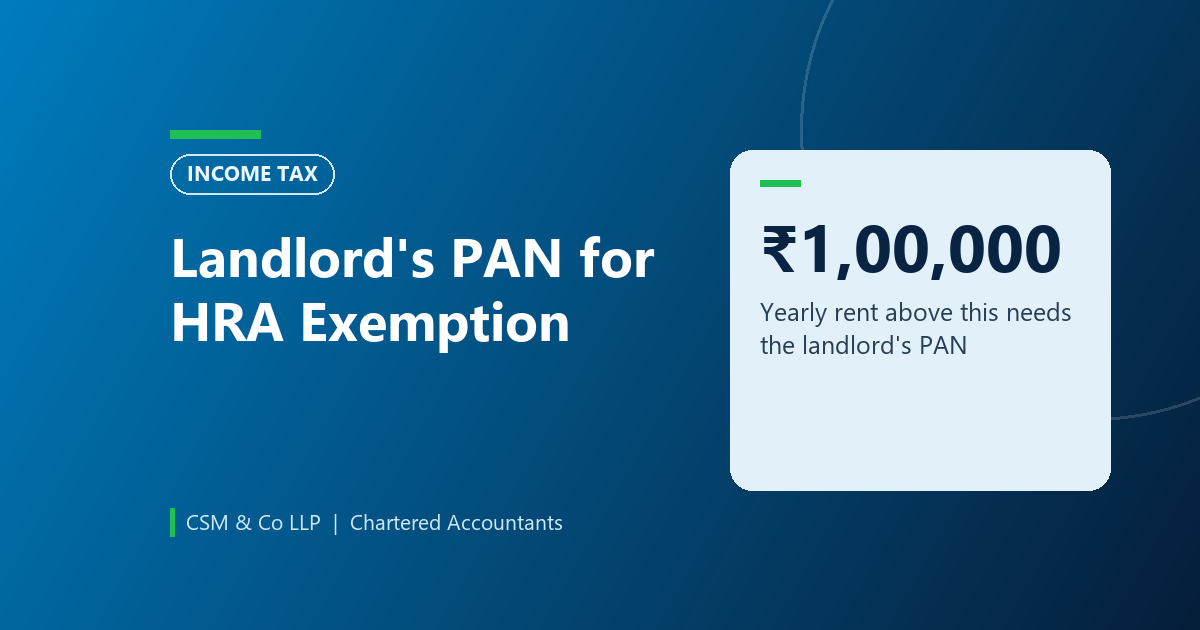
  • You must give your landlord’s PAN to your employer if the rent you pay in the year is more than ₹1,00,000 (about ₹8,333 a month).
  • If the landlord has no PAN, a declaration from the landlord with name and address is accepted.
  • Form 124 (earlier Form 12BB) asks for the landlord’s name, address, PAN, Aadhaar, relationship and rent paid; Aadhaar is not mandatory unless your employer asks.
  • The HRA exemption is only for the old tax regime. Rent paid to a spouse is not accepted, and rent to parents needs them to report the income.

If you claim the HRA exemption and pay a high rent, you must give your employer the landlord’s PAN. The rule is meant to make sure the rent is real and that the landlord reports it as income.

The rule

  • If the rent you pay in the year is more than ₹1,00,000 (about ₹8,333 a month), the landlord’s PAN must be given. The Income Tax Department’s FAQ on Form 124 says the PAN must be furnished if the annual rent exceeds ₹1,00,000.
  • If the rent is ₹1,00,000 or less, the PAN is not required, but you still give the landlord’s name and address.
  • Aadhaar is not mandatory unless your employer specifically asks for it.

If the landlord has no PAN

Get a declaration from the landlord that they do not have a PAN, stating their name and address, as allowed by CBDT Circular 8/2013 dated 10/10/2013. Give it to your employer with your other documents. The declaration should be from the landlord, not from you.

Where do you give it?

In Form 124, the statement to your employer. Up to FY 2025-26 this was Form 12BB. For HRA it asks for:

  1. Name of the landlord.
  2. Address.
  3. PAN.
  4. Aadhaar number.
  5. Relationship with the landlord, if any.
  6. Rent paid to the landlord.

A copy of the rent agreement is the supporting document. Form 124 is given to your employer. It is not uploaded on the income tax portal.

Other conditions for the HRA exemption

  • You must be getting HRA from your employer and be in the old tax regime.
  • You must actually pay rent for a house that you do not own.
  • Rent paid to your spouse is not accepted. If you pay rent to your parents, they must own the house and show the rent as income in their return.
  • The exemption is the lowest of the HRA received, 50% (eight metro cities) or 40% of salary, and rent paid less 10% of salary.

Documents to keep

  • Rent agreement.
  • Rent receipts or, better, bank proof of payment each month.
  • Landlord’s PAN or the landlord’s no-PAN declaration.
  • Salary slips showing HRA.

If you do not give the proof

  • Your employer can refuse the exemption and deduct higher TDS.
  • You can still claim the exemption in your return if you have the proof, and get a refund of the excess TDS.
  • A claim without proof may be questioned by the department.

TDS on rent is a separate matter

The tenant’s own duty to deduct tax at source on rent is different from the HRA rule. Under the Income-tax Act, 2025 (section 393, Table Sl. No. 2), a tenant who is not a specified person, such as an individual or HUF who is not liable to a tax audit, deducts tax at 2% on rent where it is ₹50,000 or more for a month or part of a month. A specified person (an audited individual or HUF, or other person) deducts 2% for machinery, plant or equipment and 10% for land, building or furniture, on the same threshold. The 1961 Act equivalents are sections 194-IB and 194-I. Check your own status with a professional.

Frequently asked questions

When is landlord PAN required for HRA?

When the rent you pay in the year is more than ₹1,00,000, that is above about ₹8,333 a month.

What if the landlord does not have a PAN?

Give your employer a declaration from the landlord that they do not have a PAN, along with their name and address.

Is Aadhaar required?

Form 124 asks for the landlord’s Aadhaar, but it is not mandatory unless your employer specifically asks for it.

Can I claim HRA without giving rent proof?

Your employer may refuse the exemption and deduct more TDS. You can still claim it in your return if you have the proof.

Is the HRA exemption available in the new tax regime?

No. It is available only in the old tax regime.

Official sources

Related reading

Disclaimer

This article is for general informational purposes only and should not be considered professional advice. Please consult a qualified expert for advice tailored to your specific situation. The author and website owner are not liable for any errors or actions based on this content.
Can You Claim Both HRA and Home Loan Interest Deduction?

Last updated: 31 July 2026 · Written and reviewed by CA Meet Dhrangadhariya, CSM & Co LLP

Quick summary

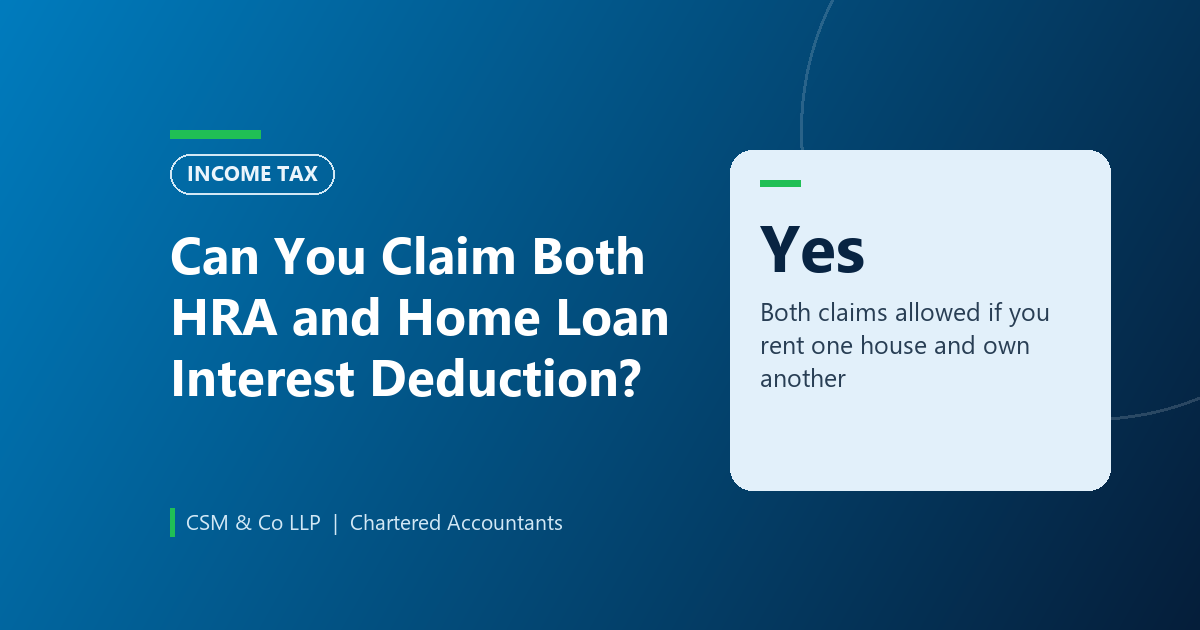
  • Yes, you can claim the HRA exemption and home loan interest together if you pay rent for a house you do not own and also have a home loan on another house.
  • The HRA rule needs that the house you live in is not owned by you and that you actually pay rent for it. It does not stop you owning a different house.
  • Interest on a self-occupied house is limited to ₹2 lakh; interest on a let-out house has no such cap on the interest itself.
  • Both claims need genuine proof and, for HRA, the old tax regime. In the new regime, HRA and self-occupied house interest are not allowed.

Many people think they must choose between HRA and a home loan. They do not. The two work on different houses and different heads of income, so they can be claimed together if you meet the conditions of each. Both are claimed in the old tax regime.

The HRA conditions

The HRA exemption is in section 10(13A) of the Income-tax Act, 1961 up to FY 2025-26, and in Schedule III (Table Sl. No. 11) of the Income-tax Act, 2025 from Tax Year 2026-27. It needs:

  • an HRA granted to you by your employer for rent,
  • the house you occupy is not owned by you, and
  • you actually pay rent for that house.

The exemption is the lowest of the HRA received, 50% (eight metro cities) or 40% of salary, and rent paid less 10% of salary (Rule 279 of the Income-tax Rules, 2026).

Nothing in these conditions stops you owning another house elsewhere.

The home loan conditions

Interest on a loan taken to buy or build a house is a deduction from house property income: section 24(b) of the 1961 Act, section 22(1)(b) of the 2025 Act.

  • For a self-occupied house the interest is limited to ₹2 lakh a year, if the house is bought or built within five years from the end of the year in which the loan was taken. Otherwise the limit is ₹30,000.
  • Interest paid before the house is completed is claimed in five equal parts from the year of completion.
  • For a let-out house the interest is deducted in full, but the loss from house property that you can set off against other income is limited to ₹2 lakh a year.
  • Principal repaid is a separate section 80C (section 123) deduction.

Four common situations

Situation HRA and interest together? Note
Own a house in another city and rent a house where you work Yes The usual case.
Own a house in the same city but rent another for a genuine reason, such as distance to work or a school Yes, if genuine Keep full proof of both.
Bought an under-construction flat and live on rent Yes Pre-completion interest is claimed in five equal parts after completion.
Rent out your own loan-financed house and live in a rented house elsewhere Yes The rent you receive is taxed as house property income, and the interest is deducted against it.

A house kept vacant, or used by your family, is generally treated as self-occupied for the interest limit.

Example

Aryan works in Gurgaon, pays rent of ₹10,000 a month and gets an HRA of ₹15,000 a month. His basic salary is ₹40,000 a month. He has a home loan for a house in Bengaluru where his parents live, with interest of ₹20,000 a month.

HRA exemption (monthly): the lowest of ₹15,000 (HRA received), ₹16,000 (40% of basic, as Gurgaon is not one of the eight metro cities) and ₹6,000 (rent ₹10,000 less ₹4,000, which is 10% of basic). So ₹6,000 a month, ₹72,000 a year, is exempt and ₹9,000 a month is taxable.

Interest: ₹2,40,000 a year, but for a self-occupied house the deduction is limited to ₹2,00,000.

New tax regime

In the new regime neither HRA nor interest on a self-occupied house is allowed. Interest on a let-out house is still allowed against the rent received.

Proof you need

  • Rent agreement, rent receipts or bank proof, and the landlord’s PAN if rent is above ₹1,00,000 a year.
  • The lender’s interest certificate, the loan agreement and the possession or completion papers.
  • The declaration to your employer in Form 124 (earlier Form 12BB).

Frequently asked questions

Can I claim HRA and home loan interest together?

Yes, if you live in a rented house that you do not own, pay rent, and have a home loan on a different house, in the old tax regime.

Can I claim both if the loan house is in the same city?

The law does not bar it, but the claim must be genuine, for example because the house is let out, too far from work or under construction. Keep full proof.

What is the limit on home loan interest?

₹2 lakh a year for a self-occupied house, if construction or purchase is completed within five years of the year the loan was taken. Otherwise ₹30,000.

Is this available in the new tax regime?

No. HRA and the interest on a self-occupied house are not allowed in the new regime. Interest on a let-out house is allowed.

Official sources

Related reading

Disclaimer

This article is for general informational purposes only and should not be considered professional advice. Please consult a qualified expert for advice tailored to your specific situation. The author and website owner are not liable for any errors or actions based on this content.

WhatsApp