NRI Selling Property in FY 2026-27: Long-Term Capital Gains, Exemptions and TDS
 CA Meet Dhrangadhariya
 November 3, 2026
 CA Meet Dhrangadhariya November 3, 2026
Table of Contents
 10 min read
Table of Contents
Last updated: 03 November 2026
Written and reviewed by CA Meet Dhrangadhariya, CSM & Co LLP
Quick summary
This article is written specifically for a non-resident individual (NRI) selling land or a building, held long term, in Financial Year 2026-27 – the first full financial year governed by the Income-tax Act, 2025. It covers the tax rate, why the resident indexation choice does not apply, which reinvestment exemptions are still available, how TDS actually works for an NRI seller, and how to reduce it before the sale rather than waiting for a refund.
The Income-tax Act, 2025 came into force from 01 April 2026 and governs Tax Year 2026-27 (the year running 01 April 2026 to 31 March 2027) onward. A property (land or a building) held for 24 months or more before the date of transfer gives a long-term capital gain (LTCG); held for less, it is short-term and simply added to total income at slab rates for everyone, resident or not. The rest of this article covers the long-term case, where the NRI-specific rules actually bite.
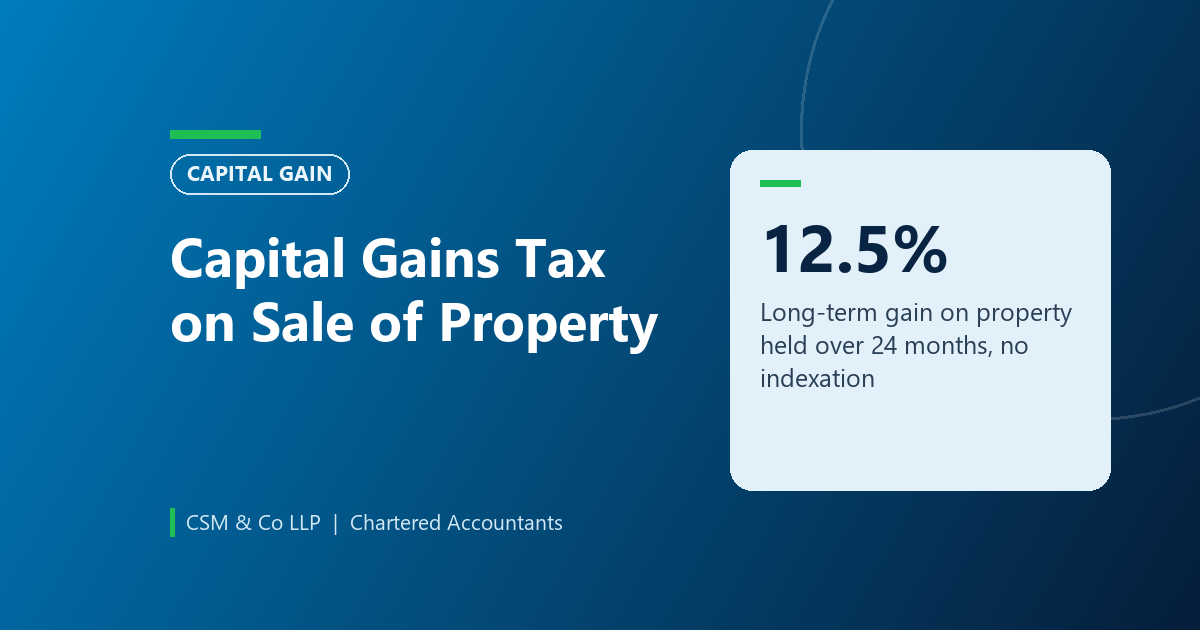
Section 197(1)(b) of the Income-tax Act 2025 taxes long-term capital gains on land or a building at 12.5%. For a resident individual or HUF who acquired the property before 23 July 2024, section 197(3) adds a choice: compute the tax both at 20% with indexation and at 12.5% without, and pay whichever is lower.
That choice does not exist for a non-resident, under any circumstance. Section 197(3) reads, in its own operative text read directly from the Act: “In the case of an individual or a Hindu undivided family, being a resident, …” – the residency condition is in the provision itself, not an inference from commentary. An NRI selling land or a building in FY 2026-27 is therefore taxed at a flat 12.5% on the long-term capital gain, computed without any indexation of the cost, whatever the acquisition date and however long the asset was held.
The basic-exemption set-off against capital gains (section 197(2), letting a resident’s unused basic exemption limit absorb part of the gain) is worded the same way – resident-only. An NRI’s entire gain is taxable from the first rupee; there is no tax-free slab to fall back on.
The indexation choice and the basic-exemption set-off are restricted to residents. The separate reinvestment exemptions are not – they are available to “an individual or a Hindu undivided family” with no residency qualifier, confirmed by reading the bare text of the relevant sections of the 2025 Act directly. For an NRI selling land or a building, the two that matter most are:
| Provision | Old section (1961 Act) | What it does | Key conditions |
|---|---|---|---|
| Section 86 | Section 54F | Reinvest the net sale consideration (not just the gain) in one residential house in India. If the whole net consideration is reinvested, the whole gain is exempt; if only part is reinvested, the exemption is proportionate. | Purchase within 1 year before or 2 years after the transfer, or construct within 3 years after. Exemption denied if the seller already owns more than one other residential house on the transfer date. Cost of the new house capped at Rs 10 crore for this purpose. If the new house is sold within 3 years, the exemption is withdrawn and taxed as LTCG in that later year. |
| Section 85 | Section 54EC | Invest the capital gain (not the full sale value) in specified bonds (such as NHAI, REC or similar notified bonds). | Investment within 6 months of transfer. Exemption capped at Rs 50,00,000. Bonds carry a lock-in (commonly 5 years) – transfer, conversion into a loan, or encashment before that withdraws the exemption. |
These two can be used together where the facts fit (for example, part of the net consideration into a house under section 86, and part of the remaining gain into bonds under section 85), subject to each provision’s own ceiling and time limit. An NRI considering either route should decide and act well before the time limit runs out from the date of transfer – these are hard deadlines, not extendable on request.
Surcharge on this long-term capital gain is capped at 15%, however large the seller’s total income is, but it is not automatically 15% – the ordinary slab still governs below the cap: nil up to Rs 50 lakh total income, 10% from Rs 50 lakh to Rs 1 crore, 15% beyond Rs 1 crore (capped there, not climbing further). Health and Education Cess of 4% applies on tax plus surcharge in every case. The surcharge slab here is based on the seller’s actual total income for the year, which is usually smaller than the gross sale value used for the TDS computation below – the two figures are not the same thing, and should never be used interchangeably.
A buyer purchasing property from a non-resident must deduct tax under section 393(2) of the Income-tax Act 2025 (the successor to section 195 of the 1961 Act), at the rate that would apply to the seller’s capital gain, grossed up for surcharge and cess. Absent a certificate for a lower or nil rate (see below), this deduction is normally computed on the entire sale consideration, not on the net gain – because the buyer has no independent way to verify the seller’s actual cost of acquisition.
The practical result: TDS deducted at the time of sale is routinely several times larger than the seller’s actual final tax liability computed above, since the gain (sale value minus cost) is almost always smaller than the sale value itself. The difference is not lost – it becomes a refund – but only after the NRI files an Indian income-tax return for that year and the return is processed.
An NRI seller does not have to wait for a refund. Before the sale completes, an application can be made to the jurisdictional Assessing Officer for a certificate for deduction of tax at a lower or nil rate – the successor process to the old section 197 certificate (Form 13) under the 1961 Act. Two things are worth being precise about:
An NRI bought a flat for Rs 45,00,000 in July 2012 and sells it in FY 2026-27 for Rs 1,15,00,000, with no reinvestment.
| Step | Amount |
|---|---|
| Sale consideration | Rs 1,15,00,000 |
| Cost of acquisition (no indexation available to an NRI) | Rs 45,00,000 |
| Long-term capital gain | Rs 70,00,000 |
| Tax @ 12.5% | Rs 8,75,000 |
| Surcharge @ 10% (total income in the Rs 50L-1Cr slab) | Rs 87,500 |
| Health and Education Cess @ 4% | Rs 38,500 |
| Final tax liability | Rs 10,01,000 |
If, instead, this NRI reinvests the full Rs 1,15,00,000 net sale consideration in one residential house in India within the time limit under section 86, the entire gain of Rs 70,00,000 is exempt and the final tax liability above falls to nil – though TDS would still have been deducted on the gross sale value at the time of the sale, to be claimed back by filing a return.
We confirm residential status and the exact capital gain computation for a specific sale, prepare the reinvestment paperwork for section 86 or section 85, apply for the lower/nil-deduction TDS certificate before the transaction closes, and file the income-tax return that claims back any excess TDS. Please reach out to our team and we will be happy to assist.
No. Section 197(3) of the Income-tax Act 2025 (successor to the 2nd proviso to section 112(1)(a) of the 1961 Act) restricts the 20%-with-indexation choice to a resident individual or Hindu undivided family. A non-resident is taxed at a flat 12.5% on the long-term capital gain, computed without indexation, whatever the acquisition date and however long the property was held.
No. That relief, under section 197(2) of the 2025 Act, is also worded for a resident individual or HUF only. An NRI’s entire long-term capital gain is taxable from the first rupee; there is no tax-free slab to absorb part of it.
Yes. The reinvestment exemptions are not restricted to residents. Under the Income-tax Act 2025, section 86 (successor to old section 54F) lets any individual or HUF – resident or non-resident – reinvest the net sale consideration in one residential house in India within the prescribed time and get a proportionate or full exemption. Section 85 (successor to old section 54EC) lets the gain be invested within six months in specified bonds (such as NHAI or REC), subject to a Rs 50 lakh ceiling and a lock-in period.
None is needed for the NRI’s own flat 12.5% computation – the Cost Inflation Index (384 for FY 2026-27, per CBDT Notification No. 85/2026 dated 15/07/2026) is relevant only to a resident seller using the indexation option, or to computing the exemption amount correctly where cost figures are compared, not to the NRI’s final tax rate.
A buyer purchasing from a non-resident deducts tax under section 393(2) of the Income-tax Act 2025 (successor to section 195), and absent a lower-deduction certificate, must deduct on the FULL sale value – not the gain – at the rate (grossed up for surcharge and cess) that would apply to the seller’s capital gain. Because the actual gain is almost always smaller than the sale value, the TDS deducted is usually far larger than the real tax liability. The excess becomes a refund only once an Indian income-tax return is filed for that year.
By applying to the jurisdictional Assessing Officer, before the sale completes, for a certificate for deduction of tax at a lower or nil rate (the successor process to the old section 197 certificate under the 1961 Act – note that section 197 of the Income-tax Act 2025 is a different provision, the capital-gains section itself, not the certificate section). The certificate is issued on the basis of the actual computed capital gain, not the gross sale price, and must reach the buyer before payment so the lower rate can be applied at source.
Yes, the same ceiling applies to everyone under section 86: if the cost of the new residential house exceeds Rs 10 crore, the excess over Rs 10 crore is ignored for computing the exemption. The exemption is also denied if the seller already owns more than one other residential house on the date of transfer, or buys or constructs another one (besides the new asset) within the following one to three years.
Yes. Under section 86, if the new residential house is sold within three years of its purchase or construction, the exemption earlier allowed is withdrawn and taxed as long-term capital gain in the year of that later sale. Under section 85, the specified bonds carry a lock-in (commonly five years); transferring, converting, or taking a loan against them before that period ends similarly withdraws the exemption.
This article is for general informational purposes only and should not be considered professional advice. Please consult a qualified expert for advice tailored to your specific situation. The author and website owner are not liable for any errors or actions based on this content.

 CA Meet Dhrangadhariya June 29, 2026
 CA Meet Dhrangadhariya June 21, 2026
 CA Meet Dhrangadhariya June 23, 2026
 CA Meet Dhrangadhariya June 28, 2026